Fixed Income · Reading 54
Commercial Paper
CFA Level I · Fixed Income · Reading 54: Fixed-Income Markets for Corporate Issuers · about 32 min
What you'll learn
- LOS 54.a Compare short-term funding sources for nonfinancial corporations (lines of credit, secured loans, factoring, commercial paper) and for financial institutions (deposits, CDs, interbank and central bank funds, CP/ABCP).
- LOS 54.b Describe repurchase agreements: mechanics (purchase price, repo rate, initial and variation margin, haircut), uses, repo-rate drivers and risks.
- LOS 54.c Contrast long-term funding of investment-grade and high-yield corporate issuers (yields and spreads, covenants, collateral, maturity, standardization, prepayment features).
Module 54.1
Fixed-Income Markets for Corporate Issuers
This reading compares the short-term funding sources open to nonfinancial companies and to financial institutions, explains how repurchase agreements work, and contrasts long-term funding for investment-grade and high-yield issuers. A candidate must be able to rank lines of credit by reliability, compute a repo's purchase price, haircut, repurchase price and variation margin, and state how high-yield issues differ from investment-grade issues.
LOS 54.a — Short-term funding alternatives
Nonfinancial corporations
A nonfinancial company funds short-term assets (cash, short-term investments, receivables and inventory) through intermediaries. The intermediaries supply this funding in two forms: loan financing and security-based financing.
Bank lines of credit let a borrower draw funds as needed, usually at a floating market reference rate (MRR) plus a fixed credit spread.
Key concept
| Type | Bank's commitment | Cost | Reliability |
|---|---|---|---|
| Uncommitted line of credit | Bank may refuse to lend if circumstances change | Usually interest only, no fees; flexible, and may be unsecured if the borrower keeps stable cash balances at the bank | Least reliable |
| Committed (regular) line of credit | Bank commits for a set period | Interest plus a commitment fee (about 50 bp on the full or unused amount) | More reliable; renewal risk at maturity |
| Revolving (operating) line of credit | Longer commitment, sometimes years | Similar to a committed line; restrictive covenants usually imposed | Most reliable |
Banks hold more regulatory reserves against committed lines. They manage that risk by keeping commitments under one year or by lending in a syndicate.
- Secured (asset-backed) loans: weaker borrowers pledge fixed assets, receivables or inventory as collateral. Receivables can also be assigned to a lender as collateral.
- Factoring: the company actually transfers its receivables, together with the credit-granting and collection functions, to a factor, which pays less than face value. The discount is effectively the interest rate and depends on the customers' creditworthiness and on collection costs.
- Commercial paper (CP): short-term unsecured debt issued by large, highly rated firms, usually maturing in under three months. For these issuers it is cheaper than a bank loan. CP funds working capital and serves as bridge financing until permanent (long-term) financing is arranged. CP is normally rolled over at maturity. The danger of being unable to sell new paper to repay maturing paper is rollover risk, which issuers manage with backup lines of credit (liquidity enhancement). US CP is a pure discount security, like a T-bill. A smaller, less liquid international market is Eurocommercial paper (ECP).
Financial institutions
- Deposits: demand deposits (checking accounts, immediate access, usually no interest), operational deposits (large customers needing cash management, custody and clearing) and savings deposits, which carry a stated term and interest rate. A certificate of deposit (CD) has a stated rate and maturity of less than a year. A nonnegotiable CD carries a penalty for early withdrawal. A negotiable CD can be sold in the open market, and wholesale negotiable CDs, traded in domestic bond markets and in the Eurobond market, are an important bank funding source.
- Interbank funds: loans from one bank to another for one day to one year, secured or unsecured, priced off an MRR such as SOFR. The most common secured form is the repo.
- Central bank funds market: banks with excess reserves at the central bank lend them to banks that are short. The rate is the central bank funds rate, which the central bank's open market operations strongly influence. Borrowing directly from the central bank as lender of last resort ("discount window lending") costs more and brings extra scrutiny.
- CP and ABCP: financial institutions issue more CP than nonfinancial companies. They also sponsor asset-backed commercial paper (ABCP), which is created in two steps. (1) The bank transfers short-term loans it has made to an off-balance-sheet special purpose entity (SPE) in exchange for cash. (2) The SPE sells ABCP to investors, who take on the risk and return of those loans, and the bank provides a backup liquidity line.
Common exam traps
- Reliability rises from uncommitted to committed to revolving lines of credit, and revolving lines usually add restrictive covenants. Committed and revolving lines carry similar fees, including a commitment fee; an uncommitted line usually costs only the interest on amounts drawn.
- Assigning receivables as collateral is not factoring. Factoring transfers the receivables and their collection to the factor.
- Excess reserves lent bank-to-bank earn the central bank funds rate. Borrowing from the central bank itself is discount window (lender of last resort) lending.
LOS 54.b — Repurchase agreements
In a repurchase agreement (repo), one party sells a security and commits to repurchase it at a later date for a higher price fixed in advance. Economically, the security buyer lends cash to the security seller and holds the security as collateral.
| Leg | Security buyer (cash lender) | Security seller (cash borrower) |
|---|---|---|
| Opening (today) | Pays the purchase price (loan amount) | Delivers the collateral securities |
| Closing (the repurchase date) | Returns the collateral | Pays the repurchase price (loan plus interest) |
The repo rate is the annualized interest rate implied by the gap between the repurchase price and the purchase price. The borrower keeps the economic benefits of the bond, such as coupons, during the term.
Initial margin protects the lender. Collateral worth more than the loan must be posted, so the loan is a discount to the market value:
Key concept
The loan value grows at the repo rate. If the collateral's value drops below (accrued loan value × initial margin), the lender calls for variation margin:
A negative result signals overcollateralization, so the borrower may request the return of some collateral.
Example. Collateral is worth $40 million, the initial margin is 105%, the repo rate is 3% and the term is 30 days (360-day year).
- Loan amount: the purchase price is .
- Haircut: .
- Amount due on the repurchase date: .
- Margin check during the term. After 10 days the loan has grown to , so the required collateral is . If the collateral is then worth $39.4 million, the borrower must post variation margin of about $633,333. If it is worth $40.5 million instead, variation margin is , so the borrower can ask for about $466,667 of collateral to be released.
| Term | Meaning |
|---|---|
| Overnight repo | Lasts one day |
| Term repo | Lasts longer than one day |
| General collateral repo | Any security of a given type is acceptable, such as Treasuries in a maturity range |
| Master repurchase agreement | The document that holds the contract terms |
| Tri-party repo | A custodian bank or clearinghouse acts as agent |
| Bilateral repo | Struck directly between the two parties |
Uses
- Dealers and other financial institutions borrow through repos (as security sellers) to finance their securities positions.
- Banks, mutual funds and pension funds lend (as security buyers) to earn the repo rate on excess cash.
- Central banks lend (buy) to add money and borrow (sell) to drain it.
- Short sellers such as hedge funds buy the security and lend cash in a repo, sell the security short, buy it back later and return it at maturity. A trade entered for the purpose of borrowing a security in this way is a reverse repo from that participant's side. Asking for a specific security is a special trade. For a hard-to-borrow security the lender of cash accepts a lower, sometimes negative, repo rate.
What drives the repo rate?
| Factor | Effect on repo rate |
|---|---|
| Higher rates on alternative money market funding | Higher |
| Higher credit quality of collateral | Lower |
| Longer repo term (when longer rates exceed short rates) | Higher |
| Collateral in high demand or low supply | Lower |
| Undercollateralized, or collateral specified but not delivered | Higher |
Because repos are short-term and collateralized, usually by high-quality sovereign bonds, repo rates are normally below bank loan rates.
A repo is safer than most short-term lending, but it is still debt for the borrower, and heavy reliance on it can lead to financial distress. Repos carry default risk (the cash borrower fails to repurchase), collateral risk, margining risk, legal risk, and netting and settlement risk. A tri-party repo helps mitigate many of these risks and improves cost efficiency in accessing, valuing and safekeeping collateral, but it does not reduce credit risk.
Common exam traps
- Divide by the initial margin to get the loan amount. The haircut is not the margin in excess of 100%: a 105% initial margin means a haircut of 4.76%, not 5%. Applying a 5% haircut to the $40 million of collateral in the example gives a loan of $38,000,000 instead of $38,095,238.
- The borrower in a repo is the security seller. A participant who buys the security to obtain it is in a reverse repo.
- Scarce ("special") collateral lowers the repo rate the cash lender accepts.
LOS 54.c — Investment-grade vs. high-yield long-term funding
With a normal (upward-sloping) yield curve, both investment-grade and high-yield issuers must pay higher yields at longer maturities. The increase is bigger for high-yield issuers because their credit spreads are larger. Issuing shorter bonds to save on yield adds rollover risk.
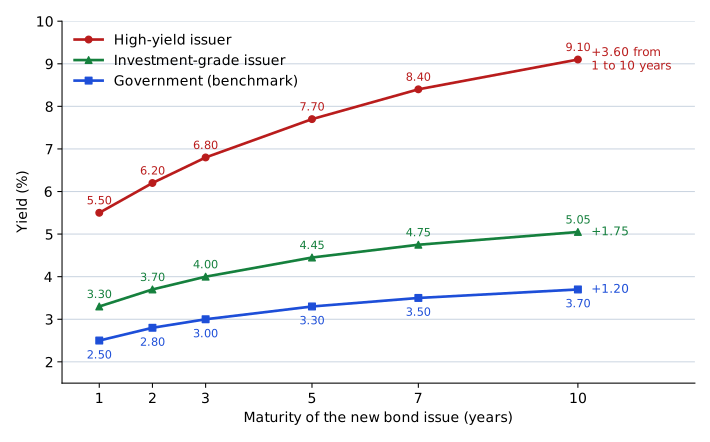
In the figure, moving from a 1-year to a 10-year issue adds 1.75 percentage points to the investment-grade yield and 3.60 points to the high-yield yield. The government curve rises by only 1.20 points, so most of the extra cost for the high-yield issuer comes from a credit spread that widens with maturity.
Key concept
| Feature | Investment grade | High yield |
|---|---|---|
| Main credit concern of investors | Downgrade risk and a rising probability of future default | Default risk and loss given default |
| Credit spread as a share of yield | Small; yield tied mostly to benchmark (sovereign) rates | Large |
| Covenants | Few (e.g., limits on liens and sale-and-leaseback of core assets) | Many: debt ratios, limits on additional debt and on distributions such as dividends |
| Collateral | Usually unsecured | Often secured |
| Standardization and maturities | Fairly standardized; issued across many maturities, which lowers rollover risk and lets issuers exploit market conditions | Less standardized; usually 10 years or less; less able to refinance when rates fall |
| Early repayment features | Less common | Leveraged loans with prepayment options or callable bonds, so debt can be refinanced if credit improves |
| Return profile | Bond-like | More equity-like |
Common exam traps
- Covenants protect lenders, so they set maximums on leverage, debt and dividends.
- An issuer hoping its credit will improve wants the right to repay early (call or prepay). A put option benefits the investor.
Exam shortcuts
- The haircut depends only on the initial margin, , so it can be found without the collateral value, the repo rate or the term.
Bottom line
- Lines of credit become more reliable from uncommitted to committed to revolving; committed and revolving lines carry a commitment fee and revolving lines usually add restrictive covenants, while an uncommitted line usually costs only interest on the amount drawn.
- Factoring transfers receivables, with the credit-granting and collection functions, to a factor at a discount to face value, whereas assigning receivables as collateral keeps them with the borrower as security for a loan.
- Commercial paper is short-term unsecured debt issued by large, highly rated firms, usually maturing in under three months, and issuers manage its rollover risk with backup lines of credit.
- In a repo the security seller borrows cash and the security buyer lends it against the security; and .
- ; a negative figure means the loan is overcollateralized and the borrower may ask for collateral back.
- The repo rate is higher when alternative money market rates are higher, when the term is longer and longer rates exceed short rates, and when the repo is undercollateralized or collateral is not delivered; it is lower for higher-quality collateral and for collateral in high demand or low supply.
- With a normal yield curve, both investment-grade and high-yield issuers pay higher yields at longer maturities, and the increase is bigger for high-yield issuers because their credit spreads are larger.
- Compared with investment-grade issues, high-yield issues carry more covenants, are often secured, usually mature in 10 years or less, more often allow early repayment through callable bonds or prepayable leveraged loans, and have more equity-like returns.
Quick check
A corporate treasurer is reviewing the bank credit lines available to her company. Which of the following statements about these lines is most accurate?
Show answer and explanation
Correct answer: C
A revolving (operating) line of credit is the most reliable source of bank funding. It is typically arranged for a longer term than a committed line, sometimes several years, and because the bank is committed for that long it usually imposes restrictive covenants that oblige the borrower to take, or to avoid, specified actions, much as a bond indenture does. Its fees and rates are similar to those of a committed line.
Why the other options are wrong
- A. An uncommitted line is flexible and usually has no fees beyond interest on the amounts drawn, because the bank can decline to lend if conditions change. Commitment fees (about 50 bp on the full or unused amount) are charged on committed lines, and revolvers carry similar fees.
- B. The least reliable form is the uncommitted line, which the bank can decline to honor. A committed line binds the bank for the stated period, although the bank may decline to renew it at maturity (renewal risk).
Key takeaway Reliability rises from uncommitted to committed to revolving lines. Commitment fees apply to committed lines and revolvers, and revolvers usually add restrictive covenants over a multiyear term.
Practice Questions
A bond dealer finances a position by entering a 60-day repurchase agreement. It delivers government bonds with a market value of $25,000,000. The lender requires an initial margin of 102% and a repo rate of 3.6%, using a 360-day year. The repurchase price the dealer will pay at the end of the term is closest to:
Show answer and explanation
Correct answer: A
The loan (purchase price) equals the collateral's market value divided by the initial margin. The repurchase price is the loan plus interest at the repo rate, de-annualized over the 60-day term on a 360-day basis.
Repo interest . Haircut .
Why the other options are wrong
- B. $24,647,000 treats the 2% margin as a straight 2% deduction () instead of dividing by 1.02, then adds interest. The haircut is .
- C. $24,509,804 is the purchase price (the amount borrowed today). It omits the repo interest that must be paid on the repurchase date.
Key takeaway The loan equals the collateral value divided by the initial margin. The repurchase price equals the loan times .
An analyst splits the yield of each of three bonds into a benchmark rate and a credit spread. The spread accounts for 4% of Bond P's yield, 12% of Bond Q's yield and 45% of Bond R's yield. Which type of bond is Bond R most likely to be?
Show answer and explanation
Correct answer: C
For investment-grade bonds, yields are driven mostly by benchmark (sovereign) rates, so the credit spread is a small part of the yield. For high-yield bonds the credit spread is a much larger part of the yield. The bond whose spread is almost half its yield is the high-yield bond.
Why the other options are wrong
- A. A government bond is the benchmark itself, so its credit spread share would be close to zero, the smallest of the three.
- B. Investment-grade yields are largely tied to benchmark rates, so their spreads are a small share of yield, like Bond P or Bond Q.
Key takeaway The larger the credit spread's share of the yield, the lower the credit quality.
This reading has 16 questions in the full bank. Practice all of them.
Key Takeaways
- Reliability rises from uncommitted to committed to revolving lines. Commitment fees apply to committed lines and revolvers, and revolvers usually add restrictive covenants over a multiyear term.
- The loan equals the collateral value divided by the initial margin. The repurchase price equals the loan times .
- The larger the credit spread's share of the yield, the lower the credit quality.