Quantitative Methods · Reading 1
Rate of Return
CFA Level I · Quantitative Methods · Reading 1: Returns of Financial Assets and Instruments · about 53 min
What you'll learn
- LOS 1.a Describe, compare and interpret returns: price, capital distribution and total return; ex ante vs. ex post and realized vs. unrealized returns; arithmetic and geometric means; annualized and continuously compounded returns.
- LOS 1.b Describe, compare and interpret required returns, real and nominal risk-free rates, risk premia and inflation, and the real, excess, gross/net, after-tax and leveraged measures of return.
Module 1.1
Rates of Return
This reading measures returns over a single period and over several periods: the holding period return, the arithmetic and geometric means, annualized returns and continuously compounded returns. It then breaks a required return into the real risk-free rate, expected inflation and risk premia, and computes real, excess, gross, net, after-tax and leveraged returns.
LOS 1.a — Measuring and comparing returns
1. Assets, instruments and indicators
Returns can be measured for three overlapping categories of items:
| Category | What it is | Typical examples | Generates cash flows itself? |
|---|---|---|---|
| Financial assets | Things of value that an investor can own | Cash, equity stakes, loans/debt (an asset for the lender), hybrid securities | Usually (dividends, interest, principal) |
| Financial instruments | Standardized, tradable vehicles through which financial assets change hands in markets | Equity and debt securities (shares, bonds), exchange-traded futures and other standardized contracts | Securities may pay dividends or coupons; standardized contracts need not pay anything |
| Financial indicators | Observable measures of value that pay nothing to anyone | Interest rates, exchange rates, market index levels | No; they are used to value other items |
A machine, a building or a truck is a real (physical) asset, so it is neither a financial instrument nor a financial indicator.
2. Return over a single period
An asset's return has two sources: the change in its price (the price return, also called the capital appreciation return) and any cash it pays out. The total return for a period adds the two.
Key concept
The capital distribution return measures a period's cash income relative to the beginning price. For a share it is the dividend yield; for a bond it is the current yield. Every component is divided by the beginning price . is the total cash actually received between purchase and sale (add up every coupon or dividend paid in the window, and nothing paid outside it).
Example. A bond is bought at 97.00, pays coupons of 1.50 and 1.50 over the year and is sold at 98.20. Price return ; distribution return ; total return .
A holding period return describes the whole holding period, however long it is. The length of the period matters only when the result has to be annualized.
Other labels for returns
| Pair | Meaning |
|---|---|
| Actual return (ex post return) vs. expected return (ex ante return) | An ex post return uses prices and income already observed; an ex ante return is an estimate for a future period. Decisions rest on expected returns, and the gap between expected and actual returns represents risk. |
| Realized returns vs. unrealized return | Realized = cash already in hand (income received, sale proceeds). Unrealized = paper gain or loss on a position still held, valued at today's market price. Taxes are usually levied on income when received and on price gains only when realized by a sale. |
| Real vs. realized | Real means adjusted for inflation (LOS 1.b). Do not confuse it with realized. |
3. Averaging returns over several periods
Key concept
- The geometric mean return (compound average return) is the constant per-period rate that turns the starting value into the ending value: equals 1 plus the holding period return for all periods together. It is the measure to use for an annualized return or a compound annual growth rate.
- The arithmetic mean return adds the periodic returns and divides by their number. It ignores compounding: it implicitly assumes the amount invested stays at its starting level, although gains, losses and cash flows change it. For this reason it can overstate what the investor actually earned.
- Under the arithmetic-geometric mean inequality principle, . The gap widens as the returns become more dispersed, and the two are equal only when every period's return is identical.
- Each period enters the product as a wealth relative, . A loss keeps its sign: a −6% year enters as 0.94.
Example. Returns of +25% and −20%: arithmetic mean , but . €1,000 grows to €1,250 and falls back to €1,000. Wealth did not change, and only the geometric mean shows this.
The root used in a geometric mean equals the count of periods. If the periods are quarters, the result is an average quarterly compound return. To get an annual rate from several sub-annual returns, take the root equal to the number of years covered. For eight quarterly returns, the annual rate is . Calculator (TI BA II Plus) for a cube root: 1.1 [y^x] 3 [1/x] [=].
4. Annualizing a holding period return
Interest rates and market returns are normally quoted as annualized returns, whatever the actual length of the period. Annualizing makes investments with different horizons comparable. For a period shorter than a year, it assumes that the same return is earned again in every remaining period of the year, which actual returns rarely do.
where counts how many such periods make up a year (12 for monthly, 4 for quarterly, 2 for semiannual). The direction of the adjustment depends on the sign of the HPR:
Key concept
| Holding period | Positive HPR | Negative HPR (between −100% and 0) |
|---|---|---|
| Longer than a year (exponent < 1) | Annualized return is smaller than the HPR | Annualized return is less negative (closer to zero) than the HPR |
| Shorter than a year (exponent > 1) | Annualized return is larger than the HPR | Annualized return is more negative than the HPR |
A zero HPR annualizes to zero. Rule of thumb: annualizing a long period pulls the return toward zero; annualizing a short period pushes it away from zero.
Example. 2% earned over 146 days: . A 0.6% monthly return: (not ). A loss of 15.36% over exactly two years: per year, which is greater (less negative) than −15.36%.
5. Compounding frequency and continuous compounding
For a given positive stated (quoted) annual rate, more frequent compounding means a higher effective annual rate, a higher future value and a lower present value. The limiting case is continuous compounding, whose effective annual rate, , is higher than that of any discrete frequency.
With compounding periods a year, the rate for each period is the stated annual rate divided by . Compounding that rate times gives
The first formula is the annualizing formula of section 4 with .
Example. The present value of 2,000 due in one year at a stated 4% is 1,923.08 with annual compounding, 1,921.96 with quarterly (, an effective annual rate of ), 1,921.71 with monthly, 1,921.58 with daily, and with continuous compounding (effective annual rate ).
To compare a continuously compounded rate with a discrete one, convert both to effective annual rates. Going the other way, the continuously compounded stated rate that gives a chosen effective annual rate is . Example. A deposit quoting 5% compounded quarterly has an effective annual rate of . A continuously compounded deposit matches it at a stated rate of .
Moving from a holding period return to a continuously compounded return (also called a logarithmic return, or log return) uses the natural logarithm:
Because the HPR is a total return, the log return built from it includes income. With a single distribution received at the end of the period, . Only when no distributions are paid does this simplify to , which on its own is a price log return. Example. Bought at 100, sold at 100, with a 5 dividend: the price log return is , but the total log return is .
- For a gain, ; for a loss, is more negative than the HPR (e.g., a fall from 100 to 90: HPR , ).
- Log returns are additive across periods. Wealth relatives multiply, , and the logarithm of a product is the sum of the logarithms. So with no distributions, (in general, the sub-period values add up). Keep the sign of each sub-period (a fall contributes a negative term).
Example. A price moves from 50 to 60 and then to 54: , , sum .
Common exam traps
- Dividing by the ending price instead of the beginning price. In the bond example, dividing the 4.20 total gain by the selling price of 98.20 gives 4.28% instead of 4.33%.
- Leaving out (or double counting) a dividend or coupon; check which payments fall inside the holding period.
- Annualizing when the question asks for the holding period return (or vice versa).
- Using simple multiplication () instead of compounding ; using 360 days when the question says 365; inverting the exponent (days/365). For the 2% earned over 146 days, inverting the exponent gives instead of 5.08%.
- Reporting the arithmetic mean when the compound (annualized) rate is asked for, forgetting to take the root, or dropping the minus sign on a loss.
- Using instead of for a continuously compounded return, or dropping a distribution by using when income was paid. For the fall from 100 to 90, instead of .
- Assuming annualization always shrinks a multi-year return. It does so only for a gain.
Exam shortcuts
- The direction of an annualized return is known before calculating: a positive HPR over more than a year annualizes to a smaller figure and over less than a year to a larger one, while a negative HPR (between −100% and 0) becomes less negative over more than a year and more negative over less than a year.
- The geometric mean return cannot exceed the arithmetic mean return of the same returns, so an answer with a higher geometric mean can be ruled out.
- A log return is below the HPR for a gain and more negative than the HPR for a loss, which rules out answers on the wrong side of the HPR.
Bottom line
- Total (holding period) return is , the price return plus the capital distribution return, with each component divided by the beginning price .
- An ex post (actual) return uses prices and income already observed, while an ex ante (expected) return is an estimate for a future period.
- The geometric mean return is the measure for an annualized return or a compound annual growth rate; it cannot exceed the arithmetic mean, and the two are equal only when every period's return is identical.
- A holding period return is annualized with , or with periods in a year; for a period shorter than a year this assumes the same return is earned in every remaining period.
- For a given positive stated annual rate, more frequent compounding gives a higher effective annual rate, , and continuous compounding gives the highest, .
- The continuously compounded return is , which reduces to only when no distributions are paid, and log returns are additive across periods.
Quick check
A macro strategist's dashboard displays the central bank policy interest rate, the USD/JPY exchange rate and the level of the Euro Stoxx 50 index. These three items are best classified as:
Show answer and explanation
Correct answer: C
Interest rates, exchange rates and market index levels are financial indicators: observable measures of value that do not produce any cash flows on their own. They matter because they are used to value other things, such as the securities and contracts that are financial instruments.
Why the other options are wrong
- A. Financial assets are items an investor can own that carry value, such as cash, shares or loans. Nobody owns an interest rate or an index level, and these items pay nothing to anyone.
- B. Financial instruments are standardized vehicles for trading financial assets in markets, such as listed shares, bonds or standardized derivative contracts. An index level or an exchange rate is a measurement and cannot itself be traded.
Key takeaway An indicator is an observed measure (rates, FX, index levels); an instrument is a standardized, tradable vehicle; an asset is something an investor owns that has value.
Module 1.2
Components and Measures of Return
LOS 1.b — Required returns, risk-free rates, risk premia, inflation and other return measures
1. Three ways to read an interest rate
An interest rate expresses the time value of money; differences in risk across securities explain why their equilibrium rates differ. An interest rate can be seen as:
- a required rate of return: the minimum return that savers must expect before they will willingly lend or invest their money (the market's equilibrium rate for that investment);
- a discount rate: the rate used to translate future cash flows into today's value (someone who can borrow at 7% should discount future payments at 7%);
- an opportunity cost of current consumption: the return given up by spending today instead of saving.
The terms interest rate and discount rate are often used interchangeably. A risk premium may be part of an interest rate, but "a measure of risk" is not one of these interpretations. When a question describes the minimum rate needed to persuade investors to commit funds, the best label is the required rate of return.
2. Building blocks of a required return
Key concept
| Rate | Contains expected inflation? | Contains default/liquidity/other risk premia? |
|---|---|---|
| Real risk-free rate | No | No; there is no uncertainty about the cash flows |
| Nominal risk-free rate (e.g., a short-term government bill) | Yes | No |
| Required return on a risky asset | Yes | Yes |
- The real risk-free rate reflects only time preference, that is, how strongly people prefer consuming now over consuming the same amount later.
- A short-term government bill is (practically) free of default risk, but its yield carries an inflation premium because expected inflation is not zero, so its yield is a nominal risk-free rate rather than a real one.
- Exact link: . Common approximation: .
- The real rate therefore moves with the nominal risk-free rate and against expected inflation. If the bill yield falls while expected inflation rises, the real rate falls.
Typical risk premia
Each additional type of risk a security carries adds its own premium and raises the required return. The lists below are examples, not complete lists.
| Bonds | Equities |
|---|---|
| Default risk premium: the borrower may not pay on time or in full | Size risk premium: return gap between small-cap and large-cap stocks |
| Liquidity risk premium: a quick sale for cash may fetch less than fair value | Value risk premium: return gap between high book-to-market (value) and low book-to-market (growth) stocks |
| Maturity risk premium: longer bonds' prices react more to rate changes |
The market risk premium, used in later readings, is the return on the market portfolio (every risky asset) minus the return on a risk-free asset.
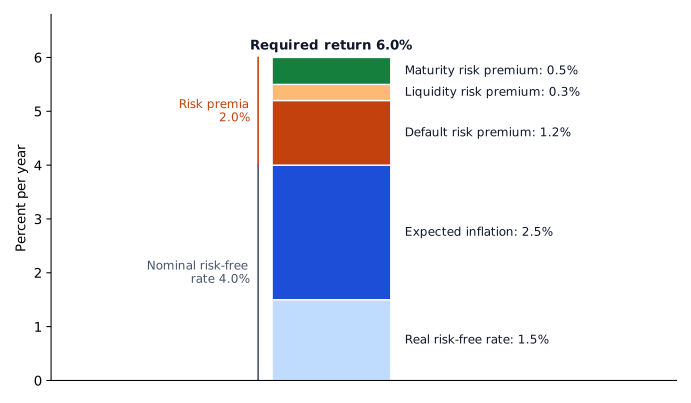
Example. Real risk-free 1.5%, expected inflation 2.5%, default risk premium 1.2%, liquidity risk premium 0.3%, maturity risk premium 0.5%: required yield ≈ 1.5 + 2.5 + 1.2 + 0.3 + 0.5 = 6.0%. Equivalently, nominal risk-free 4.0% + 2.0% of premia = 6.0%.
3. Other return measures
Real return
The real return measures the growth in purchasing power:
With positive inflation the real return is below the nominal return; with deflation () it is above it.
Example. A portfolio earns a nominal 6.0% while inflation is 2.5%. The approximate real return is ; the exact real return is . In purchasing-power terms, €1,000 grows to €1,060 while a basket of goods rises in price from €1.00 to €1.025, so the investor can buy baskets instead of 1,000, that is, 3.41% more.
Excess return
The excess return is the return over a benchmark or reference rate: approximately , exactly . For a fund return of 11% against a benchmark return of 7%, the excess return is about 4% by subtraction and exactly.
Gross vs. net return
Key concept
| Measure | Deduct trading commissions and other costs of generating the return? | Deduct management and administration fees? |
|---|---|---|
| Total return | No | No |
| Gross return | Yes | No |
| Net return | Yes | Yes |
Pretax vs. after-tax nominal return
The pretax nominal return is earned before taxes; the after-tax nominal return is what remains after the tax liability. The rates that apply can depend on the tax laws of the country where the investment is held and on those of the investor's home country. Dividends, interest, short-term gains and long-term gains may each be taxed at a different rate, and many countries tax long-term gains more lightly than short-term gains. To get the after-tax nominal return with one tax rate on capital gains () and another on distributions such as dividends and interest ():
Example. Buy at 50, receive 1.50 of dividends, sell at 54. Price return 8%, distribution return 3%, pretax 11%. With and : . If the whole return is price gain, only the capital gains rate applies. In practice, capital gains are usually taxed only when realized, and capital losses can often be used to offset gains.
Leveraged return
Leverage means using borrowed money or derivatives to control more of an asset than the investor's own cash would buy. The resulting leveraged return is the gain or loss as a percentage of the investor's cash investment. Suppose an investor puts up equity , borrows at rate and earns the unleveraged return on the whole amount:
Key concept
Example. , , . If : . If : . Both results lie further from zero than the unleveraged 9% and −3%. The second form of the formula shows why: leverage adds to the unleveraged return. A loss is always magnified, because the interest cost adds to it; a gain is magnified only if exceeds .
Derivatives such as futures and options also give leveraged returns: the cash deposited (margin or premium) is only a small fraction of the value of the underlying exposure.
Common exam traps
- Adding expected inflation to a nominal risk-free rate (double counting), or leaving it out when starting from a real rate. In the required-yield example, adding the 2.5% expected inflation to the 4.0% nominal risk-free rate gives 8.5% instead of 6.0%.
- Calling a government bill yield a real rate. It is a nominal rate.
- Adding a maturity risk premium for a short-term instrument. Commercial paper or another short-term instrument maturing with the government bill carries no extra maturity risk, so only its default (and any liquidity) premium is added.
- Mixing up the size risk premium (small vs. large cap) and the value risk premium (high vs. low book-to-market), or building an equity premium into a bond's required yield.
- Deducting transaction costs again when moving from gross to net return.
- Swapping the two tax rates, or applying one blended rate to the total return. In the tax example, swapping them gives instead of 8.90%.
- In the leverage formula: charging interest on the whole portfolio instead of only on , adding the interest instead of subtracting it, or dividing by or instead of . In the example with , charging 5% interest on all 800 gives 5.33% and dividing 62 by 800 gives 7.75%, instead of 10.33%.
Exam shortcuts
- The sign of shows whether borrowing raises or lowers a gain before any calculation: a gain is magnified only if exceeds , and a loss is always magnified.
- The real rate moves with the nominal risk-free rate and against expected inflation, so a falling bill yield with rising expected inflation means a lower real rate without computing it.
Bottom line
- An interest rate can be read as a required rate of return, a discount rate or an opportunity cost of current consumption; a measure of risk is not one of these interpretations.
- Required return = real risk-free rate + expected inflation + risk premia, where the real risk-free rate plus expected inflation is the nominal risk-free rate, such as a short-term government bill yield.
- The real risk-free rate reflects only time preference and is linked to the nominal rate exactly by , or approximately by .
- Gross return deducts trading commissions and other costs of generating the return but not management and administration fees; net return deducts both.
- With one tax rate on capital gains and another on distributions, the after-tax nominal return is price return + distribution return .
- The leveraged return is , a gain or loss measured against the investor's own cash .
Quick check
Which statement about the real risk-free interest rate is most accurate? It:
Show answer and explanation
Correct answer: B
The label "risk-free" rules out any doubt over the amount or timing of the cash flows (so no default risk), while "real" rules out any allowance for expected inflation. The real risk-free rate therefore contains neither, reflecting only time preference.
Why the other options are wrong
- A. A rate that includes an inflation premium but has zero probability of default is a nominal risk-free rate, not a real one.
- C. A liquidity risk premium is compensation for a type of risk. A risk-free rate contains no risk premiums of any kind, including a liquidity risk premium.
Key takeaway Real risk-free rate: no inflation, no risk premia. Adding expected inflation gives the nominal risk-free rate; adding risk premia to that gives the required return on a risky asset.
Practice Questions
Olivia Brandt put €50,000 into a sector fund that rose 20% in year one and then dropped 20% in year two. To express the true average yearly change in her wealth, she should use the:
Show answer and explanation
Correct answer: B
The geometric mean builds in compounding, so it is the constant annual rate that turns the starting value into the ending value. Here it is , consistent with her €50,000 becoming €60,000 and then €48,000.
Year 1: ; Year 2: .
Geometric mean: . Check: .
Why the other options are wrong
- A. The arithmetic mean is , implying her wealth was unchanged, yet she ended with €48,000, less than she started with. The arithmetic mean treats each year as if the same €50,000 were invested.
- C. The capital distribution return measures only cash income (dividends, interest) relative to the beginning price. It says nothing about the compound effect of price movements over two years.
Key takeaway A gain and loss of equal percentage size leaves the investor worse off; only the geometric mean shows it.
A company must pay a supplier €250,000 in exactly one year. Its treasurer discounts this payment at a stated annual rate of 6%. Under which compounding convention will the present value of the payment be lowest?
Show answer and explanation
Correct answer: B
For a given stated annual rate, more frequent compounding raises the effective rate used to discount the cash flow. A higher effective discount rate means a smaller present value (and, correspondingly, a larger future value for a sum invested today). Monthly is the most frequent of the three conventions, so it produces the lowest present value.
Annual:
Semiannual:
Monthly:
Why the other options are wrong
- A. Annual compounding is the least frequent convention, so it produces the highest present value: €235,849.
- C. Semiannual compounding gives €235,649. That is lower than annual but still higher than monthly, because compounding twice a year gives a smaller effective discount rate than compounding 12 times.
Key takeaway More compounding periods mean a higher effective rate, so a higher FV and a lower PV.
The managers of the Arcadia Opportunities Fund are considering borrowing to raise the fund's investment exposure from €100 million of investor capital to €150 million. Compared with remaining unleveraged, this borrowing will most likely:
Show answer and explanation
Correct answer: C
Leverage lets investors control more assets than their own capital would allow. When the portfolio return exceeds the borrowing cost, the return on equity rises; when the portfolio loses money, the loss on the smaller equity base is larger. Leverage magnifies results in both directions and offers no protection against losses.
Illustration with a 5% borrowing rate: a portfolio return of +10% gives vs. +10% unleveraged; a portfolio return of −10% gives vs. −10% unleveraged.
Why the other options are wrong
- A. Borrowing does not cushion losses. If the unleveraged portfolio loses money, the fund still owes the borrowed amount plus interest, so the loss on investor capital is larger, not smaller.
- B. When the portfolio earns more than the interest rate on the borrowing, leverage raises the return on investor capital, so gains in good years are amplified.
Key takeaway Leverage magnifies losses, and it magnifies gains as long as the portfolio return exceeds the borrowing rate.
This reading has 74 questions in the full bank. Practice all of them.
Key Takeaways
- An indicator is an observed measure (rates, FX, index levels); an instrument is a standardized, tradable vehicle; an asset is something an investor owns that has value.
- A gain and loss of equal percentage size leaves the investor worse off; only the geometric mean shows it.
- More compounding periods mean a higher effective rate, so a higher FV and a lower PV.
- Real risk-free rate: no inflation, no risk premia. Adding expected inflation gives the nominal risk-free rate; adding risk premia to that gives the required return on a risky asset.
- Leverage magnifies losses, and it magnifies gains as long as the portfolio return exceeds the borrowing rate.