From the founder
How I Passed CFA Level 1 in Two Months While Working Full Time
CredGuild founder · 2026-11-15
In 2015 I was working on project execution for an engineering project worth several hundred million dollars in Indonesia. I wanted to move from the execution side to the investment side, and the CFA Program looked like the way in. I registered for the June Level I exam.
I bought the full set of official curriculum books. When they arrived I didn't read them; there were too many pages. I found a set of condensed notes online and bought those too. They were still thick. I stalled before I had read a hundred pages. After work I had two or three hours a day, and the arithmetic never came out. The closer the exam got, the surer I was that I would fail.
So I didn't sit it. I asked to defer, CFA Institute turned the request down, and that registration fee was gone. In August I paid again, about US$700, for the December exam, in Jakarta.
So the second time I was close to starting from zero. I'm an engineer by training and by trade, with no background in finance, and the little I had read hadn't stuck. I studied for about two months, in the evenings, two or three hours a day: somewhere between 150 and 180 hours in all. I can't pin it down any closer now. I passed. What changed the second time was how I studied.
One thing up front. That is well short of the 300 hours people usually quote, and with no finance background I managed it only by being selective about how deeply I studied each part. My goal was to pass, not to score well, so I kept only what mattered most and let go of the parts I couldn't follow that rarely come up. It also helped that my job was full of numbers, project cost and schedule every day, so the calculations and the calculator didn't slow me down; time value of money questions looked a lot like the sums I did at work. If you want more margin, or numbers aren't your daily work, give yourself more time.
I stopped reading front to back
The first time, the problem wasn't that I read slowly. It was that finishing the books had become the goal. I was so focused on getting through the pages that I hardly asked whether I understood them, or how they would be tested.
The second time I switched to the lecture notes from a prep course, thinner than the condensed notes. I used them for one thing: building the framework.
I went one reading at a time:
- Read the notes for the reading to learn the main ideas, the formulas and what the reading is about. I didn't try to understand everything on the first pass. Anything hard got a mark, and I moved on.
- Do that reading's practice questions straight away, and read every explanation, including why the wrong options are wrong.
- Move to the next reading.
That kept me moving every day, and a lot of what I hadn't understood while reading made sense once I had to use it in a question.
Three passes through the questions, each with its own job
Over the two months I went through my questions about three times.
First pass: understand the ideas and learn the question types. Reading by reading, alongside the notes, with the focus on understanding each explanation.
Second pass: go after the weak spots. Mostly questions now, with the notes and the curriculum as reference. When a concept didn't make sense, or I kept missing the same kind of question, I went back to that section.
Third pass: consolidate. Go back over the questions I had missed in the first two passes and make sure I could now get them right.
By the end the curriculum was a reference book I looked things up in, not a book I had to get through.
When you miss a question, work out why
The easy trap is to count how many you got right. Misses have different causes, and each needs a different fix:
| Why you missed it | What to do |
|---|---|
| You didn't understand the concept | Go back to the notes or the curriculum and relearn that section |
| You understood it but couldn't apply it | Do more questions of the same kind |
| You ran out of time | Practise under a time limit |
| A calculation slip or a careless read | Slow down and check your work |
Sort your mistakes and your review has a direction. Don't, and you will probably miss the same thing again.
Falling behind: two decisions not to rush
A few weeks in, behind schedule, most people do one of two things. I did both.
The first is deciding you can't pass and deferring, or giving up. That was me the first time. I couldn't get through the reading, so I decided I would fail. I never worked out how much time I actually had left, or whether a different method could close the gap. As it turned out, with a different method two months was enough. If you really are far behind, deferring can be the right call, but a few weeks behind on its own doesn't mean you can't pass.
The second is racing through questions to catch up. With a pile of questions left, the instinct is to go faster and count how many you did today instead of how much you understood. Progress looks faster, but you are piling up gaps you will have to come back and fill.
A plan is there to help you learn, not to add pressure. When you fall behind, find out why, adjust the plan, and deal with what's in front of you.
Small wins keep you going
This gets little attention, and it matters most when you are studying around a job.
Reading doesn't show you progress. After hours on a reading you still can't say how much of it you understand, and that doubt wears down your confidence. It wore down mine the first time. Questions are different: one you couldn't do at first, you can do after you look it up and work through the explanation; one you missed last week, you get right this week. You can see that.
I kept my daily goals small: work through ten questions carefully today and understand two or three things I hadn't understood before. Goals that small I could always finish, and I often went past them without noticing; those extra questions felt best of all. That is what carried me through two months.
Learning from questions doesn't mean drilling questions mechanically or studying only the topics you think will come up. Level I covers a lot. Questions are a way to understand the material, reinforce it and connect it; they don't replace learning it. Without a basic framework many questions won't even make sense, so don't skip the first pass through the notes.
My result
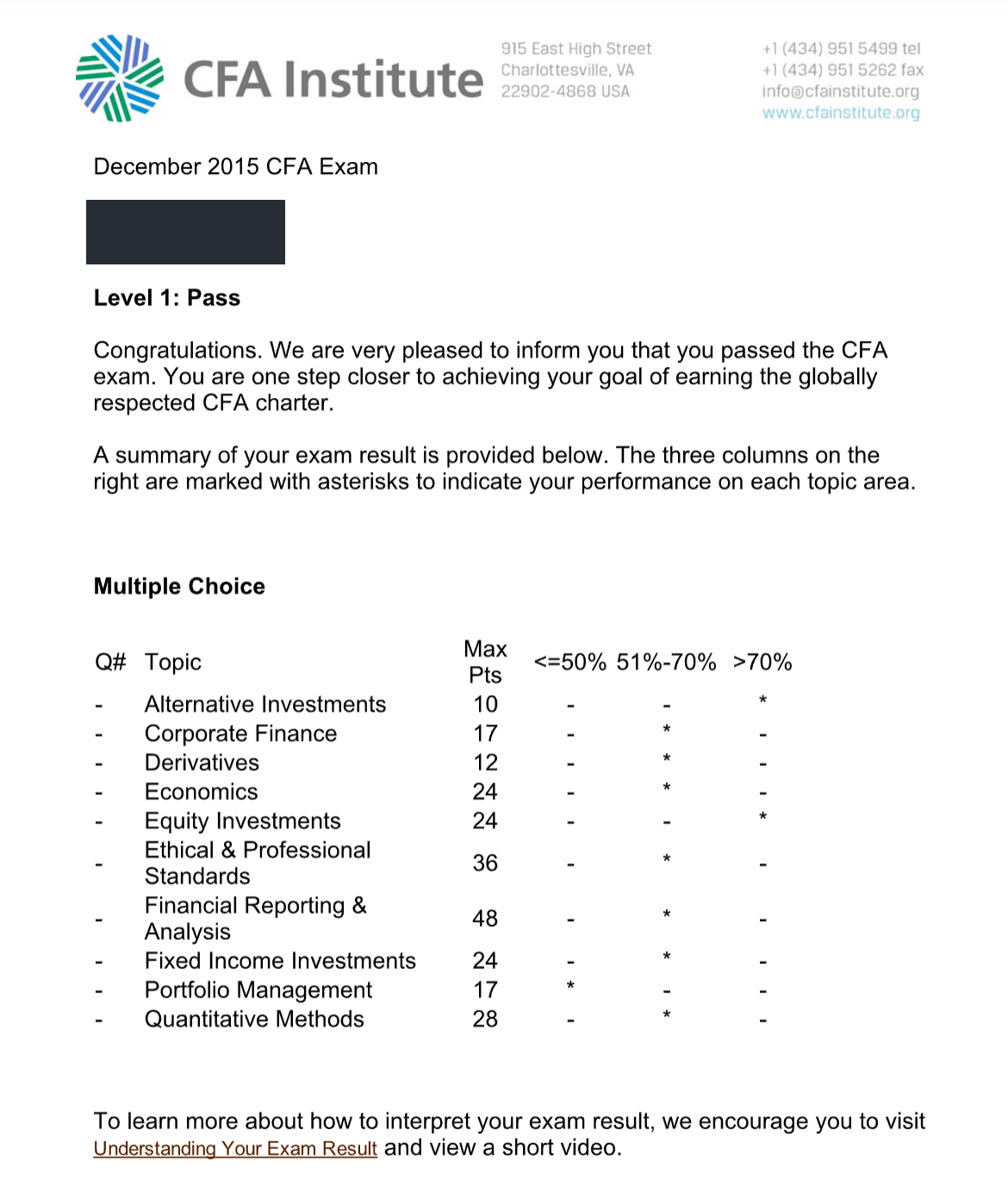
It isn't a strong result. Of the ten topics, two were above 70% (Alternative Investments and Equity Investments), one was at or below 50% (Portfolio Management) and the other seven were between 51% and 70%. I passed. Given how little time I had put in, the result surprised me too.
That was the goal: to pass, not to score high. At least in my sitting, I didn't need every topic mastered: I spent my time by the topic weights, got most topics to a solid middle, and one weak topic didn't stop me passing. That is no guarantee for anyone else or any other exam, but for someone short of time it is a more realistic aim than top marks everywhere.
The exam has changed since 2015. Then it was a paper exam of 240 questions in two three-hour sessions; now it is on computer, 180 questions in two sessions of 135 minutes, with different topics and weights. The method still holds: build the framework from the notes, find the gaps with questions, go through the questions three times.
This site is built the same way
This method is why I started CredGuild and put together the team that writes its notes and questions; its members come from CFA prep providers and financial institutions. Everything is written for the 2027 curriculum, and it is organized the way I studied:
- Notes for every reading, with the concepts, formulas, worked examples and common exam traps, to build the framework without trying to cover everything.
- Practice questions: 3,369 questions organized by reading. Each reading has a set of core questions that test each idea once, for the first pass, and the questions you miss go to your mistakes list for the second and third passes.
- A study plan: choose your exam window and weekly hours, and it schedules the notes and a first pass through the questions and, if the weeks allow, two more passes and two mock exams. That is the three passes.
- A mock exam: 180 questions in two sessions on the 2027 topic weights, to check yourself before the exam.
The notes and 398 free questions need no sign-up.
What I learned most: finishing the reading isn't the same as knowing the material, and finishing the questions isn't the same as understanding them. When time is short, use questions to find your gaps, then go back to the notes or the curriculum to fill them.