Corporate Finance · Reading 26
Business Models
CFA Level I · Corporate Finance · Reading 26 · about 23 min
What you'll learn
- LOS 26.a Describe the key features of a business model: customers, product, channels, pricing strategy, key assets and suppliers, value proposition and value chain.
- LOS 26.b Describe types of business models, including private label manufacturing, licensing, value-added resellers, network effects and crowdsourcing.
Module 26.1
Business Model Features and Types
This reading sets out the key features of a business model (its customers, product, key assets and suppliers, channels and pricing) together with the value proposition and value chain. It then describes conventional and other types of business models, including private label manufacturing, licensing, value-added resellers, network effects and crowdsourcing.
LOS 26.a — Key features of business models
A business model explains how a firm provides a product or service, finds customers, delivers to them and makes a profit. A useful checklist asks who, what, how, where and how much:
Key concept
| Question | What the model should cover |
|---|---|
| Who: customers | The target customers (segmenting the market into customer groups), how they are acquired, the cost of acquiring them, and how satisfaction is monitored and kept |
| What: product or service | The need it meets and what differentiates it from competitors (low price, premium quality, innovative features) |
| How: key assets and suppliers | The assets that matter (patents, software, skilled staff) and the critical suppliers |
| Where: channels | Where and how the firm sells and delivers, which is its channel strategy |
| How much: pricing | The pricing strategy and why buyers will pay that price given the competition |
The model describes how the firm works and earns money. Detailed forecasts of revenues and expenses belong in a financial plan rather than in the business model.
Channel strategy
The channel strategy covers how the firm sells (online, physical stores, direct mail, trade shows, sales representatives), whether it sells directly to buyers (direct sales) or through intermediaries (wholesalers, retailers, agents, franchisees), and how it delivers the product. A strategy that combines digital and physical channels, such as ordering online and collecting in store, is an omnichannel strategy.
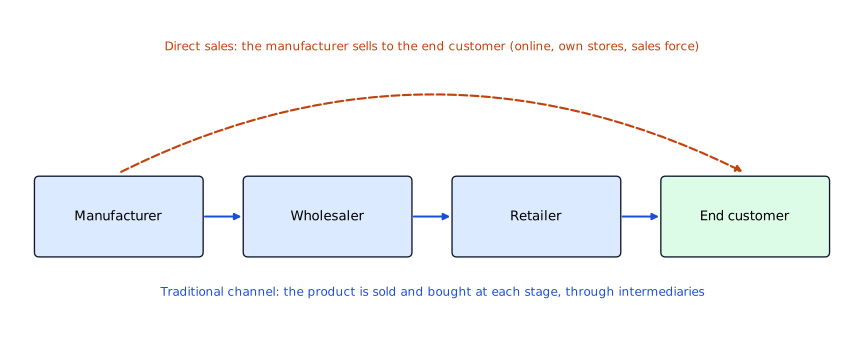
Firms selling to other businesses are B2B (business to business) firms; firms selling to consumers are B2C (business to consumer) firms.
Pricing strategies
Commodity producers with undifferentiated products are price takers, so premium pricing does not fit their business model. Firms with few competitors or highly differentiated products have pricing power. Added services or features that customers value can support a premium price.
Price discrimination means charging different prices to different customers or groups of customers. The common forms are:
- Tiered pricing: the price depends on the volume purchased, with lower unit prices for larger orders.
- Dynamic pricing: the price varies with when the purchase is made, for example the hour or the weekday (peak and off-peak prices, or cheap airfares on flights at very early or very late hours).
- Value-based pricing: the price is set by the value customers perceive in the product, such as a premium for a new drug that protects slightly better than existing ones.
- Auction pricing: buyers bid.
Pricing models for multiple products:
Key concept
| Model | How it works | Example |
|---|---|---|
| Bundling | Complementary products sold together at one price | A hotel room priced with breakfast and parking included |
| Razors-and-blades | Equipment sold at a low price and margin; profit made on consumables used with it | A coffee machine sold cheaply, with profits from the capsules |
| Add-on pricing | Core product sold at a normal margin; high-margin options added after the purchase decision | A sofa with pricey fabric protection and an extended warranty offered at checkout |
Other pricing models:
| Model | How it works |
|---|---|
| Penetration pricing | Low margins (even losses) for a period to build market share and scale |
| Freemium pricing | Basic product free; extra functionality sold or unlocked for a fee |
| Hidden revenue | Product is free to the user; revenue comes from advertisers or from selling user data |
Two models offer alternatives to outright purchase. Under the subscription model, customers pay regularly for access, as with software sold as a monthly subscription. Under licensing and franchising, a firm lets others produce or sell its product. A biotech firm may license a new drug to an established drug maker that already has a sales force. A franchisee sells in a set area and pays the franchisor a share of sales in return for product and marketing support.
Value proposition and value chain
A firm's value proposition is how customers will value the characteristics of its product or service, given competing products and their prices. The value chain is how the firm executes that value proposition: its assets and organization, and how they add value and exploit its competitive advantage through product quality and functionality, included service, the sales process and pricing relative to competitors. Michael Porter's value chain analysis names five activities a firm should execute well. Exam convention: inbound logistics, operations, outbound logistics, marketing, and sales and service. Current practice: Porter's own list groups the last two as marketing and sales, and service; the first three activities are the same in both.
Example. A meal-kit company's value proposition is "restaurant-quality dinners at home in 20 minutes for less than takeout." Its value chain consists of the sourcing contracts, the packing centers, the refrigerated delivery network and the recipe team that deliver on that promise.
Common exam traps
- A discount is not automatically tiered pricing. A discount for buying at off-peak times is dynamic pricing; only a discount tied to the quantity bought is tiered pricing.
- A free product is not automatically freemium pricing. If no paid version exists and all revenue comes from advertisers or user data, the model is hidden revenue.
- Timing separates add-on pricing from bundling: add-ons are offered after the customer has decided to buy, while a bundle is priced as one package from the start.
- "Direct sales" describes the channel strategy, and "B2B" or "B2C" describes the customers. Neither is a pricing strategy.
LOS 26.b — Types of business models
Conventional business models are largely industry-specific: manufacturers, distributors and retailers, natural resource producers, banks and brokers, software firms and service providers. Other common models:
Key concept
| Business model | Description |
|---|---|
| Private label manufacturers (contract manufacturers) | Make products that other companies sell under their own brand names, such as a store brand |
| Licensing agreements | A company lets another company use its brand on that company's products for a fee |
| Value-added resellers | Resell complex equipment together with installation, service, support or customization |
Business model innovation often comes from new entrants that use new technology to challenge incumbents. Examples are software as a service (SaaS), ultra-low-cost airlines and discount brokers.
Network effects are the increase in a network's value as its user base grows, as with messaging apps, online marketplaces and social media. Network effects favor an initial penetration pricing strategy to build the user base quickly, and they exploit both size and scope. A network can be two-sided or multi-sided, as with a platform that matches travelers with hosts.
Crowdsourcing models benefit from users' contributions, such as articles for an online encyclopedia, traffic reports for a navigation app, or code for open-source software.
Common exam traps
- A manufacturer that makes goods for a retailer's own brand is a private label (contract) manufacturer. In a licensing agreement, the brand is what is rented out.
- A value-added reseller adds services such as installation and support to equipment it resells. It does not manufacture the equipment.
- A platform that needs enough users on each side (drivers and riders, hosts and guests) relies on network effects. Crowdsourcing is different: there users contribute content or improvements.
Exam shortcuts
- Classify a price difference by what triggers it: the quantity bought means tiered pricing, the time of purchase means dynamic pricing, and the value customers perceive means value-based pricing.
- For a free product, a paid upgrade means freemium pricing and revenue from advertisers or user data means hidden revenue; for extras, options offered after the purchase decision mean add-on pricing, while a package priced from the start is bundling.
Bottom line
- A business model covers who the customers are, what the product is, how the firm operates (key assets and suppliers), where it sells (channels) and how much it charges, while detailed revenue and expense forecasts belong in a financial plan.
- The channel strategy covers how the firm sells, whether directly or through intermediaries, and how it delivers; an omnichannel strategy combines digital and physical channels, and B2B or B2C describes the customers.
- Commodity producers are price takers, firms with few competitors or highly differentiated products have pricing power, and price discrimination takes the forms of tiered, dynamic, value-based and auction pricing.
- Pricing models include bundling, razors-and-blades and add-on pricing for multiple products, penetration, freemium and hidden-revenue models, and subscription, licensing and franchising as alternatives to outright purchase.
- The value proposition is how customers value the product given competing products and prices, and the value chain is how the firm executes it; the exam convention lists Porter's activities as inbound logistics, operations, outbound logistics, marketing, and sales and service, while Porter's own list groups the last two as marketing and sales, and service.
- Besides industry-specific conventional models, firms can be private label (contract) manufacturers, license their brand to others for a fee, or act as value-added resellers that add installation, service or customization to complex equipment.
- Network effects raise a network's value as its user base grows and favor initial penetration pricing, while crowdsourcing models benefit from content or improvements contributed by users.
Quick check
An analyst is writing up the business model of Seabrook Outfitters. Which of the following items is least likely to belong in the description of the business model?
Show answer and explanation
Correct answer: A
A business model explains how a firm provides its product, finds and serves customers, and makes a profit: who the customers are, what is offered, how and where it is delivered, and how it is priced. Detailed forecasts of revenue and expenses belong in a financial plan, not in the business model.
Why the other options are wrong
- B. Target customers and how they are acquired and kept are core parts of a business model.
- C. The assets and suppliers that matter to the firm are part of how the business model works.
Key takeaway Business model = who, what, how, where and how much; detailed financial forecasts belong to the financial plan.
Practice Questions
A laptop maker has sold a premium keyboard, a high-resolution display and three years of on-site support as separate options. For its next model it decides to stop selling them separately and to include all three with the laptop for one combined base price. Which pricing model best reflects this decision?
Show answer and explanation
Correct answer: B
Bundling prices several complementary products together as one package, usually to make the overall offer more profitable. Here the laptop, the premium keyboard, the high-resolution display and the three-year support contract are all sold for one combined base price. This is different from add-on pricing, where the base laptop would be sold at a normal margin and the upgrades and support offered separately, after the purchase decision, at high margins.
Why the other options are wrong
- A. Value-based pricing sets the price according to the value customers perceive in the product. The decision described here is about how the items are sold: complementary items that were sold separately are combined into a single package price, which is bundling.
- C. Dynamic pricing charges different prices depending on the time of day or day of the week (peak and off-peak pricing). Nothing in the decision depends on timing.
Key takeaway Complementary extras included in one package price are bundling. Extras sold separately after the purchase decision are add-on pricing.
Fairfield Mills produces breakfast cereals that are sold only under the store brands of several large supermarket chains. Fairfield's name does not appear on any package. Which business model best describes Fairfield Mills?
Show answer and explanation
Correct answer: C
Private label (contract) manufacturers make products that other companies sell under their own brand names, as store brands are. Fairfield makes the cereal and the supermarkets sell it under their brands, so Fairfield is a private label manufacturer.
Why the other options are wrong
- A. A value-added reseller resells complex equipment and adds installation, service, support or customization. Fairfield manufactures goods; it does not resell them with added services.
- B. In a licensing agreement, a company lets another company use its brand on that company's products for a fee. Here no brand is rented out: the supermarkets put their own brands on products Fairfield makes.
Key takeaway A firm that makes products for others to sell under their brands is a private label (contract) manufacturer. A firm that rents out its brand uses a licensing agreement.
This reading has 15 questions in the full bank. Practice all of them.
Key Takeaways
- Business model = who, what, how, where and how much; detailed financial forecasts belong to the financial plan.
- Complementary extras included in one package price are bundling. Extras sold separately after the purchase decision are add-on pricing.
- A firm that makes products for others to sell under their brands is a private label (contract) manufacturer. A firm that rents out its brand uses a licensing agreement.