Corporate Finance · Reading 20
Organizational Forms, Corporate Issuer Features, and Ownership
CFA Level I · Corporate Finance · Reading 20 · about 30 min
What you'll learn
- LOS 20.a Compare sole proprietorships, general and limited partnerships, and corporations by legal identity, owner-operator separation, liability, taxation and access to capital.
- LOS 20.b Describe the key features of corporations: separate legal identity, shareholder voting and limited liability, dividends, and double taxation.
- LOS 20.c Compare public (listed) and private companies, and the ways a private company goes public or a public company goes private.
Module 20.1
Features of Corporate Issuers
This reading compares sole proprietorships, partnerships and corporations by legal identity, the link between owners and operators, owner liability, taxation and access to capital, and describes the key features of corporate issuers, including the double taxation of dividends. It then contrasts public and private companies and the ways a company goes public or private.
LOS 20.a — Comparing organizational forms
A business's organizational form is its legal and organizational set-up. Five features separate one form from another:
- whether the business is a separate legal entity from its owners;
- whether the owners also run the business, and if not, how owners and operators are related;
- whether the owners' liability for the business's debts and actions is limited liability or unlimited liability;
- how the profits (or losses) are taxed;
- how easily the business can raise more capital and spread its risk.
The four common forms
- Sole proprietorship: one person owns and runs the business. The law does not separate the business from its owner: all profits and losses are hers, profits are taxed as her personal income, and she has unlimited liability for the business's obligations. Growth is limited to what one individual can finance.
- General partnership: two or more partners pool their capital and share the risk, so the business can operate on a larger scale than a sole proprietorship. The partners run it under a partnership agreement (written, verbal, or implied by how the partners act) that sets out duties and profit shares. Every general partner has unlimited liability, and each partner's share of profit is taxed as personal income.
- Limited partnership: two classes of partner. There must be at least one general partner, who runs the business and has unlimited liability, and at least one limited partner, whose liability is capped at the amount invested and whose profit claim is proportional to that investment. Limited partners usually do not take part in management and usually do not appoint or remove the general partners. Exam convention: because general partners run the business, they typically receive a larger portion of the profits than the limited partners. Current practice: the comparison is best read per unit of capital, since general partners usually earn a promote or carried interest on top of a pro-rata share, while limited partners, who often supply most of the capital, can still receive most of the profits in absolute terms. Profits are taxed as personal income of each partner.
- Limited liability partnership (LLP): permitted in some jurisdictions; no general partner is required, so all partners have a liability shield. Unlike the passive limited partners of an LP, LLP partners may take part in running the firm. Exam convention: in the United States, LLPs are open only to providers of professional services such as law and accounting, with limits on the number of partners and the equity invested. Current practice: the rules are set state by state; some states restrict LLPs to designated professions, while others allow any partnership to register as an LLP.
- Corporation (a limited company): a legal entity separate from its owners and managers. All shareholders have limited liability: the most an owner can lose is the amount invested in the shares. Owners and managers are separated: shareholders elect a board of directors, which hires senior managers to run the company in shareholders' interests. Corporations have the widest access to capital, both debt (borrowed capital) and equity (ownership capital), which is why most large firms are corporations. Because owners do not have to run the business, a corporation can raise equity from many investors who want a share of the profits but no role in management.
Key concept
| Feature | Sole proprietorship | General partnership | Limited partnership | Corporation |
|---|---|---|---|---|
| Separate legal entity | No | No* | No* | Yes |
| Owners also operate? | Yes | Yes (all partners) | General partners only | No; board hires managers |
| Owner liability | Unlimited | Unlimited | GPs unlimited, LPs limited | Limited |
| Taxation of profits | Personal income | Personal income | Personal income | Corporate tax, then possibly tax on dividends |
| Access to capital | Limited (one owner) | Limited (partners) | Limited (partners) | Greatest (debt and equity) |
*Exam convention: a partnership is an extension of its partners, and only the corporation is a separate legal entity. Current practice: many US states, under the Revised Uniform Partnership Act, treat a partnership as a separate entity, but its general partners remain personally liable.
A public corporation (public limited company) has shares that are sold to the public. Most public limited companies are listed, so their shares trade on a stock exchange. A private limited company has a limited number of shareholders, and the transfer of its shares is restricted.
Common exam traps
- A limited partnership needs a minimum of one general partner and one limited partner. Two of either class is not required.
- Assuming a general partner's liability is capped because the business is a limited partnership. Only the limited partners have limited liability.
- Treating separate legal identity and limited liability as one feature. Where a partnership is a separate entity, its general partners are still personally liable; limited liability for every owner is what sets the corporation apart.
- Applying double taxation to a partnership. Partnership profit is taxed once, as the partners' personal income.
LOS 20.b — Key features of corporate issuers
- Legal identity. A corporation is formed by filing articles of incorporation with a regulator. As a legal person it can hire employees, sign contracts, borrow and lend.
- Shares and voting. Issuing shares lets a corporation raise large amounts of capital. Shareholders have voting rights to elect the board; listed shares are easy to transfer.
- Dividends. The board may distribute part of earnings as dividends; the corporation is not required to do so.
- Double taxation. Where a country taxes corporate earnings and taxes dividends as personal income, distributed profit is taxed twice. The burden is smaller when a company pays out less and reinvests more.
Key concept
More generally, with payout ratio : total tax per unit of pretax profit .
Example. Pretax profit is $1,000, the corporate rate is 30% and dividends are taxed at 10%.
- Full payout: corporate tax $300; dividends $700; dividend tax $70; total $370, an effective rate of 37.0%.
- Half of after-tax profit paid out: corporate tax $300; dividends $350; dividend tax $35; total $335, an effective rate of 33.5%.
Common exam traps
- The dividend tax applies to the after-tax profit that is actually paid out. Applying it to pretax profit overstates the tax. In the full-payout example, a dividend tax on the $1,000 pretax profit gives a total of $400 (40.0%) instead of $370 (37.0%).
LOS 20.c — Public versus private companies
Most public limited companies are listed companies: their shares are listed on a stock exchange, a rules-based open market with price and volume transparency. Shareholders may be individuals, other corporations, nonprofits or governments. Shares that are actively traded (those not held by insiders, strategic investors or sponsors) form the free float, usually quoted as a percentage of total shares outstanding:
Public companies must meet compliance and reporting requirements, such as filing quarterly or annual financial reports with a regulator and disclosing material changes in the business or its ownership. Private companies face fewer regulatory requirements, disclose less, and can take a longer-term view; but their shares do not trade on an exchange, so value is hard to observe and exit is difficult (investors usually wait for an IPO or a sale of the company).
Key concept
| Public (listed) company | Private company | |
|---|---|---|
| Share trading | On an exchange; price observable | No exchange; transfer difficult |
| Periodic reporting to regulators | Required | Generally not required |
| Raising equity | Public offerings | Private placements to accredited investors (corporate and institutional investors, high-net-worth individuals) |
| Investment horizon | Pressure from public investors | Can take a longer-term view |
Moving between private and public
The figure summarizes the routes described below.
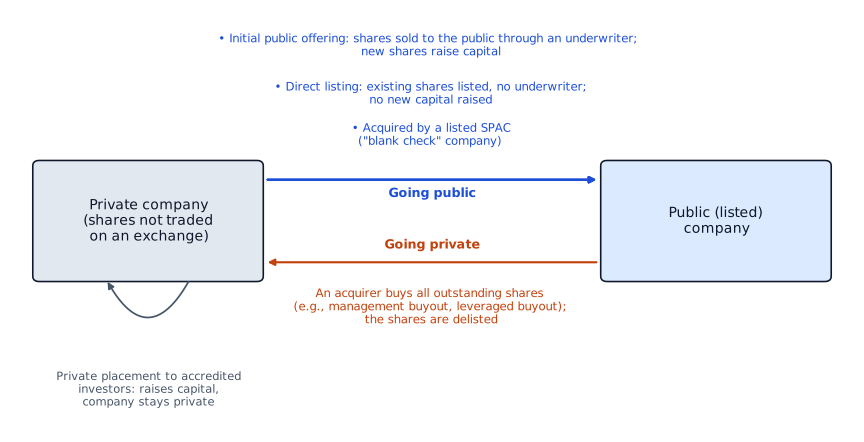
Ways to go public:
- Initial public offering (IPO): the company's shares are first sold to the public, usually through an underwriter (investment bank). The company must meet the listing requirements of the chosen exchange. Once the shares are listed, investors buy and sell them among themselves without dealing with the company. An IPO typically includes new shares that raise equity capital; existing shareholders may also sell some of their shares in the offering.
- Direct listing: an exchange lists the company's existing shares. It is faster than an IPO and needs no underwriter. Exam convention: a direct listing raises no new capital for the company. Current practice: that describes the traditional (secondary) direct listing; some exchanges (e.g., NYSE) also permit a primary direct listing, in which the company sells new shares in the opening auction.
- Acquisition by a special purpose acquisition company (SPAC), a "blank check" company that raises money in its own IPO, holds it in trust, and must use it to acquire a (not-yet-identified) private company within a set time. Because the SPAC is already listed, the acquired business becomes part of a listed company when the deal closes.
Going private. An acquirer buys all outstanding shares, for example in a management buyout or a leveraged buyout, and the company is delisted, often to restructure an underperforming firm with a lighter regulatory burden.
Common exam traps
- Assuming that going public always raises money for the company. Only newly issued shares do: a direct listing of existing shares raises none, and existing shares sold in an IPO pay the selling shareholders.
- A private placement raises capital but does not make the company public; buyouts take companies private.
- Computing free float from all shares outstanding. Holdings of insiders, strategic investors and sponsors are not actively traded and must be left out.
Exam shortcuts
- To decide whether going public raises money for the company, ask whether new shares are issued: new shares in an IPO raise capital, while existing shares sold in an IPO pay the selling shareholders, and under the exam convention a direct listing raises no new capital (current practice also allows a primary direct listing that sells new shares).
Bottom line
- Organizational forms differ in whether the law treats the business as distinct from its owners, whether owners also operate it, whether owner liability is limited, how profits are taxed and how easily it can raise capital.
- In a sole proprietorship and a general partnership the owners run the business, have unlimited liability and pay personal income tax on its profits.
- A limited partnership needs at least one general partner, who runs the business with unlimited liability, and at least one limited partner, whose liability is capped at the amount invested and who usually takes no part in management.
- A corporation exists as a legal person distinct from its owners and managers, all shareholders have limited liability, the shareholders elect a board that hires managers, and it has the widest access to debt and equity capital.
- Where both corporate earnings and dividends are taxed, the effective rate on distributed profit is , and paying out less of the profit reduces the double-taxation burden.
- Most public companies are listed, so their shares trade on an exchange, and they must meet compliance and reporting requirements, while private companies disclose less, raise equity through private placements to accredited investors and offer investors no easy exit.
- Free float is the actively traded part of the shares outstanding, which excludes holdings of insiders, sponsors and strategic investors.
- A private company goes public through an IPO, a direct listing or acquisition by a SPAC, and a public company goes private when an acquirer, as in a management or leveraged buyout, buys all its shares and delists it.
Quick check
Two siblings plan to buy and operate a vineyard. They will manage it themselves and accept unlimited liability for its debts. Four cousins will contribute capital but will take no part in running the business and want their liability capped at the amount they invest. The most appropriate organizational form is a:
Show answer and explanation
Correct answer: A
A limited partnership combines general partners, who manage the business and have unlimited liability (the siblings), with limited partners, whose liability is limited to their investment (the cousins). That is the mix described.
Why the other options are wrong
- B. In a general partnership every partner is a general partner with unlimited liability, so the cousins could not cap their liability.
- C. A limited liability partnership has no general partner: every partner has a liability shield. It does not fit owners who choose to accept unlimited liability, and some US states restrict LLPs to designated professions such as law and accounting.
Key takeaway Mixed roles (managers with unlimited liability + passive investors with limited liability) point to a limited partnership.
Practice Questions
An analyst drafts a list of features of Kittredge Marine, a corporation. Which item on her list is incorrect?
Show answer and explanation
Correct answer: B
The defining feature of a corporation is its legal identity, separate from that of its owners and its managers. It is formed by filing articles of incorporation with a regulator and, as a legal person, it can hire employees, enter into contracts, and borrow and lend in its own name. Having no legal identity apart from the owner describes a sole proprietorship, whose business is legally an extension of its owner. For a corporation this item is the error on the list.
Why the other options are wrong
- A. This item is accurate. Ownership and management are separated in a corporation: shareholders elect the board, which hires the managers. A large shareholder may sit on the board or serve as an executive, but most shareholders take no management role.
- C. This item is accurate for a country that taxes corporate earnings and also taxes dividends as personal income, which is why it says profits may be taxed twice. The second layer of tax falls on distributed profit, so the burden is smaller when the company retains more of its earnings.
Key takeaway Key features of a corporation: separate legal identity, owners separated from managers, limited liability for shareholders, and possible double taxation of distributed profits.
Brenmoor Robotics is privately held. Its board wants to bring in new equity capital and, at the same time, allow its shares to be bought and sold by the public on a stock exchange. The board is most likely to pursue:
Show answer and explanation
Correct answer: C
An initial public offering (IPO) typically includes new shares sold by the company to the public (existing holders may sell some shares as well), so the proceeds add to its equity capital, and the shares then trade on an exchange. It is the only choice that achieves both of the board's goals.
Why the other options are wrong
- A. A direct listing of existing shares makes them tradable on an exchange, but no new shares are sold, so the company raises no new capital. Some exchanges also allow a primary direct listing that sells new shares, but this option lists existing shares only.
- B. A management buyout is a way of taking a public company private; it raises no equity for the company and moves in the opposite direction.
Key takeaway IPO = go public, typically raising new capital; direct listing of existing shares = go public without raising capital; buyout = go private.
This reading has 18 questions in the full bank. Practice all of them.
Key Takeaways
- Mixed roles (managers with unlimited liability + passive investors with limited liability) point to a limited partnership.
- Key features of a corporation: separate legal identity, owners separated from managers, limited liability for shareholders, and possible double taxation of distributed profits.
- IPO = go public, typically raising new capital; direct listing of existing shares = go public without raising capital; buyout = go private.