Corporate Finance · Reading 21
Shareholder vs Stakeholder
CFA Level I · Corporate Finance · Reading 21: Investors and Other Stakeholders · about 26 min
What you'll learn
- LOS 21.a Compare the claims, risk and upside of lenders (debtholders) and shareholders, and why their interests can conflict.
- LOS 21.b Describe a company's stakeholder groups (shareholders, lenders, board, managers, employees, suppliers, customers, governments) and compare their interests under shareholder and stakeholder theory.
- LOS 21.c Describe the environmental, social and governance (ESG) factors investors consider and how ESG risks affect equity and debt investors.
Module 21.1
Stakeholders and ESG Factors
This reading contrasts what lenders and shareholders are owed and what each of them wants, including how leverage changes return on equity. It then describes a company's other stakeholder groups and board structures, and the environmental, social and governance factors that investors evaluate.
LOS 21.a — Lenders versus shareholders
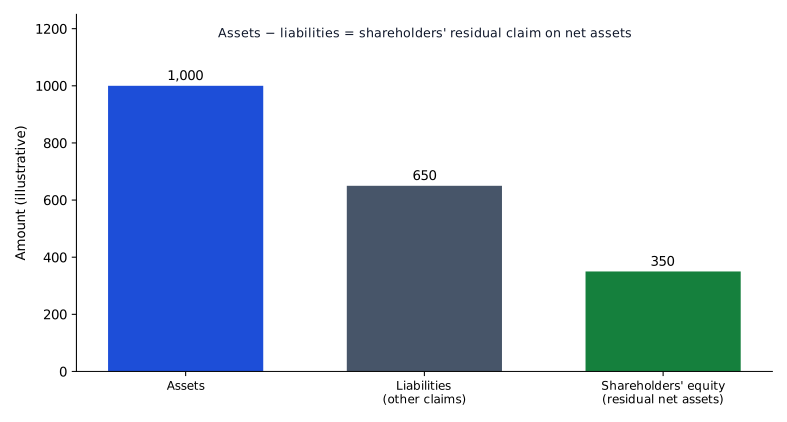
Lenders (debtholders) have a legal, contractual claim to the interest and principal the company has promised to pay. Shareholders (equity holders, owners) have a residual claim: whatever is left of the company's net assets after all other claims are met. Lenders therefore rank ahead of owners, debt is less risky than equity, and debt is the cheaper form of capital. In most tax systems interest is also deducted in computing the company's taxable income, whereas dividends are paid out of after-tax profit.
The figure illustrates the balance-sheet claim: shareholders' residual is the company's net assets after liabilities, not an automatic distribution of annual net income.
Both groups can lose their whole investment if the firm fails, but no more than they put in. The difference lies in the upside:
Key concept
| Debtholders | Equity holders | |
|---|---|---|
| Claim | Contractual: promised interest + principal | Residual: net assets after all other claims |
| Priority | Higher | Lower |
| Best case | Receive exactly what was promised | Theoretically unlimited gains |
| Worst case | Lose the investment | Lose the investment |
| Attitude to risk-increasing growth | May oppose: more default risk, no extra return | May favor: they keep the upside |
Firm value = value of debt + value of equity. While the firm is worth more than its debt, extra value accrues to equity and the debt value stays roughly constant; if the firm becomes worth less than its debt, equity is worth zero and debt value falls with firm value.
Example: leverage and ROE. A firm needs $800 of assets; revenue is $600 and cash operating expenses are $480 (no taxes), so operating income is $120 (a 15% return on assets).
- All-equity: ROE .
- Half debt at 6%: interest ; net income ; ROE .
- If revenue falls 20% to $480 while operating expenses stay at $480, operating income is zero: ROE is 0% unlevered but levered, and lenders are still owed their $24.
Leverage raises ROE as long as the firm earns more on its assets than it pays on its debt; when it earns less, leverage lowers ROE and magnifies any loss. Lenders get only their promised return either way, so they have no upside and only downside. Shareholders therefore may favor adding debt to fund growth (it also avoids diluting their ownership), while existing lenders resist; lenders protect themselves with covenants, such as a maximum leverage ratio or a minimum interest coverage ratio.
Common exam traps
- Only interest and principal are contractual; common and preferred dividends are paid at the board's discretion.
LOS 21.b — Stakeholder groups and their interests
Under shareholder theory, corporate governance focuses on shareholders' interest in maximizing the market value of common equity, so the main conflict is the one between shareholders (the owners) and the managers they employ. Under stakeholder theory, the focus is broader: governance must balance the competing interests of shareholders and the other groups affected by the company's actions: creditors, employees, suppliers, customers, communities and governments.
Key concept
| Stakeholder | Main interests |
|---|---|
| Shareholders | Residual claim; vote to elect the board; want profitability and growth in share value. Residual claim with theoretically unlimited upside, and they can diversify their portfolios cheaply, so they may favor riskier growth. |
| Lenders — public bondholders and private debtholders (banks) | Timely interest and principal; solvency. Private lenders may see nonpublic information (less information asymmetry), which makes them a key funding source for small and medium-sized firms; some also hold equity and may be more willing to renegotiate loan terms. Bondholders rely on public information and have little or no influence over operations. Both are protected by covenants. |
| Board of directors | Protect shareholders' interests; hire, fire and pay senior managers; set strategy; monitor performance. |
| Senior managers | Salary, bonus, perks, continued employment. Bonuses tied to firm performance give them a stake in its financial success. Their employment income is tied to the firm, so they may choose less business risk than shareholders would. |
| Employees | Pay, advancement, training, working conditions, firm sustainability; may own shares through employee stock plans; in some industries they bargain through unions. |
| Suppliers | Ongoing, profitable trade relationship; as short-term creditors, the firm's solvency and stability. |
| Customers | Quality product at a fair price; after-sale support; increasingly, the firm's social and environmental record. |
| Governments / regulators | Tax revenue, job creation, economic growth, social welfare; compliance with laws. |
Board structure. Boards include inside directors (executives, founders) and independent directors with no material relationship to the company, who better protect shareholders. A one-tier board puts both on one board; exchanges typically require a majority of independent directors and may also require a range of backgrounds and skills. In a two-tier board (continental Europe), a supervisory board oversees a management board of insiders. In a staggered board, only a fraction of directors is elected each year, which makes a rapid overhaul by shareholders harder; companies defend it as giving continuity and a longer-term view of strategy. Minority shareholders generally prefer a majority-independent board elected in full.
Common exam traps
- Stakeholder theory does not put other groups in place of shareholders; it balances all groups, shareholders included.
- Lenders are less keen on a riskier strategy than suppliers. Both are creditors, but suppliers also gain from a customer's growth through more trade, while lenders can receive no more than the promised payments.
- When the firm's financial position weakens, shareholders absorb losses first, and the groups whose claims depend on its solvency are directly exposed: lenders, suppliers as short-term creditors, and managers and employees whose pay and jobs are at stake. Customers tend to be less affected than these groups. They mainly want a good product at a fair price, although they can lose after-sale support.
LOS 21.c — ESG factors considered by investors
Investors who take a stakeholder perspective evaluate environmental, social, and governance (ESG) factors because (1) governments increasingly push climate and social policy through regulation, (2) ESG issues can hit results through lost customer goodwill, fines and legal judgments, (3) poor governance lets managers exploit shareholders, and (4) many younger investors want ESG considered. Negative externalities, costs a firm imposes on others without bearing them, increasingly have to be recognized, explicitly or implicitly.
Key concept
| Factor | Examples |
|---|---|
| Environmental | Climate change, air and water pollution, deforestation, energy efficiency, waste management, water scarcity |
| Social | Customer privacy and data security, customer satisfaction, employee engagement, diversity and inclusion, labor relations, community relations |
| Governance | Board and audit committee composition, executive compensation, bribery and corruption, political contributions, lobbying |
Climate-related risks come in two forms: physical risk, which is damage to assets or operations from more frequent severe weather, and transition risk, which arises when regulation or consumer choices force a move from high-carbon to low-carbon activity. Assets made unviable by such changes are stranded assets; an example is a plant closed because retrofitting it to new emissions rules is uneconomic. Resource-intensive industries affect the environment directly, while other industries may affect it indirectly. Weak safety policies or governance raise the risk of events such as oil spills or groundwater contamination, whose penalties, cleanup, litigation and reputational costs can be large.
Social factors shape how the company is seen to treat employees, customers and communities. Lowering social risk can cut costs through higher productivity, lower staff turnover, more loyal customers and fewer lawsuits. Governance systems need checks that keep managers acting ethically, lawfully and in shareholders' interests.
Who bears ESG risk. Analysts identify and measure the ESG risks a company faces and how they could affect the cash flows it generates in the future. Adverse ESG outcomes fall most heavily on equity investors. Debt investors are hurt mainly if losses are large enough to cause default. Because some ESG risks may take years to appear (a plant that complies today may become obsolete later), holders of longer-maturity debt may be more exposed than short-term lenders.
Common exam traps
- A carbon tax or a shift in customer demand toward low-carbon products is transition risk even though climate change is the underlying cause. Physical risk is damage done by the weather itself.
Exam shortcuts
- Compare the return on assets with the cost of debt before computing ROE: if the firm earns more on its assets than it pays on its debt, leverage raises ROE, and if it earns less, leverage lowers ROE.
- Classify a climate risk by its channel: damage done by the weather itself is physical risk, while a carbon tax, a new rule or a shift in demand toward low-carbon products is transition risk.
Bottom line
- Lenders have a contractual claim to promised interest and principal and rank ahead of shareholders, whose claim is residual, so debt is less risky than equity and the cheaper form of capital.
- Lenders and shareholders can each lose their whole investment but no more, yet lenders can receive at most the promised payments while equity has theoretically unlimited upside, so shareholders may favor risk-increasing growth that lenders resist with covenants.
- Shareholder theory focuses governance on maximizing the market value of common equity and on the conflict between shareholders and managers, while stakeholder theory balances the interests of shareholders and all other affected groups.
- Private lenders such as banks may see nonpublic information, which makes them a key funding source for small and medium-sized firms, while bondholders rely on public information and have little influence over operations.
- Independent directors better protect shareholders than inside directors; a two-tier board has a supervisory board overseeing a management board, and a staggered board makes a rapid overhaul by shareholders harder.
- Investors evaluate ESG factors because regulation increasingly targets climate and social issues, ESG problems can cause lost goodwill, fines and judgments, poor governance lets managers exploit shareholders, and many younger investors want ESG considered.
- Climate change brings physical risk from severe weather and transition risk from regulation or consumer choices, and assets made unviable by these changes are stranded assets.
- Adverse ESG outcomes fall most heavily on equity investors, debt investors are hurt mainly if losses cause default, and holders of longer-maturity debt may be more exposed than short-term lenders.
Quick check
Orrin Freight has bank loans, preferred stock and common stock outstanding. Which of the following payments are contractual obligations of Orrin?
Show answer and explanation
Correct answer: A
Lenders have a legal, contractual claim to the interest and principal payments the company has promised. Owners have only a residual claim: the company may pay dividends, but it is not required to.
Why the other options are wrong
- B. Common stock dividends are paid at the board's discretion. They are not a contractual obligation.
- C. Preferred stock dividends are also not a contractual obligation of the company. Only interest and principal owed to lenders are.
Key takeaway Contractual = interest + principal to lenders. Dividends (common or preferred) = discretionary distributions to owners.
Practice Questions
Which of the following best describes the primary focus of the stakeholder theory of corporate governance?
Show answer and explanation
Correct answer: C
Under stakeholder theory, corporate governance deals with the competing interests of the people who run the company and all the groups its actions affect. Shareholders are one of those groups, alongside creditors, employees, suppliers, customers, communities and governments.
Why the other options are wrong
- A. Stakeholder theory does not replace shareholders' interests with those of other groups. Shareholders are among the stakeholders whose interests are balanced.
- B. Maximizing the value of common equity is the focus of shareholder theory.
Key takeaway Stakeholder theory = balance everyone, shareholders included. Shareholder theory = maximize equity value.
Ardent Power generates most of its electricity from coal. New national emissions limits and a steady shift in customer demand toward low-carbon energy threaten to make several of its plants uneconomic before the end of their useful lives. The climate-related risk Ardent faces is best described as:
Show answer and explanation
Correct answer: B
Transition risk arises when government regulation or consumer choices force a shift from high-carbon to low-carbon activities. Assets made unviable by that shift, like Ardent's coal plants, become stranded assets.
Why the other options are wrong
- A. Physical risk is the risk of damage to assets or operations from climate events such as more frequent severe weather. Nothing in the scenario involves physical damage.
- C. Governance factors concern board composition, executive pay, bribery, lobbying and similar matters. The threat here comes from environmental regulation and market shifts. How the company is governed is not the issue.
Key takeaway Climate risk splits into physical risk (weather damage) and transition risk (rules and preferences moving to low carbon); assets killed by transition become stranded assets.
This reading has 16 questions in the full bank. Practice all of them.
Key Takeaways
- Contractual = interest + principal to lenders. Dividends (common or preferred) = discretionary distributions to owners.
- Stakeholder theory = balance everyone, shareholders included. Shareholder theory = maximize equity value.
- Climate risk splits into physical risk (weather damage) and transition risk (rules and preferences moving to low carbon); assets killed by transition become stranded assets.