Derivatives · Reading 71
Forward vs Futures
CFA Level I · Derivatives · Reading 71: Forward Commitment and Contingent Claim Features and Instruments · about 31 min
What you'll learn
- LOS 71.a Define swaps, credit default swaps, and call and put options, and describe the rights and obligations of each party.
- LOS 71.b Calculate the value at expiration and the profit of long and short call and put positions, including breakeven and maximum gain/loss.
- LOS 71.c Contrast forward commitments (forwards, futures, most swaps) with contingent claims (options, credit default swaps).
Module 71.1
Forwards and Futures
This reading describes the main derivative instruments, forwards, futures, swaps, credit default swaps and options, and how option values and profits are measured at expiration. A candidate must be able to track a futures margin account through the daily mark-to-market, compute net swap payments, compute option values, profits and breakevens, and classify a derivative as a forward commitment or a contingent claim.
LOS 71.a — Forward and futures contracts
Forward contracts
A forward contract is a private agreement in which one party (the buyer, long) is obligated to purchase a physical or financial asset from the other (the seller, short) at a price fixed today, on a specific future settlement date. Both sides are obligated, and neither pays anything at initiation. The long profits if the underlying's price at settlement is above the forward price; the short profits if it is below.
Futures contracts
A futures contract is essentially a forward that is standardized and traded on an exchange. The main differences are:
Key concept
| Feature | Forward | Futures |
|---|---|---|
| Terms | Customized | Standardized |
| Market | OTC dealer market | Organized exchange |
| Liquidity / secondary market | Limited | Liquid |
| Regulation and transparency | Lower | Higher |
| Counterparty credit risk | Each side bears it | Minimal: clearinghouse guarantee |
| Gains and losses | Usually settled only at maturity | Settled daily (mark-to-market) |
Margin and the daily mark-to-market
Futures margin is collateral (cash or acceptable securities) that both buyer and seller must post. It protects the clearinghouse. Unlike margin on a stock purchase, it is not a loan, so no interest is charged.
Key concept
- Initial margin is the amount that must be deposited before a trade. Its size is set at about the largest price move expected in one day on the contract's value.
- Maintenance margin is the minimum balance the account must keep. The exchange sets both margin requirements.
- In the mark-to-market (marking to market), every account is credited with gains and debited with losses at the end of each day, based on the change in the settlement price.
- The settlement price is the average price of trades during a closing period at the end of the session. The exchange sets the length of that period.
- A margin call occurs if the balance falls below the maintenance margin. The trader must then deposit enough to bring the account back to the initial margin, or the position is closed out. In an equity margin account, by contrast, the investor only has to restore the maintenance level.
Daily cash settlement of gains and losses, together with the clearinghouse, minimizes counterparty credit risk on futures. Forward contracts typically are not marked to market daily, although they can be when a central clearing party is used.
Example. A trader buys one crude oil futures contract on 1,000 barrels at $78.00. Initial margin is $6,000 and maintenance margin is $4,500.
| Day | Settlement price | Daily gain/loss (long) | Balance before deposit | Deposit | Ending balance |
|---|---|---|---|---|---|
| 0 | 78.00 | — | 6,000 | — | 6,000 |
| 1 | 76.80 | 4,800 | 0 (above 4,500) | 4,800 | |
| 2 | 75.90 | 3,900 | 6,000 |
On Day 2 the balance of $3,900 is below $4,500, so the deposit must restore the initial margin of $6,000. The short's account is credited with the same amounts.
Price limits
Many futures have price limits: the exchange caps how far the settlement price may move from the previous day's. Trades outside the limits are not allowed, so if the equilibrium price lies beyond a limit, trading stops. Some exchanges use circuit breakers that halt trading briefly when a limit is hit.
Common exam traps
- A margin call restores the account to the initial margin. The maintenance margin is only the trigger. On Day 2 of the crude oil example, restoring only the maintenance level would need $600 instead of the required $2,100.
- The settlement price is an average over a closing window. It is not the last trade of the day.
Bottom line
- A forward is a private, customized agreement that obligates both parties, with nothing paid at initiation; the long profits if the underlying's price at settlement is above the forward price, and the short profits if it is below.
- A futures contract is a standardized, exchange-traded forward whose gains and losses are settled daily and whose performance the clearinghouse guarantees, which keeps counterparty credit risk minimal.
- Futures margin is collateral posted by both buyer and seller, not a loan; initial margin must be deposited before a trade, and maintenance margin is the minimum balance the account must keep.
- When a futures account falls below the maintenance margin, the margin call requires a deposit that restores it to the initial margin, or the position is closed out.
- The settlement price used for the daily mark-to-market is the average price of trades during a closing period, and price limits cap how far it may move from the previous day's settlement price.
Quick check
Laszlo Bencze holds a long futures position. The initial margin on his account is $3,800 and the maintenance margin is $2,900. After today's mark-to-market, his account balance is $2,650. If Bencze wants to keep the position open, the deposit he must make is closest to:
Show answer and explanation
Correct answer: B
Because the balance ($2,650) has fallen below the maintenance margin ($2,900), Bencze receives a margin call. In futures trading the deposit must restore the account to the initial margin level, otherwise the position is closed out.
Balance maintenance margin margin call.
Why the other options are wrong
- A. $250 only restores the account to the maintenance margin (). That is the rule for equity margin accounts. Futures accounts must be restored to the initial margin.
- C. $2,900 is the maintenance margin itself. There is no rule requiring a deposit equal to the maintenance margin; the deposit is whatever brings the balance back to the initial margin.
Key takeaway After a futures margin call, the account is topped up to the initial margin whenever the balance drops below the maintenance margin.
Module 71.2
Swaps and Options
LOS 71.a — Swaps, credit default swaps and options
Interest rate swaps
A swap is an agreement to exchange a series of payments on several settlement dates. In a plain fixed-for-floating interest rate swap, one party pays a fixed rate (the swap rate) and the other pays a floating market reference rate (MRR), both on the same notional principal. On each date the two amounts are netted, and only the net payment is made, by the party that owes more. The floating rate for a period is set at the start of that period and paid at its end, so the first payment is known when the swap begins.
The swap rate is chosen to give the swap a value of zero when it starts. A swap is equivalent to a series of forward contracts on the floating rate. Each forward settles on one swap settlement date, with the fixed rate playing the role of the forward price. Interest rate forwards often settle at the start of the period, paying the present value of the end-of-period swap amount. Swaps trade in dealer markets, so counterparty credit risk exists unless a central counterparty is used; a central counterparty may also require the parties to post margin and make mark-to-market payments.
Example. A 1-year swap has a notional principal of $40 million, quarterly payments and a fixed rate of 2.50%, so every fixed payment is . The MRRs that set the four floating payments turn out as follows:
| Quarter | MRR set at start of quarter | Floating payment (end of quarter) | Net payment |
|---|---|---|---|
| 1 | 2.10% (known at inception) | Fixed-rate payer pays $40,000 | |
| 2 | 2.30% | $230,000 | Fixed-rate payer pays $20,000 |
| 3 | 2.80% | $280,000 | Fixed-rate payer receives $30,000 |
| 4 | 3.10% | $310,000 | Fixed-rate payer receives $60,000 |
The net payment changes direction once MRR rises above the fixed rate.
A firm with a floating-rate loan can pay fixed and receive floating in a swap to convert its liability to a fixed rate. The floating receipts cover the loan's interest, so the swap hedges the uncertainty about future rates. As rate expectations change after inception, the swap takes on positive value for one side and negative value for the other.
Credit default swaps (CDS)
In a credit default swap, the protection buyer makes a series of fixed periodic payments to the protection seller. The seller pays only if the reference security suffers a credit event (default, bankruptcy, involuntary restructuring), and the payment covers the resulting drop in the security's value. The periodic payments reflect the credit spread, which compensates for the expected loss from default (probability of default times the loss if default occurs). The buyer is effectively buying insurance against default; a holder of the risky bond can hedge its default risk this way. The seller earns the credit spread and takes on risk similar to owning the reference bond.
Options
- A call option gives its buyer (holder) the right, but not the obligation, to buy the underlying at the exercise price (strike price) until or at expiration. The call writer (seller) must sell if the holder exercises.
- A put option gives its holder the right to sell the underlying at the exercise price, with no obligation to do so. The put writer must buy if the holder exercises.
- Options have a cost at initiation: the buyer pays the option premium to the writer.
- A European option can be exercised only at expiration.
LOS 71.b — Value at expiration and profit for long and short option positions
With the underlying price at expiration and the exercise price:
Key concept
An option's value can never be negative, because the holder simply lets an out-of-the-money option expire. A call is in the money when (by ), and a put is in the money when (by ). Otherwise the option is out of the money, or at the money when .
Key concept
| Position | Max gain | Max loss | Breakeven | Exposure to underlying |
|---|---|---|---|---|
| Long call | Unlimited | Premium | Long | |
| Short call | Premium | Unlimited | Short | |
| Long put | Premium | Short | ||
| Short put | Premium | Long |
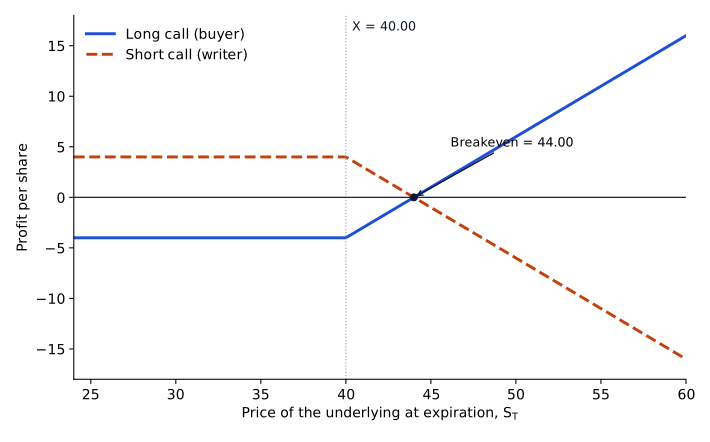
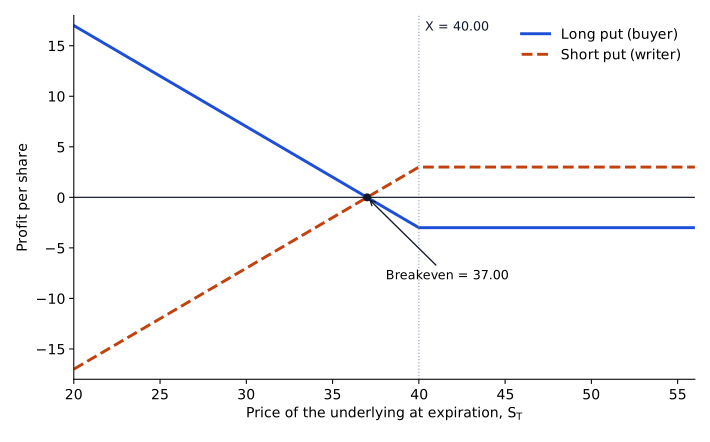
Example. A call and a put both have . The call premium is $4 and the put premium is $3.
| Long call | Short call | Long put | Short put | |
|---|---|---|---|---|
| $47 | ||||
| $34 |
Options are a zero-sum game: the writer's profit is always the buyer's loss, and vice versa. The call holder exercises whenever , even if the premium is not fully recovered, because exercising reduces the loss.
LOS 71.c — Forward commitments versus contingent claims
- A forward commitment is a legally binding promise to perform an action in the future (buy, sell, or exchange payments). Forwards, futures and most swaps are forward commitments. The underlying can be an asset, an index, a portfolio or a rate.
- A contingent claim is a claim whose payoff is contingent on whether a particular event happens. Options fall into this category (the event being the underlying finishing above or below the strike), and so do credit default swaps (the event being a credit event).
Key concept
| Forward commitment | Contingent claim | |
|---|---|---|
| Obligation | Both parties obligated | Holder has a right; writer is obligated if exercised |
| Cost at initiation | Usually zero value | Buyer pays a premium |
| Payoff profile | Linear (symmetric) | One-sided (asymmetric) |
| Examples | Forwards, futures, interest rate swaps | Calls, puts, credit default swaps |
Common exam traps
- A put holder has the right to sell; a put writer has the obligation to buy. A call holder has the right to buy and never an obligation.
- A CDS is called a swap, but it is a contingent claim.
- An option is a contingent claim whatever its underlying. An option on a futures contract is a contingent claim even though the futures contract itself is a forward commitment.
- Profit is value minus premium. When a question asks only for the value at expiration, the premium is not subtracted. At in the example, the call's value at expiration is $7; the $3 figure, after the $4 premium, is its profit.
- The breakeven for both call parties is ; for both put parties it is .
- Exposure follows the direction that profits, not the option type. A short call has short exposure and a short put has long exposure.
Exam shortcuts
- Both sides of a call break even at and both sides of a put at , so the writer's breakeven needs no separate calculation.
Bottom line
- In a plain fixed-for-floating interest rate swap, the fixed and floating amounts on the same notional principal are netted and only the party that owes more pays; each floating rate is set at the start of its period and paid at the end.
- An interest rate swap works like a set of forwards on the floating rate, one for each settlement date with the fixed rate as the forward price, and the swap rate is chosen to give the swap zero value when it starts.
- In a credit default swap, the protection buyer makes fixed periodic payments and the protection seller pays only if a credit event occurs, covering the drop in the reference security's value.
- and ; the buyer's profit is the value at expiration minus the premium paid, and the writer's profit is the reverse.
- A long call and a short put have long exposure to the underlying, while a long put and a short call have short exposure.
- A forward commitment (forwards, futures, most swaps) obligates both parties and has a linear payoff, while a contingent claim (options, credit default swaps) gives the holder a right, costs the buyer a premium and has a one-sided payoff.
Quick check
Bergen Pension Fund owns bonds issued by Holloway Freight. It enters a credit default swap as the buyer of credit protection on those bonds. Under the swap, the fund:
Show answer and explanation
Correct answer: C
In a credit default swap the protection buyer makes a series of fixed periodic payments to the protection seller. In return, the seller pays an amount that offsets the loss in value if the reference bond suffers a credit event such as default. The fund is effectively buying insurance on its Holloway bonds.
Why the other options are wrong
- A. A note funded by cash flows from an underlying bond is not a CDS. The CDS protection buyer issues nothing; it pays periodic premiums and receives a payment only after a credit event.
- B. Exchanging the bond's total return for a fixed or floating rate describes a different credit derivative. In a CDS the buyer pays fixed periodic premiums and receives a payment only after a credit event.
Key takeaway CDS: protection buyer pays periodic premiums; protection seller pays only if a credit event occurs.
Practice Questions
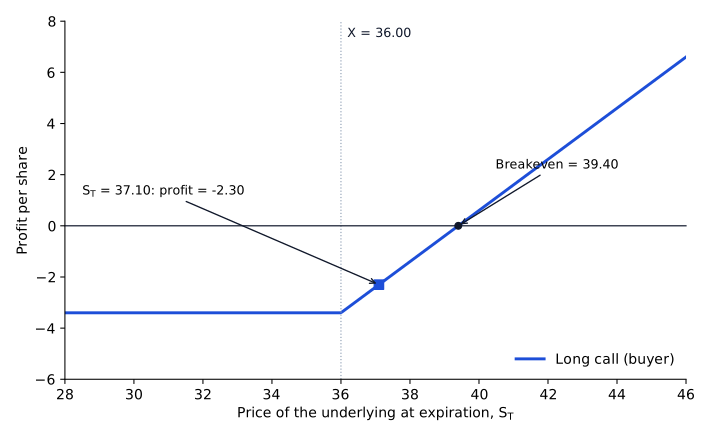
Tobias Grant buys a call option on Wexford Bio shares with an exercise price of $36.00 for a premium of $3.40, when the shares trade at $38.90. At expiration the shares are priced at $37.10. Grant's net profit or loss on the call is closest to:
Show answer and explanation
Correct answer: B
At expiration the call is in the money by $1.10, so Grant exercises it and recovers part of the premium. His net result is the exercise value minus the $3.40 premium, a loss of $2.30. The share price when he bought the call ($38.90) does not affect the result.
Breakeven ; the share price of $37.10 is below it, so there is a loss.
Why the other options are wrong
- A. A loss of the full $3.40 premium would occur only if the call expired out of the money. Here , so exercising recovers $1.10.
- C. +$2.30 has the sign reversed: the $1.10 exercise value is smaller than the $3.40 premium paid, so the position loses money.
Key takeaway Exercise whenever . Even below breakeven, exercising reduces the loss.
A trainee lists features of forward commitments. Which item on her list is least accurate?
Show answer and explanation
Correct answer: C
Forward commitments legally bind both parties to carry out a specified action at a future date, so neither side can simply walk away. The underlying can be an individual asset, a stock index, a portfolio or a rate.
Why the other options are wrong
- A. Accurate. Forward commitments can be written on a stock index or a portfolio as well as on single assets.
- B. Accurate. Both parties are legally bound to perform, which is what separates a forward commitment from a contingent claim.
Key takeaway A forward commitment binds both sides. Only the holder of a contingent claim, such as an option, has the right to walk away.
This reading has 31 questions in the full bank. Practice all of them.
Key Takeaways
- After a futures margin call, the account is topped up to the initial margin whenever the balance drops below the maintenance margin.
- CDS: protection buyer pays periodic premiums; protection seller pays only if a credit event occurs.
- Exercise whenever . Even below breakeven, exercising reduces the loss.
- A forward commitment binds both sides. Only the holder of a contingent claim, such as an option, has the right to walk away.