Derivatives · Reading 70
Derivative Instrument and Derivative Market Features
CFA Level I · Derivatives · Reading 70 · about 27 min
What you'll learn
- LOS 70.a Define a derivative, identify its underlying, contract price, size and settlement date, and describe long/short exposure, cash vs physical settlement, and hedging vs speculation.
- LOS 70.b Describe derivative markets and contrast exchange-traded (standardized, centrally cleared) with OTC (customized, dealer) derivatives, including the central clearing mandate.
Module 70.1
Derivatives Markets
This reading defines derivatives, their basic features and their uses, and compares exchange-traded derivatives with those traded over the counter. A candidate must be able to compute the payoff of a forward to each side, distinguish hedging from speculation and deliverable from cash-settled contracts, and contrast exchange-traded and OTC markets, including the role of central clearing.
LOS 70.a — What a derivative is and its basic features
A derivative is a contract whose value comes from (is derived from) the value of something else at a specified future date. That something else is the underlying: most often a stock or bond price, a stock or bond index, or an interest rate, but also a currency, a commodity, credit, or even the weather, a cryptocurrency or longevity.
Every derivative contract spells out four basic features:
Key concept
| Feature | Meaning | Example (the forward below) |
|---|---|---|
| Underlying | Asset or variable that drives the contract's value | Shares of a listed company |
| Contract price (e.g., forward price) | Price at which the future trade will take place | $62 per share |
| Contract size | Quantity of the underlying covered | 300 shares |
| Settlement date (maturity date) | Date on which the exchange (or payment) occurs | Three months from today |
The forward price is normally chosen so that the contract is worth zero to both parties at initiation, and neither side pays anything to enter it.
Long and short exposure
- The buyer of a forward agrees to buy the underlying. She has long exposure and gains when the spot price at settlement is above the forward price.
- The seller agrees to deliver the underlying. He has short exposure and gains when the spot price at settlement is below the forward price.
- One side's gain equals the other side's loss (a zero-sum outcome before costs).
Key concept
Because neither side pays anything to enter the contract, this payoff is also each party's profit or loss on the forward.
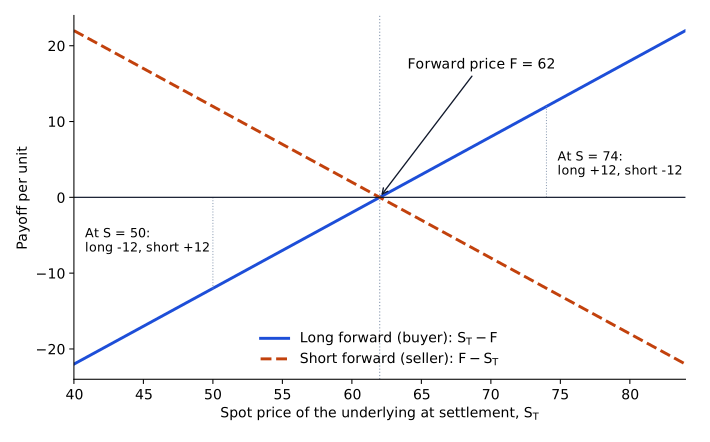
Example. A forward commits one party to buy 300 shares at $62 in three months.
- If the spot price at settlement is $74, the buyer pays for shares worth and gains . The seller loses .
- If the spot price at settlement is $50, the buyer loses and the seller gains the same amount.
Deliverable versus cash-settled
- A deliverable contract requires the underlying to be exchanged for the contract price at settlement.
- A cash-settled contract exchanges only the net gain or loss: the losing side pays to the winning side. With a settlement price of $50 in the example above, the buyer pays the seller in cash instead of paying for shares worth . Ignoring trading costs, the two methods are economically the same.
Hedging versus speculating
- Hedging: a party with an existing risk uses a derivative to offset it, fully or partially. A holder of shares who sells them forward locks in the sale price.
- Speculating: a party with no existing exposure takes one on through the derivative, which increases its risk.
- A useful rule for hedgers: take the derivative position now that matches the trade the party must make later in the cash market. A firm that will receive foreign currency will have to sell it, so it sells the currency forward. A firm that must pay foreign currency buys it forward.
Why use derivatives instead of a cash market trade?
- Exposure can be obtained with little cash, so the position is highly leveraged.
- Transaction costs can be much lower than for the equivalent cash trade.
- Entering the position may move the price of the underlying less than an equivalent cash trade would.
Underlyings and the main derivative types
A higher interest rate benefits the buyer of an interest rate forward but hurts the buyer of a bond forward, because bond prices fall when rates rise. Commodities may be hard (mined or extracted, such as gold and oil) or soft (grown, such as coffee and cattle). Currency forwards are quoted as price currency per unit of base currency: USD/EUR 1.10 means one euro costs 1.10 US dollars. The long side agrees to buy the base currency (here, euros) at the forward rate and pays the price currency; the short side sells the base currency.
The main derivative types are forwards, futures, options and swaps. A call option lets its buyer purchase the underlying on a later date at a price set today, with no obligation to do so; a put option gives its buyer the same kind of right to sell. In a plain interest rate swap, the two sides exchange periodic payments on the same notional amount: one pays a fixed rate, and the other pays a floating rate set from a market reference rate (MRR). The fixed-rate payer is in effect borrowing at a fixed rate to hold a floating-rate bond. In a credit default swap, one party makes fixed periodic payments, and the other pays only if the issuer of the underlying credit instrument defaults.
LOS 70.b — Derivative markets: exchange-traded versus OTC
Exchange-traded derivatives
Futures, some options and some other derivatives trade on organized exchanges; the largest by trading volume are the National Stock Exchange of India, B3 (Brazil) and CME Group (United States). The exchange writes standardized contracts (size, underlying, dates) and the rules of trading. Exchange members (market makers or dealers) mainly earn the bid–ask spread rather than speculating.
The central clearinghouse (CCH) steps in between the two traders and becomes the buyer to every seller and the seller to every buyer (novation). It therefore guarantees that each side's obligations will be performed. To back that guarantee, it collects deposits from both sides when a trade opens and further deposits when a position loses value, which keeps counterparty credit risk very low.
Standardization makes exchange contracts more liquid, more transparent and cheaper to trade, and it makes it easy to exit a position by taking an offsetting one. It also simplifies clearing (recording the trade and handling payments) and settlement (final delivery or payment at maturity).
Over-the-counter (OTC) dealer markets
Forwards, most swaps and some options are customized contracts that dealers create in a market with no central trading venue, the over-the-counter (OTC) market. Size, underlying, settlement date and delivery method can be tailored, and the trade can be kept private. Without a central clearinghouse, each side bears the other's counterparty credit risk. Dealers trade with end users and also with each other to lay off their exposure to price changes in the underlying.
Since 2008, a central clearing mandate has required many swaps to be cleared through a central counterparty (CCP). Trades reported on a swap execution facility (SEF) are replaced by two trades with the CCP. This lowers counterparty risk but concentrates it in the CCP.
Key concept
| Feature | Exchange-traded | OTC (no central clearing) |
|---|---|---|
| Terms | Standardized | Customized |
| Where traded | Centralized exchange, through members | Dealer network, no central location |
| Liquidity | Higher | Lower |
| Transparency | High; trades known to exchange and regulators | Lower |
| Regulation | Exchange rules; more regulated | Traditionally less regulated; post-2008 rules now cover many OTC derivatives |
| Counterparty risk | Minimal (CCH guarantee plus deposits) | Each side faces the other |
| Collateral deposits | Required from both sides (exchange/CCH margin) | No exchange-imposed margin; depends on the contract, the counterparties and regulation |
| Trading costs | Lower | Higher |
| Clearing and settlement | Simpler | More difficult |
OTC trades that fall under the central clearing mandate have lower counterparty risk and more disclosure, but they remain customizable dealer contracts.
Exam convention: exchange-traded derivatives are standardized, liquid, transparent and margined through the clearinghouse, while OTC derivatives are customized, less transparent, largely unregulated, not subject to collateral deposit requirements and carry more counterparty risk. Current practice: trading outside a CCP does not mean trading outside regulation or without collateral. Bilateral collateral is set by the contract and the counterparties, and for many covered counterparties uncleared-swap margin rules require both initial and variation margin.
Common exam traps
- A derivative's value depends on an underlying. Being a contract, or trading in a particular place, does not make an instrument a derivative.
- A forward has zero value at initiation, but the forward price is not zero.
- Selling forward is not automatically a hedge. The same trade hedges an existing exposure but is speculation for a party that has no such exposure.
- The clearinghouse does not hold an insurance policy or stabilize prices of the underlying. It guarantees performance by being the counterparty to both sides.
- Illiquidity, customized terms and bilateral counterparty risk describe OTC contracts outside central clearing. Exchange-traded futures and options are standardized, liquid and backed by the clearinghouse.
Exam shortcuts
- A hedger takes now the derivative position that matches the trade it must make later in the cash market: a party that will have to sell the underlying sells forward, and a party that will have to buy it buys forward.
Bottom line
- A derivative is a contract whose value is derived from an underlying, and every derivative specifies four features: its underlying, contract price, settlement date and contract size.
- The forward price is normally set so that the contract is worth zero to both parties at initiation; at settlement the long receives and the short receives , so one side's gain is the other's loss.
- A deliverable contract exchanges the underlying for the contract price, a cash-settled contract exchanges only the net gain or loss, and ignoring trading costs the two are economically the same.
- Hedging uses a derivative to offset an existing risk, while speculating takes on an exposure the party did not have, so the same trade can be a hedge for one party and speculation for another.
- Compared with a cash market trade, a derivative gives highly leveraged exposure for little cash, can cost much less to trade and may move the underlying's price less.
- For exchange-traded derivatives, the central clearinghouse becomes the buyer to every seller and the seller to every buyer (novation), guaranteeing performance and collecting deposits from both sides, which keeps counterparty credit risk very low.
- Exam convention: exchange-traded derivatives are standardized, liquid, transparent and margined through the clearinghouse, while OTC derivatives are customized, less transparent, largely unregulated, carry more counterparty risk and are not subject to collateral deposit requirements; current practice: an OTC trade outside a CCP still has collateral set by the contract and the counterparties, and for many covered counterparties uncleared-swap margin rules require initial and variation margin.
- Since 2008, a central clearing mandate has required many swaps to be cleared through a central counterparty, which lowers counterparty risk but concentrates it in the CCP.
Quick check
Harlow Capital agrees with a dealer to buy 200 shares of Pemberton Mills in three months at a forward price of $48.00 per share. The contract is cash settled. On the settlement date, Pemberton shares trade at $44.50. The settlement of the contract is:
Show answer and explanation
Correct answer: B
In a cash-settled forward only the gain or loss changes hands. Harlow, the buyer (long), agreed to pay $48.00 for shares now worth $44.50, so it has a loss and pays the difference to the dealer (the short).
The long (Harlow) has a $700 loss and pays it to the short (the dealer). Economically this equals delivery: Harlow would pay $9,600 for shares it could sell for .
Why the other options are wrong
- A. This reverses the direction. The buyer of a forward loses when the spot price at settlement is below the forward price, so the buyer pays the seller.
- C. $9,600 is the full forward price () that Harlow would pay in a deliverable contract in exchange for the shares. With cash settlement, only the net difference is paid.
Key takeaway Cash settlement transfers only size, from the losing side to the winning side.
Practice Questions
A client asks her adviser how exchange-traded derivatives differ from contracts arranged with dealers. Which of the adviser's statements about exchange-traded derivatives is least accurate?
Show answer and explanation
Correct answer: C
Exchange-traded derivatives use standardized contracts, which makes them liquid in most cases: a trader can exit easily by taking an offsetting position. Illiquidity is a characteristic of customized OTC contracts, so this statement is the inaccurate one.
Why the other options are wrong
- A. Accurate. Exchange-traded derivatives are backed by a central clearinghouse that guarantees performance.
- B. Accurate. They trade at a centralized location, the exchange, through exchange members (market makers).
Key takeaway Exchange-traded: standardized, liquid, transparent, cleared centrally. OTC: customized, less liquid, counterparty risk.
A portfolio manager is explaining to a trustee why an interest rate swap held by the fund is classified as a derivative. The defining feature she should point to is that the instrument's value:
Show answer and explanation
Correct answer: A
A derivative is a security whose value is derived from the value of something else, the underlying (another security, a commodity, an index, or a variable such as an interest rate). For an interest rate swap, the underlying is the market reference rate, so the swap's value depends on how that rate moves.
Why the other options are wrong
- B. Many contracts between two parties (a loan agreement, for example) are not derivatives. A derivatives contract does state the price at which a future transaction will (or may) take place, but being a contract does not by itself make an instrument a derivative.
- C. Where a contract trades does not decide whether it is a derivative. Futures and some options trade on organized exchanges and are still derivatives; forwards and most swaps trade OTC.
Key takeaway A derivative's value is derived from an underlying. Contract form and trading venue are features of derivatives but do not define them.
This reading has 7 questions in the full bank. Practice all of them.
Key Takeaways
- Cash settlement transfers only size, from the losing side to the winning side.
- Exchange-traded: standardized, liquid, transparent, cleared centrally. OTC: customized, less liquid, counterparty risk.
- A derivative's value is derived from an underlying. Contract form and trading venue are features of derivatives but do not define them.