Fixed Income · Reading 69
Mortgage-Backed Security (MBS) Instrument and Market Features
CFA Level I · Fixed Income · Reading 69 · about 33 min
What you'll learn
- LOS 69.a Define prepayment risk (contraction and extension risk) and describe how time tranching reallocates it.
- LOS 69.b Describe the features of residential mortgage loans that are securitized: prepayment penalties, recourse, LTV and DTI, agency vs non-agency RMBS.
- LOS 69.c Describe mortgage pass-through securities and CMOs (sequential pay, PAC and support, Z, IO/PO, floating-rate tranches) and their cash flows and risks.
- LOS 69.d Describe the characteristics and risks of commercial MBS, including DSCR, LTV, call protection and balloon risk.
Module 69.1
Mortgage-Backed Security (MBS) Instrument and Market Features
This reading covers mortgage-backed securities: prepayment risk, the features of residential mortgage loans, pass-throughs and CMOs, and commercial MBS. A candidate must be able to explain contraction and extension risk, compute LTV, DTI, WAC, WAM and DSCR, and describe how sequential pay, PAC, support, IO and PO tranches reallocate prepayment risk.
LOS 69.a — Prepayment risk and time tranching
Prepayments are principal repayments above the scheduled amortization of a mortgage, usually because borrowers sell their homes or refinance. MBS are priced on an assumed prepayment rate, and prepayment risk is the risk that actual prepayment speeds differ from that assumption. The average life of an MBS is the average time until its principal is received, weighted by the amount of principal paid at each date. Faster prepayments shorten it and slower prepayments lengthen it.
Example. A borrower's scheduled monthly payment is $1,500, of which $900 is interest and $600 is scheduled principal. If the borrower pays $2,300, the extra $800 is a prepayment, and the loan balance falls by $1,400 instead of $600.
Key concept
| Risk | What happens | Typical trigger | Why it hurts investors |
|---|---|---|---|
| Contraction risk | Prepayments faster than expected; cash arrives sooner, average life shortens | Interest rates fall (refinancing) | Principal must be reinvested at lower rates; MBS prices rise less than option-free bonds when rates fall (negative convexity, like a callable bond) |
| Extension risk | Prepayments slower than expected; average life lengthens | Interest rates rise | Cash flows are received later and discounted over more periods at a higher rate |
Time tranching creates bond classes with different maturities. It reallocates prepayment risk among them without removing it. Tranches that mature first offer more protection against extension risk; longer tranches offer more protection against contraction risk. Sequential pay tranching (LOS 69.c) is the standard example.
LOS 69.b — Features of residential mortgage loans
A residential mortgage loan is secured by residential real estate. The lender's legal claim on the property is a first lien: if the borrower defaults, the lender can take possession of the property and sell it, a process called foreclosure.
- A prepayment penalty is an extra payment by a borrower who prepays when rates have fallen. It reduces the lender's prepayment risk. Prepayment penalties are common in Europe and rare in the United States.
- With a recourse loan, the lender can also claim the borrower's other assets for any shortfall after foreclosure. With a nonrecourse loan, the lender can look only to the property. When a home is worth less than the loan (an underwater mortgage, or negative equity), a nonrecourse borrower has a stronger incentive to strategically default, walking away even though they could pay. Most mortgages in Europe are recourse loans. US rules differ from state to state, but most US loans are nonrecourse.
- The loan-to-value ratio (LTV) is the loan divided by the property value. A lower LTV means more borrower equity, which lowers default risk and raises recovery.
- The debt-to-income ratio (DTI) is monthly debt payments divided by monthly gross pretax income. A lower DTI means lower default risk.
Example. A $360,000 loan on a $450,000 home has an LTV of 80%. At 5.5% for 30 years with monthly payments, the payment is $2,044.04. On a financial calculator in END mode with P/Y = C/Y = 1: N = 360, I/Y = 5.5/12, PV = 360,000, FV = 0, CPT PMT = −2,044.04 (the loan received is positive, the payment negative). With gross income of $96,000 a year ($8,000 a month), DTI .
Prime loans are made to borrowers whose credit record is strong and whose LTV and DTI are both low. Subprime loans involve weaker credit, a higher DTI or LTV, or a lower-priority lien.
Agency RMBS (U.S.) are guaranteed by the government or by a government-sponsored enterprise (GSE). A GSE is legally separate from the government, so securities it guarantees carry only the GSE's own guarantee, not the full faith and credit of the government. The collateral must meet minimum underwriting standards. Non-agency RMBS are issued by private entities such as banks without these guarantees and rely on credit enhancement (insurance, letters of credit, tranching, private guarantees). They are widely blamed for helping to trigger the 2007–2009 financial crisis: senior tranches rated investment grade, backed by pools of subprime loans, took large losses when many of those loans defaulted. New issuance almost stopped in the years after the crisis as regulation tightened.
LOS 69.c — Mortgage pass-throughs and CMOs
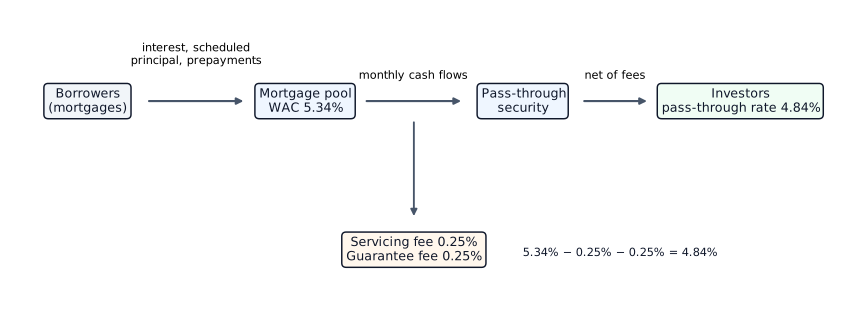
A mortgage pass-through security is a claim on the cash flows of a mortgage pool, net of fees.
- The weighted average maturity (WAM) and weighted average coupon (WAC) weight each mortgage's maturity or rate by its share of the pool's outstanding balance.
- Investors receive the pool's monthly cash flows minus servicing and guarantee or insurance fees, so the pass-through rate (net coupon) is below the WAC.
With the share of mortgage in the pool's outstanding balance:
Example. A pool holds balances of 150, 250 and 100 (total 500) at rates of 4.8%, 5.4% and 6.0%, with remaining terms of 18, 26 and 12 years.
Collateralized mortgage obligations (CMOs) are backed by pass-throughs and mortgage pools. They split the cash flows into tranches with different exposure to prepayment risk. The total prepayment risk of the collateral is unchanged; it is reallocated to suit investors with different concerns (some worry mainly about extension risk, others about contraction risk). This widens the market for securitized mortgages and may lower funding costs.
Key concept
| CMO structure | How it works / who it suits |
|---|---|
| Sequential pay | All principal (scheduled and prepaid) goes to the first ("short") tranche until it is retired, then to the next. This is the time tranching of LOS 69.a, so the short tranche suits investors most concerned about extension risk |
| Planned amortization class (PAC) | Makes scheduled payments as long as prepayments stay within a range, reducing both contraction and extension risk |
| Support tranche | Absorbs the variability: receives excess principal when prepayments are fast and has its principal payments curtailed when they are slow, so PAC schedules are met. Bears high prepayment risk. If speeds move outside the range, the protection breaks down |
| Z-tranche (accrual / accretion bond) | Receives no cash interest during an accrual period; interest is added to principal (e.g., $200 at 4% becomes $208). Typically the lowest-ranking tranche |
| Principal-only (PO) | Pays only principal (a zero-coupon-like security bought at a discount). Its return is the gap between the price paid and the principal received, so the sooner principal arrives, the higher the return: it benefits from falling rates and faster prepayments |
| Interest-only (IO) | Pays only interest on the principal still outstanding. Faster prepayments shrink that balance and so the total interest received: it is hurt by falling rates and faster prepayments |
| Floating-rate / inverse floater | Coupon tied to a market reference rate (often capped/floored); an inverse floater's coupon rises as rates fall |
| Residual | Most junior, like an ABS equity tranche |
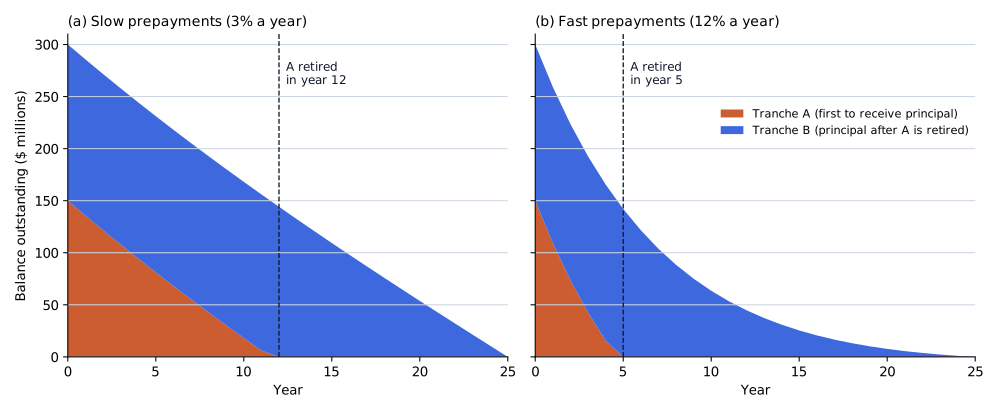
Example: sequential pay. A $300 million pool of 6%, 25-year mortgages backs Tranche A ($150 million) and Tranche B ($150 million). All principal, scheduled and prepaid, goes to A until A is retired. If 3% of the balance is prepaid each year, A is paid off in year 12. If 12% is prepaid each year, A is paid off in year 5, and B starts receiving principal seven years earlier. Fast prepayments shorten A's life sharply (contraction risk), and slow prepayments leave B waiting much longer for its principal (extension risk). Tranche A has the shorter expected average life, so it suits investors who prefer shorter-term securities.
Example: PAC and support. A PAC tranche is scheduled to receive $20 million of principal this year, and the support tranche has $40 million outstanding. The PAC schedule therefore holds as long as the pool's principal for the year is between $20 million and $60 million.
| Pool principal this year | PAC tranche receives | Support tranche receives |
|---|---|---|
| $24 million (slow) | $20 million | $4 million |
| $40 million (as expected) | $20 million | $20 million |
| $58 million (fast) | $20 million | $38 million |
| $15 million (below the range) | $15 million, $5 million short of schedule | $0 |
Inside the range the support tranche takes all the variation. In the last row it has nothing left to give up, so the PAC tranche falls short. Above $60 million the support tranche would be paid off, and the excess principal would go to the PAC tranche ahead of schedule.
LOS 69.d — Commercial mortgage-backed securities
CMBS are backed by mortgages on income-producing property (multifamily, industrial, retail, office, health care, hotels). Pools contain fewer loans than RMBS pools, sometimes just one, so diversification is lower. A pool may hold loans from one lender or several loans to one borrower. In an RMBS pool of thousands of small, similar home loans, one default barely affects investors; in a CMBS pool, the default of a single large loan can. U.S. CMBS coupons are typically fixed; European CMBS usually float. The loans are repaid by property investors who depend on tenants' rents, and the pool's regular income, the weighted average proceeds from the mortgages (WAMP), plays the role the WAC plays for RMBS. Commercial mortgages are nonrecourse loans, so the lender's recovery depends on the property and its income. Analysis therefore focuses on the credit risk of the property rather than that of the borrower. CMBS are tranched so that credit losses are absorbed by the lowest-priority tranches first, in sequence.
Key concept
Net operating income (NOI) is rental income minus cash operating expenses and a replacement reserve. A higher debt service coverage ratio (DSCR) and a lower LTV indicate better credit quality. For example, NOI of $1.3 million and debt service of $1.0 million give a DSCR of ; a $12 million loan on a $16 million property has an LTV of 75%.
Call protection (protection against prepayment) is a key difference from RMBS:
- At the loan level: a prepayment lockout (typically 2–5 years), prepayment penalty points (1 point = 1% of the principal prepaid), and defeasance (the borrower buys government securities that replicate the remaining loan payments, freeing the property from the lien).
- At the structure level: sequential pay tranching of the pool.
Balloon payments. Commercial loans are usually not fully amortizing, which leaves a balloon payment at maturity. If the borrower cannot refinance it, the lender may extend the loan in a workout, so balloon risk is a form of extension risk.
Common exam traps
- Contraction and extension describe the average life, not the stated maturity: contraction comes with falling rates and faster prepayments, extension with rising rates and slower prepayments.
- Residential mortgages in agency RMBS pools can usually be prepaid freely; CMBS loans typically carry call protection.
- A support tranche's high risk is prepayment risk in both directions, not credit risk; with agency collateral its credit risk is low.
- Prepayment speed changes the timing of cash flows, not the net coupon; the gap between the WAC and the pass-through rate comes from fees.
Bottom line
- Contraction risk is the risk that prepayments run faster than expected, typically when rates fall, which shortens the average life and forces reinvestment at lower rates; extension risk is the risk that they run slower, typically when rates rise, which lengthens it.
- Time tranching reallocates prepayment risk among bond classes without removing it, and the tranches that mature first give more protection against extension risk.
- A lower loan-to-value ratio and a lower debt-to-income ratio mean lower default risk, and a borrower with an underwater nonrecourse loan has a stronger incentive to default strategically.
- A GSE is legally separate from the government, so agency RMBS it guarantees carry only the GSE's own guarantee, while non-agency RMBS rely on credit enhancement.
- A pass-through's net coupon is below the pool's weighted average coupon because servicing and guarantee or insurance fees are deducted, and the WAC and WAM weight each mortgage by its share of the outstanding balance.
- A PAC tranche makes its scheduled payments as long as prepayments stay within a range, which reduces both contraction and extension risk, while the support tranche absorbs the variation and bears high prepayment risk.
- A principal-only security benefits from falling rates and faster prepayments, while an interest-only security is hurt by them.
- Commercial mortgages are nonrecourse, so CMBS analysis focuses on the property: a higher and a lower LTV indicate better credit quality, call protection is common, and balloon risk is a form of extension risk.
Quick check
A sequential-pay CMO has two tranches. Class J receives all principal payments until it is fully repaid, and principal then goes to Class K. Relative to Class K, Class J has:
Show answer and explanation
Correct answer: C
In a sequential-pay structure the first tranche receives all scheduled principal and prepayments first. If prepayments speed up, it is repaid sooner (more contraction risk); if they slow, it is still first in line, so it is well protected against extension, which falls mainly on the later tranche.
Why the other options are wrong
- A. This is the profile of the later tranche (Class K), which waits longest for principal.
- B. Time tranching reallocates prepayment risk: the short tranche gains extension protection in exchange for bearing more contraction risk, so it cannot have more of both.
Key takeaway First-pay tranche: contraction risk. Last-pay tranche: extension risk.
Practice Questions
The Linwell pass-through security is backed by the three mortgages shown below. Servicing and guarantee fees total 0.50% a year.
| Mortgage | Current balance ($ thousands) | Mortgage rate | Remaining term (years) |
|---|---|---|---|
| 1 | 120 | 5.00% | 22 |
| 2 | 80 | 6.50% | 15 |
| 3 | 200 | 5.75% | 27 |
The pass-through rate on the security is closest to:
Show answer and explanation
Correct answer: A
The pool's weighted average coupon (WAC) weights each mortgage rate by its share of the pool's outstanding balance. Investors receive the pool's interest net of servicing and guarantee fees, so the pass-through rate is the WAC minus the fees.
Total balance .
The remaining terms are not needed here. They would be used for the WAM, years.
Why the other options are wrong
- B. 5.25% subtracts the fees from a simple average of the three rates (5.75%) instead of the balance-weighted WAC.
- C. 5.68% is the WAC itself; it omits the 0.50% of fees deducted before investors are paid.
Key takeaway Weight by current balance, then deduct fees. The pass-through rate is always below the WAC when fees are charged.
When comparing the loans backing different CMBS pools, which combination of credit ratios most likely indicates better credit quality?
Show answer and explanation
Correct answer: A
A higher debt service coverage ratio means the property's net operating income covers the required interest and principal by a wider margin. A lower loan-to-value ratio means the loan is smaller relative to the property's value, so the borrower has more equity and the lender recovers more in a default. Both indicate better credit quality.
Why the other options are wrong
- B. Both ratios point to weaker credit: thinner income coverage and more leverage.
- C. The higher DSC ratio is favorable, but a higher LTV ratio signals more leverage and higher default risk.
Key takeaway A higher DSCR and a lower LTV indicate stronger CMBS credit.
This reading has 16 questions in the full bank. Practice all of them.
Key Takeaways
- First-pay tranche: contraction risk. Last-pay tranche: extension risk.
- Weight by current balance, then deduct fees. The pass-through rate is always below the WAC when fees are charged.
- A higher DSCR and a lower LTV indicate stronger CMBS credit.