Fixed Income · Reading 68
Asset-Backed Security (ABS) Instrument and Market Features
CFA Level I · Fixed Income · Reading 68 · about 26 min
What you'll learn
- LOS 68.a Describe the characteristics and risks of covered bonds (including hard-bullet, soft-bullet and conditional pass-through) and how they differ from other ABS.
- LOS 68.b Describe internal credit enhancement structures: overcollateralization, excess spread and subordination (credit tranching).
- LOS 68.c Describe the cash flows and risks of non-mortgage ABS, such as credit card ABS and solar ABS.
- LOS 68.d Describe collateralized debt obligations (CBOs, CLOs), their collateral manager, cash flows and risks.
Module 68.1
Asset-Backed Security (ABS) Instrument and Market Features
This reading compares covered bonds with other asset-backed securities, explains the internal credit enhancements that protect ABS investors, and describes non-mortgage ABS and collateralized debt obligations. A candidate must be able to contrast covered bonds with typical ABS, allocate collateral losses through a tranche waterfall, and describe credit card ABS, solar ABS and CLOs.
LOS 68.a — Covered bonds versus other ABS
Covered bonds are senior debt obligations of financial institutions (mainly European, Asian and Australian banks) backed by a segregated pool of assets, the cover pool, which usually consists of mortgages. No SPE is created, so the cover pool stays on the issuer's balance sheet. Because the bond is the bank's own debt, in the normal course the bank pays interest and principal from its general resources, and the cover pool is security that bondholders can turn to if the bank defaults.
Key concept
| Feature | Covered bond | Typical ABS |
|---|---|---|
| Where the assets sit | On the issuer's balance sheet (segregated) | Sold to a bankruptcy-remote SPE |
| Investor recourse | Dual recourse: the cover pool and the issuer's other unencumbered assets | The collateral pool only |
| Asset pool | Dynamic: the issuer must replace or add to nonperforming or prepaid assets so the pool keeps supporting the promised payments | Fixed at issuance |
| Credit tranching | Typically none | Common |
| Issuer's capital relief | None (assets stay on balance sheet) | Yes |
| Yield | Generally lower than comparable ABS (higher credit quality) | Higher |
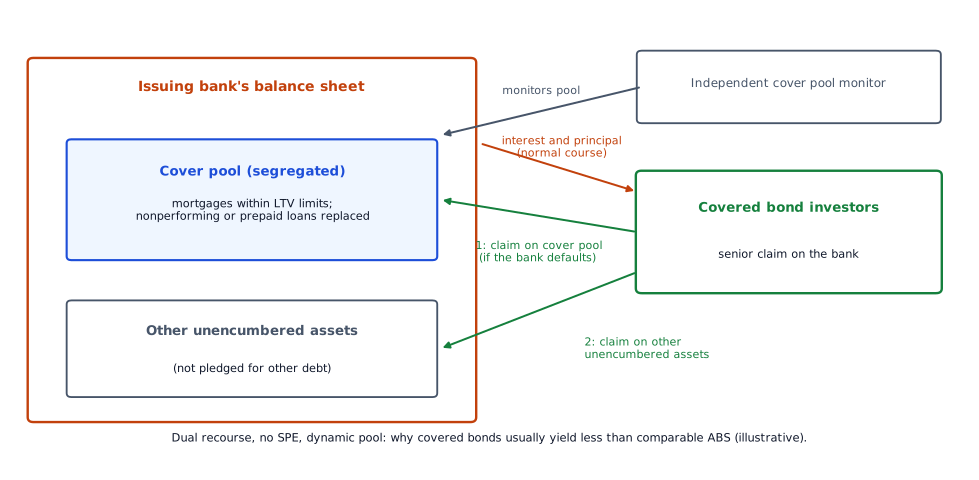
Covered bond investors have further protection from loan-to-value limits on the mortgages in the pool, from overcollateralization (pool value above the bonds outstanding), and from monitoring of the pool by a third party.
If the issuer misses a payment, the outcome depends on the bond's terms:
Key concept
| Type | Treatment |
|---|---|
| Hard-bullet covered bond | In default as soon as a scheduled payment is missed; payments to bondholders are accelerated |
| Soft-bullet covered bond | The original maturity can be postponed by as much as a year, delaying default and acceleration |
| Conditional pass-through covered bond | Converts to a pass-through bond at maturity if payments remain due; later recoveries from the cover pool are passed through to investors |
LOS 68.b — Internal credit enhancement
Internal credit enhancements are features built into the ABS structure to absorb defaults in the collateral pool.
Key concept
- Overcollateralization: the collateral value exceeds the ABS face value. For example, if collateral of $250 million backs ABS of $225 million, the $25 million excess can absorb losses of of the collateral value before any ABS investor loses money.
- Excess spread: the collateral earns more interest than the ABS coupons require, and the surplus builds a reserve that absorbs losses.
- Subordination (credit tranching): the ABS is split into tranches with different priority. Junior tranches absorb losses first, up to their principal, which protects the senior tranches. The larger the subordinated share, the greater the protection for the senior tranche.
This loss-absorption order is a waterfall structure: each junior tranche receives only what is left after the more senior tranches are paid. The lowest-ranking tranche has a residual claim and is often called the equity tranche. Credit tranching and the bankruptcy-remote SPE together can allow senior tranches to be rated above the originator.
Example. A deal backed by $200 million of collateral has a senior tranche of $160 million, a subordinated tranche of $30 million and an equity tranche of $10 million. Collateral losses are $18 million. The equity tranche absorbs the first $10 million and is wiped out. The subordinated tranche absorbs the other $8 million, so its face value falls from $30 million to $22 million. A subordinated tranche investor's coupon is paid on the reduced face value, so it falls to of its previous amount. The senior tranche loses nothing.
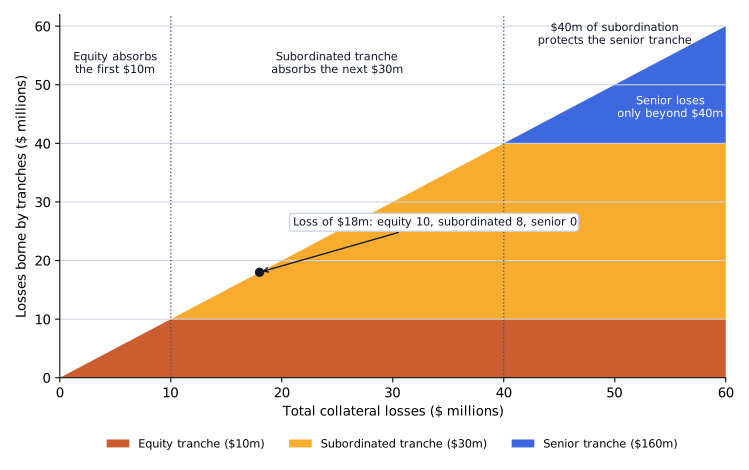
The figure extends the example to any level of collateral losses: the senior tranche is hit only once losses exceed the $40 million of subordination, which is 20% of the $200 million collateral.
Credit tranching redistributes default risk. Time tranching, covered with MBS, redistributes prepayment risk.
LOS 68.c — Non-mortgage ABS
Any asset that generates future cash flows can be securitized: business loans, accounts receivable and auto loans, and even music royalties or franchise license payments. A key distinction is whether the loans are amortizing (scheduled principal paydown) or nonamortizing (no schedule).
Credit card ABS
- Backed by credit card receivables of banks, retailers and others. The collateral is nonamortizing, though cardholders may repay principal at will.
- Cash flows consist of finance charges (interest), fees (membership, late payment) and principal. Rates may be fixed or floating and are typically subject to a cap.
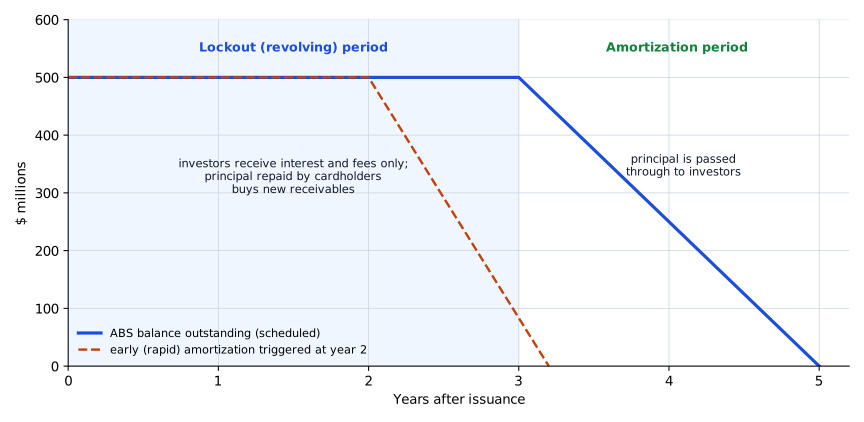
- During the lockout period (revolving period), investors receive only interest and fees. Principal repaid by cardholders buys new receivables, which keeps the pool size stable, so investors face no prepayment risk during this period.
- After the lockout, the amortization period passes principal through to investors. An early (rapid) amortization provision accelerates principal repayment if needed to protect credit quality.
Solar ABS
- Backed by loans to homeowners to install solar energy systems, made by specialist finance companies or the finance arms of solar energy companies. The asset class draws investors who weigh environmental, social and governance (ESG) factors.
- The loans are secured on the system itself or on the home as a junior mortgage. Borrowers usually have good credit and save on energy bills, so credit risk is thought to be low, although the asset class has not yet been tested through a full credit cycle.
- Internal credit enhancement is common. Many deals have a pre-funding period during which the trust invests newly raised funds in additional solar loans, building a larger, more diversified pool.
LOS 68.d — Collateralized debt obligations
A collateralized debt obligation (CDO) is a structured security that an SPE issues against a pool of debt obligations.
| Type | Collateral |
|---|---|
| Collateralized bond obligation (CBO) | Corporate and emerging market debt |
| Collateralized loan obligation (CLO) | Leveraged loans: senior secured bank loans to companies with high existing debt or a poor credit history |
A CDO differs from ordinary ABS in having a collateral manager, who actively buys and sells securities in the pool to generate the cash needed to pay investors. Ordinary ABS rely on a static pool. CDOs are tranched like ABS, and the structure must still offer an attractive return to the equity tranche after paying the senior tranches.
Example. A CLO buys $400 million of leveraged loans yielding 8% and funds them with $360 million of debt tranches at an average cost of 5.5% plus a $40 million equity tranche. Collateral income is million and interest on the debt tranches is million, which leaves $12.2 million, a 30.5% return on the equity before fees. If defaults cost $6 million in a year, the residual falls to $6.2 million and the equity return roughly halves to 15.5%, while the debt tranches are still paid in full. The equity tranche earns the gap between the collateral yield and the cost of the debt tranches, magnified by leverage, and it absorbs the first losses.
Since the 2007–2009 crisis, CDOs have become simpler, requirements for collateral quality have become more stringent, and most are now backed by leveraged loans, so the CLO is the most common form.
| CLO type | How investors are paid |
|---|---|
| Cash flow CLO | From the cash flows of the underlying collateral |
| Market value CLO | From trading the collateral at market value |
| Synthetic CLO | Exposure is created with credit derivative contracts; the trust does not own the collateral |
CLO collateral is subject to protective tests: coverage of payments to investors by collateral cash flows; overcollateralization limits for each tranche (a breach diverts cash to buy more collateral or to repay the most senior tranche); diversification; and limits on CCC rated holdings.
Common exam traps
- A covered bond differs from a typical ABS on three points that are easy to reverse: it gives recourse to the issuer, uses no SPE, and has a dynamic rather than fixed pool. It usually yields less.
- A hard bullet means immediate default; a soft bullet allows a maturity extension of up to a year.
- The lockout period belongs to credit card ABS; the pre-funding period belongs to solar ABS.
- The collateral manager distinguishes a CDO. Tranching and the use of an SPE are common to ABS in general.
Exam shortcuts
- Under subordination, the senior tranche loses nothing until collateral losses exceed the total of the tranches ranked below it, so smaller losses need only be allocated among the junior tranches.
Bottom line
- Covered bonds are senior debt of financial institutions backed by a segregated cover pool, usually mortgages, that stays on the issuer's balance sheet because no SPE is created.
- Covered bond investors have dual recourse to the cover pool and to the issuer's unencumbered assets, the cover pool is dynamic, and covered bonds generally yield less than comparable ABS.
- When an issuer misses a payment, a hard-bullet covered bond defaults at once and payments are accelerated, a soft-bullet one lets the maturity slip by up to a year, and a conditional pass-through one becomes a pass-through security at maturity if payments are still owed.
- Internal credit enhancements are overcollateralization, excess spread and subordination, under which junior tranches absorb losses first, up to their principal, to protect the senior tranches.
- Credit tranching redistributes default risk, while time tranching redistributes prepayment risk.
- Credit card ABS are backed by nonamortizing receivables; during the lockout (revolving) period investors receive only interest and fees, and principal repaid by cardholders buys new receivables.
- Solar ABS are backed by loans to homeowners to install solar energy systems, and many deals have a pre-funding period in which the trust adds new solar loans to the pool.
- A CDO differs from ordinary ABS by having a collateral manager who actively buys and sells securities in the pool, and the CLO, backed by leveraged loans, is now its most common form.
Quick check
Compared with otherwise similar asset-backed securities, covered bonds issued by Eskdale Bank most likely offer investors:
Show answer and explanation
Correct answer: A
Covered bondholders have dual recourse: a claim on the cover pool and a claim on the issuing bank's other unencumbered assets. Ordinary ABS investors can look only to the collateral held by the SPE. The extra recourse, together with overcollateralization and loan-to-value limits, gives covered bonds higher credit quality and lower yields than comparable ABS.
Why the other options are wrong
- B. Because covered bonds are safer, investors accept lower yields than on comparable ABS.
- C. Dual recourse and a dynamic, overcollateralized cover pool give covered bonds higher credit quality than comparable ABS.
Key takeaway A covered bond has dual recourse, no SPE and a dynamic cover pool, which give it higher credit quality and a lower yield than comparable ABS.
Practice Questions
Halden Card Trust issued asset-backed securities backed by credit card receivables, and the securities are still in their lockout period. Which event would most likely cause the ABS holders to start receiving principal payments ahead of schedule?
Show answer and explanation
Correct answer: B
During the lockout (revolving) period, ABS holders receive only interest and fees, and principal repaid by cardholders is used to buy new receivables so that the pool stays about the same size. An early (rapid) amortization provision ends this reinvestment and passes principal to investors sooner when that is needed to protect the credit quality of the securities, much like the acceleration of a loan when credit conditions worsen.
Why the other options are wrong
- A. Principal that cardholders repay during the lockout period is reinvested in new receivables, so faster repayment does not reach the ABS holders as principal. For the same reason, investors bear no prepayment risk during this period.
- C. A cap on the card rate limits the interest earned on the receivables. It can affect the interest available to investors, but it does not change when principal is repaid.
Key takeaway Credit card ABS: in the lockout (revolving) period investors get interest and fees only and principal is recycled into new receivables; in the amortization period principal is passed through; an early (rapid) amortization provision brings principal forward to protect credit quality.
Which feature most clearly distinguishes a collateralized debt obligation (CDO) from most other asset-backed securities?
Show answer and explanation
Correct answer: B
Ordinary ABS rely on the cash flows from a static collateral pool. In a CDO, a collateral manager actively trades the pool's holdings to raise the cash required for the payments promised to CDO investors.
Why the other options are wrong
- A. Most ABS are also issued through a special purpose vehicle (SPV), so this does not distinguish a CDO.
- C. Senior/subordinated tranching is common to many ABS structures as well as CDOs.
Key takeaway The collateral manager is the defining feature of a CDO.
This reading has 17 questions in the full bank. Practice all of them.
Key Takeaways
- A covered bond has dual recourse, no SPE and a dynamic cover pool, which give it higher credit quality and a lower yield than comparable ABS.
- Credit card ABS: in the lockout (revolving) period investors get interest and fees only and principal is recycled into new receivables; in the amortization period principal is passed through; an early (rapid) amortization provision brings principal forward to protect credit quality.
- The collateral manager is the defining feature of a CDO.