Fixed Income · Reading 67
Fixed-Income Securitization
CFA Level I · Fixed Income · Reading 67 · about 17 min
What you'll learn
- LOS 67.a Explain the benefits of securitization for originators, investors, economies and financial markets, and the risks to ABS investors.
- LOS 67.b Describe the securitization process and the roles of the seller, SPE (issuer/trust), servicer and trustee.
Module 67.1
Fixed-Income Securitization
This reading explains how securitization turns pools of loans into asset-backed securities and who takes part in the process. A candidate must be able to describe the benefits of securitization to originators, investors and the wider economy, and explain the roles of the seller, the SPE, the servicer and the trustee and why the SPE is bankruptcy remote.
LOS 67.a — Benefits of securitization
Key concept
Securitization turns a pool of loans or receivables into tradable securities:
- An originator (a bank making loans, or a company extending credit to customers) builds a pool of debt-based assets.
- It sells the pool, called the collateral, to a separate legal entity, the special purpose entity (SPE).
- The SPE issues asset-backed securities (ABS) whose payments come from the borrowers' loan repayments, and sells them to investors such as pension and fixed-income funds.
Securitization links investors directly with the borrowers in the pool and takes the originator out of the intermediation chain.
The word "issuer" is used in two ways. In lists of the benefits of securitization, "issuers" are the originators. The legal issuer of the ABS is the SPE.
Key concept
| Who benefits | Benefit |
|---|---|
| Originators (issuers) | Increased business activity: sale proceeds are re-lent, so a bank can lend more than its own balance sheet would allow |
| Improved profitability: fees for originating the loans and for selling them to the SPE | |
| Lower capital reserves: selling the loans removes their credit risk from the bank's balance sheet, so regulators require less capital | |
| Improved liquidity: illiquid loan portfolios can be sold | |
| Investors | Tailored risk and return to match their needs (e.g., long-horizon investors in long mortgage pools) |
| Access to loan pools without the expertise to originate and service loans | |
| Liquidity: ABS are easier to sell than the underlying loans | |
| Economies and financial markets | Decreased liquidity risk and improved market efficiency (tradable ABS allow equilibrium prices) |
| Lower financing costs for originators than issuing their own debt or equity | |
| Lower leverage for originators, which can grow without adding debt to their balance sheets |
Risks to ABS investors. Cash flows are uncertain in timing and size; for example, borrowers may prepay at an unexpected rate. The credit risk of the collateral also passes through to ABS investors, who bear defaults in the pool. A system-wide buildup of this risk contributed to the 2007–2009 financial crisis.
LOS 67.b — The securitization process and its parties
Example. Harbor Home Appliances sells washing machines on installment credit. It bundles 20,000 installment contracts worth $80 million and sells them for $80 million to Harbor Receivables Trust, an SPE created solely to buy the contracts and issue ABS. Harbor keeps collecting the monthly payments through a finance subsidiary.
Key concept
| Party | Role in the example |
|---|---|
| Seller / depositor (originator) | Harbor Home Appliances creates the loans and sells the pool to the SPE; it is the firm raising funds through the securitization |
| Issuer / trust (SPE, also special purpose vehicle (SPV) or special purpose company) | Harbor Receivables Trust buys the loans and issues ABS to investors |
| Servicer | Harbor's finance subsidiary collects payments, sends delinquency notices, and repossesses and sells collateral when borrowers default |
| Trustee | An independent (disinterested) party that safeguards the collateral and cash flows due to ABS holders and reports to them |
The seller and servicer are often, but not always, the same company. The figure traces the flows in the example.
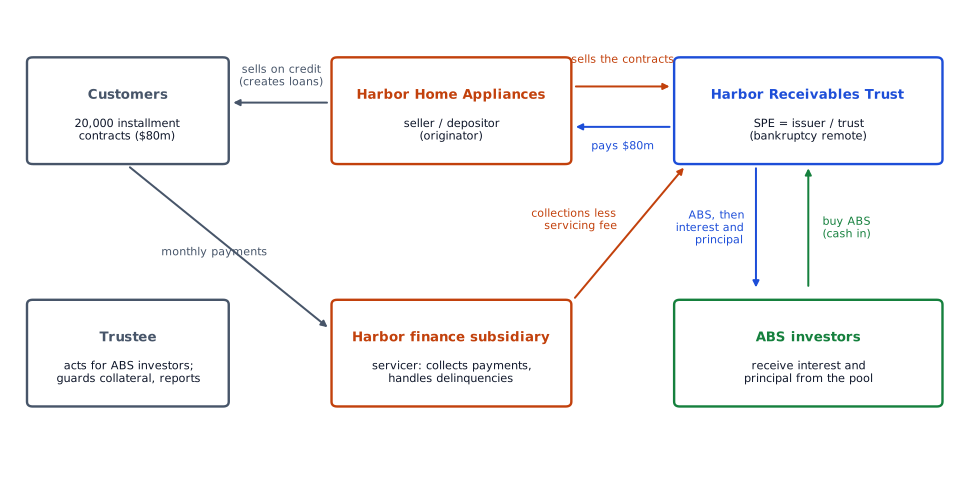
Flow of cash. Collections of principal and interest on the pool first pay the servicing fee and other administrative fees. The rest goes to ABS investors as interest and principal, so investors receive less than the total payments collected from the pool.
Bankruptcy remote. The SPE is a separate legal entity that owns the collateral outright, so the assets are legally isolated from the seller. A decline in the seller's finances, even its bankruptcy, does not affect the ABS holders' claim on the collateral, and the seller's creditors cannot reach the pool. The SPE is therefore bankruptcy remote. In return, ABS holders have no claim on the seller's other assets. This separation can allow senior ABS to carry a higher credit rating than the seller's own corporate bonds, whose holders are exposed to all of the seller's risks.
Key documents. Besides the indenture and covenants, a securitization relies on the purchase agreement (the terms on which the SPE buys the collateral) and the prospectus (fees paid to servicers and administrators, and how collateral cash flows are distributed to ABS investors).
Common exam traps
- Removing liabilities from the balance sheet is not a benefit of securitization. Only assets (loans, receivables) are sold; deposits and bonds stay with the originator.
- Securitization does not make loans more collectible or protect investors from defaults in the pool. Credit enhancement may reduce that risk but does not eliminate it.
- The SPE's independence from the seller is legal: it is a separate legal entity that has bought the collateral outright. An SPE sponsored or even owned by the seller can still be bankruptcy remote if the structure isolates the assets; being a subsidiary or a joint venture is not what the requirement asks for.
- ABS do not rank "senior" to the seller's bonds in the seller's bankruptcy. They sit outside it, and their higher rating comes from the SPE structure and any credit enhancement.
- The servicer collects from borrowers; the trustee protects investors' interests.
Bottom line
- In a securitization, an originator sells a pool of loans or receivables, the collateral, to a special purpose entity, which issues asset-backed securities paid from the borrowers' loan repayments.
- Securitization lets originators increase business activity, earn fees, hold lower capital reserves and turn illiquid loan portfolios into cash.
- Investors gain risk and return tailored to their needs, access to loan pools without the expertise to originate and service loans, and securities that are easier to sell than the underlying loans.
- For economies and financial markets, securitization decreases liquidity risk, improves market efficiency and gives originators lower financing costs and lower leverage.
- ABS investors bear uncertainty in the timing and size of cash flows, for example from unexpected prepayments, and the credit risk of the collateral passes through to them.
- The seller (depositor) originates and sells the loans, the SPE (issuer or trust) buys them and issues the ABS, the servicer collects from borrowers, and the trustee safeguards the collateral and cash flows for ABS holders.
- The SPE owns the collateral outright as a legally separate entity, which makes it bankruptcy remote: the seller's creditors cannot reach the pool, and ABS holders have no claim on the seller's other assets.
- Collections from the pool pay the servicing fee and other administrative fees first, so ABS investors receive less than the total payments collected.
Quick check
Kestrel Savings Bank funds its mortgage lending mainly with customer deposits. It sells $400 million of its mortgages to a special purpose entity, which pays for them with the proceeds of an ABS issue. As a direct result of the sale, which item on Kestrel's balance sheet is least likely to change?
Show answer and explanation
Correct answer: B
Securitization sells financial assets, not liabilities. Kestrel gives up $400 million of mortgage loans and receives $400 million of cash, so both of these asset lines change. The deposits that funded the loans stay on the balance sheet, because the SPE buys the loans and takes on none of the bank's obligations to its depositors. The bank benefits from the cash it can re-lend and from the lower capital it must hold once the loans are sold; removing deposits or other liabilities is not a benefit of securitization.
Effect of the sale on Kestrel's balance sheet:
- Mortgage loans: million (sold to the SPE).
- Cash: million (sale proceeds).
- Customer deposits and other liabilities: no change.
Why the other options are wrong
- A. The mortgages are the assets sold to the SPE, so this line falls by $400 million.
- C. The SPE pays $400 million for the mortgages, so cash rises by that amount until the bank re-lends it.
Key takeaway In a securitization the originator swaps loans for cash on the asset side; its deposits and other liabilities are not transferred.
Practice Questions
Brenlow Bank sells a pool of its auto loans to a newly created trust, which issues asset-backed securities (ABS). The senior ABS receive a higher credit rating than Brenlow's own senior bonds. The most likely reason is that:
Show answer and explanation
Correct answer: B
The trust is a special purpose entity, legally separate from Brenlow. Because it is bankruptcy remote, Brenlow's creditors have no claim on the loan pool, and a decline in Brenlow's finances does not affect ABS holders' claim on the collateral. The ABS can therefore be rated on the pool (plus any credit enhancement) rather than on Brenlow's overall credit.
Why the other options are wrong
- A. ABS are not automatically investment grade; subordinated tranches can be rated well below investment grade.
- C. ABS holders have no claim in Brenlow's bankruptcy at all. Their claim is on the SPE's collateral only, so they are not ranked against Brenlow's bonds.
Key takeaway Bankruptcy remoteness of the SPE (plus credit tranching) can allow senior ABS to be rated above the originator.
An investor buys ABS backed by a pool of consumer loans originated by Farrow Bank. Which of the following risks does the investor most likely bear?
Show answer and explanation
Correct answer: B
In a securitization the credit risk of the collateral passes through to ABS investors: if borrowers in the pool default, investors bear the losses (after any credit enhancement). ABS investors also face uncertainty about the timing of cash flows, for example from prepayments.
Why the other options are wrong
- A. The SPE holds only the securitized pool, so the investor is not exposed to the bank's other loans.
- C. The SPE is bankruptcy remote, so the bank's creditors have no claim on the securitized collateral.
Key takeaway ABS investors swap exposure to the originator for exposure to the collateral pool itself.
This reading has 9 questions in the full bank. Practice all of them.
Key Takeaways
- In a securitization the originator swaps loans for cash on the asset side; its deposits and other liabilities are not transferred.
- Bankruptcy remoteness of the SPE (plus credit tranching) can allow senior ABS to be rated above the originator.
- ABS investors swap exposure to the originator for exposure to the collateral pool itself.