Derivatives · Reading 74
Pricing and Valuation of Forward Contracts and for an Underlying With Varying Maturities
CFA Level I · Derivatives · Reading 74 · about 22 min
What you'll learn
- LOS 74.a Explain how the value and price of a forward contract are determined at initiation, during its life and at expiration, including holding costs and benefits.
- LOS 74.b Explain how implied forward interest rates are derived from spot rates and how forward rate agreements (FRAs) are settled and used.
Module 74.1
Forward Contract Valuation
This reading separates the price of a forward from its value and applies forward pricing to interest rates through implied forward rates and forward rate agreements. A candidate must be able to value a forward at initiation, during its life and at expiration, compute implied forward rates from spot rates, and compute the settlement payment on an FRA.
LOS 74.a — Value and price of a forward: at initiation, during its life, at expiration
A forward has both a price and a value, and the two are different things:
- The forward price is the price written into the contract at which the underlying will change hands at . It is fixed at initiation and does not change.
- The value of the forward is what the position is worth to one party at a point in time. It is normally zero at initiation and then moves with the spot price.
For an underlying with no costs or benefits of holding, priced at its no-arbitrage level :
Key concept
| Time | Value of the long forward | Comment |
|---|---|---|
| Initiation | Neither party pays to enter | |
| During the life | Spot price minus the present value of the forward price | |
| Expiration | Spot minus forward price |
The value to the short is the negative of the value to the long, because one party's gain is the other's loss.
The long can lock in by shorting the asset at and investing in a zero-coupon bond. At , the bond pays , which buys the asset under the forward, and the asset is delivered to close the short. The position is fully offset, and the cash left over today is .
With costs and benefits of holding (the general case):
Key concept
Example. A 1-year forward on a non-dividend-paying asset was entered at . Three months later, with 9 months remaining, the spot price is 104 and .
The long has a gain of 7.59 and the short a loss of 7.59. Two common errors give different answers: forgets to discount the forward price, and wrongly discounts the spot price too.
Worked example: valuing a forward on a dividend-paying share during its life
Eight months ago an investor went long a 1-year forward on a share at a forward price of 62.40. Today the share trades at 65.10, a dividend of 1.20 will be paid in 2 months, before the forward settles, and the annual risk-free rate is 4.5%. Compute the value of the long forward today and its value to the short.
Step 1. Four months remain, so year.
Step 2. Present value of the dividend, a benefit of holding the share: .
Step 3. Present value of the forward price: .
Step 4. .
Result. The long forward is worth 2.42 today, and the short forward is worth −2.42.
LOS 74.b — Forward interest rates and forward rate agreements (FRAs)
Forward rate notation
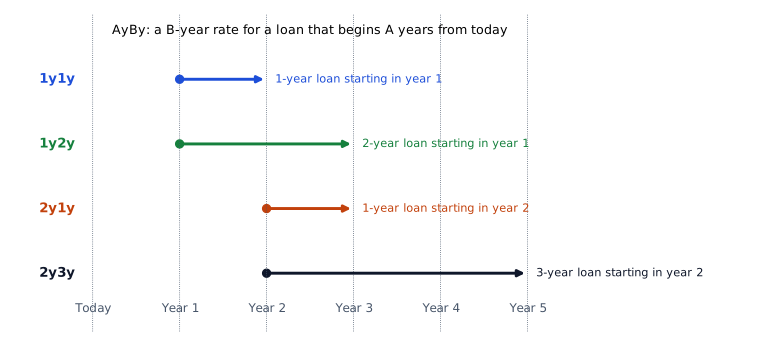
A forward rate is an interest rate for a loan that starts in the future. yy (or ) is the rate for a -year loan beginning years from today. Thus 1y1y is a 1-year loan starting in one year, and 2y3y is a 3-year loan from year 2 to year 5. Money market versions use months: 3m6m is a 6-month rate three months from now.
Implied (no-arbitrage) forward rates
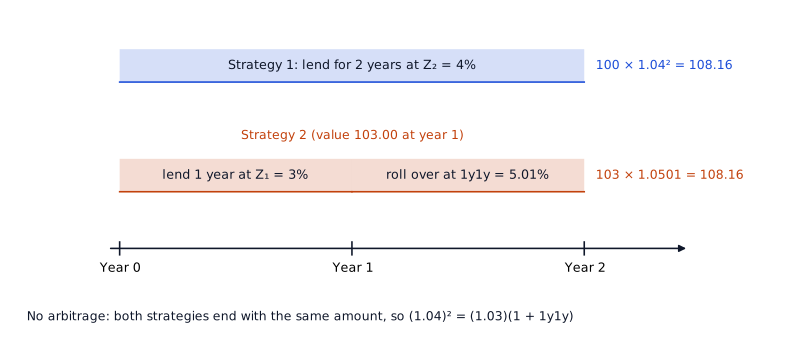
With spot rates (zero-coupon yields) , the implied forward rate makes two strategies earn the same: investing to the forward date and rolling over at the forward rate, or investing for the whole period at the longer spot rate.
Key concept
Example. With and , . With zero rates only out to year 3, one can derive 1y1y, 1y2y and 2y1y, but no forward rate that ends after year 3.
Money market rates use simple interest on a 360-day year, and the same logic applies with day-count adjustments ( = days in each period):
Example. The 3-month MRR is 2.0% and the 9-month MRR is 2.6%. Then and , so the implied 3m6m rate is .
Forward rate agreements (FRAs)
A forward rate agreement (FRA) lets a party lock in an interest rate today for borrowing or lending that begins in the future. It is a forward commitment, so both parties are obligated.
- The long (FRA buyer) pays the fixed contract rate and receives the market reference rate (MRR) on a notional principal. It gains if MRR rises. A future borrower goes long to hedge.
- The short (FRA seller) receives fixed and pays MRR. A future lender goes short.
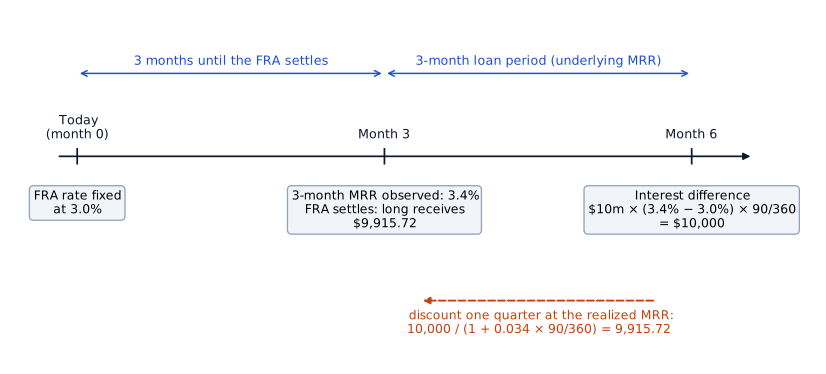
- Only the net amount is paid. Settlement happens at the start of the loan period, so the interest difference, which relates to the end of the period, is discounted at the realized MRR:
Example. A 3-month forward on 3-month MRR (a 3m3m FRA) has a notional principal of $10 million and an FRA rate of 3.0%. Three months later, 3-month MRR is 3.4%.
- Interest difference for the loan period, due at its end (month 6): .
- Discount it to the settlement date (month 3) at the realized MRR: .
- MRR is above the FRA rate, so the long receives $9,915.72 from the short.
FRAs are used mainly by financial institutions to manage the rate sensitivity of their assets and liabilities. An FRA is equivalent to a single-period swap. A multi-period interest rate swap is a series of FRAs and is used mainly by issuers and investors.
| Instrument | What it does |
|---|---|
| FRA | Locks in one future period's rate (obligation) |
| Interest rate swap | Exchanges fixed for floating over many periods |
| Interest rate option | Right, not obligation, to a rate (contingent claim) |
Common exam traps
- The forward contract's value is usually zero at initiation; its price is the contract price.
- FRA settlement is discounted at the realized MRR, not at the FRA rate, and it is not paid undiscounted. In the 3m3m example, discounting at the 3.0% FRA rate gives $9,925.56 and paying undiscounted gives $10,000, instead of $9,915.72.
- In yy, the first number is when the loan starts and the second is how long it lasts.
Bottom line
- The forward price is written into the contract at initiation and does not change, while the forward's value is normally zero at initiation and then moves with the spot price.
- For an underlying with no costs or benefits of holding, a long forward is worth during its life and at expiration, and the short's value is the negative of the long's.
- With costs and benefits of holding, .
- In AyBy notation, the first number is when the loan starts and the second is how long it lasts, so 2y3y is a 3-year loan from year 2 to year 5.
- , the rate that makes rolling over at the forward rate earn the same as investing at the longer spot rate.
- The long in an FRA pays the fixed FRA rate and receives MRR, so it gains when MRR rises; a future borrower hedges by going long and a future lender by going short.
- The FRA payment to the long is discounted at , because it is paid at the start of the loan period.
- A multi-period interest rate swap is a series of FRAs, so each FRA amounts to a swap with only one period.
Quick check
Eight months ago, Selma Varga entered a 1-year long forward contract on a share that has no dividends or other costs or benefits of holding, at a forward price of $55.00. The share now trades at $57.00 and the annual risk-free rate is 3%. The value of Varga's forward position is closest to:
Show answer and explanation
Correct answer: C
For an underlying that is costless to hold and pays nothing, a long forward's value before expiration is the spot price less the present value of the forward price. Four months remain, so the forward price is discounted for 4/12 of a year.
Why the other options are wrong
- A. $1.98 is the present value of the difference, . It wrongly discounts the spot price as well as the forward price.
- B. $2.00 is the undiscounted difference between spot and forward prices. That would be the value only at expiration.
Key takeaway Discount only the forward price, for the time remaining .
Practice Questions
Annual-pay zero-coupon yields are 2.4% for 1 year, 2.8% for 2 years, and 3.1% for 3 years. The implied 1-year forward 2-year rate (1y2y), stated as an annual rate, is closest to:
Show answer and explanation
Correct answer: A
The 1y2y rate is the rate for a 2-year loan starting in one year. Investing for three years at the 3-year spot rate must give the same result as investing for one year at the 1-year spot rate and then for two years at the 1y2y rate.
Why the other options are wrong
- B. 3.70% is the 2y1y rate (a 1-year loan starting in two years), . The first number in the notation is the start date and the second is the length of the loan.
- C. 7.02% is the cumulative 2-year forward return, . It has not been converted to an annual rate by taking the square root.
Key takeaway yy: divide by , then take the -th root.
A company expects to invest surplus cash for three months, starting four months from today. It wants to lock in the return on that future investment with an FRA. The company should enter the FRA as the party that:
Show answer and explanation
Correct answer: B
A future lender or investor wants to protect against a fall in MRR. Receiving the fixed FRA rate and paying MRR produces a gain when MRR falls, offsetting the lower return earned on the future investment.
Why the other options are wrong
- A. Paying fixed and receiving MRR benefits from rising rates and is the hedge for a future borrower.
- C. An FRA exchanges the fixed-rate and floating-rate differences; one party does not receive both legs.
Key takeaway A future borrower pays fixed and receives floating; a future lender receives fixed and pays floating.
This reading has 9 questions in the full bank. Practice all of them.
Key Takeaways
- Discount only the forward price, for the time remaining .
- yy: divide by , then take the -th root.
- A future borrower pays fixed and receives floating; a future lender receives fixed and pays floating.