Derivatives · Reading 75
Pricing and Valuation of Futures Contracts
CFA Level I · Derivatives · Reading 75 · about 18 min
What you'll learn
- LOS 75.a Compare the price and value of forwards and futures over their lives, and interpret interest rate futures quotes and basis point value.
- LOS 75.b Explain why forward and futures prices differ (daily settlement and the correlation of interest rates with futures prices) and the convexity bias of FRAs versus interest rate futures.
Module 75.1
Futures Valuation
This reading compares the pricing and valuation of forwards and futures, including interest rate futures, and explains why their prices can differ. A candidate must be able to describe how daily settlement changes a futures contract's price and value, compute an interest rate futures price and its basis point value, and relate the forward–futures price difference to the correlation between interest rates and futures prices and to convexity bias.
LOS 75.a — Value and price of forwards versus futures
Forwards (no mark-to-market). The forward price stays fixed for the whole life of the contract. The forward's value changes as the spot price moves, and the entire gain or loss is paid only at settlement, as the difference between the spot price and the unchanged forward price.
Futures (daily mark-to-market). At the end of each day, the gain or loss since the previous settlement price is credited to or debited from each margin account, and the contract is then treated as if it had been re-entered at the new settlement price. As a result:
- the futures price changes every day, because it is reset to the latest settlement price; and
- the value of the futures position goes back to zero after each daily settlement.
Example. A trader is long one futures contract on 100 units bought at 250.
| Day | Settlement price | Mark-to-market cash flow (long) | Contract price after MTM | Value after MTM |
|---|---|---|---|---|
| 0 | 250 | — | 250 | 0 |
| 1 | 253 | credited | 253 | 0 |
| 2 | 247 | debited | 247 | 0 |
Over the two days the long has received $300 and paid $600, a net . A forward entered at 250 and settled at 247 would pay the same total, ignoring interest. What differs is the timing: futures gains and losses arrive day by day, and that timing is the source of the forward–futures price differences in LOS 75.b.
A forward that is marked to market daily, for example under a central clearing arrangement, behaves the same way.
Interest rate futures
Interest rate futures are the exchange-traded counterparts of forward rate agreements (FRAs), but they are quoted on a price basis:
Key concept
A quote of 95.80 implies an MRR of 4.20%. The price moves opposite to the rate, so a long futures position gains when rates fall.
The basis point value (BPV) is the change in contract value for a 1 bp change in the rate:
Key concept
For a 6-month rate on $2,000,000, per basis point.
LOS 75.b — Why forward and futures prices can differ
The key pricing difference is the daily settlement of futures gains and losses. Gains above initial margin can be withdrawn and reinvested, and losses that take the account below the maintenance margin must be funded. Forwards usually generate no cash flows until settlement.
Key concept
| Correlation between interest rates and the futures price | Effect of daily settlement on a long futures | Which is more attractive to a long? | Price relationship |
|---|---|---|---|
| Positive | Cash received when rates are high (reinvested at high rates); cash paid when rates are low (cheap to finance) | Futures | Futures price > forward price |
| Negative | Cash paid when rates are high (costly); cash received when rates are low (poor reinvestment) | Forward | Futures price < forward price |
| Zero or constant rates | No systematic effect | Indifferent | Equal |
These differences do not create arbitrage opportunities. They reflect the value of the mark-to-market cash flows. In practice the differences are usually too small to observe, because most forwards are short-dated, funds are available near the risk-free rate, and many dealers post margin.
Convexity bias in interest rate forwards versus futures
An FRA settles at the start of the loan period, so its payment is the interest difference discounted at the realized MRR. Interest rate futures pay an undiscounted, linear amount (BPV per basis point). A like-for-like comparison sets the FRA long, which gains when rates rise, against a short futures position, whose value also rises when rates rise because futures prices then fall.
- If rates rise, the FRA long receives the interest saving discounted at a higher realized rate, so it receives slightly less than the futures payment.
- If rates fall by the same amount, the FRA long pays an amount discounted at a lower rate, which is larger than what it would receive for the rise.
- The FRA payoff is therefore a nonlinear function of the rate: a rise in rates changes it by less than an equal fall does. From the side of the FRA short (the lender, whose position resembles a bond), the curve is convex, like a bond's price–yield curve. The long's payoff is the mirror image (concave). This curvature is the FRA's convexity. Futures payoffs are linear and have no convexity.
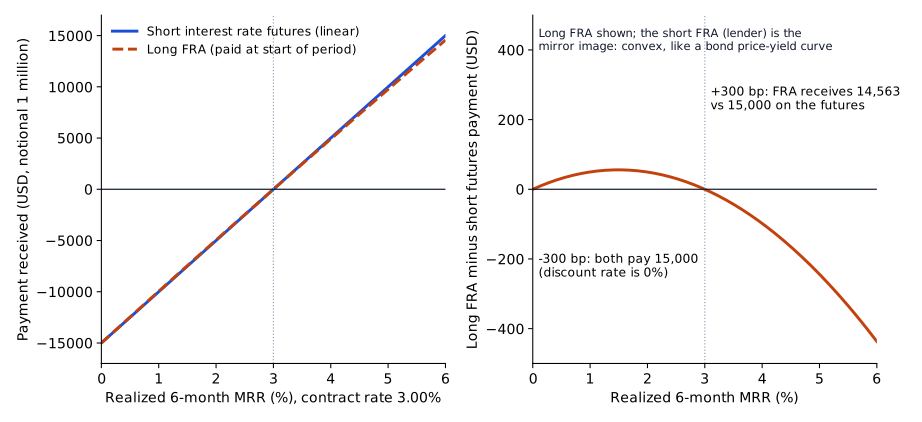
This convexity bias grows with the length of the period and can make forward and futures prices differ noticeably for longer-term rates.
Common exam traps
- For futures, both the price and the value change each day, and the value is reset to zero. For forwards, the price is fixed and the value fluctuates.
- Positive correlation between rates and futures prices favors the long futures; negative correlation favors the long forward.
- The FRA exhibits convexity; the futures contract is linear.
Bottom line
- A forward's price stays fixed and its whole gain or loss is paid at settlement, while a futures contract is marked to market daily, so its price resets to each settlement price and its value returns to zero after each daily settlement.
- Ignoring interest, the daily futures cash flows add up to the same total as the payoff of a forward entered at the same price; what differs is the timing.
- An interest rate futures price is quoted as , so a long futures position gains when rates fall.
- gives the change in an interest rate futures contract's value for a 1 bp change in the rate.
- A positive correlation between rates and futures prices makes futures more attractive to a long, so the futures price is above the forward price; a negative correlation makes the forward more attractive and the futures price lower; with zero correlation or constant rates the two are equal.
- Forward–futures price differences reflect the value of the mark-to-market cash flows and do not create arbitrage opportunities, and in practice they are usually too small to observe.
- Because an FRA's settlement is discounted at the realized MRR, its payoff is nonlinear in the rate while a futures payoff is linear; this convexity bias grows with the length of the period and can make prices differ noticeably for longer-term rates.
Quick check
A trader buys one futures contract on 50 tonnes of cocoa at a price of 4,120 per tonne. At the end of the day, the settlement price is 4,180. After the daily mark-to-market, which statement is most accurate?
Show answer and explanation
Correct answer: C
The daily mark-to-market credits the trader's account with the day's gain and resets the futures price to the new settlement price. Because the gain has already been paid, a contract at the new price of 4,180 has a value of zero again.
Gain credited .
New contract price ; value after mark-to-market .
Why the other options are wrong
- A. The price does change, but the change in value is only temporary. Once the gain is settled in cash, the value returns to zero.
- B. This describes a forward without mark-to-market, whose price is fixed while its value moves. A futures price is reset every day.
Key takeaway A futures price resets daily and its value goes back to zero; a forward price is fixed while its value fluctuates.
Practice Questions
Analyst Farah Idris observes that when the price of a commodity rises, short-term interest rates also tend to rise. For an investor seeking long exposure, which statement is most accurate about a long futures contract compared with an otherwise equivalent forward that has no mark-to-market?
Show answer and explanation
Correct answer: A
Idris describes a positive correlation between interest rates and the underlying's price. Daily settlement then gives the long futures cash (excess margin) when the price rises and rates are high, so it can be reinvested at high rates, and requires deposits when the price falls and rates are low, so the opportunity cost of those deposits is small. That makes the futures more desirable than the forward.
Why the other options are wrong
- B. The forward is preferred when the correlation is negative, which is the opposite of what Idris observes.
- C. Equal attractiveness requires interest rates that are constant or uncorrelated with the futures price.
Key takeaway Positive correlation between rates and the underlying's price makes long futures worth more than long forwards.
A fund manager is long 8 three-month MRR futures contracts, each on a notional principal of $1,000,000. Over the day, the futures price falls from 96.40 to 96.25. The change in the value of the manager's position is:
Show answer and explanation
Correct answer: B
Interest rate futures are quoted as 100 minus the rate, so a price drop from 96.40 to 96.25 means the implied MRR rose from 3.60% to 3.75%, a 15 bp increase. A long futures position loses when rates rise, by the basis point value per contract for each basis point.
Implied MRR: and bp.
Why the other options are wrong
- A. $12,000 uses a BPV of $100 per contract. It ignores that the rate applies to a 3-month period (0.25 year).
- C. The sign is reversed. A falling futures price (rising rate) produces a loss for the long.
Key takeaway Rate futures price ; ; longs lose when rates rise.
This reading has 7 questions in the full bank. Practice all of them.
Key Takeaways
- A futures price resets daily and its value goes back to zero; a forward price is fixed while its value fluctuates.
- Positive correlation between rates and the underlying's price makes long futures worth more than long forwards.
- Rate futures price ; ; longs lose when rates rise.