Derivatives · Reading 76
Interest Rate Swap
CFA Level I · Derivatives · Reading 76: Pricing and Valuation of Interest Rates and Other Swaps · about 21 min
What you'll learn
- LOS 76.a Describe how an interest rate swap is equivalent to a series of FRAs at the swap rate (values summing to zero at inception) and how it can be replicated with cash market positions.
- LOS 76.b Contrast the price of a swap (the par swap rate, fixed at initiation) with its value (zero at inception, then changing with expected future rates).
Module 76.1
Swap Valuation
This reading treats an interest rate swap as a series of forward rate agreements and separates a swap's price, its fixed rate, from its value. A candidate must be able to explain how the FRAs embedded in a swap differ from market FRAs, replicate a swap with cash market positions, compute the par swap rate from spot rates, and value a swap after initiation.
LOS 76.a — Swaps compared with a series of forward contracts
In a plain fixed-for-floating interest rate swap, one party pays a fixed rate and the other pays a floating market reference rate (MRR) on the same notional principal. On each settlement date only the net payment changes hands.
A swap as a series of FRAs
Take a 1-year swap with quarterly settlements. The floating rate for each quarter is set at the start of the quarter, so:
- The first net payment (end of quarter 1) is already known at initiation. It depends on today's MRR and the swap's fixed rate.
- Each later payment (quarters 2, 3 and 4) equals the payoff of a forward rate agreement in which the fixed-rate payer is long at a contract rate equal to the swap fixed rate. From the fixed-rate payer's perspective, each payment is .
- The timing differs slightly. A standard FRA on the 90-day MRR is cash-settled at the start of the underlying quarter, when the rate is set, and pays the present value of the interest difference: discounted for one quarter at . The FRAs that replicate the swap's payments on days 180, 270 and 360 therefore settle on days 90, 180 and 270. Growing each discounted settlement forward one quarter at gives the swap's net payment at the end of the quarter, so the amounts are equivalent and only the payment date differs.
A swap is therefore equivalent to a series of FRAs. Like an FRA, it can produce gains or losses for either side, and each party bears the other's counterparty credit risk unless a central counterparty is used. The one important difference is in the contract rates:
Key concept
| Series of market FRAs | FRAs embedded in a swap | |
|---|---|---|
| Contract rates | Each FRA has its own no-arbitrage rate, so each starts at zero value | All use the same rate: the swap fixed rate |
| Value of each forward at initiation | Zero | Generally not zero: some positive, some negative |
| Total value at initiation | Zero | The values sum to zero |
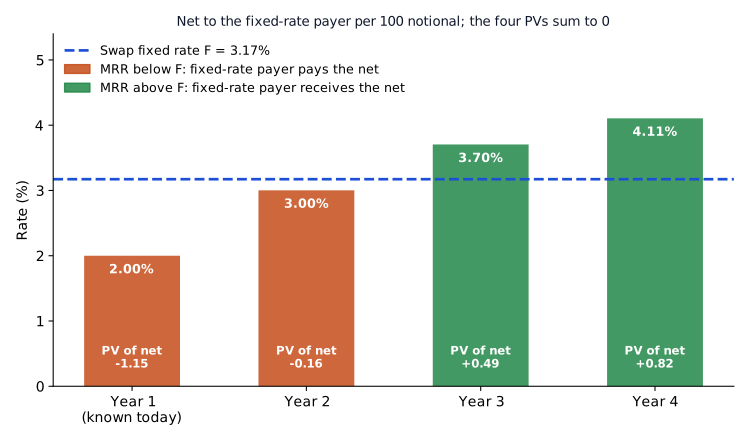
With an upward-sloping curve, the early FRAs (swap rate above the forward rate) have negative value to the fixed-rate payer and the later ones have positive value. In total they offset.
Example. For an annual-pay 4-year swap with spot rates of 2.0%, 2.5%, 2.9% and 3.2%, the implied 1-year MRRs are 2.00%, 3.00%, 3.70% and 4.11% (for year 2, ). The fixed rate that gives the swap zero value, the par swap rate derived in LOS 76.b, is 3.17%. Per 100 of notional, the present values of the net payments to the fixed-rate payer are −1.15, −0.16, +0.49 and +0.82, which sum to zero. For year 1, .
Replicating a swap with cash market positions
| Swap position | Cash market replication |
|---|---|
| Fixed-rate payer (receives floating) | Borrow at a fixed rate (issue a fixed-rate bond) and invest the proceeds at the floating rate (buy a floating-rate note) |
| Floating-rate payer (receives fixed) | Borrow at a floating rate (issue a floating-rate note) and invest the proceeds in a fixed-rate bond |
The floating-rate payer's net cash flows are also equivalent to a series of FRAs (the other side of the fixed-rate payer's FRAs). Those FRAs would all carry the swap rate, so they would not be zero-value FRAs.
LOS 76.b — Price versus value of a swap
- The price of a swap is its fixed rate, the par swap rate, written into the contract at initiation. It does not change over the swap's life.
- The value of the swap is zero at initiation, because the par swap rate is chosen so that the fixed leg and the expected floating leg have equal present values. Neither party pays to enter.
- After initiation, the value changes as expected future MRRs change.
Solving for the par swap rate
Let be the spot rate for period and the floating rate for period implied by those spot rates (the first equals the current MRR). The par swap rate (per period) satisfies
A floating-rate note paying the implied rates and then returning its principal is worth par. Per unit of notional, the floating payments alone are therefore worth , and the equation simplifies to
Key concept
Example. An annual-pay 2-year swap faces spot rates and . The discount factors are and , so . As a check, the implied 1y1y rate is , and , which matches .
Value during the life
Example. Take the 2-year swap above with a notional principal of $50 million and a fixed rate of 2.49%. At the first settlement the fixed-rate payer pays the net . Just after that payment, 1-year MRR is 3.90%, above the 3.51% implied at initiation, and it sets the final floating payment. One net payment remains, due in a year: to the fixed-rate payer. Its value today is to the fixed-rate payer and to the floating-rate payer. Had MRR come in at the expected 3.51%, the remaining payment would be worth , about what the fixed-rate payer paid at the first settlement. The rise in MRR above that expectation is the fixed-rate payer's gain and the floating-rate payer's loss.
Key concept
| Change in expected future MRRs after initiation | Value to fixed-rate payer | Value to floating-rate payer | Swap price (fixed rate) |
|---|---|---|---|
| Increase | Rises (positive) | Falls (negative) | Unchanged |
| Decrease | Falls (negative) | Rises (positive) | Unchanged |
This value is the basis for mark-to-market payments on centrally cleared swaps.
Common exam traps
- A floating-rate payer's position is like issuing floating-rate debt and buying a fixed-rate bond, a long-duration position that gains when rates fall.
- The par swap rate is neither the simple average of the spot rates nor the longest spot rate. For the 4-year swap in the example, the simple average gives 2.65% and the longest spot rate 3.20%, against a par swap rate of 3.17%.
Exam shortcuts
- The par swap rate needs only the spot-rate discount factors, , so the implied floating rates do not have to be computed first.
Bottom line
- An interest rate swap is equivalent to a series of FRAs in which the fixed-rate payer is long at the swap fixed rate, and its first net payment is already known at initiation.
- Market FRAs each carry their own no-arbitrage rate and start at zero value, while the FRAs embedded in a swap all use the swap fixed rate, so their individual values are generally not zero but sum to zero.
- A fixed-rate payer's position replicates borrowing at a fixed rate and investing the money at the floating rate, and a floating-rate payer's position replicates borrowing at a floating rate and putting the money into a fixed-rate bond.
- A swap's price is its fixed par swap rate, which is set at initiation and does not change, while its value is zero at initiation and then changes as expected future MRRs change.
- , the fixed rate per period that makes the fixed leg and the expected floating leg equal in present value.
- Value to the fixed-rate payer = PV(expected floating payments) − PV(remaining fixed payments), so a rise in expected MRRs after initiation gives the fixed-rate payer a gain and the floating-rate payer an equal loss.
Quick check
An analyst breaks a fixed-for-floating interest rate swap into a series of forward contracts (FRAs), each with a contract rate equal to the swap's fixed rate. For this series to replicate a swap entered at market terms, the forward contracts must have:
Show answer and explanation
Correct answer: B
Because every FRA in the series uses the same contract rate (the swap fixed rate), the individual FRAs will generally not be zero-value contracts: some have positive and some negative value. A swap entered at market terms has zero value at initiation, so the FRA values must add up to zero at that date.
Why the other options are wrong
- A. Zero-value FRAs would each need their own no-arbitrage contract rate. With a single common rate, individual values are generally non-zero; only their sum is zero.
- C. The zero-sum condition applies at initiation, when the swap is priced to have zero value. At expiration, the values reflect realized rates and need not sum to zero.
Key takeaway A swap is a series of off-market FRAs whose values sum to zero at inception.
Practice Questions
Six months after Orsolya Farms entered a 5-year interest rate swap as the fixed-rate payer, expected future MRRs have risen. Which statement is most accurate?
Show answer and explanation
Correct answer: C
The fixed-rate payer receives floating payments. Higher expected MRRs raise the present value of the floating payments it will receive relative to the fixed payments it owes, so the swap's value to Orsolya increases. The swap price, the fixed rate set in the contract, does not change.
Why the other options are wrong
- A. The direction is reversed: a rise in expected rates increases the value of the fixed-rate payer's position (it would decrease the floating-rate payer's).
- B. The value rises, but the price is the fixed rate agreed at inception and does not move with market rates.
Key takeaway When expected rates rise, the fixed-rate payer gains and the floating-rate payer loses. The swap price does not change.
Rhea Kapoor wants to use cash market transactions to reproduce the net cash flows of the floating-rate payer in a plain vanilla interest rate swap. She could best do so by:
Show answer and explanation
Correct answer: A
The floating-rate payer pays MRR and receives fixed payments on the notional principal. Borrowing at a floating rate (a floating-rate loan or note) and investing the proceeds in a fixed-rate bond produces the same net cash flows.
Why the other options are wrong
- B. Borrowing at a fixed rate creates fixed payments, the opposite of the floating-rate payer's obligation, and zero-value FRAs would not replicate the swap anyway.
- C. The swap's net payments are equivalent to a series of FRAs that all carry the swap's single fixed rate, so those FRAs would generally not be zero-value FRAs; zero-value FRAs would each have a different contract rate. A floating-rate loan combined with zero-value FRAs therefore does not reproduce the floating-rate payer's cash flows.
Key takeaway The floating-rate payer's position equals a short floating-rate note plus a long fixed-rate bond; the fixed-rate payer's position is the reverse.
This reading has 6 questions in the full bank. Practice all of them.
Key Takeaways
- A swap is a series of off-market FRAs whose values sum to zero at inception.
- When expected rates rise, the fixed-rate payer gains and the floating-rate payer loses. The swap price does not change.
- The floating-rate payer's position equals a short floating-rate note plus a long fixed-rate bond; the fixed-rate payer's position is the reverse.