Derivatives · Reading 77
Pricing and Valuation of Options
CFA Level I · Derivatives · Reading 77 · about 25 min
What you'll learn
- LOS 77.a Explain an option's exercise (intrinsic) value, moneyness (in, at, out of the money) and time value.
- LOS 77.b Contrast no-arbitrage pricing of forward commitments with replication-based pricing of contingent claims, including the upper and lower bounds for European option values.
- LOS 77.c Identify the six factors that determine an option's value and the direction in which each affects call and put values.
Module 77.1
Option Valuation
This reading covers the building blocks of option pricing: moneyness, exercise value and time value, the no-arbitrage bounds on European option values, and the factors that move option values. A candidate must be able to compute exercise value, time value and the lower and upper bounds of European calls and puts, and state how each of the six factors changes call and put values.
LOS 77.a — Moneyness, exercise value and time value
Moneyness describes what the holder would receive from exercising an option right now. With = current price of the underlying and = exercise (strike) price:
Key concept
| Call | Put | |
|---|---|---|
| In the money | ||
| At the money | ||
| Out of the money |
An in-the-money option would produce a positive payoff if exercised immediately. An out-of-the-money option would not, so the holder would simply not exercise it.
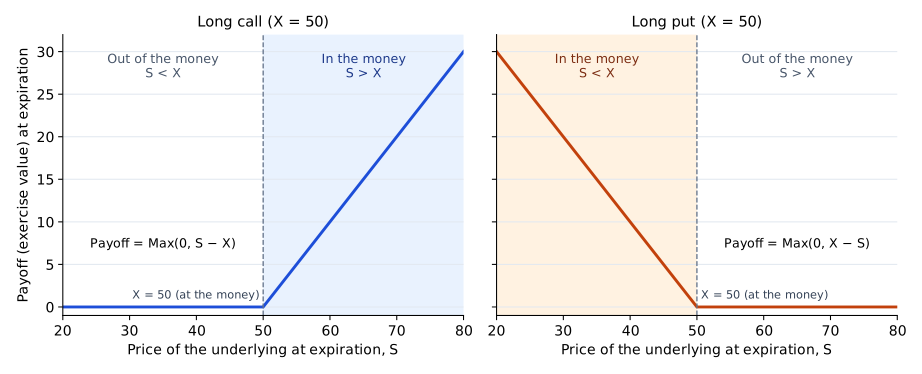
The exercise value (also called intrinsic value) is the amount by which the option is in the money, floored at zero:
Before expiration an option normally trades above its exercise value. The difference is the time value (sometimes called speculative value):
Three consequences follow:
- For an out-of-the-money or at-the-money option, exercise value is zero, so the entire premium is time value.
- For an in-the-money option, exercise value is positive, so time value is less than the premium.
- Time value comes from the chance that the underlying moves favorably before expiration. It generally shrinks as expiration approaches and is zero at expiration, when the option is worth exactly its exercise value (zero if at or out of the money). Time value is typically positive but can be negative: a deep in-the-money European put can trade below , because its holder must wait until expiration to receive .
Example. A stock trades at $83. An 80-strike call is $3 in the money (exercise value $3), and an 80-strike put is $3 out of the money (exercise value $0). If the call's premium is $5.40, its time value is . If the put's premium is $0.85, all $0.85 is time value.
LOS 77.b — Arbitrage and replication for contingent claims
Forward commitments (forwards, futures, swaps) are priced so that their value at initiation is zero to both parties, and both sides face essentially unlimited gains or losses. Options (contingent claims) differ in two ways. The buyer pays a premium, so the value at initiation is positive, and the payoffs are one-sided, because the buyer's loss is limited to the premium. Options are therefore priced with a replication approach. The option's payoff is combined with a position in the underlying and a pure discount bond (risk-free zero-coupon bond), and no-arbitrage requires that a portfolio whose payoff is never negative must itself have a value of zero or more.
Two such portfolios give the lower bounds:
- Call. Buy the call, buy a pure discount bond that pays at , and short one share. The payoff at is : zero if and otherwise. Because it is never negative, , so .
- Put. Buy the put, buy one share, and borrow . The payoff at is : zero if and otherwise. Hence , so .
Combined with the fact that no option can have a negative value, this yields boundary values for European options at time (expiration at , = risk-free rate):
Key concept
| Option | Minimum value | Maximum value |
|---|---|---|
| European call | ||
| European put |
Nobody pays more than the share price for the right to buy the share. A European put can never pay more than , and that payment cannot arrive before expiration, so its ceiling is the present value of . The lower bounds use the present value of the exercise price because a European option cannot be exercised early.
Example. , , six months to expiration and . . The lower bound for the call is ; the lower bound for the put is .
LOS 77.c — Factors that determine option values
Six factors determine option values. Their effects, other things equal, are:
Key concept
| Increase in … | Call value | Put value |
|---|---|---|
| Price of the underlying | Increase | Decrease |
| Exercise price | Decrease | Increase |
| Risk-free rate | Increase | Decrease |
| Volatility of the underlying | Increase | Increase |
| Time to expiration | Increase | Usually increase (exceptions for some European puts) |
| Costs and benefits of holding the asset | Benefits (dividends, interest, convenience yield): decrease. Storage costs: increase | Benefits: increase. Storage costs: decrease |
- Underlying price and exercise price. These drive exercise value directly: a call gains as rises or falls, and a put gains as falls or rises. At expiration only these two matter, because time value is zero. Interest rates and volatility affect only time value.
- Risk-free rate. A call holder pays in the future, and a higher rate lowers the present value of that payment, so the call is worth more. A put holder receives in the future, and a higher rate lowers the present value of that receipt, so the put is worth less. A falling rate therefore lowers calls and raises puts.
- Volatility. Volatility makes both calls and puts valuable, because the downside is capped while the potential upside widens. With no volatility, the time value that comes from possible favorable price moves would disappear. Exam convention: option values then equal their exercise values. Current practice: pricing models still discount the exercise price of a European option. With zero volatility the underlying grows at the risk-free rate, so a European call on a non-dividend-paying share is worth when .
- Time to expiration. More time effectively means more volatility, so calls and most puts are worth more. A deep in-the-money European put, however, can be worth less with a longer life, because its upside is almost capped and the payment of is received later, at a lower present value. The effect is more likely for a put that is deeper in the money, when the risk-free rate is higher, and when the time to expiration is longer.
- Holding benefits and costs. Benefits such as a dividend lower the price of the underlying, which hurts calls and helps puts. Storage costs work the other way.
A long call profits when the underlying rises, so its profit is positively correlated with the price. A long put profits when the underlying falls, so its profit is negatively correlated with the price. Short positions have the opposite sensitivity: a short put gains value when the underlying price rises and loses value when volatility increases or, for most puts, when time to expiration increases.
Example. An investor is long a put and long a call on the same share. If the risk-free rate falls, the call loses value and the put gains value, so only one of the two positions benefits. If the investor were instead long the put and short the call, both positions would gain.
Common exam traps
- Moneyness compares the exercise price with the current price. It says nothing about whether the option is now worth more than the holder paid for it.
- The European bounds use . The put's upper bound is , not , and using in the lower bounds gives the exercise value from immediate exercise instead. In the six-month example, using gives a call lower bound of 3.00 instead of 4.55 and a put upper bound of 80 instead of 78.45.
- The risk-free rate moves call and put values in opposite directions, while volatility moves them in the same direction.
- A longer life does not always raise a European put's value.
Bottom line
- A call is in the money when and a put when ; either is at the money when .
- Exercise value is for a call and for a put, and time value is the premium minus the exercise value, so the whole premium of an option with zero exercise value is time value.
- Time value generally shrinks as expiration approaches and is zero at expiration; it is typically positive but can be negative for a deep in-the-money European put.
- European option bounds: and .
- Other things equal, a higher underlying price or a lower exercise price raises a call's value and lowers a put's, a higher risk-free rate raises calls and lowers puts, and higher volatility raises both.
- A longer time to expiration raises a call's value and usually a put's, but a deep in-the-money European put can be worth less with a longer life, more likely when it is deeper in the money, the risk-free rate is higher and the time to expiration is longer.
- Benefits of holding the underlying, such as dividends, lower call values and raise put values, while storage costs do the opposite.
- At expiration only the underlying price and the exercise price matter, because time value is zero; interest rates and volatility affect only time value.
Quick check
Hana Novak owns two options on the same stock: a call with an exercise price of $62 and a put with an exercise price of $70. If the stock currently trades at $66:
Show answer and explanation
Correct answer: C
The call is in the money because it lets Novak buy at $62 a stock worth $66 (). The put is in the money because it lets her sell at $70 a stock worth $66 ().
Why the other options are wrong
- A. Each option would give a positive payoff if exercised now, so both are in the money.
- B. The call is in the money, but so is the put, because its exercise price is above the market price.
Key takeaway Check each option separately: call ITM if , put ITM if . With different strikes both can be in the money at once.
Practice Questions
Which statement about a European put option is most accurate?
Show answer and explanation
Correct answer: C
A put pays off when the stock price is below the exercise price. Its exercise value is therefore : the exercise price less the stock price when that amount is positive, and zero otherwise. Exercise value is also called intrinsic value.
Why the other options are wrong
- A. is the exercise value of a call. For a put the subtraction runs the other way.
- B. Time value is the market price minus the exercise value. Adding the two gives more than the premium itself.
Key takeaway Call exercise value ; put exercise value . Time value is the premium minus the exercise value.
Compared with forward commitments, why must a different no-arbitrage approach be used to price options?
Show answer and explanation
Correct answer: A
Forward commitments are priced so that their value at initiation is zero to both parties, and both sides face essentially unlimited gains and losses. An option buyer pays a premium, so the option has a positive value at initiation, and the payoffs are one-sided (the buyer's loss and the writer's gain are limited to the premium). Options are therefore priced by replication: combining the option with a pure discount bond and a long or short position in the underlying.
Why the other options are wrong
- B. Contingent claims are priced by replication: the option is combined with a risk-free pure discount bond and a position in the underlying.
- C. No-arbitrage and replication pricing discount at the risk-free rate. A risk-adjusted discount rate is not needed.
Key takeaway Forwards have zero initial value and two-sided payoffs. Options have a positive premium and one-sided payoffs, so they are priced by replication.
Tomás Reyes has bought a European call option and written a European put option on the same equity index. Holding all other factors constant, an increase in the risk-free interest rate will increase the value of:
Show answer and explanation
Correct answer: C
A higher risk-free rate raises call values and lowers put values. Reyes is long the call, so that position gains; he is short the put, so the fall in the put's value also benefits him. Both positions become more valuable.
Why the other options are wrong
- A. Neither position would gain only if the rate change hurt both of them. Because a rate increase raises call values and lowers put values, the long call gains and the short put also gains.
- B. Only one position would gain if Reyes were long both options (or short both), because the rate moves call and put values in opposite directions. Being long the call and short the put, he benefits on both.
Key takeaway Rates move call and put values in opposite directions; then flip the sign for any short position.
This reading has 21 questions in the full bank. Practice all of them.
Key Takeaways
- Check each option separately: call ITM if , put ITM if . With different strikes both can be in the money at once.
- Call exercise value ; put exercise value . Time value is the premium minus the exercise value.
- Forwards have zero initial value and two-sided payoffs. Options have a positive premium and one-sided payoffs, so they are priced by replication.
- Rates move call and put values in opposite directions; then flip the sign for any short position.