Derivatives · Reading 78
Put Call Parity
CFA Level I · Derivatives · Reading 78: Option Replication Using Put-Call Parity · about 20 min
What you'll learn
- LOS 78.a Explain put–call parity for European options (fiduciary call = protective put) and use it to build synthetic stocks, calls, puts and bonds.
- LOS 78.b Explain put–call forward parity for European options and the option view of a firm's equity and debt (credit risk as a put).
Module 78.1
Put-Call Parity
This reading derives put–call parity and put–call forward parity from no-arbitrage and applies option thinking to a firm's equity and debt. A candidate must be able to use parity to value an option or build a synthetic position, identify and exploit a parity violation, and explain why shareholders hold a call on the firm's assets and debtholders are short a put.
LOS 78.a — Put–call parity
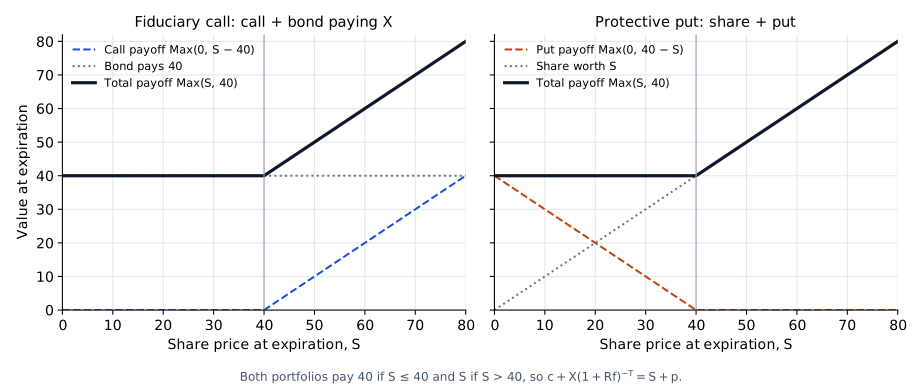
Two portfolios, both built with European options on the same underlying with the same exercise price and the same expiration :
- Fiduciary call = long call + a risk-free pure-discount bond that pays at expiration.
- Protective put = long one share of the underlying + long put.
Payoffs at expiration:
| Fiduciary call | call + bond = | call + bond = |
| Protective put | share + put = | share + put = |
Both pay in every state (see the figure below), so no-arbitrage forces them to cost the same today. This is put–call parity:
Key concept
Synthetic securities
Rearranging parity isolates any one instrument; a + sign means a long position and a − sign a short position (a short bond = borrowing the PV of ; a long bond = lending it):
Key concept
| Target (synthetic equivalent) | Replicating portfolio |
|---|---|
| Synthetic stock: | long call, short put, long bond |
| Synthetic put: | long call, short stock, long bond |
| Synthetic call: | long stock, long put, short bond (borrow) |
| Synthetic bond: | long stock, long put, short call |
Parity in this form holds for European options with the same exercise price and expiration on an underlying that pays no income and has no holding costs during the option's life.
Arbitrage. If one side of parity is cheap relative to the other, buy the cheap side and sell the expensive side. Example: if a put trades below , buy the put and sell the synthetic put: write the call, buy the stock and borrow . The difference is an arbitrage profit received today.
Example. , , 3 months to expiration, , put price 1.10. The call implied by parity is
If the call is quoted at 3.00 instead, it is expensive relative to the synthetic call worth 2.61. Write the call for 3.00 and build the synthetic call: buy the share for 36, buy the put for 1.10 and borrow 34.49. The synthetic call costs 2.61, so 0.39 is received today. At expiration the share plus the put is worth , the loan repayment is 35 and the written call costs . These net to zero in every state, so the 0.39 is an arbitrage profit.
Common exam traps
- Confusing a fiduciary call (call + bond paying ) with a covered call (stock + short call) or with call + stock.
- Getting the bond sign wrong: a synthetic call borrows (short bond); a synthetic put lends (long bond).
- Discounting at the wrong horizon, or forgetting to discount it at all. In the 3-month example, leaving the 35 undiscounted gives a call value of 2.10, and discounting it for a full year gives 4.08, instead of 2.61.
LOS 78.b — Put–call forward parity and options in corporate finance
A long forward contract with price plus a pure-discount bond paying at replicates the underlying: at the bond proceeds exactly pay for the asset. The forward costs nothing at initiation, so this synthetic asset costs . Substituting it for in put–call parity gives put–call forward parity (at initiation of the forward):
Key concept
Equivalently,
So a long put plus a short call (same ) has the same value as a risk-free bond that pays at expiration. The option pair matches the bond in value, not in payoff: at expiration it pays , which is uncertain. The long forward (payoff ) removes that uncertainty, so options plus forward pay the fixed amount ; because the forward costs nothing at initiation, adding it leaves the value unchanged. The components are the call, the put, the PV of the exercise price and the present value of the forward price. The spot price of the underlying does not appear.
Example. One-year forward price 62, , : , so the call must be worth 1.90 more than the put.
Option view of a firm (equity and debt)
Consider a firm financed by equity and one zero-coupon debt issue with face value ; firm value = equity + debt.
- Because of limited liability, shareholders hold a call option on the firm's assets with exercise price : if they pay off the debt and keep the rest; if they default and walk away.
- Equivalently, shareholders own the assets plus a long put on the assets with exercise price . Defaulting amounts to "putting" the assets to the debtholders.
- Debtholders hold a risk-free claim to plus a short put written to the shareholders. That put is the firm's credit risk (default risk): the debt is worth less than by the value of the put.
Here is the equity and is the risky debt.
At debt maturity the two claims pay
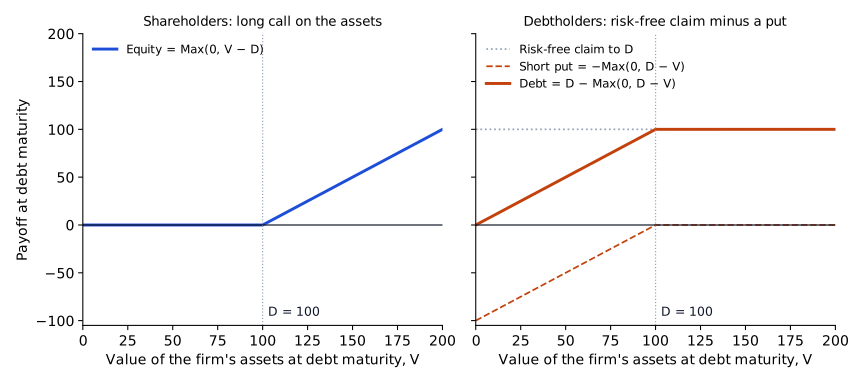
Example. With : if , shareholders repay 100 and keep 30. If , they default, equity is worth 0 and debtholders receive 70, which is the risk-free 100 minus the put payoff of 30.
Common exam traps
- Saying the credit-risk put is written by the shareholders. The debtholders are short the put and the shareholders hold it.
- Including the spot price in put–call forward parity; the forward price (in PV terms) replaces it.
- Using the future value, rather than the present value, of the forward price. In the one-year example, this gives instead of −1.90.
- Claiming that long put + short call alone replicates the bond's payoff; the long forward is also needed.
Bottom line
- A fiduciary call (long call plus a bond paying ) and a protective put (share plus long put) both pay , so .
- Put–call parity in this form holds for European options with the same exercise price and expiration on an underlying with no income and no holding costs during the option's life.
- Rearranging parity gives synthetic positions: a synthetic call is long the stock, long the put and short the bond (borrowing ), and a synthetic put is long the call, short the stock and long the bond (lending ).
- When one side of parity is cheap relative to the other, buying the cheap side and selling the expensive side earns the price difference today as an arbitrage profit.
- Put–call forward parity replaces the spot price with the present value of the forward price, , so .
- For a firm financed by equity and zero-coupon debt with face value , shareholders hold a call on the firm's assets with exercise price , or equivalently the assets plus a long put.
- Debtholders hold a risk-free claim to plus a short put written to the shareholders; that put is the firm's credit risk, and .
Quick check
A portfolio manager wants to reproduce the expiration payoff of a European put without trading any puts. She can trade the stock, a European call with the same strike and expiration, and a risk-free pure-discount bond that pays the exercise price X at expiration. Based on put–call parity, which combination should she hold?
Show answer and explanation
Correct answer: B
Solving put–call parity for the put gives : a long call, a short stock position and an investment of in the risk-free bond (a long bond position). At expiration the combination pays exactly .
Why the other options are wrong
- A. Borrowing (short bond) has the wrong sign; the put equation adds , so the bond is held long.
- C. This is the negative of the synthetic put (the position of someone who has sold a put synthetically).
Key takeaway Put side of parity: , so hold a long call, short stock and a long bond.
Practice Questions
Castellan Group is financed with common equity and a single issue of zero-coupon debt. When options theory is applied to this capital structure, the firm's credit risk can be modeled as a:
Show answer and explanation
Correct answer: A
If, when the debt matures, the firm's assets are worth less than the face value owed, the shareholders default and in effect "put" the assets to the debtholders at a price equal to the face value of the debt. The debtholders have written this put, so their claim is worth the principal discounted at the risk-free rate less the value of the put; that put is the firm's credit (default) risk.
Why the other options are wrong
- B. The shareholders' residual claim can be viewed as a call on the firm's assets, but credit risk itself is the put the debtholders have written to the shareholders.
- C. The direction is wrong: shareholders hold the options (a call, or the assets plus a put); debtholders are the writers.
Key takeaway Debt = risk-free − put; equity = call on the assets with exercise price .
Shares of Brisa Networks trade at $73.00. A 6-month European call on the shares with an exercise price of $70.00 is priced at $6.20, and the annual risk-free rate is 4%. The shares pay no dividends. Based on put–call parity, the value of a 6-month European put with the same exercise price is closest to:
Show answer and explanation
Correct answer: A
Put–call parity gives the put as the call minus the stock plus the present value of the exercise price, discounting the exercise price at the risk-free rate over the 6-month life.
Why the other options are wrong
- B. $3.20 uses the undiscounted exercise price (); parity requires .
- C. $10.56 reverses the signs, computing .
Key takeaway Always discount over the option's remaining life in put–call parity.
This reading has 14 questions in the full bank. Practice all of them.
Key Takeaways
- Put side of parity: , so hold a long call, short stock and a long bond.
- Debt = risk-free − put; equity = call on the assets with exercise price .
- Always discount over the option's remaining life in put–call parity.