Economics · Reading 17
Comparative Advantage
CFA Level I · Economics · Reading 17: International Trade · about 38 min
What you'll learn
- LOS 17.a Describe the benefits (comparative advantage, scale, variety, competition) and costs (import-competing job losses, inequality) of international trade.
- LOS 17.b Compare tariffs, quotas, export subsidies, VERs and domestic content rules, the arguments for them, and their welfare effects on consumers, producers and government.
- LOS 17.c Explain why countries form trading blocs and rank free trade areas, customs unions, common markets, economic unions and monetary unions by integration.
Module 17.1
International Trade
This reading weighs the benefits and costs of international trade, starting from comparative advantage, and compares tariffs, quotas, voluntary export restraints and export subsidies by their effects on prices, consumer and producer surplus and national welfare. It closes with capital restrictions and with the levels of integration in regional trading agreements, from free trade areas to monetary unions.
LOS 17.a — Benefits and costs of international trade
Why countries gain from trade. Traditional trade models focus on comparative advantage. A country has a comparative advantage in a good when its relative (opportunity) cost of producing that good is lower than other countries'. Comparative advantage comes from differences in technology and resource endowments. When each country specializes in the goods where it has a comparative advantage, exports them, and imports the rest, total output rises.
Example. In one day a worker in Quilland can make 6 tablets or 3 bicycles, and a worker in Dorvik can make 2 tablets or 2 bicycles. To find comparative advantage, compare opportunity costs rather than output:
- Cost of one bicycle in tablets given up: Quilland , Dorvik . Dorvik has the lower cost.
- Cost of one tablet in bicycles given up: Quilland , Dorvik . Quilland has the lower cost.
- Quilland specializes in tablets and Dorvik in bicycles.
Quilland's workers produce more of both goods, yet Dorvik still has a comparative advantage in bicycles. Gains from trade come from differences in relative cost, so even the less productive country has something to export.
Newer trade models add further sources of gains:
- Economies of scale: specialized producers selling to a world market have lower unit costs;
- greater variety of goods for consumers;
- more competition, which lowers costs, improves quality and limits the pricing power of domestic monopolies;
- a more efficient allocation of resources.
Countries can also trade the same kind of good. In markets with differentiated products (monopolistic competition, e.g., cars), a country may export one type and import others, so consumers get more variety at lower cost.
Who gains and who loses.
| Group | Effect of freer trade |
|---|---|
| Domestic consumers of imported goods | Gain: lower prices, more choice |
| Domestic producers (and workers) in export industries | Gain: larger markets |
| Domestic producers and workers in industries competing with imports | Lose: lower profits, lost jobs, possibly lower wages |
| Domestic consumers of goods that are now exported | May lose: stronger foreign demand can raise domestic prices |
The most cited costs of trade are job losses in import-competing industries and greater income inequality. For example, a high-wage country that imports labor-intensive textiles may see wages and jobs fall in its textile industry.
Net effect. Economic analysis concludes that the overall gains from trade exceed the losses, especially in the long run. In principle the gainers could fully compensate those who lose and still come out ahead, and both the importing and the exporting country share the net gains. The costs are concentrated in specific import-competing industries and are largely short-run: over time, retrained workers move into other industries, and the costs shrink or even reverse.
Common exam traps
- "Everyone gains from trade" is wrong. Import-competing industries and their workers bear real costs.
- "Only the exporting country gains" is wrong; in the long run both trading partners benefit.
- Expecting openness to raise consumer prices or cut jobs in export industries. Import competition tends to lower consumer prices, export industries expand, and specialization increases.
LOS 17.b — Trade restrictions and their economic implications
Reasons given for trade restrictions
Key concept
| Supported by economists (at least conceivably valid) | Little or no support in economic theory |
|---|---|
| Infant industry: temporary protection lets a new industry reach internationally competitive scale and move down the learning curve | Protecting domestic jobs: jobs lost to imports are offset by jobs created elsewhere (export and growing industries), so restrictions do not raise the net number of jobs in the long run, and consumers pay more |
| National security: keep domestic production of goods vital to national defense, even if imports are cheaper | Protecting domestic industries: usually the result of political lobbying, at the expense of consumers |
Other stated reasons include retaliation against foreign restrictions, raising government revenue from tariffs, countering foreign governments' subsidies, and preventing dumping, in which foreign firms sell exports below their cost of production to capture market share. An industry in which a country already has a comparative advantage needs no protection.
Types of trade restrictions
| Restriction | What it is |
|---|---|
| Tariffs | Taxes on imported goods, collected by the government |
| Quotas | Limits on the amount of imports allowed over some period |
| Export subsidies | Government payments to firms that export goods |
| Minimum domestic content | A required percentage of a product's content must come from the domestic country |
| Voluntary export restraint (VER) | The exporting country agrees to limit the quantity of a good it exports, often to avoid tariffs or quotas from its trading partner |
Consumer surplus is the difference between what buyers would be willing to pay and the price they actually pay. Producer surplus is the difference between the price sellers receive and the lowest price at which they would be willing to sell.
Effects compared. Most effects of the four policies run the same way, even though an export subsidy works in a different market:
Key concept
| Effect | Tariff | Import quota | VER | Export subsidy |
|---|---|---|---|---|
| Market affected | Importing country | Importing country | Importing country | Exporting country |
| Trade volume | Imports fall | Imports fall | Imports fall | Exports rise |
| Domestic price | Rises | Rises | Rises | Rises |
| Domestic quantity supplied and producer surplus | Rise | Rise | Rise | Rise |
| Consumer surplus | Falls | Falls | Falls | Falls |
| Domestic government | Collects tariff revenue | Collects revenue only if it sells the import licenses | Collects nothing | Pays the subsidy |
| National welfare | Falls | Falls | Falls | Falls |
The national welfare row has one exception: quotas and tariffs imposed by a large importing country could raise its welfare under certain assumptions, because its reduced demand can lower the world price.
Tariffs vs quotas. An equivalent quota is one that cuts imports by the same amount as a given tariff; both raise the domestic price from the world price to .
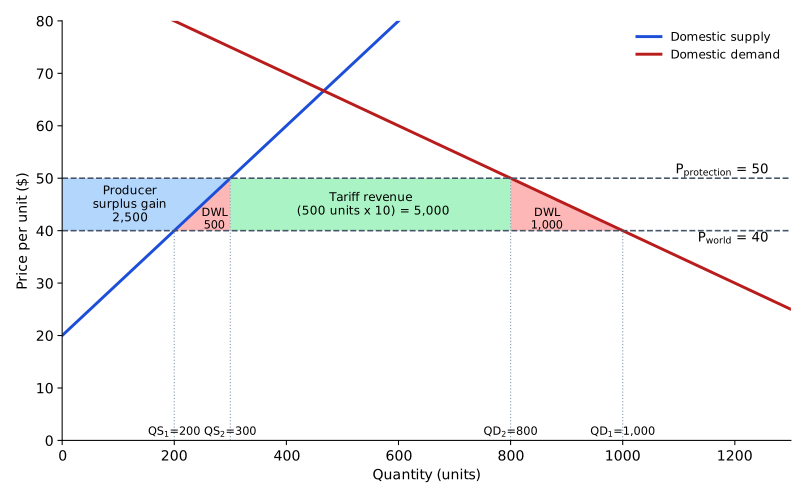
- The loss of consumer surplus is the whole area between and to the left of the demand curve.
- Part of it goes to domestic producers (the producer surplus gain, left of the supply curve).
- The rectangle (new imports price increase) is tariff revenue for the government under a tariff.
- The two triangles are the deadweight loss: welfare lost to the economy as a whole.
Under a quota, the rectangle goes to whoever holds the import licenses. If the domestic government sells the licenses for their full value, the outcome equals the tariff. If it gives them away, the rectangle becomes quota rents earned by the license holders. When the licenses are given free to foreign exporters, the rents leave the country and the domestic welfare loss is larger by that amount. A VER produces the same welfare loss as an equivalent quota whose licenses are given to foreign exporters free of charge, because the importing country captures none of the quota rents.
Tariff welfare formulas (small country)
For a small importing country (the world price does not change) and straight-line supply and demand between the two prices, let subscript 0 denote free trade at , subscript 1 denote the protected price , , and denote imports after the restriction. Then:
Key concept
Worked example (small country). The world price of a good is $40; a tariff of $10 per unit raises the domestic price to $50. Domestic supply rises from 200 to 300 units and domestic demand falls from 1,000 to 800 units, so imports fall from 800 to 500.
With an equivalent quota and free licenses granted to foreign exporters, the $5,000 becomes quota rents for those exporters and the domestic loss rises to $6,500.
Export subsidies and other effects of trade restrictions
Export subsidies. For a small exporting country, the domestic price rises by the full amount of the subsidy (world price + subsidy), because producers will not sell at home for less than they earn on each exported unit. For a large exporter, the world price falls, so foreign consumers capture part of the benefit and foreign producers are hurt.
Other winners and losers from a tariff. Workers in the protected industry gain along with its producers. Domestic consumers also lose choice, foreign exporters lose sales, and domestic users of the protected good (e.g., firms buying protected machinery as an input) face higher costs. Tariff revenue helps explain why trade restrictions remain widespread, but the gains to protected producers and the government are usually smaller than the losses to consumers and other industries.
Capital restrictions limit cross-border flows of financial capital: bans on foreign investment in the country, prohibitions or taxes on the income residents earn on foreign investments, bans on foreign investment in certain industries, and limits on repatriating the earnings of foreign-owned firms. They are generally thought to reduce welfare. Developing countries have sometimes used them in the short run to damp surges of capital inflows in booms and outflows in panics, but these short-run benefits may not offset the longer-run cost of being excluded from global capital markets.
Common exam traps
- Assuming every quota earns the government revenue. Revenue needs sold licenses; licenses given free to foreign exporters send the quota rents abroad. In the worked example, free licenses to foreign exporters raise the domestic loss from $1,500 to $6,500.
- Foreign consumers are unaffected by a small (price-taking) country's tariff or quota. A large importer's restriction can lower the world price, which benefits foreign consumers rather than harming them.
- A VER is imposed by the exporting country, yet it protects producers in the importing country.
- Forgetting downstream users. A tariff on imported lumber raises costs for domestic home builders, so they lose even though lumber producers gain.
LOS 17.c — Trading blocs, common markets and economic unions
Motivation. All regional trading agreements (RTAs), also called trading blocs, reduce trade barriers among members. Their primary purpose is to raise members' economic welfare. Gains come from trading according to comparative advantage and from greater competition among member firms. Some firms and workers lose and may need to retrain. On balance, reducing trade restrictions raises welfare. However, if an agreement raises barriers against nonmembers, a member may switch from low-cost imports from a nonmember to higher-priced imports from a member, which reduces the gains and in an extreme case could outweigh them. A free trade area leaves each member's own policy toward nonmembers in place, so it is the form least likely to force such a switch.
Levels of integration (each level adds one feature to the previous one):
Key concept
| Agreement | Free trade among members | Common trade restrictions with nonmembers | Free movement of labor and capital | Common institutions and economic policy | Single currency |
|---|---|---|---|---|---|
| Free trade area | Yes | No | No | No | No |
| Customs union | Yes | Yes | No | No | No |
| Common market | Yes | Yes | Yes | No | No |
| Economic union | Yes | Yes | Yes | Yes | No |
| Monetary union | Yes | Yes | Yes | Yes | Yes |
Examples: NAFTA was a free trade area, the European Union is an economic union, and the eurozone is a monetary union. The single currency of a monetary union removes currency conversion costs and exchange rate risk on trade among members.
Example. Four countries scrap all tariffs on trade among themselves and apply one common tariff schedule to imports from outside, but a worker from one member still needs a permit to take a job in another. Free trade and common external restrictions are present, while free movement of labor is not, so the arrangement is a customs union. Dropping the permits and the barriers to capital flows would turn it into a common market.
Common exam traps
- A common market already has common external trade restrictions; what an economic union adds is common institutions and economic policy.
- Crediting a customs union with free movement of labor. That feature starts at the common market level.
- Only a monetary union requires a single currency.
Exam shortcuts
- Find comparative advantage from opportunity costs, not output: the country that gives up less of the other good has the advantage, even if the other country produces more of both goods.
- Each level of integration adds one feature to the level below, so classify an agreement by the highest feature it has: free trade among members, common restrictions on nonmembers, free movement of labor and capital, common institutions and economic policy, then a single currency.
Bottom line
- A country has a comparative advantage in a good when its opportunity cost of producing it is lower than other countries', and specializing according to comparative advantage raises total output.
- Newer trade models add gains from economies of scale, more variety for consumers, stronger competition and a better allocation of resources.
- Consumers of imported goods and export industries gain from trade while import-competing producers and workers lose, but overall gains exceed losses, especially in the long run, and both trading partners share the net gains.
- Infant industry and national security arguments for trade restrictions have some support among economists, while protecting domestic jobs or industries has little or none.
- Tariffs, import quotas and VERs reduce imports, raise the domestic price, domestic quantity supplied and producer surplus, lower consumer surplus and reduce national welfare, with the possible exception of a tariff or quota imposed by a large importing country.
- A quota whose licenses the government sells for full value has the same outcome as an equivalent tariff, while free licenses to foreign exporters send the quota rents abroad, and a VER causes the same welfare loss as an equivalent quota with free licenses to foreign exporters.
- An export subsidy raises the domestic price by the full subsidy in a small exporting country, while a large exporter's subsidy lowers the world price, benefiting foreign consumers and hurting foreign producers.
- A free trade area removes barriers among members, a customs union adds common restrictions on nonmembers, a common market adds free movement of labor and capital, an economic union adds common institutions and economic policy, and a monetary union adds a single currency.
Quick check
Regarding the gains and losses that international trade creates, which of the following statements is most accurate?
Show answer and explanation
Correct answer: B
For the economy as a whole, the benefits of trade exceed the costs. The costs are concentrated among firms and workers in domestic industries that compete with imports, who may suffer lower profits or lost jobs.
Why the other options are wrong
- A. Not every group gains. Import-competing industries and their workers can lose, even though the gainers could in principle compensate them.
- C. Jobs lost in import-competing industries are offset by jobs created in export and growing industries, and over time retrained workers find new work. Economists do not conclude that trade's employment costs exceed its benefits.
Key takeaway Overall gains exceed losses, but the losses are concentrated in import-competing industries.
Practice Questions
Which of the following statements correctly describes how a tariff differs from a quota?
Show answer and explanation
Correct answer: C
A tariff is a tax on imported goods collected by the government; a quota caps the quantity that may be imported over a period. Both are trade restrictions imposed by individual countries.
Why the other options are wrong
- A. Tariffs are not set by international organizations. Individual countries impose both tariffs and quotas.
- B. A quota is not a worldwide agreement on total trade. It is a limit on imports set by the individual importing country, just as a tariff is.
Key takeaway Tariff = tax on imports; quota = quantity limit on imports; both are imposed by the importing country.
Tessaly, a small country, is choosing among three measures that would each cut its imports of washing machines by the same quantity: a tariff, an import quota whose licenses the government auctions for their full value, or a voluntary export restraint agreed with the main exporting country. Which measure would cause the greatest loss of national welfare for Tessaly?
Show answer and explanation
Correct answer: A
All three measures raise Tessaly's domestic price by the same amount and cut imports by the same quantity, so they cause the same loss of consumer surplus, the same gain in domestic producer surplus and the same deadweight losses. They differ in who receives the amount equal to the price increase times the remaining imports. Under a tariff the government collects it as tariff revenue, and under the auctioned quota the government captures it by selling the licenses. Under a voluntary export restraint the foreign exporters keep it as quota rents, so it is lost to Tessaly and the national welfare loss is the largest.
Illustration with assumed areas: consumer surplus falls by 50, domestic producer surplus rises by 20, the rectangle (price increase remaining imports) is 18 and the two deadweight triangles total 12, so .
Tariff: . Auctioned quota: . Voluntary export restraint: , because the rectangle goes to foreign exporters.
Why the other options are wrong
- B. A tariff causes the same price rise and deadweight losses, but the government collects tariff revenue equal to the price increase times the remaining imports. That revenue stays in Tessaly and offsets part of the consumers' loss.
- C. Auctioning the licenses for their full value lets the government capture the quota rents, so the national welfare effect matches the tariff. A quota would be as costly as the voluntary export restraint only if its licenses were given away to foreign exporters.
Key takeaway For an importing country, the national welfare loss from a tariff equals that from a quota whose licenses are sold at full value. A voluntary export restraint, like a quota whose rents go to foreign exporters, adds the quota rents to the loss.
Which sequence ranks regional trading agreements correctly, starting with the lowest and ending with the highest level of economic integration?
Show answer and explanation
Correct answer: B
Integration increases in this order: free trade area, customs union, common market, economic union, monetary union. Each step adds a feature: common external trade restrictions (customs union), free movement of labor and capital (common market), common institutions and economic policy (economic union), and a single currency (monetary union). The sequence free trade area, customs union, common market follows that order.
Why the other options are wrong
- A. A customs union is less integrated than a common market, so it cannot come after it.
- C. A free trade area is the least integrated form, so it cannot come after a customs union.
Key takeaway Least to most integrated: free trade area, customs union, common market, economic union, monetary union.
This reading has 28 questions in the full bank. Practice all of them.
Key Takeaways
- Overall gains exceed losses, but the losses are concentrated in import-competing industries.
- Tariff = tax on imports; quota = quantity limit on imports; both are imposed by the importing country.
- For an importing country, the national welfare loss from a tariff equals that from a quota whose licenses are sold at full value. A voluntary export restraint, like a quota whose rents go to foreign exporters, adds the quota rents to the loss.
- Least to most integrated: free trade area, customs union, common market, economic union, monetary union.