Economics · Reading 16
Introduction to Geopolitics
CFA Level I · Economics · Reading 16 · about 31 min
What you'll learn
- LOS 16.a Describe geopolitics as the degree of cooperation versus competition among state and nonstate actors, and why countries cooperate.
- LOS 16.b Relate geopolitics to globalization versus nationalism and classify countries as autarky, hegemony, bilateralism or multilateralism.
- LOS 16.c Describe the functions and objectives of the IMF, the World Bank and the WTO.
- LOS 16.d Describe event, exogenous and thematic geopolitical risk and its likelihood, impact and velocity (including black swan risk).
- LOS 16.e Describe national security, economic and financial tools of geopolitics and their effects.
- LOS 16.f Describe how geopolitical risk affects investments: impact, discrete vs broad effects, business cycle, scenario analysis and signposts.
Module 16.1
Geopolitics
This reading describes geopolitics through two lenses, cooperation versus competition and globalization versus nationalism, which combine into four archetypes, and it sets out the roles of the IMF, the World Bank and the WTO. It then classifies geopolitical risks and the tools of geopolitics, and explains how investors judge a risk's likelihood, impact and velocity using scenario analysis and signposts.
LOS 16.a — Geopolitics as cooperation versus competition
Geopolitics is the study of interactions among nations. The players are state actors (national governments) and nonstate actors (companies, nongovernment organizations and individuals). Geopolitics also looks at how geography shapes these interactions: a country with a long coastline and deep-water ports, for example, tends to produce firms that dominate seaborne shipping.
A useful lens is the degree of cooperation among countries. Cooperation means engaging with other countries on diplomatic, military, economic and cultural matters. Economic cooperation includes:
- letting goods, services and capital move freely between countries;
- agreeing on common tariff levels;
- adopting common international rules (e.g., shared financial reporting standards);
- transfers of information and technology.
A country that restricts these flows, for example by banning exports of a particular good, is acting noncooperatively. In practice cooperation varies along a spectrum. A country may cooperate on trade but not on defense, and its stance can shift with elections or a change of leadership, so analysts watch the current decision makers and the length of the political cycle.
Why countries cooperate. A country cooperates when doing so advances its national interests, which can be ranked as a hierarchy with survival at the top. The motives fall into three groups:
- Security. Survival comes first, so a country may join its neighbors in a military alliance to protect its citizens from invasion.
- Economic interests. Resource endowments shape these: a country rich in minerals but short of farmland must trade minerals for food, so it wants international trade lanes kept open. Nonstate actors cooperate across borders because they want to put resources to their highest-valued use, and they push for standardized regulations and processes.
- Culture. Cultural factors (a shared language, historical migration) and strong, stable institutions (laws, organizations, customs) make cooperation easier. Large exporters of films, music and other cultural content usually have strong legal protection for intellectual property. Such exports are one source of soft power: influencing other countries without using or threatening force.
Common exam traps
- Treating cooperation as all-or-nothing; a country can be cooperative on some issues and noncooperative on others.
- Assuming cooperation is altruistic; it is driven by national interest.
LOS 16.b — Geopolitics and globalization
Globalization is the long-run trend toward worldwide integration of economic activity and cultures. Economic openness (trade as a share of world output) climbed from roughly a quarter of output in the early 1970s to around 60% before the 2008 financial crisis and has stayed near that level. Its opposite, nationalism, here means a country putting its own economic interests first, acting either alone or in competition with other countries. Countries near the globalization end trade more, allow freer movement of capital and currency exchange, and are more open to cultural interaction.
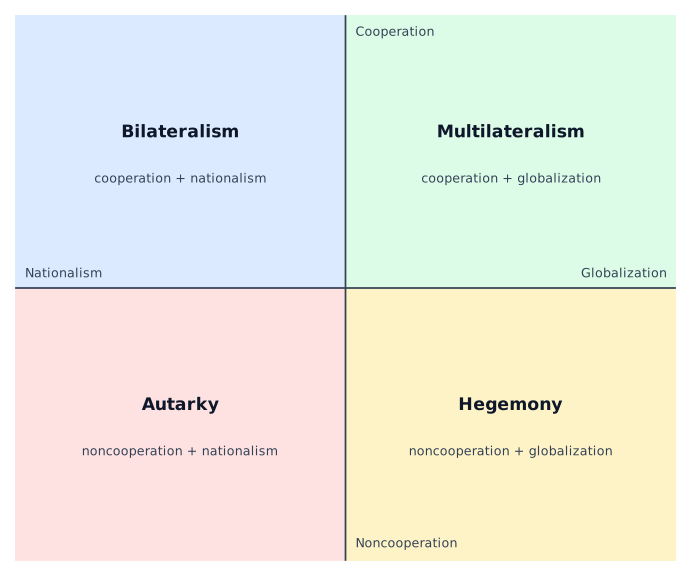
Crossing the cooperation spectrum with the globalization spectrum gives four archetypes of geopolitical behavior:
Key concept
| Archetype | Cooperation axis | Globalization axis | Typical behavior |
|---|---|---|---|
| Autarky | Noncooperation | Nationalism | Seeks national self-reliance and self-sufficiency; produces most goods at home, so little or no external trade; often a state-dominated society with government control of industry and media |
| Hegemony | Noncooperation | Globalization | Open to global trade but large enough to influence other countries without needing to cooperate |
| Bilateralism | Cooperation | Nationalism | Cooperates through one-to-one relationships with individual countries (possibly many of them) but avoids multicountry arrangements |
| Multilateralism | Cooperation | Globalization | Trades extensively and cooperates with many countries at once; regionalism is a variant that cooperates multilaterally mainly with neighbors |
Nonstate actors may be more globally minded than their governments: firms look abroad for profits, lower costs and new markets; investors look abroad for returns and diversification, through portfolio investment flows (buying foreign securities) or foreign direct investment (owning production capacity abroad).
Example. Country Q trades heavily with the rest of the world and is so large that it sets terms on its own rather than joining multicountry agreements. It is globalized but noncooperative, so it fits hegemony. If instead it signed dozens of separate two-country trade deals but kept away from regional blocs, it would fit bilateralism.
Common exam traps
- Bilateralism is cooperative, even though it sits on the nationalist side.
- Hegemony is globalized, even though it is noncooperative.
LOS 16.c — International organizations that facilitate trade
| Organization | Core mission | Key functions |
|---|---|---|
| International Monetary Fund (IMF) | International monetary stability | Article I goals: promoting international monetary cooperation; facilitating the expansion and balanced growth of international trade; promoting exchange stability; assisting in the establishment of a multilateral system of payments; making resources available (with adequate safeguards) to members experiencing balance of payments difficulties |
| World Bank | Fighting poverty | Financial and technical assistance to developing countries: low-interest loans, interest-free credits and grants for education, health, infrastructure, agriculture, public administration and more. Made up of the IBRD (middle-income and creditworthy poorer countries) and the IDA (the poorest countries) |
| World Trade Organization (WTO) | Global rules of trade | The only international organization dealing with the rules of trade between nations; aims for trade that flows smoothly, predictably and freely; negotiated agreements bind members' trade policies; a dispute settlement process resolves trade friction |
Common exam traps
- Thinking only the WTO works to expand trade. The IMF's Article I goals include the expansion and balanced growth of international trade.
- Thinking only one body provides funds. The IMF makes resources available to members with balance of payments difficulties, and the World Bank lends to developing countries for development and poverty reduction.
- Mixing up the roles that belong to one body: fighting poverty is the World Bank's mission (it is not among the IMF's Article I goals), exchange stability is an IMF goal, and settling trade disputes is the WTO's job.
LOS 16.d — Geopolitical risk
Geopolitical risk is the possibility of events that disrupt peaceful international relations. Three types:
Key concept
| Type | What is known | Example |
|---|---|---|
| Event risk | Timing known, outcome unknown | A national election or a scheduled referendum |
| Exogenous risk | Not anticipated at all | A sudden war, coup or rebellion |
| Thematic risk | Known factors whose effects play out over a long period | Migration patterns, climate trends, cyber risks |
Geopolitical risk changes the risk premium investors demand for holding assets in a country or region. A higher risk premium means a higher discount rate, and therefore lower asset values, for the same expected cash flows. Three dimensions describe a risk:
- Likelihood: the probability that it occurs.
- Impact: how large its effect on investment outcomes would be.
- Velocity: how quickly investment values reflect the effect.
The cooperation/globalization framework helps with likelihood: more cooperative and globalized countries face less risk of some events (armed conflict) but more of others (e.g., supply chain disruptions such as those of 2020–2021).
Velocity classes
| Velocity | Horizon | Typical effect |
|---|---|---|
| High | Short term | Exogenous shocks moving markets quickly; includes black swan risk — low-likelihood exogenous events with substantial short-term effects |
| Medium | Intermediate | Raises costs or disrupts production for specific companies or industries |
| Low | Long term | Affects companies mainly in the environmental, social, and governance (ESG) realm |
Investors with long horizons usually do not need to react to black swan events; short-horizon investors may have to. Long-horizon investors should instead analyze medium- and low-velocity risks.
Common exam traps
- Velocity measures how fast investment values respond. How fast the event itself unfolds is a separate matter.
- A black swan is low probability with a short-term (not long-term) impact.
- Calling a scheduled election exogenous because its result is unknown. A known date makes it event risk.
LOS 16.e — Tools of geopolitics
Tools of geopolitics are the means (mostly used by state actors) to advance national interests. There are three categories, and they are classified in two different ways.
National security tools include armed conflict, espionage, and bilateral or multilateral defense agreements meant to reinforce or prevent armed conflict. They are classified by status: active if a country is using the tool now, threatened if it is not using it but appears likely to. Armed conflict destroys productive capital and drives migration away from conflict zones.
Economic tools and financial tools are classified by whether a country uses them cooperatively:
Key concept
| Category | Cooperative use | Noncooperative use |
|---|---|---|
| Economic tools | Free trade areas, common markets, economic and monetary unions | Domestic content requirements, voluntary export restraints, nationalization of companies or industries |
| Financial tools | Allowing foreign investment and the free exchange of currencies | Restricting foreign investment or currency exchange |
Sanctions restrict the financial interests of a specific geopolitical actor. They count as a financial tool, and state actors often combine them with national security tools.
Common exam traps
- Classifying sanctions as a national security tool because they accompany military pressure. They are a financial tool.
- Restrictions on currency conversion are a noncooperative financial tool; voluntary export restraints are a noncooperative economic tool.
LOS 16.f — Geopolitical risk and investments
Analysis costs time and money, so investors should concentrate on risks with potentially high impact, and for those, judge whether the effect is discrete (a single company or industry) or broad (a country, region or the world). The business cycle matters: a geopolitical risk may have a larger effect on investment values in a recession than in an expansion.
Tools for the analysis:
- Scenario analysis (qualitative or quantitative) estimates how a geopolitical risk would affect a portfolio.
- Signposts are data or indicators that signal whether an event's likelihood is rising or falling (e.g., market volatility measures), helping investors track a risk over time.
Common exam traps
- Mixing up the two tools. A volatility index watched for a change in the chance of conflict is a signpost; a what-if estimate of the portfolio loss if conflict breaks out is scenario analysis.
Exam shortcuts
- Place a country on the two axes and the archetype follows: noncooperative and nationalist is autarky, noncooperative and globalized is hegemony, cooperative and nationalist is bilateralism, and cooperative and globalized is multilateralism.
- Classify a geopolitical risk by what is known in advance: a known date with an unknown outcome is event risk, an unanticipated event is exogenous risk, and known factors with long-lasting effects are thematic risk.
Bottom line
- Geopolitics studies interactions among nations, involving state actors (national governments) and nonstate actors (companies, nongovernment organizations and individuals), and a country's cooperation varies along a spectrum, driven by its national interests in security, economic needs and culture.
- Globalization is the long-run integration of economic activity and cultures across the world, and nationalism here means a country putting its own economic interests first, alone or in competition with others.
- The IMF promotes international monetary cooperation, balanced growth of trade and exchange stability and makes resources available, with adequate safeguards, to members with balance of payments difficulties; the World Bank fights poverty with loans, credits and grants to developing countries; the WTO, the sole international body for the rules of trade between nations, runs a dispute settlement process.
- Geopolitical risk changes the risk premium on a country's or region's assets and is described by its likelihood, its impact and its velocity, meaning how quickly investment values reflect it.
- A black swan is a low-likelihood exogenous event with substantial short-term effects; long-horizon investors usually need not react to one and should instead analyze medium- and low-velocity risks.
- National security tools are classified as active or threatened, while economic and financial tools are classified as cooperative or noncooperative, and sanctions count as a financial tool.
- Investors should focus on geopolitical risks with potentially high impact, judge whether their effects are discrete or broad, estimate them with scenario analysis and track their likelihood with signposts.
Quick check
During the same year, the government of Aldmere (1) signs an agreement with neighboring states to harmonize product standards and lower tariffs among them, and (2) bans all exports of rare-earth minerals mined within its borders. From a geopolitical perspective, which of the two actions counts as cooperative?
Show answer and explanation
Correct answer: C
In geopolitics, cooperation means interacting and engaging with other countries, for example by allowing goods to move freely across borders, harmonizing tariffs and standardizing rules. The regional agreement is therefore cooperative. Banning exports of a particular good restricts engagement with other countries, so it is noncooperative. Only one of the two actions is cooperative.
Why the other options are wrong
- A. The trade and standards agreement is a clear example of economic cooperation, so it is not true that neither action is cooperative.
- B. An export ban limits interaction with other countries and is noncooperative, so both actions cannot be cooperative. A country can be cooperative on some issues and noncooperative on others at the same time.
Key takeaway Cooperation is a spectrum and is judged issue by issue: trade agreements and harmonization are cooperative, while export bans and investment restrictions are noncooperative.
Practice Questions
An analyst compares the goals listed in Article I of the International Monetary Fund's (IMF's) Articles of Agreement with the stated mission of the World Bank and the role of the World Trade Organization (WTO). Which of her conclusions is most accurate?
Show answer and explanation
Correct answer: A
The World Bank describes its mission as fighting poverty, and it provides low-interest loans, interest-free credits and grants to developing countries for that purpose. The IMF's goals in Article I of its Articles of Agreement concern monetary cooperation, the growth of trade, exchange stability, the payments system and balance of payments support, and the WTO deals with the rules of trade. Neither Article I nor the WTO's role includes poverty reduction, so the World Bank is the only one of the three explicitly focused on it. The IMF's broader mission statement also mentions reducing poverty, which is why the comparison uses Article I.
Why the other options are wrong
- B. Expanding trade is not unique to the WTO. One of the IMF's main goals is facilitating the expansion and balanced growth of international trade.
- C. Providing funds is not unique to the IMF. The IMF makes resources available to members with balance of payments difficulties, but the World Bank also provides loans, credits and grants to developing countries for development.
Key takeaway Trade growth: IMF and WTO. Funding members: IMF and World Bank. Poverty: World Bank only.
A portfolio manager is classifying the geopolitical risks that could affect her emerging market holdings. Which of the following is best described as an event risk?
Show answer and explanation
Correct answer: C
Event risk arises from an event whose timing is known but whose outcome is uncertain. The referendum is scheduled a year ahead, while its result remains unknown.
Why the other options are wrong
- A. A known factor with effects that build over many years is thematic risk.
- B. A sudden rebellion with no advance warning is exogenous risk, not event risk.
Key takeaway Event risk: known timing, uncertain outcome. Exogenous risk: unanticipated events. Thematic risk: known factors whose effects develop over a long period.
Which of the following statements about the effect of geopolitical risk on investments is most accurate?
Show answer and explanation
Correct answer: B
The business cycle affects the impact of geopolitical risk. The same risk may have a greater effect on investment values during a recession than it would during an expansion.
Why the other options are wrong
- A. Scenario analysis, qualitative or quantitative, is a standard way to gauge the potential effects of geopolitical risks on a portfolio.
- C. Geopolitical risks can have discrete effects on a specific company or industry as well as broad effects on a country, a region or the world. Investors should judge which applies to each high-impact risk.
Key takeaway Focus analysis on high-impact risks, decide whether each is discrete or broad, allow for a larger impact in a recession, and use scenario analysis and signposts.
This reading has 24 questions in the full bank. Practice all of them.
Key Takeaways
- Cooperation is a spectrum and is judged issue by issue: trade agreements and harmonization are cooperative, while export bans and investment restrictions are noncooperative.
- Trade growth: IMF and WTO. Funding members: IMF and World Bank. Poverty: World Bank only.
- Event risk: known timing, uncertain outcome. Exogenous risk: unanticipated events. Thematic risk: known factors whose effects develop over a long period.
- Focus analysis on high-impact risks, decide whether each is discrete or broad, allow for a larger impact in a recession, and use scenario analysis and signposts.