Economics · Reading 15
Quantitative Easing
CFA Level I · Economics · Reading 15: Monetary Policy · about 49 min
What you'll learn
- LOS 15.a Describe the roles of central banks (currency supplier, bankers' bank, regulator, lender of last resort, reserve holder, monetary policy) and their objectives, chiefly price stability.
- LOS 15.b Describe the policy rate, reserve requirements and open market operations, the monetary transmission mechanism, and how monetary policy affects growth, inflation, interest rates and exchange rates.
- LOS 15.c Describe the qualities of effective central banks, compare inflation, interest rate and exchange rate targeting, judge the policy stance against the neutral rate, and describe the limitations of monetary policy.
- LOS 15.d Explain how combinations of monetary and fiscal policy affect interest rates, output and the private and public sectors.
Module 15.1
Central Bank Objectives and Tools
This reading covers the roles and objectives of central banks, the tools of monetary policy and the transmission mechanism through which a policy-rate change reaches inflation. It then describes the qualities of an effective central bank, inflation, interest rate and exchange rate targeting, the neutral interest rate, the limits of monetary policy, and how monetary and fiscal policy interact.
LOS 15.a — What central banks do and what they aim for
Roles of a central bank. A modern central bank typically performs six roles:
Key concept
| Role | What it means in practice |
|---|---|
| Sole supplier of currency | Only the central bank can issue the country's currency (notes and coins) and bank reserves. Exam convention: the central bank is described as the sole supplier of money. Current practice: its monopoly covers currency and bank reserves, while most deposit money is created by commercial banks when they lend. Today currency is fiat money — money with no backing in gold or any other tangible asset, accepted because the law makes it legal tender and because it keeps its value. |
| Banker to the government and other banks | Holds accounts for the government and for commercial banks and provides them with banking services. |
| Regulator and supervisor of the payments system | Sets risk-taking standards and reserve requirements for banks and oversees domestic and cross-border clearing. |
| Lender of last resort | Because it can create money, it can lend to banks that run short of funds. Knowing this backstop exists reassures depositors and helps prevent bank runs. |
| Holder of gold and foreign exchange reserves | Keeps the nation's official gold and foreign currency reserves. |
| Conductor of monetary policy | Controls or influences the quantity of money and its growth over time. |
Collecting taxes is not a central bank function; a separate government agency does it. Being banker to the government means providing it with banking services, such as holding its accounts; making loans to government agencies is not among the central bank roles listed here.
Key concept
Objectives. The primary objective is to control inflation so as to promote price stability. High inflation imposes menu costs (firms repeatedly re-pricing their goods) and shoe leather costs (people making extra trips to the bank to avoid holding cash that loses value). Some central banks have additional goals:
- stable exchange rates with foreign currencies;
- full employment;
- sustainable positive economic growth;
- moderate long-term interest rates.
Inflation targets. Most developed-country central banks aim for inflation in a range around 2% to 3%. They avoid a zero target because random swings around zero would often mean deflation, which is disruptive. Exam convention: the US Federal Reserve and the Bank of Japan are the developed-country exceptions without an explicit inflation target. The Fed's goals also include maximum employment and moderate long-term rates, and Japan has struggled with persistent deflation. Current practice: both now have explicit 2% goals. The Fed adopted a longer-run goal of 2% inflation, measured by the PCE price index, in January 2012, alongside its dual mandate (maximum employment as well as stable prices). The Bank of Japan adopted a 2% CPI price stability target in January 2013 while fighting deflation.
Pegging. Some countries instead peg their currency to another currency, most often the US dollar, and run monetary policy to hold that exchange rate. How a peg is defended, and what it does to the money supply, interest rates and inflation, is covered under exchange rate targeting (LOS 15.c).
Common exam traps
- "Minimize long-term interest rates" is not a goal. The goal is moderate long-term rates.
- A mandate focused only on price stability means the bank fights above-target inflation even during a recession.
LOS 15.b — Policy tools and the monetary transmission mechanism
The three main tools
Key concept
| Tool | Expansionary use | Contractionary use |
|---|---|---|
| Policy rate — the rate at which the central bank lends reserves to banks: the discount rate (US), the refinancing rate (ECB), the two-week repo rate (Bank of England, lending through a repurchase agreement) | Lower it | Raise it |
| Reserve requirements — percentage of deposits banks must hold as reserves | Lower them (more funds to lend) | Raise them |
| Open market operations — buying and selling (usually government) securities | Buy securities | Sell securities |
- In a repurchase agreement (repo), the central bank buys securities from a bank that agrees to buy them back later at a slightly higher price. The percentage difference between the two prices is the interest rate on what is, in effect, a short-term loan to the bank.
- Open market purchases: cash replaces securities in investors' accounts, banks get excess reserves, more funds are available for lending, the money supply rises and interest rates fall. Open market sales do the reverse and push rates up.
- In the US, the federal funds rate is the market rate banks charge each other for overnight loans of reserves. The Federal Reserve sets a target for it and uses open market operations (its most-used tool) to steer the actual rate there. Do not confuse it with the discount rate, which is the rate a bank pays when it borrows from the Federal Reserve.
- The central bank does not set exchange rates, the prices of government securities or the yield on existing bonds directly. It also cannot compel banks to tighten or loosen their credit standards. It can only encourage them.
- Lowering reserve requirements has an effect only when banks want to extend more loans and borrowers want to take them.
- Exam convention: the policy rate, reserve requirements and open market operations are the three working tools of monetary policy. Current practice: the Federal Reserve set its reserve requirement ratios to zero in March 2020, and with reserves plentiful since the 2008 financial crisis it steers the federal funds rate mainly through the interest rate it pays on banks' reserve balances rather than through day-to-day open market operations.
The monetary transmission mechanism is how a change in the policy rate reaches the price level and inflation. It works through four channels: other short-term rates, asset prices, expectations, and exchange rates. The figure traces a policy-rate increase:
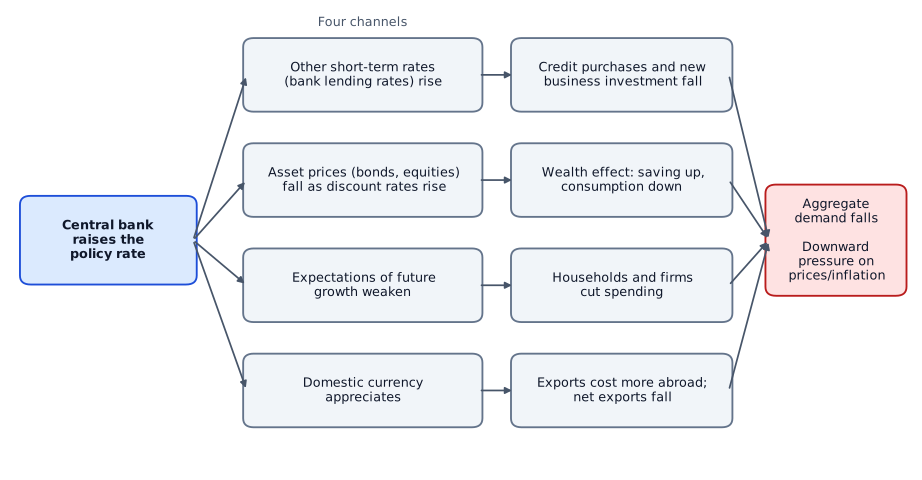
- Banks raise their short-term lending rates, so consumers cut credit purchases and firms cut investment.
- Higher rates for discounting future cash flows lower bond, equity and other asset prices. The resulting wealth effect raises saving and lowers consumption.
- Expectations of future growth weaken, so spending falls.
- Higher rates attract foreign capital, the domestic currency appreciates, exports become more expensive for foreigners and net exports fall. Through this channel the trade balance worsens.
Together these reduce aggregate demand and push the price level down. The policy rate acts directly on the first links in the chain: other short-term rates, asset prices, expectations and the exchange rate. Inflation is the end point, reached through these channels and only after a lag. A policy-rate cut works through the same channels in the opposite direction.
Expansionary policy step by step. The central bank buys securities, so bank reserves rise and the interbank rate falls. Other short-term rates and then longer-term rates fall, and the currency depreciates. Business investment, consumer purchases of houses, autos and durable goods, and net exports all rise. Aggregate demand increases, which raises inflation, employment and real GDP in the short run. If money neutrality holds, monetary policy has no effect on real output in the long run.
Example. The central bank of a small economy raises its policy rate from 3.00% to 3.50% and sells government bonds to make the higher rate stick. Expected effects: bank reserves and excess reserves fall; short- and long-term market rates rise; bond and share prices fall; the currency appreciates; investment, durable-goods spending and exports fall. Aggregate demand falls, so in the short run both real GDP and the price level fall, and the unemployment rate rises.
Common exam traps
- Tightening raises the currency's foreign exchange value, so a "decrease in the foreign exchange value" is not a channel through which tightening cuts spending.
- Tightening raises real interest rates in the short run and increases unemployment.
- If inflation is below target, the central bank eases: it buys securities or cuts the policy rate or reserve requirement.
Exam shortcuts
- Monetary tightening makes the domestic currency appreciate, so an answer in which tightening cuts spending through a weaker currency can be ruled out.
Bottom line
- A central bank supplies currency, acts as banker to the government and other banks, regulates and supervises the payments system, is lender of last resort, holds gold and foreign exchange reserves and conducts monetary policy; under the exam convention it is the sole supplier of money, while in current practice its monopoly covers currency and bank reserves and commercial banks create most deposit money.
- Controlling inflation to promote price stability is a central bank's primary objective, and some central banks also aim for stable exchange rates, full employment, sustainable growth and moderate long-term interest rates.
- Most developed-country central banks aim for inflation in a range around 2% to 3%, not zero, because swings around a zero target would often mean deflation.
- Exam convention: open market operations, the policy rate and reserve requirements are the three working tools, used expansionarily by cutting the rate or requirements and buying securities; current practice: the Federal Reserve has set reserve requirements to zero and steers the federal funds rate mainly through the rate it pays on reserve balances.
- The federal funds rate is the market rate US banks charge each other for overnight loans of reserves, which the Federal Reserve targets, while the discount rate is what a bank pays to borrow from the Federal Reserve.
- A policy-rate change reaches the price level through other short-term rates, asset prices, expectations and exchange rates; a rate increase lowers aggregate demand and appreciates the currency, and if money neutrality holds, monetary policy has no long-run effect on real output.
Quick check
Rumors about loan losses lead depositors at several banks in Harwick to start withdrawing their money. Harwick's central bank announces that it will provide whatever funds are needed to any sound bank facing a cash shortage, and the withdrawals soon stop. This announcement reflects the central bank's role as:
Show answer and explanation
Correct answer: A
Because the central bank can create central bank money (reserves and currency) at will, it can lend to banks that run short of funds. Knowing this backstop exists assures depositors their money is safe and helps prevent bank runs. That is the lender-of-last-resort role.
Why the other options are wrong
- B. Holding the nation's gold and foreign currency reserves is a separate role. It concerns official reserves rather than emergency lending to domestic banks.
- C. Being the sole supplier of currency is what enables emergency lending, but the role being performed here is lending to banks in distress, i.e., lender of last resort.
Key takeaway Preventing bank runs by standing ready to lend to banks is the lender-of-last-resort role.
Module 15.2
Monetary Policy Effects and Limitations
LOS 15.c — Effective central banks, targeting regimes and limits of policy
Three essential qualities of an effective central bank
Key concept
| Quality | Meaning | Clue in a question |
|---|---|---|
| Independence | Free from political interference, which matters because politicians may want to boost growth before elections at the cost of higher inflation | Who decides the policy rate or the target? |
| Credibility | The bank follows through on what it says, so its targets become self-fulfilling: wages and contracts are set on the expected (target) inflation rate. A target set by a heavily indebted government instead would lack credibility, because that government gains from letting inflation overshoot | Economic actors base their decisions on the stated target |
| Transparency | Regular disclosure, e.g. inflation reports, and a clear statement of which indicators it uses and how. This supports credibility and makes policy moves easier to anticipate | Publishes reports and explains which indicators it uses and how |
Relevance, reliability, comparability and consistency are financial-reporting qualities. They are not on the central bank list.
Independence comes in degrees rather than all-or-nothing. Even a fairly independent central bank may have its head appointed by politicians.
- Operational independence: the central bank alone sets the policy rate.
- Target independence: in addition, it defines how inflation is computed, chooses the target inflation level and sets the horizon for reaching it. The ECB has both types. Most other central banks have operational independence alone.
Targeting regimes
Key concept
| Regime | How it works | Notes |
|---|---|---|
| Interest rate targeting | Add money when rates rise above a target band, withdraw money when they fall below it | Used in the past |
| Inflation targeting | Adjust policy to keep expected inflation (about two years ahead) inside a band | Most widely used today, and required by law in some countries. Users include the Bank of England, the ECB and the central banks of Canada, Australia, Brazil and Mexico |
| Exchange rate targeting | Buy or sell the domestic currency to hold a target exchange rate, often against the US dollar | Common in developing countries |
The most common inflation target is 2%, with a permitted deviation of ±1% (band 1% to 3%). Because of the deflation risk described under LOS 15.a, the band is set so that its lower edge (target minus deviation) stays at or above zero.
Exchange rate targeting mechanics. If the domestic currency falls below the target, the central bank buys domestic currency with foreign reserves. This reduces money supply growth and raises interest rates. If the currency rises above the target, the bank sells domestic currency, which increases the money supply and lowers rates. As a result, the money supply and interest rates can become more volatile. A country can run out of foreign reserves, so intervention has limits. Monetary policy must follow the peg regardless of domestic conditions, and the pegging country ends up with the anchor country's inflation rate.
Neutral interest rate and policy stance
Exam convention: the neutral interest rate is described as the growth rate of the money supply that neither speeds up nor slows economic growth. Current practice: it is treated as the policy interest rate at which policy neither stimulates nor restrains the economy, which is what the formula and the stance test below use:
Key concept
- Policy rate above neutral: contractionary. Policy rate below neutral: expansionary. Equal: neutral.
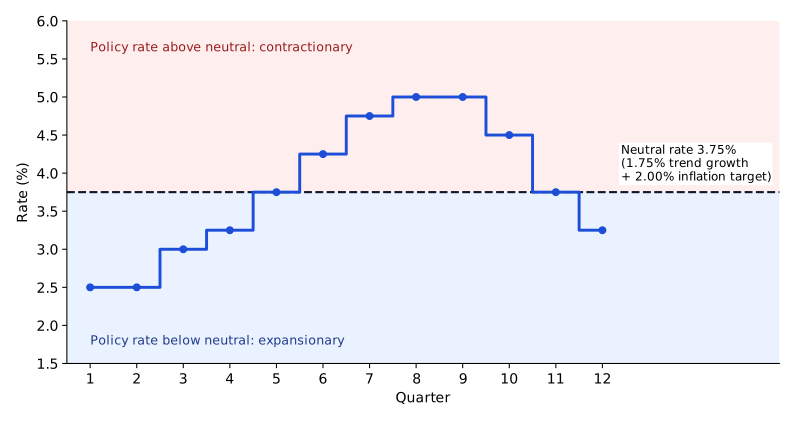
Example. Trend real growth 1.75% and inflation target 2.00% give a neutral rate of . A policy rate of 4.50% (above 3.75%) is contractionary. A policy rate of 3.00% is expansionary.
Limitations of monetary policy
- Long-term rates may not follow short-term rates. The central bank controls short-term rates directly, but long-term rates, which drive most household and business decisions, reflect expected inflation. Tightening can lower long-term yields. If markets believe it will work, expected inflation falls. If they see it as too severe, the higher probability of a recession makes long-term bonds more attractive. Easing that markets see as inflationary can raise long-term yields. Investors who sell long-term bonds for this reason are called bond market vigilantes. With a credible central bank this effect is small.
- Liquidity trap. When the demand for money becomes very elastic, people simply hold the extra money as cash, so adding money does not push rates down or stimulate spending. Deflation that persists despite expansionary policy points to a liquidity trap.
- Zero lower bound. Exam convention: the nominal policy rate cannot be cut below zero, so a central bank whose rate is already at zero has little room left to stimulate. Current practice: some central banks (e.g., the ECB, the Swiss National Bank and the Bank of Japan) have set slightly negative policy rates, but not far below zero. Either way, deflation is harder to reverse than inflation. Inflation can be fought by raising rates, which have no upper limit.
- Banks may not lend even when excess reserves rise (as after 2008). With short-term rates near zero, central banks turned to quantitative easing (QE): large-scale purchases of longer-term government bonds, mortgage securities and even securities with credit risk. The aim was to lower long-term rates and create excess reserves that encourage lending. Buying securities with credit risk may also shift risk from the private to the public sector.
- Developing economies face extra problems: illiquid government debt markets (making interest rate signals unreliable and open market operations hard), difficulty estimating the neutral rate, rapid financial innovation that changes money demand, and central banks that lack credibility or independence.
Common exam traps
- The benchmark for stance is the neutral interest rate. The inflation target and the trend growth rate are only its components.
- Setting the policy rate alone does not make a central bank target independent.
LOS 15.d — Interaction of monetary and fiscal policy
| Monetary | Fiscal | Interest rates | Output | Private sector | Public sector |
|---|---|---|---|---|---|
| Tight | Tight | Higher | Lower | Lower | Lower |
| Easy | Easy | Lower | Higher | Higher | Higher |
| Tight | Easy | Higher | Higher (exam convention, from the fiscal stimulus) | Lower | Higher |
| Easy | Tight | Lower | Varies (lower rates tend to raise it) | Higher | Lower |
When the two policies pull in opposite directions, the output entries follow the exam convention. Exam convention: expansionary fiscal with contractionary monetary policy is taken to raise aggregate demand and output. Contractionary fiscal with expansionary monetary policy has an output effect that varies, although the lower interest rates tend to raise private consumption and output. Current practice: in both mixed cases output rises only if the expansionary policy is the stronger of the two, so the direction depends on their relative strength. The sector-share effects (private vs. public share of GDP) and the direction of interest rates do not depend on that assumption.
- Contractionary fiscal + expansionary monetary: lower government borrowing and a larger money supply both lower rates, so the private sector grows and government spending as a share of GDP falls.
- Expansionary fiscal + contractionary monetary: rates rise (heavier government borrowing plus tight money), the public sector's share of GDP rises and the private sector is squeezed.
- Fiscal multipliers differ: direct government spending has had a larger multiplier than transfers or tax cuts. Among the latter, transfers to the poor have the greatest effect, followed by tax cuts for workers, then broad untargeted transfers. Every type of fiscal stimulus is more powerful when combined with expansionary monetary policy, possibly because of higher inflation, falling real interest rates and the extra business investment they bring. Cutting the discount rate or buying securities therefore reinforces expansionary fiscal policy during high unemployment.
Common exam traps
- Selling bonds or raising reserve requirements works against an expansionary fiscal stance.
Exam shortcuts
- To judge the stance, add the real trend growth rate and the inflation target and compare the policy rate with that sum: above it means contractionary, below it expansionary.
Bottom line
- An effective central bank has independence, credibility and transparency; operational independence means it sets the policy rate alone, and target independence means it also defines the inflation measure, the target and the horizon for reaching it.
- Inflation targeting, the most widely used regime, keeps expected inflation inside a band, most commonly 2% ± 1%, while an exchange rate target makes the central bank buy its currency with foreign reserves when it falls below target and sell it when it rises above, so the pegging country ends up with the anchor country's inflation rate.
- The neutral interest rate equals the real trend rate of economic growth plus the inflation target, and a policy rate above it is contractionary and below it expansionary; the exam convention describes the neutral rate as the money supply growth rate that neither speeds up nor slows growth, while current practice treats it as the policy rate that neither stimulates nor restrains the economy.
- Monetary policy can fail when long-term rates move against short-term rates because of expected inflation, in a liquidity trap where demand for money is very elastic, and when banks will not lend despite excess reserves, which led central banks to quantitative easing.
- Exam convention: the nominal policy rate cannot be cut below zero, leaving little room to stimulate; current practice: some central banks have set slightly negative rates; either way deflation is harder to reverse than inflation.
- With expansionary fiscal and contractionary monetary policy, interest rates rise and the public sector's share of GDP rises, while contractionary fiscal and expansionary monetary policy lower rates and let the private sector grow.
Quick check
In Taviston, unions and employers routinely write the central bank's announced inflation target into multi-year wage agreements, and lenders price loans on the assumption that inflation will stay close to that target. This behavior indicates that Taviston's central bank has:
Show answer and explanation
Correct answer: A
A credible central bank is one whose stated targets people believe. They then base their decisions (wages, nominal contracts, loan pricing) on the target inflation rate, which helps make the target self-fulfilling.
Why the other options are wrong
- B. Transparency means periodically disclosing the state of the economy (e.g., inflation reports) and the indicators used. It supports credibility, but the behavior described is the definition of credibility itself.
- C. Target independence means the central bank determines how inflation is computed, sets the target level and the horizon. It says nothing about whether the public believes the target.
Key takeaway Decisions based on the announced target = credibility. Regular inflation reports = transparency. Deciding the policy rate or the target = independence.
Practice Questions
Suppose the Federal Reserve carries out open market sales of Treasury securities. What happens to bank reserves and to the federal funds rate?
Show answer and explanation
Correct answer: A
Buyers of the securities pay with funds that leave the banking system, so bank reserves fall. With fewer reserves to lend to one another, banks bid up the overnight rate, and the federal funds rate increases. This is how the Federal Reserve moves the rate toward a higher target.
Why the other options are wrong
- B. The reserve effect is right, but scarcer reserves push the federal funds rate up.
- C. This describes open market purchases, which add reserves and lower the federal funds rate.
Key takeaway Open market sale: reserves down, federal funds rate up.
Quellan's central bank has set its policy rate at 4.0% and aims for inflation of 2.4%. Economists expect real GDP to expand at a trend pace of 1.6% a year. How is Quellan's monetary policy most likely classified?
Show answer and explanation
Correct answer: A
The neutral rate of interest equals the real trend rate of growth plus the inflation target, 4.0%. The policy rate equals the neutral rate, so monetary policy is neither expansionary nor contractionary.
Policy rate neutral rate, so policy is neutral.
Why the other options are wrong
- B. Expansionary would require a policy rate below 4.0%.
- C. Contractionary would require a policy rate above 4.0%. This answer comes from comparing 4.0% with only the inflation target (2.4%) or the trend growth rate (1.6%).
Key takeaway When the policy rate equals trend real growth plus the inflation target, the stance is neutral.
Growth in Tarnovia has stalled. Its government and central bank want both public-sector spending and private-sector consumption and investment to expand. Which policy mix fits this goal, and what is its most likely effect on interest rates?
Show answer and explanation
Correct answer: C
When both policies are expansionary, government spending grows through fiscal policy while easier monetary policy keeps interest rates low, usually lower than before, which supports private consumption and investment. Both the public and the private sectors expand, and aggregate demand rises strongly. Expansionary fiscal policy also has a larger effect on output when monetary policy is expansionary at the same time.
Why the other options are wrong
- A. Tight monetary policy combined with fiscal expansion raises interest rates. Government spending grows as a share of GDP, but higher rates discourage private investment and consumption, so the private sector does not share in the expansion.
- B. Lower interest rates stimulate private spending, but contractionary fiscal policy reduces government spending as a share of GDP. The public sector shrinks, which conflicts with the goal.
Key takeaway Easy fiscal and easy monetary: rates usually lower, both sectors grow. Tight fiscal and tight monetary: rates higher, both sectors shrink. Easy fiscal and tight monetary: rates higher, the public sector's share rises. Tight fiscal and easy monetary: rates lower, the private sector's share rises.
This reading has 47 questions in the full bank. Practice all of them.
Key Takeaways
- Preventing bank runs by standing ready to lend to banks is the lender-of-last-resort role.
- Open market sale: reserves down, federal funds rate up.
- Decisions based on the announced target = credibility. Regular inflation reports = transparency. Deciding the policy rate or the target = independence.
- When the policy rate equals trend real growth plus the inflation target, the stance is neutral.
- Easy fiscal and easy monetary: rates usually lower, both sectors grow. Tight fiscal and tight monetary: rates higher, both sectors shrink. Easy fiscal and tight monetary: rates higher, the public sector's share rises. Tight fiscal and easy monetary: rates lower, the private sector's share rises.