Economics · Reading 14
Fiscal Policy
CFA Level I · Economics · Reading 14: Fiscal Policy · about 47 min
What you'll learn
- LOS 14.a Compare fiscal policy (taxes and spending, set by government) with monetary policy (money and credit, set by the central bank).
- LOS 14.b Describe the objectives of fiscal policy, discretionary policy versus automatic stabilizers, and the arguments for and against concern about deficits and the debt-to-GDP ratio.
- LOS 14.c Describe spending and revenue tools of fiscal policy, their advantages and disadvantages, the fiscal multiplier, the balanced budget multiplier and Ricardian equivalence.
- LOS 14.d Explain how fiscal policy is implemented, the recognition, action and impact lags and other difficulties, and how to judge whether policy is expansionary or contractionary.
Module 14.1
Fiscal Policy Objectives
This reading compares fiscal and monetary policy, sets out the objectives of fiscal policy and the arguments over whether the size of the national debt relative to GDP matters. It then covers spending and revenue tools, the fiscal and balanced budget multipliers, the lags and difficulties of implementation, and how to judge whether fiscal policy is expansionary or contractionary.
LOS 14.a — Fiscal policy versus monetary policy
Fiscal policy is the government's use of taxation and government spending to influence economic activity. Monetary policy is the central bank's management of the quantity of money and credit (and so of short-term interest rates) in the economy.
Budget vocabulary: the budget is balanced when tax revenues equal expenditures. A budget surplus means revenues exceed spending, and a budget deficit means spending exceeds revenues.
Key concept
| Fiscal policy | Monetary policy | |
|---|---|---|
| Who decides | Government (legislature / finance ministry) | Central bank |
| Tools | Tax rates, government spending, transfer payments | Money supply, policy (short-term) interest rates, credit availability |
| Expansionary form | Higher spending or lower taxes, so a larger deficit or smaller surplus | More money and credit, lower short-term rates: expansionary (accommodative, easy) |
| Contractionary form | Lower spending or higher taxes, so a smaller deficit or larger surplus | Less money and credit, higher short-term rates: contractionary (restrictive, tight) |
| Goals | Price stability and economic growth, plus redistribution of income and wealth | Price stability and economic growth |
Key points:
- Only fiscal policy is a direct tool for redistribution of income and wealth, through who pays taxes and who receives transfers.
Common exam traps: "fiscal policy aims at growth, monetary policy at price stability" is false because both aim at both. "Accommodative" is another name for expansionary monetary policy, not a neutral stance.
LOS 14.b — Roles and objectives of fiscal policy; does the debt-to-GDP ratio matter?
Objectives of fiscal policy
- Influencing the level of economic activity and aggregate demand.
- Shifting income and wealth between different groups in the population.
- Allocating resources among economic agents and sectors.
Lower taxes and higher spending raise aggregate demand, growth and employment; higher taxes and lower spending do the opposite.
Schools of thought. Keynesian economists hold that fiscal policy can strongly affect output when the economy is below full employment. Monetarists see fiscal stimulus as only temporary and prefer monetary policy for managing inflation over time. They also oppose using monetary policy to fine-tune aggregate demand over the cycle.
Discretionary fiscal policy vs. automatic stabilizers
Key concept
| Discretionary fiscal policy | Automatic stabilizers | |
|---|---|---|
| What it is | Active, deliberate decisions on spending and taxes to steer the economy | Built-in features of the tax and transfer system that respond to the state of the economy |
| New legislation needed? | Yes, so it is slowed by the policy lags described under LOS 14.d | No, so they work without the delay of legislative action |
| Examples | A stimulus package, a temporary tax cut, a new infrastructure program | Unemployment compensation, the progressive income tax, the corporate profits tax |
| Effect in a recession | Whatever lawmakers choose | Transfers rise and tax receipts fall, so the budget moves toward deficit (expansionary) |
| Effect in a boom | Whatever lawmakers choose | Tax receipts rise and transfers fall, so the budget moves toward surplus (contractionary) |
Automatic stabilizers therefore deliver countercyclical fiscal policy and dampen the cycle.
Debt dynamics. Persistent deficits build up debt, which carries interest costs. Analysts judge deficits, debt and interest expense relative to GDP. When these ratios climb past certain levels, markets may start to doubt the country's solvency. The debt ratio is aggregate government debt divided by GDP. Because tax revenue is linked to GDP, it grows as real GDP grows. Exam convention: with tax rates held constant,
- if the real interest rate on government debt is above the real growth rate of GDP, the debt ratio rises over time;
- if the real interest rate is below real growth, the debt ratio falls.
Current practice: the rule holds when the primary budget (the budget balance before interest payments) is balanced and other changes in the debt, such as valuation changes, are ignored. A primary deficit can raise the ratio even when the real interest rate is below real growth, and a primary surplus can lower it even when the real interest rate is above real growth.
Worked example. Debt is 70% of GDP, the real interest rate on the debt is 4%, real GDP growth is 2%, and the primary budget is balanced. The debt grows only by the interest on it (4%) while GDP grows 2%, so next year the ratio is about . It creeps up to about 71.4%.
With a primary deficit, next year's ratio primary deficit as a share of GDP. For example, with , , and a primary deficit of 4% of GDP, the ratio becomes .
Arguments for and against concern about the size of a fiscal deficit
Key concept
| Reasons for concern | Reasons against concern |
|---|---|
| Higher deficits imply higher future taxes, which weaken incentives to work and start businesses and so reduce long-term economic growth | If the debt is held mostly by the country's own citizens, the problem is overstated |
| Markets may lose confidence and refuse to refinance. This can lead to default on foreign-currency debt, or to money printing and inflation for local-currency debt | Debt that finances productive capital investment can pay for itself through future growth |
| The crowding-out effect: government borrowing displaces private borrowing and investment (steps below) | Deficits may prompt needed tax reform |
| Ricardian equivalence: households raise saving to meet the expected future taxes, which just offsets the deficit's effect on demand | |
| If the economy is below full capacity, deficits do not divert capital from productive uses and can raise GDP and employment |
Crowding out, step by step: a larger deficit is financed by borrowing in the loanable funds market. Demand for loanable funds rises, the real interest rate rises, and some private investment projects become uneconomic, which offsets part of the deficit's boost to aggregate demand.
Common exam traps
- Listing Ricardian equivalence as a reason to worry about deficits reverses it.
- Crowding out is not a multiplier effect, and it does not work through higher private saving; the saving response is Ricardian equivalence.
- Unemployment compensation is an automatic fiscal stabilizer. It is neither discretionary nor a monetary policy tool.
Exam shortcuts
- Classify a policy by who acts: taxes, government spending and transfers set by the government are fiscal policy, while money, credit and short-term rates managed by the central bank are monetary policy.
Bottom line
- Fiscal policy is the government's use of taxes and government spending to steer economic activity, and monetary policy is the central bank's management of the quantity of money and credit.
- Both policies aim at price stability and economic growth, and only fiscal policy is a direct tool for redistributing income and wealth.
- Expansionary fiscal policy means higher spending or lower taxes, giving a larger deficit or smaller surplus; expansionary monetary policy is also called accommodative or easy, and contractionary monetary policy restrictive or tight.
- Automatic stabilizers such as unemployment compensation and the progressive income tax push the budget toward deficit in a recession and toward surplus in a boom without new legislation, while discretionary fiscal policy needs legislation and is slowed by policy lags.
- Exam convention: with tax rates held constant, the debt ratio rises when the real interest rate on government debt exceeds real GDP growth and falls when it is below; current practice: this holds when the primary budget is balanced, since a primary deficit or surplus can reverse the result.
- Concerns about deficits are higher future taxes, a loss of market confidence and crowding out of private investment; arguments against concern include debt held by citizens, debt that finances productive investment, needed tax reform, Ricardian equivalence and an economy below full capacity.
Quick check
To support a slowing economy, the finance ministry of Norvessa announces a cut in personal income tax rates together with a larger budget for road and rail projects. These measures are best described as:
Show answer and explanation
Correct answer: A
Fiscal policy is the government's use of taxation and spending to influence economic activity. Cutting tax rates and raising infrastructure spending are both fiscal tools, and they are chosen here to influence growth.
Why the other options are wrong
- B. Monetary policy is conducted by the central bank through the quantity of money and credit (and short-term interest rates). Neither tax rates nor government spending are monetary tools.
- C. No central bank action (money supply or policy rate change) is involved, so nothing in the package is monetary policy.
Key takeaway Taxes and government spending mean fiscal policy; money, credit and policy rates mean monetary policy.
Module 14.2
Fiscal Policy Tools and Implementation
LOS 14.c — Fiscal policy tools: spending and revenue, advantages and disadvantages
Spending tools
- Transfer payments (entitlement programs) such as government pensions and unemployment benefits redistribute income. They are not counted in GDP, because they move income from taxpayers to recipients without paying for any newly produced good or service.
- Current spending is routine government purchases of goods and services.
- Capital spending pays for infrastructure (for example, roads, bridges, schools and hospitals) and is expected to raise future productivity.
Reasons for government spending include providing public goods (e.g., national defense), building infrastructure, supporting growth and employment through aggregate demand, guaranteeing a minimum standard of living, and subsidizing high-risk research (e.g., green technology).
Revenue tools
- Direct taxes are levied on income or wealth: income, wealth, estate, corporate, capital gains and social security taxes. Progressive direct taxes help redistribute income.
- Indirect taxes are levied on goods and services: sales taxes, value-added taxes (VATs) and excise taxes. They can discourage specific consumption (tobacco, alcohol, gambling).
Desirable attributes of tax policy: simplicity (easy to comply with and to enforce); efficiency (little interference with market forces or work incentives); fairness, which includes horizontal equality (similar people pay similar taxes) and vertical equality (richer people pay more); and sufficiency (enough revenue to meet spending needs).
| Advantages | Disadvantages |
|---|---|
| Indirect taxes can be changed quickly to implement social policy | Direct taxes and transfer payments take time to change, which delays the effect |
| Indirect taxes can raise revenue quickly at little extra cost | Capital spending takes a long time; the economy may have recovered before it bites |
Announcing a fiscal change can itself move expectations. A pledge to raise taxes next year may cut consumption at once, so the drop in aggregate demand arrives well before the tax does.
Which tools pack the biggest punch? Spending has the largest effect on aggregate demand because every unit is spent. Tax cuts are weaker because households save part of the tax cut instead of spending it. The marginal propensity to consume (MPC) is the share of an extra unit of disposable income that households spend. The rest is saved, so the marginal propensity to save (MPS) is . Tax cuts aimed at low-income households work better because those households have a higher MPC.
The fiscal multiplier. Extra government spending becomes someone's income, and part of that income is spent again. The rounds build up as follows:
- Spending of raises incomes by .
- Taxes take the fraction , so disposable income rises by .
- Households spend the fraction MPC of that, so the next round of income is .
- Every later round is times the one before, so the rounds shrink and their total converges:
Key concept
The multiplier rises with the MPC and falls with the tax rate.
Worked example. With and , each round of income is times the one before. A $40 billion rise in spending adds $40 billion of income, then billion, then billion, and so on. The multiplier is , so aggregate demand can rise by up to billion.
Balanced budget multiplier. A tax increase lowers disposable income, and the first-round cut in spending is , which is then multiplied:
Continuing the example, a $40 billion tax increase reduces AD by billion. Exam convention: an equal rise of $40 billion in government spending and (autonomous) taxes leaves the budget balanced and raises AD by billion, so the balanced budget multiplier is positive. Current practice: with a 20% income tax, the higher output also brings in extra tax receipts of about billion, so the budget ends slightly in surplus; the direction of the output effect is unchanged. The multiplier is positive because all of the extra spending enters the economy, while part of the tax increase comes out of saving (the MPS share) rather than consumption. To leave AD unchanged, taxes would have to rise by billion.
Tax cuts and Ricardian equivalence. Ricardian equivalence (LOS 14.b) also limits what a debt-financed tax cut can do. If taxpayers save the whole cut to meet the future tax bill, aggregate demand does not change. If they underestimate that liability, the equivalence fails. Whether it holds in practice is an open question.
Common exam traps
- Equal increases in spending and taxes are not neutral: real GDP rises. In the worked example, AD rises by $18.75 billion instead of staying unchanged.
- When consumption is given as a share of pre-tax income, that share already equals . Do not multiply it by again.
- Use in the multiplier, not , and don't forget the tax rate. ignores taxes and overstates the effect. In the worked example, and , instead of 3.125.
- Cutting the fed funds target rate or changing the money supply is monetary policy, even when the goal is the same.
LOS 14.d — Implementing fiscal policy: lags, difficulties, and judging the stance
Discretionary fiscal policy should be expansionary (higher spending, lower taxes) when the economy is below full employment, and contractionary (lower spending, higher taxes) during an inflationary boom. The aim is to stabilize aggregate demand by changing how much households and firms have to spend and invest.
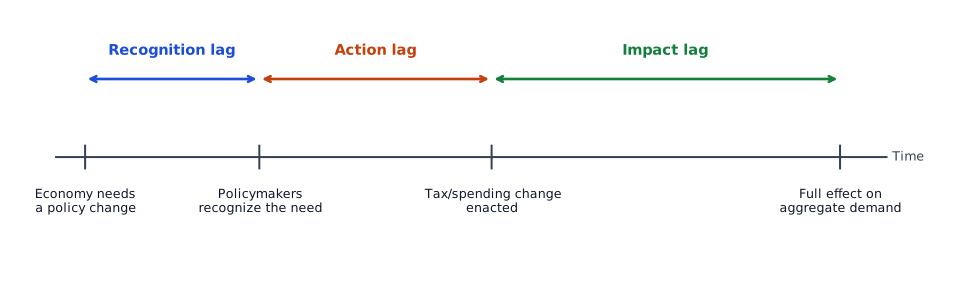
Why timing is hard. Forecasts can be wrong, and recessions and expansions cannot be predicted accurately. On top of that, three lags separate the need for policy from its effect:
Key concept
| Lag | Time between … | Example |
|---|---|---|
| Recognition lag | the economy needing a change and policymakers realizing it (the data describe where the economy was a few months ago, not where it is now) | Data arrive late and are revised, so the slowdown is confirmed only months later |
| Action lag | recognizing the need and enacting the change | Drafting, debating and voting on a budget bill |
| Impact lag | enactment and the change actually affecting the economy | Households and firms respond gradually, and multiplier rounds take time |
Because of these lags, a badly timed policy can destabilize the economy. Stimulus may arrive after a private-sector recovery is already under way. Proper timing is what lets discretionary policy exert a stabilizing influence.
Other difficulties
- Misreading economic statistics: full employment cannot be measured precisely. Stimulus applied at full capacity only raises inflation.
- Crowding-out effect (LOS 14.b): it can shrink the demand boost from expansionary policy, and opinions differ on how large it is.
- Supply shortages: if output is held back by scarce labor or resources rather than weak demand, stimulus mainly produces inflation.
- Limits to deficits: if markets consider the deficit already too high relative to GDP, financing becomes hard and interest rates rise.
- Multiple targets: fiscal policy cannot fight high unemployment and high inflation at the same time.
Is fiscal policy expansionary or contractionary?
Key concept
| Change | Stance |
|---|---|
| Deficit increases, or surplus decreases | Expansionary |
| Deficit decreases, or surplus increases | Contractionary |
| Higher spending item (e.g., highway construction, transfers) | Expansionary |
| Higher revenue item (e.g., sales tax, income tax rates) | Contractionary |
Structural vs. actual deficit. In a recession the actual deficit widens automatically because tax receipts fall and transfers rise, even if lawmakers change nothing. To judge the policy stance, economists use the structural budget deficit (cyclically adjusted budget deficit): the deficit current policies would produce if the economy were at full employment. The difference between the actual and the structural deficit is the part caused by the cycle. To read the stance from budget data:
- Use the change in the budget balance over the period; the level of the deficit alone does not reveal the stance.
- Remove the effect of the cycle by using the structural deficit. A change in the actual deficit that leaves the structural deficit unchanged reflects the cycle rather than a change in policy.
- A rise in the structural deficit (or a fall in a structural surplus) means expansionary policy; the reverse means contractionary policy.
Worked example. Last year the actual deficit was 6% of GDP and the structural deficit 2.5%, so 3.5 percentage points came from the weak economy. This year the economy recovers and the actual deficit narrows to 4.5%, but a tax cut lifts the structural deficit to 3.5%. The smaller actual deficit reflects the recovery; the larger structural deficit shows that fiscal policy has turned expansionary.
Common exam traps
- Higher government spending is not expansionary if taxes rise by more. Judge the stance by the change in the budget balance.
- An actual deficit above the structural deficit does not show the stance either way: the gap reflects the cycle, while the change in the structural deficit shows the discretionary stance.
Exam shortcuts
- To leave aggregate demand unchanged when government spending rises by , taxes must rise by , more than the spending increase.
Bottom line
- Fiscal spending tools are transfer payments (not counted in GDP), current spending and capital spending, and revenue tools are direct taxes on income or wealth and indirect taxes on goods and services; indirect taxes can be changed quickly, while direct taxes, transfers and capital spending take time.
- Government spending raises aggregate demand more than an equal tax cut, because households save part of a tax cut, and tax cuts aimed at low-income households, who have a higher MPC, work better.
- The fiscal multiplier is , which rises with the MPC and falls with the tax rate.
- Exam convention: equal increases in government spending and taxes leave the budget balanced and raise aggregate demand, so the balanced budget multiplier is positive; current practice: with an income tax the higher output also raises tax receipts, but the direction of the output effect is unchanged.
- Recognition, action and impact lags separate the need for discretionary fiscal policy from its effect, so a badly timed policy can destabilize the economy.
- The stance is judged from the change in the structural (cyclically adjusted) deficit, the deficit current policies would produce at full employment: a rise means expansionary policy, while a change in the actual deficit that leaves it unchanged reflects the cycle.
Quick check
Inflation in Brennholt is running well above target. Which of the following is an appropriate discretionary fiscal policy response?
Show answer and explanation
Correct answer: A
Discretionary fiscal policy consists of the government's decisions about spending and taxes. Cutting spending on major public construction lowers aggregate demand and eases pressure on prices, which is the appropriate direction when inflation is high.
Why the other options are wrong
- B. Raising a policy interest rate target (like the federal funds target rate in the US) is a monetary policy action by the central bank. It fights inflation, but it is not fiscal policy.
- C. Reducing the money supply is also a monetary policy action.
Key takeaway Right direction is not enough; check the tool. Spending and taxes are fiscal, while interest rates and the money supply are monetary.
Practice Questions
The governments of Tarsia and Morvenna both keep their tax rates unchanged and both run a balanced primary budget, meaning that tax revenue exactly covers all government spending other than interest on the debt. Tarsia's government debt equals 85% of GDP, the real interest rate on that debt is 3.1%, and Tarsia's real GDP grows by 1.3% a year. Morvenna's government debt equals 50% of GDP, the real interest rate on that debt is 0.9%, and Morvenna's real GDP grows by 2.7% a year. If these conditions persist, the ratio of government debt to GDP will most likely:
Show answer and explanation
Correct answer: A
With tax rates held constant, tax revenue grows with real GDP, while the debt grows with the interest paid on it. A government whose debt carries a real interest rate above real GDP growth sees its debt ratio climb over time; one whose real borrowing rate is below real growth sees the ratio shrink. In Tarsia the real interest rate of 3.1% exceeds real growth of 1.3%, so the ratio rises. In Morvenna the real interest rate of 0.9% is below real growth of 2.7%, so the ratio falls.
With a balanced primary budget, the government borrows only to pay the interest on its debt, so in real terms the debt grows at while real GDP grows at . Next year's debt ratio is approximately
Tarsia: . The ratio rises from 85.0% to about 86.5% and keeps rising while .
Morvenna: . The ratio falls from 50.0% to about 49.1% and keeps falling while .
Why the other options are wrong
- B. This looks only at the debt. A government with a balanced primary budget borrows to pay its interest, so debt grows in both countries. In Morvenna, however, real GDP grows at 2.7%, faster than the 0.9% real rate at which the debt grows, so debt shrinks relative to GDP.
- C. This treats a balanced primary budget as a balanced overall budget, as if the debt stayed constant while GDP grew. The primary balance leaves out interest, which is paid with new borrowing. In Tarsia the debt grows at a real 3.1% a year while real GDP grows only 1.3%, so the ratio rises.
Key takeaway With tax rates unchanged and a balanced primary budget, the debt-to-GDP ratio rises when the real interest rate on government debt exceeds real GDP growth and falls when it is below real growth. The comparison of with sets the direction; the starting level of the debt does not.
The government of Kestrel Isles increases its spending by $60 million. Households have a marginal propensity to consume of 90%, and the tax rate is 30%. The potential increase in aggregate demand is closest to:
Show answer and explanation
Correct answer: B
Each round of extra spending becomes income. Part of it is taxed and the MPC share of what remains is spent again. The fiscal multiplier captures the total effect, and the potential increase in aggregate demand equals the change in spending times the multiplier.
First rounds: income ; disposable income ; new spending ; then , and so on until the total converges to about 162.
Why the other options are wrong
- A. $600 million uses , ignoring the tax leakage. Taxes reduce the disposable income available for each round of spending.
- C. $82 million puts the tax rate in place of : , and . The MPC applies to the after-tax share of income, .
Key takeaway Fiscal multiplier : it rises with the MPC and falls with the tax rate.
Over the past year, new tax and spending decisions (not the business cycle) have widened the budget deficit of Estavia's government and shrunk the budget surplus of Marquessa's government. How would the fiscal policies of the two countries best be described?
Show answer and explanation
Correct answer: A
When the change comes from policy decisions rather than from the business cycle, fiscal policy is judged expansionary if the deficit increases or the surplus decreases, and contractionary if the deficit decreases or the surplus increases. A widening deficit (Estavia) and a shrinking surplus (Marquessa) are both expansionary.
Why the other options are wrong
- B. Contractionary would require a shrinking deficit or a growing surplus, which is the opposite of both situations described.
- C. It is tempting to treat 'deficit' and 'surplus' as opposites. What matters is the direction of change, and both budgets moved toward more stimulus.
Key takeaway Look at the direction of change in the policy-driven (structural) budget balance. Whether the balance is a deficit or a surplus does not decide the stance.
This reading has 37 questions in the full bank. Practice all of them.
Key Takeaways
- Taxes and government spending mean fiscal policy; money, credit and policy rates mean monetary policy.
- With tax rates unchanged and a balanced primary budget, the debt-to-GDP ratio rises when the real interest rate on government debt exceeds real GDP growth and falls when it is below real growth. The comparison of with sets the direction; the starting level of the debt does not.
- Right direction is not enough; check the tool. Spending and taxes are fiscal, while interest rates and the money supply are monetary.
- Fiscal multiplier : it rises with the MPC and falls with the tax rate.
- Look at the direction of change in the policy-driven (structural) budget balance. Whether the balance is a deficit or a surplus does not decide the stance.