Equities · Reading 41
Equity Issuance and Trading
CFA Level I · Equities · Reading 41 · about 49 min
What you'll learn
- LOS 41.a Describe primary and secondary equity markets: IPOs and other listing routes, seasoned offerings, and the functions of secondary trading.
- LOS 41.b Compare exchange, off-exchange and over-the-counter equity trading, including quotes, spreads, order types, the limit order book and VWAP.
- LOS 41.c Describe liquidity measures for a listed share and calculate market float, average daily volume and turnover.
- LOS 41.d Describe the main types of equity indexes and match them to benchmarking needs.
Module 41.1
Equity Markets and Exchanges
This reading covers how shares are first issued in the primary market and then traded on exchanges, off-exchange and over the counter, including the bid-ask spread, order types and VWAP. It then shows how to calculate market float, average daily volume and the turnover ratio, and describes the main types of equity index.
LOS 41.a — Primary and secondary equity markets
Primary equity markets are where newly issued shares are sold to investors for the first time; the issuer receives the proceeds. Secondary equity markets are where those shares change hands afterward, between investors.
Key concept
| Primary market | Secondary market | |
|---|---|---|
| What trades | New issues (IPOs, primary follow-on offerings, private placements) | Shares already issued |
| Who receives the cash | Issuer | The selling investor |
| Sensitivity to market direction | Most active when share prices are rising overall; slower when prices fall | Active in rising and falling markets |
| Main function | Raising capital, changing ownership structure | Liquidity for holders, price discovery, feedback on performance |
Why firms issue equity in the primary market
Typical situations: an early-stage company outgrows venture capital funding; a public company spins off a division as a separately listed company; a company goes public after several years of restructuring by private owners; or a government sells all or part of a state-owned enterprise, which is a privatization: the business moves from government to private ownership. In market language, "publicly held" means that a company's shares trade publicly; it does not mean that the state owns the company.
The IPO process
In an initial public offering (IPO) a company that has never had publicly traded shares lists on an exchange and sells shares, usually with an investment bank acting as equity underwriter. The underwriter prices the offer, handles compliance and may guarantee that the whole issue is bought; underwriters play the same role in later (secondary) offerings. Before the offer, the company must meet listing and other regulatory requirements and market the shares. The marketing introduces the company to analysts and investors, tests how the market will receive it, measures demand and leads to a price range for the issue. An approximate timeline:
| Time before issuance | Regulatory track | Marketing track |
|---|---|---|
| About 6 months | Issuer and bank propose the listing and timeline to regulators | Issuer and bank meet equity analysts and gauge market acceptance |
| About 3 months | Issuer files a confidential prospectus with regulators | Issuer and bank look for potential investors; analysts publish research |
| Issuance date | Regulators approve; prospectus released to investors | Bank sets the price range and starts book building |
The equity prospectus covers the business model, the main risks facing the company and its industry, audited financial statements, the offer terms (share count, expected price range) and the use of proceeds. The issuer and its advisers, including the underwriters, prepare it, and the relevant market authority must approve it before the issuer releases it. Regulatory approval does not mean the regulator endorses the offer or vouches for the prospectus's accuracy.
IPO underpricing
Underwriters and the issuer's owners have a conflict of interest. Owners want the highest price, and a higher offer price also earns the underwriters higher fees, but over time underwriters may gain more by placing underpriced shares with institutional clients (strong demand, investors keen to join future deals). This conflict helps explain why IPOs are often underpriced and jump on the first trading day. That benefits the underwriters and the investors who were allocated shares; it costs the existing owners, who raise less than the shares are worth.
Other routes to a listing
| Route | How it works | New capital raised? |
|---|---|---|
| Direct listing | A private company's existing shares are admitted to trading; no underwriter, price set by the market | No |
| Special purpose acquisition company (SPAC) | A listed shell raises cash in its own IPO, holds it in a trust account, and must buy a private company (approved by shareholders) within a set period (the de-SPAC transaction) or return the cash | Yes, at the SPAC IPO |
| Back-door listing | A private company acquires a company that is already listed and uses that listing | No (for the acquirer) |
Exam convention: a direct listing creates no new shares and raises no new capital. Current practice: this describes the traditional (secondary) direct listing; some exchanges, the NYSE among them, also permit a primary direct listing in which the company sells newly issued shares.
Shareholders vote on the de-SPAC target, but an individual who voted against it can still end up owning shares in the acquired business.
Seasoned equity offerings
Key concept
A company that already has listed equity can sell more shares in a seasoned equity offering (a follow-on offering); a prospectus is still required. Whether the offering dilutes existing holders depends on whose shares are sold:
- Primary follow-on offering: the company sells new shares. Each existing share's proportional claim on net income and assets falls, so the offering is dilutive. Used to raise equity or pay down debt.
- Secondary follow-on offering: existing privately held shares (founders, insiders, private equity funds) are sold to the public for the first time. No new shares are created, so it is nondilutive, and the company receives no proceeds; the sellers diversify their concentrated holdings.
A private placement sells shares directly to qualified investors rather than to the public.
What the secondary market does
It gives holders liquidity and lets new investors buy in. Its prices let investors and analysts measure returns, volatilities and correlations and judge a company's performance, and they feed back into the issuer's decisions on financing, payouts and compensation (e.g., firms that pay in restricted stock units (RSUs) use share price changes to evaluate performance).
Common exam traps
- A back-door listing does not raise new capital for a listed company. It is a way for a private firm to become listed.
- "Seasoned" does not mean dilutive: only a primary follow-on is necessarily dilutive.
- An IPO is a first public offering, usually underwritten, and it typically includes new shares. Any selling shareholders receive proceeds only for the existing shares they sell; those shares are the secondary part of the offer. A direct listing, which uses no underwriter, is a different route.
- Analyst meetings start roughly six months before issuance; the price range is set at issuance.
LOS 41.b — Exchange, off-exchange and over-the-counter trading
Equity exchanges
An equity exchange is a rules-based venue with regular trading hours; its rules promote liquidity and transparency. Investors trade through broker-dealers, who route orders to a centralized order matching system that pairs buy and sell orders. A broker-dealer acts either as an agent, arranging the client's trade with another party, or as a principal, taking the other side of the client's trade itself (the counterparty). The exchange usually appoints one designated market maker per listed stock, which stands ready to buy, hold or sell the shares so that the stock trades continuously. It supports liquidity and price discovery during normal trading hours and at times of order imbalance or high volatility.
Quotes and the spread
The bid price is what a dealer will pay; the ask price (offer price) is what a dealer will sell at. The bid-ask spread (bid-offer spread) is the dealer's compensation and the investor's round-trip cost:
Key concept
An investor always trades on the less favorable side of the spread, buying at the ask and selling at the bid.
Example. The best quotes for a stock are a bid of 24.90 and an ask of 25.00. Spread , or ; mid-market price .
Order types
A market order executes immediately at the best available price. A limit order sets a boundary: a maximum price for a buy, a minimum price for a sell. The limit can be above, at, or below the current market price; a sell limit above the market simply waits until the price rises to it.
The limit order book
In a limit order book, buy limit orders (the bid side) sit at prices below the mid-market price and sell limit orders (the offer side) sit above it; the gap between the highest bid and the lowest offer is the spread.
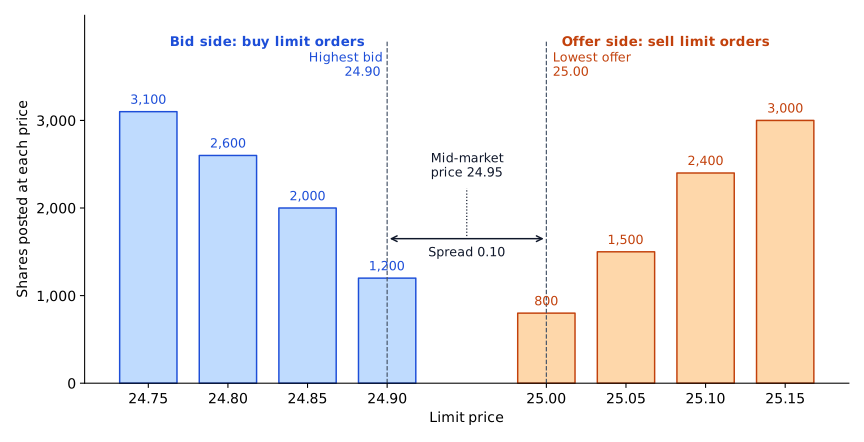
Market depth is the relative size of the orders at or near the best bid and ask (or the mid-market price). Market breadth is the number of orders at price levels close to the best bid and ask. Both measure how much can be traded without moving the price, and they are compared with market resiliency under LOS 41.c.
Example. The book above lies behind the quotes in the spread example: the highest bid is 24.90 and the lowest offer is 25.00. Depth at the best prices is 1,200 shares bid and 800 shares offered. A market order to buy 1,000 shares therefore fills 800 shares at 25.00 and the other 200 at the next price, 25.05, an average of . The average is worse than the best offer because the order is larger than the depth at that price. A price that moves against a large order in this way is market impact, one of the implicit costs of trading described below. A buy limit order at 24.95 would not trade at once. It would become the new highest bid and narrow the spread to 0.05.
VWAP
The volume-weighted average price (VWAP) tracks intraday trading:
Example. Trades of 2,000 shares at 10.00, 3,000 at 10.20 and 5,000 at 10.10 give .
Off-exchange and OTC trading
Off-exchange trading is used for illiquid, thinly traded shares and for block trades (usually 10,000 shares or more). Its purpose is to reduce the implicit costs of trading, the indirect and unobservable costs that come from the market impact of trading: market impact (the price moves against a large order executed at once), delay costs or slippage (the trade cannot be completed immediately), and opportunity costs (profit forgone because the trade was not done quickly).
Over-the-counter (OTC) trading is quote-driven: broker-dealers in a network act as market makers and post bid and ask prices that are firm quotes, meaning they must trade at those prices. Dealers hold inventory and offset trades with one another. Quote-driven markets are also called dealer markets or price-driven markets; most non-equity securities trade this way, often electronically.
| Exchange | Off-exchange | OTC (quote-driven) | |
|---|---|---|---|
| Matching | Centralized order matching system | Negotiated / alternative venues | Dealers trade from inventory |
| Typical use | Liquid listed shares | Block trades, illiquid shares | Dealer network; most non-equity securities |
| Transparency | Highest | Lower | Lower than exchanges; best price not guaranteed |
Common exam traps
- The spread is the lowest ask minus the highest bid. The extremes of the book are irrelevant.
- A sell limit is a minimum price, but it need not be below the market price.
- OTC quotes are firm, yet OTC markets are less transparent than exchanges.
Exam shortcuts
- Of the two follow-on offerings, only the primary one creates new shares, so a secondary follow-on can be ruled out whenever a question asks which offering is dilutive or brings the company cash.
Bottom line
- In the primary market newly issued shares are sold and the issuer receives the cash, and it is most active when share prices are rising overall; in the secondary market investors trade shares already issued, and it is active whether prices rise or fall.
- Underwriters may gain more over time by placing underpriced shares with institutional clients than from the higher fees of a higher offer price, a conflict with the issuer's owners that helps explain why IPOs are often underpriced and jump on the first trading day.
- Exam convention: a direct listing admits a private company's existing shares to trading without an underwriter and raises no new capital; current practice: that describes the traditional direct listing, and some exchanges, the NYSE among them, also permit a primary direct listing of new shares.
- A SPAC raises cash in its own IPO, holds it in a trust account and must buy a shareholder-approved private company within a set period or return the cash, while a back-door listing has a private company acquire an already listed company to use its listing.
- A primary follow-on offering sells new shares and dilutes each existing share's claim on net income and assets; a secondary follow-on sells existing privately held shares, creates no new shares and brings the company no proceeds.
- The bid-ask spread is the lowest ask minus the highest bid (as a percentage, divided by the lowest ask), and an investor buys at the ask and sells at the bid; OTC dealers post firm quotes, yet OTC markets are less transparent than exchanges.
Quick check
An analyst lists three recent transactions. Which one took place in the primary market?
Show answer and explanation
Correct answer: C
The primary market is the market for new issues: the securities are sold for the first time and the issuer receives the proceeds. The utility's sale of newly issued shares to finance a plant is a primary market transaction.
Why the other options are wrong
- A. Institutions trading existing listed shares with each other is a secondary market trade; the issuer receives nothing.
- B. Buying bonds that already sit in a dealer's inventory is a secondary market purchase. Credit quality (investment grade or not) has nothing to do with whether a market is primary or secondary.
Key takeaway A primary market sale is the first sale of a new security, with proceeds going to the issuer.
Module 41.2
Equity Indexes and Liquidity Measures
LOS 41.c — Float, trading volume and other liquidity measures
Market float is the portion of a company's shares available to the investing public; it is often quoted as the market value of those shares. Shares held by controlling shareholders, restricted shares (e.g., executives' shares under selling restrictions) and other shares not available for trading are excluded. Institutional investors such as mutual funds, pension funds and ETFs are part of the investing public, so their holdings stay in the float.
Key concept
Average daily volume (ADV) is the average number of shares traded per day over a chosen period:
The turnover ratio shows what fraction of the float changes hands on a typical day:
Key concept
These measures tell an investor how quickly a position can be built or unwound without moving the price.
Example. A company has 50 million shares outstanding, of which 8 million are held by its controlling family. Float million. Over the last month ADV was 1.26 million shares, so turnover per day. A fund holding 900,000 shares may trade no more than 15% of ADV per day, i.e. shares; it needs , so 5 trading days to exit fully. A fractional result is rounded up.
Order-book liquidity measures show how easily shares can be traded without a big adverse price move. Depth and breadth were introduced with the limit order book under LOS 41.b; the table compares them with resiliency:
| Measure | What it captures | Falls when… |
|---|---|---|
| Market depth | Relative size of orders posted at or near the best bid and offer | Orders near the best prices get smaller |
| Market breadth | Number of orders at prices just above and below the best bid and offer | Fewer separate orders near the best prices |
| Market resiliency | Ability of the shares to hold a steady price that clears every buy and sell order; after a shock, a more resilient market settles at its new clearing price sooner | Prices take longer to stabilize |
Common exam traps
- Institutional holdings stay in the float. Only controlling, restricted or otherwise untradeable shares are subtracted.
- The turnover ratio uses float in the denominator rather than total shares outstanding. In the example, dividing ADV of 1.26 million by the 50 million shares outstanding gives 2.52% instead of 3.0%.
- Smaller orders with the same number of orders mean lower depth and unchanged breadth.
- Days-to-liquidate: divide by the daily allowed volume and round up. In the example, dividing 900,000 by the full ADV of 1,260,000 gives 0.71 days and rounding 4.76 down gives 4 days, but the fund needs 5.
LOS 41.d — Types of equity indexes
A security market index represents the performance of an asset class, market or market segment. It is built as a portfolio of constituent securities, and its value is computed from their prices at a point in time. Indexes are used as benchmarks for managers and as the basis for index funds.
Key concept
| Index type | What it holds / how weighted | Typical use |
|---|---|---|
| Broad-based equity index (often called a broad market index) | The largest listed companies, market-capitalization-weighted and adjusted for market float; may be tiered by size. A composite market index measures the overall market and usually covers more than 90% of its total value | Measuring the overall market |
| Sector index | Companies in one industry sector (e.g., health care, financials), national or global | Benchmarking sector managers; building index portfolios; business-cycle (cyclical) analysis, since sectors lead or lag in different phases |
| Investment theme index | Companies selected by an investor trend that cuts across industries and sizes (e.g., ESG-screened firms, an aging-population or clean-energy theme) | Thematic funds |
| Alternatively weighted index | Same constituents as a broad-based equity index but equal-weighted, or weighted by fundamental factors (factor-based indexes, e.g., quality, value) | Reducing large-cap concentration; factor investing |
| Multi-market index | Combines national indexes for a region, a development stage (e.g., emerging markets), or the world | Global and regional benchmarks |
The weighting method decides which companies drive an index. In a market-capitalization-weighted index of three companies with market capitalizations of 600, 300 and 100, the largest carries 60% of the weight and the smallest 10%. An equal-weighted index of the same three gives each one-third, so the smallest company's influence more than triples. When an equal-weighted index outperforms a cap-weighted index with the same constituents, the smaller constituents have therefore done better, on average, than the larger ones.
Choosing a benchmark
Match the index to the mandate. A fund confined to one industry is benchmarked against a sector index, a fund built around a cross-industry trend against an investment theme index, and a fund that picks stocks by value or quality characteristics against a factor-based index.
Common exam traps
- Broad-based equity indexes are typically float-adjusted and cap-weighted. Equal weighting and factor weighting are alternative methods.
- A theme spanning several industries is not a sector index.
- A factor-based index selects on stock characteristics such as value, quality or dividend yield; a theme index selects on a trend.
Exam shortcuts
- When an equal-weighted index outperforms a cap-weighted index with the same constituents, the smaller constituents have done better on average than the larger ones, so no weight calculation is needed to answer which group drove the gap.
Bottom line
- Market float is shares outstanding less restricted or otherwise untradeable shares, so shares of controlling shareholders and restricted shares are excluded while holdings of institutions such as mutual funds, pension funds and ETFs stay in.
- Average daily volume is total shares traded over a period divided by the number of days, and the turnover ratio is average daily volume divided by market float.
- The days needed to exit a position equal the position divided by the volume allowed per day (the permitted share of ADV times ADV), with a fractional result rounded up.
- Market depth is the relative size of orders at or near the best bid and offer, market breadth is the number of orders at prices close to them, and market resiliency is the ability to hold a stable market-clearing price, a more resilient market reaching its new clearing price sooner after a shock.
- Broad-based equity indexes hold the largest listed companies, weighted by float-adjusted market capitalization, and a composite market index usually covers over 90% of the total value of the market.
- A fund confined to one industry is benchmarked against a sector index, a fund built on a cross-industry trend against an investment theme index, and a fund selecting on value or quality against a factor-based index; multi-market indexes combine national indexes for a region, a development stage or the world.
Quick check
An index provider designing a broad-based equity index for a national stock market would most typically weight the constituent stocks:
Show answer and explanation
Correct answer: A
Broad-based equity indexes include the largest listed firms and are calculated on a market-capitalization-weighted basis, adjusted for market float. Larger companies therefore carry larger weights.
Why the other options are wrong
- B. Price weighting is not the typical method for broad-based equity indexes.
- C. Equal weighting is an alternative weighting method used to reduce the dominance of the largest companies in a broad-based equity index; it is not the standard approach.
Key takeaway Broad-based equity indexes are float-adjusted and cap-weighted; equal-weighted and factor-weighted versions are the alternatives.
Practice Questions
An analyst makes three statements about methods of issuing equity. Which statement is least accurate?
Show answer and explanation
Correct answer: C
A seasoned equity offering is dilutive only when the company sells newly created shares (a primary follow-on offering). When the shares sold are existing shares held by founders or other private investors (a secondary follow-on offering), no new shares are created and existing proportional ownership is unchanged, so the statement that every seasoned offering dilutes current holders is false.
Why the other options are wrong
- A. This is accurate. In a back-door listing a private company buys a listed company and uses its listing; in a direct listing a private company has its existing shares admitted to trading. Both give a private company the benefits of listed status.
- B. This is accurate. SPAC shareholders vote to approve the acquisition target, but the vote need not be unanimous, so an investor who opposed the target can still become a shareholder of the acquired business after the de-SPAC transaction.
Key takeaway A primary follow-on sells new shares and is dilutive; a secondary follow-on sells existing shares and is nondilutive. The word "seasoned" alone does not say which.
Owen Achebe owns 2,000 shares of Kilnsey Water and enters a limit order to sell all of them at 27.35. Just before his order arrives, the limit order book looks like this:
| Bid size (shares) | Limit price | Offer size (shares) |
|---|---|---|
| 27.60 | 800 | |
| 27.55 | 1,200 | |
| 900 | 27.45 | |
| 600 | 27.40 | |
| 1,100 | 27.30 |
Any shares that cannot be sold at once remain in the book as an offer. The average price of the shares he sells immediately is closest to:
Show answer and explanation
Correct answer: C
A sell limit order trades against the bids in order from the highest price downward, but never at a price below its limit. The bids at 27.45 and 27.40 are within the 27.35 limit; the bid at 27.30 is not. The order therefore sells 1,500 shares at once, and the average price is the volume-weighted average of those two fills.
Bids at or above 27.35: 900 shares at 27.45 and 600 shares at 27.40, a total of 1,500 shares.
The other 500 shares stay in the book as an offer at 27.35, which becomes the new lowest offer.
Calculator: [(] 900 [×] 27.45 [)] [+] [(] 600 [×] 27.40 [)] [=] [÷] 1500 [=] 27.43
Why the other options are wrong
- A. 27.35 is the limit price, the least the order may accept. The fills take place at the bid prices in the book, which are higher.
- B. 27.40 sells the last 500 shares at 27.30: . That bid is below the 27.35 limit, so those shares cannot be sold.
Key takeaway A marketable sell limit order works down through the bids from the highest price and stops at its limit; weight the fill prices by the shares actually sold.
This reading has 32 questions in the full bank. Practice all of them.
Key Takeaways
- A primary market sale is the first sale of a new security, with proceeds going to the issuer.
- A primary follow-on sells new shares and is dilutive; a secondary follow-on sells existing shares and is nondilutive. The word "seasoned" alone does not say which.
- A marketable sell limit order works down through the bids from the highest price and stops at its limit; weight the fill prices by the shares actually sold.
- Broad-based equity indexes are float-adjusted and cap-weighted; equal-weighted and factor-weighted versions are the alternatives.