Equities · Reading 42
Sources of Equity Returns
CFA Level I · Equities · Reading 42 · about 37 min
What you'll learn
- LOS 42.a Describe the features and uses of cash dividends, share repurchases, stock dividends, stock splits and reverse splits.
- LOS 42.b Describe the dividend payment chronology and the share price behavior on the ex-dividend date.
- LOS 42.c Calculate price return and total return on equity, including splits and reinvested dividends, and relate price to the present value of expected cash flows.
Module 42.1
Dividends, Stock Splits, and Share Repurchases
This reading describes cash dividends, share repurchases, stock dividends, stock splits and reverse splits, and the chronology of a dividend from declaration to payment. It then shows how to calculate price return and total return, including returns with reinvested dividends, and how a share's value follows from discounting its expected price and dividend.
LOS 42.a — Dividends, share repurchases, stock splits and reverse splits
Cash dividends are cash payments to shareholders. They are subject to income tax in the period received. Paying them is at the discretion of the board of directors. Mature companies with few growth opportunities tend to pay out cash; fast-growing companies tend to retain it for reinvestment.
Key concept
| Distribution | What happens | Typical use |
|---|---|---|
| Regular cash dividend | A portion of profits paid on a consistent schedule (e.g., quarterly) | A stable or rising record signals financial stability; firms often hold dividend per share steady to avoid a negative signal from a cut |
| Special cash dividend (extraordinary dividend) | One-time cash payment on top of any regular dividend | Cyclical firms share profits in good years without committing to higher payments in bad years |
| Liquidating dividend | Paid by a company that is ceasing operations and has positive net assets | Viewed more as a return of capital than a distribution of earnings |
| Share repurchase (buyback) | The company buys its own outstanding shares | Alternative way to distribute cash; each holder decides whether to sell |
| Stock dividend (bonus issue) | New shares instead of cash, stated as a percentage (a 10% stock dividend gives 10 more shares per 100 held) | Share count rises, price per share falls, total equity unchanged |
| Stock split (forward split) | Each share becomes several shares, stated as a ratio (3-for-1: each old share becomes three) | Makes a high-priced share more affordable for retail investors, which can improve liquidity and broaden the shareholder base. Today stock splits are used more often than stock dividends |
| Reverse stock split | Several shares become one (1-for-5: five old shares become one) | Raises the price per share, e.g., to stay above an exchange's minimum price and avoid delisting |
Share repurchases in more detail
A repurchase has the same effect on total shareholder wealth as a cash dividend of the same amount. Reasons to buy back shares: to support the share price or signal that management thinks the shares are undervalued; to offset the increase in shares outstanding when employees exercise stock options; to raise reported EPS by shrinking the share count; to keep flexibility, since a company that wants to hold cash for growth opportunities as they arise may prefer buybacks to regular dividends (a buyback creates no expectation of repetition); and, where capital gains are taxed more lightly than dividends, because shareholders prefer it.
Splits and stock dividends do not create value
The company's total value is unchanged, so the price per share adjusts in proportion to the change in the share count. A shareholder's wealth and proportional ownership are unchanged. A 3-for-2 split is economically identical to a 50% stock dividend: 50% more shares, each worth one-third less.
Example. An investor holds 200 shares at 90. After a 3-for-1 split she holds 600 shares; other things equal the price falls to 30, and the position is still worth .
Common exam traps
- Among cash distributions, only a share repurchase reduces the number of shares outstanding; regular and special cash dividends leave it unchanged. A reverse split also cuts the share count, but it rescales every holding proportionally and distributes no cash. It therefore cannot offset dilution from option exercises the way a buyback can.
- A forward split or a stock dividend lowers the price per share; a reverse split raises it.
LOS 42.b — Dividend payment chronology
In time order, a dividend passes through its declaration date, its ex-dividend date, its record date and finally its payment date. The ex-dividend and record dates can fall on the same day, as explained below.
Key concept
| Date | What happens |
|---|---|
| Declaration date | The board approves the dividend and announces the amount per share, the record date and the payment date |
| Ex-dividend date | The first day on which a buyer of the shares will not receive the declared dividend. Its position depends on the settlement period for share trades |
| Record date (holder-of-record date) | The company identifies the owners entitled to the dividend. This dividend record date is separate from the record date used for proxy voting |
| Payment date | The dividend is paid (checks mailed or electronic transfer) |
How the ex-dividend date is set relative to the record date
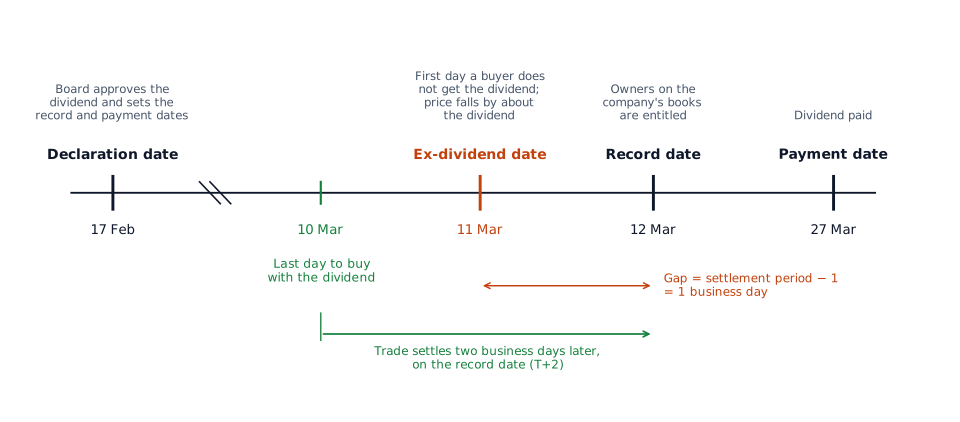
A trade takes time to settle. The last purchase that carries the dividend is the one made the business day before the ex-dividend date; it settles exactly on the record date. So the gap between the ex-dividend date and the record date is one business day less than the settlement period: with T+3 settlement the gap is two business days, with T+2 it is one, and with T+1 the two dates coincide. Anyone who buys before the ex-dividend date receives the dividend. Anyone who sells on or after the ex-dividend date still receives it, because they were the owner at the cutoff, and their buyer does not.
Exam convention: the ex-dividend date comes one or two business days ahead of the record date, with the exact gap set by the settlement cycle. Current practice: US equity trades have settled on a T+1 basis since May 2024, so a US company's ex-dividend date and record date are now normally the same day.
The timeline shows the exam-convention case of T+2 settlement, with a one-day gap, for a dividend whose record date is 12 March.
Price behavior
Other things equal, the share price drops by the amount of the dividend (relative to the prior close) when the stock goes ex-dividend, because buyers no longer get the payment.
Separating the causes of a price change on the ex-dividend date
The day's percentage change equals the negative dividend effect plus the market effect plus the company-specific effect. If the stock's risk equals the market's, its expected market-driven move equals the index move.
Example. A share closes at 60.00 the day before going ex-dividend; the dividend is 1.20 (2.0% of 60). On the ex-dividend date it closes at 59.40, while the market index rises 0.8%.
- Actual change
- Change not caused by the dividend
- Company-specific part
In price terms the share fell 0.60, even though the dividend alone would have taken off 1.20: the other +0.60 came from the market () and company news (0.12).
Common exam traps
- The cutoff for buyers is the ex-dividend date, not the record date.
- A seller between the ex-dividend date and the record date still gets the dividend.
- The price drops on the ex-dividend date. The declaration, record and payment dates bring no such drop.
- When isolating the company-specific move, add back the dividend drop and subtract the market move. In the example, subtracting the 0.8% market move from the −1.0% actual change without adding back the 2.0% dividend drop gives −1.8% instead of +0.2%.
Exam shortcuts
- A 3-for-2 split and a 50% stock dividend are economically identical (50% more shares, each worth one-third less), so other things equal neither lowers the share price more than the other.
- The ex-dividend date comes one business day less than the settlement period before the record date, so T+2 settlement gives a one-day gap and T+1 settlement puts the two dates on the same day.
Bottom line
- A share repurchase has the same effect on total shareholder wealth as a cash dividend of the same amount, but each holder decides whether to sell, and among cash distributions only a repurchase reduces the number of shares outstanding.
- A special cash dividend is a one-time payment on top of any regular dividend, which lets cyclical firms share profits in good years without committing to them in bad years, while a liquidating dividend is viewed more as a return of capital.
- Stock dividends and forward splits raise the share count and lower the price per share in proportion, and reverse splits do the opposite, so the company's total value, a shareholder's wealth and proportional ownership are unchanged.
- In time order a dividend is declared, the stock goes ex-dividend, the record date passes and the dividend is paid; other things equal, the share price falls by the dividend amount when the stock goes ex-dividend, the first day a buyer no longer receives it.
- Exam convention: the ex-dividend date precedes the record date by one or two business days, with the gap set by the settlement cycle; current practice: US equity trades have settled T+1 since May 2024, so a US company's two dates are now normally the same day.
- On the ex-dividend date the percentage price change equals the negative dividend effect plus the market effect plus the company-specific effect, so for a stock as risky as the market the company-specific part is the actual change plus the dividend percentage minus the index move.
Quick check
Torvald Steel's profits rise and fall with the business cycle. After an exceptionally profitable year, its board wants to share the windfall with shareholders without committing to larger payments in future years. The type of distribution the board is most likely to declare is a:
Show answer and explanation
Correct answer: A
A special (extraordinary) cash dividend is a one-time payment made when favorable circumstances allow, in addition to any regular dividend. Many cyclical companies use special dividends to share profits in good years while keeping the flexibility to conserve cash when profits fall.
Why the other options are wrong
- B. Raising the regular dividend creates an expectation that the higher payment will continue; cutting it later would send an adverse signal, and the board wants to avoid both.
- C. A stock dividend distributes new shares rather than cash and does not share any profits: total equity and shareholder wealth are unchanged.
Key takeaway A cyclical firm that wants to share a good year without a lasting commitment pays a special dividend.
Module 42.2
Return Calculations for Equities
LOS 42.c — Price return and total return on equity
A price return uses only the change in the share price (adjusted for stock splits). A total return adds income, i.e., cash dividends received.
Key concept
Example. Buy at 30.00, receive a 0.60 dividend just before selling at 33.00. Price return ; total return .
Stock splits and stock dividends do not change returns
Adjust the beginning price, ending price and dividend per share to the same share basis (or simply work with the value of the whole position). An investor who ends up with more shares after a split receives the same total dividend and holds a position of the same value, so the rate of return is unchanged. The same is true of stock dividends and reverse splits. The common mistake is to compare a post-split ending price with a pre-split purchase price.
Reinvested dividends
When a dividend received part-way through the holding period is used to buy more of the same stock (reinvested dividends), the investor acquires fractional shares of per share originally held, where is the price on the dividend payment date. The holding period return is:
Key concept
With several reinvested dividends, track the share count step by step: each dividend adds (shares held × dividend per share) / price on that payment date.
Example. Buy at 40.00; halfway through the period a 1.00 dividend is paid when the price is 50.00 and reinvested; the ending price is 45.00. Extra shares per share, so
. Had the dividend instead been deposited in an account paying 4% over the whole holding period, it would earn interest only for the second half and grow to , and .
Summary: how a dividend enters the holding period return
Key concept
| Treatment of the dividend | How it enters the holding period return |
|---|---|
| Received just before the sale | Add it once to the price change: |
| Reinvested in the same stock | Convert it into extra shares at ; value all shares at |
| Invested elsewhere (e.g., a bank deposit) | Add the dividend plus what it earns until the end of the period to the price change |
| Paid in shares (stock dividend) or a split | Not income; once prices are on the same share basis the return is unchanged |
The holding period used in these calculations may be shorter or longer than a year; read the question to see whether an annualized figure is wanted.
Equity value as a present value
Rearranging the return formula for a stock with no dividend, , gives . Because the ending price is not known in advance, use expectations, and include a dividend expected at the end of the period:
Here is investors' required rate of return on the equity. This is the foundation of discounted cash flow models: a share is worth the present value of its expected future cash flows.
Example. Expected price in one year 52.50, expected dividend 1.50, required return 8%: .
Common exam traps
- When dividends are reinvested, do not also add the cash dividend; it has already been turned into shares. In the reinvestment example, adding the 1.00 dividend on top of the extra shares gives 17.25% instead of 14.75%.
- Use the price on the payment date to compute the shares bought with each dividend. In the same example, buying the extra shares at the 40.00 purchase price gives 15.31% instead of 14.75%.
- After a split, put both prices (and the dividend) on the same share basis before computing returns.
- In the present value formula, discount the expected dividend as well as the expected price. In the example, adding the 1.50 dividend undiscounted to gives 50.11 instead of 50.00.
Exam shortcuts
- Splits, stock dividends and reverse splits leave the rate of return unchanged, so working with the value of the whole position avoids restating every per-share figure on a new share basis.
Bottom line
- Price return is , using only the split-adjusted price change, and total return is , adding the cash dividends received.
- Stock splits, stock dividends and reverse splits do not change the rate of return once the beginning price, ending price and dividend per share are on the same share basis.
- A dividend reinvested in the same stock buys extra shares per share held at the price on the payment date, and the return is , with the cash dividend not added again.
- A dividend invested elsewhere, such as in a bank deposit, enters the holding period return as the dividend plus what it earns until the end of the period.
- A share's value is , where is the required rate of return; this is the basis of discounted cash flow models, in which a share is worth the present value of expected future cash flows.
- A holding period may be shorter or longer than a year, so a return question has to be read for whether an annualized figure is wanted.
Quick check
An analyst expects shares of Marlow Utilities to trade at $66.00 one year from now and to pay a dividend of $2.20 per share at the end of the year. Investors' required rate of return on Marlow's equity is 11%. The value of a Marlow share today is closest to:
Show answer and explanation
Correct answer: B
The value of an equity security today is the present value of the cash flows the investor expects to receive, discounted at the required rate of return. Over one period, those cash flows are the expected dividend and the expected ending price, both received at the end of the year.
Why the other options are wrong
- A. $59.46 discounts only the expected price and leaves out the expected dividend.
- C. $61.66 discounts the expected price but adds the dividend undiscounted, even though it is also received a year from now.
Key takeaway : discount every future cash flow, including the dividend.
Practice Questions
Galloway Brewing pays a dividend of $0.90 per share. Its shares close at $48.00 on the day before the ex-dividend date and at $45.60 on the ex-dividend date. Assume Galloway has the same risk as the overall market and there is no company news. The fraction of Galloway's ex-dividend-date price drop that is attributable to the market is closest to:
Show answer and explanation
Correct answer: A
Other things equal, the price should fall by the dividend on the ex-dividend date. Any decline beyond the dividend is attributed to the market, given that the stock has market-level risk and no company-specific news is mentioned.
Total decline .
Due to the dividend: . Due to the market: .
Why the other options are wrong
- B. 37.5% is the part of the decline caused by the dividend. The question asks for the market's part.
- C. 3.3% expresses the market-driven dollar decline as a percentage of the share price. The question asks what fraction of the decline is due to the market.
Key takeaway Split the ex-date price drop into dividend and market pieces in dollars first, then express each as a share of the total drop.
This reading has 17 questions in the full bank. Practice all of them.
Key Takeaways
- A cyclical firm that wants to share a good year without a lasting commitment pays a special dividend.
- Split the ex-date price drop into dividend and market pieces in dollars first, then express each as a share of the total drop.
- : discount every future cash flow, including the dividend.