Ethical and Professional Standards · Reading 97
Duties to Clients
CFA Level I · Ethical and Professional Standards · Reading 97: Guidance for Standard III: Duties to Clients · about 43 min
What you'll learn
- LOS 97.a Apply Standard III (loyalty, prudence and care; fair dealing; suitability; performance presentation; confidentiality) to situations involving professional integrity.
- LOS 97.b Recommend practices and procedures that prevent violations of Standard III.
- LOS 97.c Identify conduct that conforms to Standard III and conduct that violates it.
Module 97.1
Guidance for Standards III(A), III(B), III(C), III(D), and III(E)
This reading covers Standard III, Duties to Clients: Loyalty, Prudence, and Care; Fair Dealing; Suitability; Performance Presentation; and Preservation of Confidentiality. A candidate must be able to apply each duty to a fact pattern, recommend procedures for compliance, and tell conduct that conforms from conduct that violates.
Standard III sets out what members and candidates owe the people whose money or information they handle. Five Standards sit under it: Standard III(A) Loyalty, Prudence, and Care, Standard III(B) Fair Dealing, Standard III(C) Suitability, Standard III(D) Performance Presentation, and Standard III(E) Preservation of Confidentiality. The three LOS cover applying them to fact patterns (97.a), recommending compliance procedures (97.b) and separating conduct that conforms from conduct that violates (97.c).
LOS 97.a — Applying the five duties to clients
III(A) Loyalty, Prudence, and Care
Members and candidates have a duty of loyalty to their clients and must act with reasonable care and exercise prudent judgment. Members and candidates must act for the benefit of their clients and place their clients' interests before their employer's or their own interests.
The Standard does not create a fiduciary duty where none already exists. It does require acting in the client's best interest and recommending products that suit the client's investment objectives and risk tolerance, with the prudence, care, skill and diligence that a person acting in a similar role and familiar with such matters would use under the circumstances.
- Governing documents and total portfolio. Manage pooled client assets according to the governing documents (trust documents, investment management agreements), and make decisions in the context of the total portfolio.
- Disclose limitations. Tell clients about any limits on the advisory relationship (e.g., an adviser who may recommend only her own firm's products).
- Identify the client. For a pension plan, the duty runs to the plan participants and beneficiaries. The sponsoring company, its management and its shareholders are not the client. In some roles the "client" is the investing public as a whole rather than a specific person. For a pooled fund, decisions serve the fund's investors as a whole, in line with the fund's mandate, rather than each investor's individual needs.
- Diversification. A prudent manager of retirement assets keeps the portfolio properly diversified. Holding some of the sponsor's own stock is not banned; concentrating the plan in it at management's request is imprudent.
- Client brokerage (the commissions generated by client trades, also called soft dollars or soft commissions) is an asset of the client, because the client's trades pay for it. It must be used to benefit the client, e.g., to buy research that assists the manager in managing client accounts, and the arrangement should be disclosed to the client. Using it for research relevant only to the manager's own holdings, or for personal benefits the member could not otherwise obtain, breaches the duty.
- Best execution: seek the most favorable terms reasonably available for each trade. A trader who only executes client orders may owe no fiduciary duty, but the Standard still applies: in that role, loyalty and care mean seeking best execution on each order.
- Trading a client's account more often than its objectives require, in order to generate commissions for the member or the firm, puts their interests ahead of the client's and violates the Standard.
- Directed brokerage: when a client instructs that its trades go to a particular broker, following the instruction is acceptable because the brokerage belongs to the client. The member should disclose that best execution may not be achieved.
- Proxy voting: proxies have economic value, so they must be voted in an informed, responsible way in the clients' interest. Management's wishes do not decide the vote. A cost-benefit analysis may show that voting a particular proxy is not worthwhile, so voting every proxy is not required.
- Trade errors: a broker that absorbs the cost of its own trading error, with no implied promise of future business, raises no issue.
III(B) Fair Dealing
Members and candidates must deal fairly and objectively with all clients when providing investment analysis, making investment recommendations, taking investment action, or engaging in other professional activities.
Fair treatment is not the same as equal treatment. Firms may offer different levels of service (e.g., a premium research tier for a fee) as long as the tiers are disclosed to all clients and prospects, are available to anyone willing to pay for them, and do not disadvantage any client. Differences in when e-mails or other messages happen to arrive are a normal part of business.
- Do not discriminate among clients when disseminating recommendations. Delivery channels may differ: e-mail to clients who supplied an address and same-day post to the rest is fair. The duty is owed to clients, so a firm may keep its research for its clients and need not release it to the public.
- Give every client a fair opportunity to act on each recommendation. A client unaware of a changed recommendation should be told of the change before an order for that security is accepted.
- Treat individual and institutional clients fairly and impartially. A member must not exploit his or her position in the industry at clients' expense (e.g., by taking shares of an oversubscribed IPO for personal accounts).
- Clients may not be ranked by account size, fees or trading volume for the order in which they hear of recommendation changes or receive fills.
- Trade allocation: when an order is only partly filled or filled in blocks at different prices, allocate pro rata (in proportion to each account's order size) across all accounts for which the trade is suitable, at the same average price. Allocation by alphabet, fee level or other arbitrary rule is unfair. So is waiting to see which fills have gained before deciding which accounts get them.
- Tipping portfolio managers of discretionary accounts before the report reaches other clients favors some clients over others. Acting on the tip is also a violation.
Example. A manager's block order for a stock fills in three lots of equal size at $41.10, $41.30 and $41.50. Fair Dealing requires every participating account to receive its pro rata share of all three lots at the average price of $41.30. Giving the cheapest lot to favored clients would be a violation.
Example. A downgrade goes to every client at the same time. That afternoon the analyst who wrote it walks the firm's largest institutional clients through the report by phone, a service they pay for under the firm's disclosed premium tier. This is fair dealing, because everyone received the recommendation first. If she had told those clients that her private view was less negative than the published one, she would violate Standard III(B): they would be acting on a recommendation that other clients never received.
III(C) Suitability
Key concept
1. When members and candidates are in an advisory relationship with a client, they must: a) Make a reasonable inquiry into a client's or prospective client's investment experience, risk and return objectives, and financial constraints prior to making any investment recommendation or taking investment action and must reassess and update this information regularly. b) Determine that an investment is suitable to the client's financial situation and consistent with the client's written objectives, mandates, and constraints before making an investment recommendation or taking investment action. c) Judge the suitability of investments in the context of the client's total portfolio. 2. When members and candidates are responsible for managing a portfolio to a specific mandate, strategy, or style, they must make only investment recommendations or take only investment actions that are consistent with the stated objectives and constraints of the portfolio.
- The financial constraints cover liquidity needs, expected cash flows, time horizon, tax, and legal and regulatory circumstances. The information is usually documented in an investment policy statement (IPS) gathered at the start of the relationship, and it is reassessed regularly and whenever circumstances change.
- Consider whether the use of leverage is suitable for the client.
- Because suitability is judged for the portfolio as a whole, a volatile holding can suit a moderate-risk client if it lowers the risk of the total portfolio.
Under part 2, a fund whose mandate admits only dividend-paying stocks may not buy a non-dividend growth stock, however attractive. The manager of such a fund judges investments against the fund's mandate. Whether the fund suits an individual investor is the concern of the adviser who recommends it.
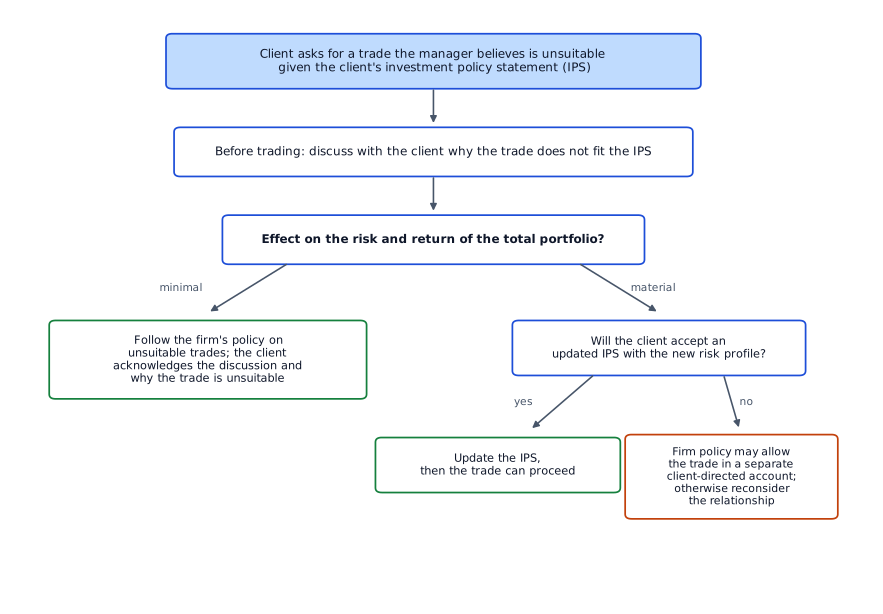
Unsolicited trade requests that look unsuitable: the member does not execute the trade until he or she has discussed with the client why it does not fit the IPS. If the effect on the total portfolio's risk/return profile is minimal, the member may then follow the firm's policy on unsuitable trades; the client must acknowledge the discussion and why the trade is unsuitable. If the effect is material, the client may agree to revise the IPS and accept the changed risk profile. If the client will not, firm policy may allow the trade in a separate client-directed account. Failing other options, the member may need to reconsider the relationship.
III(D) Performance Presentation
When communicating investment performance information, members and candidates must make reasonable efforts to ensure that it is fair, accurate, and complete.
- The Standard covers oral as well as written performance communications.
- The same facts often breach Standard I(C) Misrepresentation too, which counts selective performance data and results that omit accounts among its violations. Standard III(D) is the Standard aimed specifically at performance communications.
- Do not present a new fund's "history" built from the past returns of assets it now holds, or from other accounts, as if the fund itself had earned it.
- Do not cherry-pick. A list of winning picks misrepresents results unless it is the complete list, however accurate each return on it is.
- A firm's stated rules on which accounts enter a composite, and from what date, apply to every account alike; bringing an account in early or leaving one out because of its results misstates performance.
- Adhering to the Global Investment Performance Standards (GIPS) is voluntary, but a claim of GIPS compliance that the firm's calculations do not support misleads clients and prospects about its performance and violates the Standard.
- Do not turn a single fund's or single period's result into a claim about the firm's typical results. Never guarantee future returns, and never suggest, directly or by implication, that past returns can be repeated.
- Stating accurate past results is acceptable. Brief presentations are allowed if detailed information is available on request and the presentation indicates that it offers only limited information.
III(E) Preservation of Confidentiality
Members and candidates must keep information about current, former, and prospective clients confidential unless: 1. The information concerns illegal activities on the part of the client, 2. Disclosure is required by law, or 3. The client or prospective client permits disclosure of the information.
Information may be shared with the CFA Institute Professional Conduct Program in an investigation, because the program keeps it confidential. No family tie or private agreement lets a member withhold it. Inside the firm, share client information only with colleagues who work on the client's account. Illegal activity by a client may create an obligation to report it to the authorities.
When unsure whether an exception applies, the member consults compliance or legal counsel. Client data must also be protected: storing identifiable client records on unsecured personal devices or networks is a failure to preserve confidentiality. When a client reveals her own information in an online group or chat the member runs, the disclosure is the client's, not the member's; the member's duty is to take reasonable precautions, such as warning users that posts are visible to all and removing such a post promptly.
LOS 97.b — Recommended procedures for compliance
| Standard | Recommended practices |
|---|---|
| III(A) | Send clients, at least quarterly, itemized statements of all securities in custody and all debits, credits and transactions; encourage firm policies that: follow applicable rules and laws, establish each client's investment objectives, consider suitability, diversify, deal fairly with all clients, disclose conflicts and compensation arrangements, vote proxies in the best interest of clients and ultimate beneficiaries, maintain confidentiality, seek best execution |
| III(B) | Encourage the firm to set compliance procedures for proper dissemination of recommendations and fair treatment of all clients; limit the number of people who know a recommendation is about to be released; shorten the time between the decision and its dissemination; publish guidelines that bar staff who know of a pending recommendation from discussing it or acting on it before release; send new or changed recommendations at the same time to every client who has expressed interest in the security or for whom it is suitable (and, where possible, at the same time inside and outside the firm); keep a list of clients and their holdings; develop and disclose written trade allocation procedures (pro rata, same price); establish systematic account review; disclose available levels of service |
| III(C) | Written IPS for each client covering type of client and any separate beneficiaries, return and risk objectives, constraints (liquidity, cash flows, time, tax, legal and regulatory) and performance benchmarks; review objectives and constraints periodically |
| III(D) | Encourage the firm to adhere to the Global Investment Performance Standards (GIPS); consider the sophistication of the audience; present a weighted composite of similar portfolios rather than a single account; include terminated accounts (and state when they ended); disclose gross/net of fees and any model results; keep the data and records behind the figures |
| III(E) | Share client information only with authorized colleagues who also work for that client; follow firm procedures for storing electronic data, and recommend such procedures if the firm has none |
LOS 97.c — Violation or not? Quick reference
Key concept
| Situation | Conclusion |
|---|---|
| Soft dollars buy research that helps manage client accounts | Conforms (disclose) |
| Soft dollars buy research relevant only to the manager's personal holdings | Violates III(A) |
| Client directs its brokerage to a named broker | Conforms |
| Manager skips a proxy vote after a cost-benefit analysis | Conforms |
| Clients told of a recommendation in order of account size, with signed consent | Violates III(B) |
| Pro rata allocation across all suitable accounts | Conforms |
| Premium service tier, disclosed and open to all | Conforms |
| New ideas pitched to a prospect before existing clients get them, with no fact-finding | Violates III(B) and III(C) |
| No client update for several years despite regular mailings | Violates III(C) |
| New fund advertises returns of its current holdings as "historical" | Violates III(D) |
| Confidential data shared with the Professional Conduct Program | Conforms |
| Client's plans mentioned to a colleague not working on the account | Violates III(E) |
Common exam traps
- Client consent or disclosure does not make an unfair allocation or dissemination practice acceptable.
- Suitability requires active updating. A newsletter asking clients to call in is not an update.
- Pro rata allocation is in proportion to each account's order size, never to the size of the account.
- Relabeling a client's objectives (say, from conservative to growth) so that a favored product fits is not an IPS update. The IPS is revised with the client when the client's circumstances or wishes change, and before any trade that relies on the new profile.
Exam shortcuts
- Client consent or disclosure does not make an unfair allocation or dissemination practice acceptable, so an answer that relies on consent to justify one can be ruled out.
Bottom line
- Standard III(A) requires loyalty to clients, reasonable care and prudent judgment, with clients' interests placed before the employer's and the member's own, but it does not create a fiduciary duty where none already exists.
- For a pension plan, the duty of loyalty runs to the plan participants and beneficiaries, not to the sponsoring company, its management or its shareholders.
- Client brokerage (soft dollars) is an asset of the client and must be used for the client's benefit, such as research that assists in managing client accounts, while a client's instruction to direct its trades to a named broker may be followed with disclosure that best execution may not be achieved.
- Proxies must be voted in an informed and responsible way in clients' interests, although a cost-benefit analysis may show that voting a particular proxy is not worthwhile.
- Fair dealing is not equal treatment: disclosed service tiers open to anyone willing to pay are allowed, but a partly filled order is allocated pro rata to each account's order size, across all accounts for which the trade is suitable, at the same average price.
- In an advisory relationship, Standard III(C) requires a reasonable inquiry into the client's experience, objectives and constraints before acting, regular reassessment, and a judgment of suitability in the context of the total portfolio; a manager running a portfolio to a mandate acts only within its stated objectives and constraints.
- Standard III(D) requires reasonable efforts to make performance information fair, accurate and complete, and a brief presentation is allowed if detailed information is available on request and the presentation says it gives only limited information.
- Under Standard III(E), confidential information about current, former and prospective clients may be disclosed only if it concerns illegal activities by the client, if the law requires disclosure, or if the client or prospective client permits it, and giving it to the Professional Conduct Program in an investigation is permitted.
Quick check
Lucia Ferraz, CFA, manages the Tessaro Emerging Markets Equity Fund and routes the fund's trades to Blakemore Securities, which gives her soft dollar credits for buying research. In her own personal account, Ferraz holds several high-yield corporate bonds; the fund holds no bonds. She spends some of the soft dollars on reports about emerging-market companies and some on a credit newsletter that covers the high-yield bonds she owns personally. Her use of the soft dollars is:
Show answer and explanation
Correct answer: C
Soft dollars come from client brokerage, which is an asset of the client. Under Standard III(A) Loyalty, Prudence, and Care, they must be used to benefit the client, for example by paying for research that assists in managing client accounts. Emerging-market equity research helps manage the fund and is acceptable; a credit newsletter on bonds that only Ferraz owns benefits her personally and is a violation.
Why the other options are wrong
- A. Research on emerging-market companies is directly relevant to the fund's holdings, so buying it with the fund's soft dollars is appropriate.
- B. The credit newsletter serves only Ferraz's personal bond holdings; paying for it with client brokerage uses client assets for her own benefit.
Key takeaway Ask whether the soft-dollar purchase benefits the client. Research that helps manage client accounts does; research on the manager's personal holdings does not.
Practice Questions
Dmitri Olsen, CFA, finishes a research report with a buy recommendation on Harrow Grain Logistics. Some weeks earlier he asked all of his clients for their e-mail addresses. At 11 a.m. he e-mails the report to the clients who supplied an address, and that afternoon he posts printed copies to all clients, who receive them two to four days later. Olsen has:
Show answer and explanation
Correct answer: B
Standard III(B) Fair Dealing requires fair, not identical, treatment. Olsen gave every client the chance to receive e-mail, sent the e-mail to all who responded and mailed the report to everyone on the same day. That dissemination is fair to all clients.
Why the other options are wrong
- A. Every client was invited to provide an e-mail address; those who did not simply receive the report by post. Offering the same option to all is fair.
- C. Using a faster channel for clients who chose it, with same-day mailing to everyone, is not preferential treatment.
Key takeaway Fair Dealing means fair, not equal: different delivery channels are fine if offered to all and used promptly.
Gloria Ansel, a retired bus driver who lives on the income from a small annuity, asks Viktor Lindqvist, CFA, to buy 8,000 shares of Quarrystone Genetics, a newly formed biotechnology start-up. The purchase would materially change the risk of her portfolio, and Lindqvist believes it is unsuitable given her investment policy statement. Consistent with the Standards, Lindqvist should most appropriately:
Show answer and explanation
Correct answer: C
When a client makes an unsolicited request for an unsuitable trade, the member should discuss it with the client before acting. Because this trade would have a material effect on the portfolio, the right step is to discuss whether it reflects a change in her objectives and risk tolerance, i.e., whether she wants to update her investment policy statement.
Why the other options are wrong
- A. Refusing outright is premature. The first step is a discussion with the client; only if she will not update her IPS might the member follow firm policy, such as a separate client-directed account, or reconsider the relationship.
- B. Obtaining the client's acknowledgement under firm procedures is appropriate when an unsuitable unsolicited trade has only a minor effect on the portfolio. Here the effect is material.
Key takeaway For an unsolicited, unsuitable trade, a minor effect on the portfolio leads to the firm's acknowledgement procedure; a material effect leads to a discussion of updating the IPS.
Carden Asset Management launches a new emerging-market debt fund. It correctly calculates the returns over the past four years of each bond now in the fund and, using the fund's current weights, arrives at an average annual return of 14%. Carden's launch advertising describes the fund as having produced 14% a year historically. Under the Standards, Carden's advertising is:
Show answer and explanation
Correct answer: B
The fund has just been created and has no track record. Presenting the back-filled returns of its current holdings as the fund's historical return implies that Carden earned that return, which is not fair, accurate and complete under Standard III(D) Performance Presentation. Using only the bonds the fund holds today also introduces survivorship bias.
Why the other options are wrong
- A. Accurate arithmetic does not make the presentation fair: the fund never earned the 14%, and the figure ignores bonds that might have been sold or defaulted.
- C. The Standards do not ban presenting historical returns on risky assets; they require such presentations to be fair, accurate and complete.
Key takeaway A new fund has no history, so back-filled returns presented as its record are misleading.
Tobias Ferrante, CFA, has gathered evidence suggesting that one of his clients is likely laundering money. According to Standard III(E) Preservation of Confidentiality, Ferrante is prohibited from which of the following actions?
Show answer and explanation
Correct answer: C
Standard III(E) lets a member disclose information that concerns illegal activities on the part of the client. Suspected money laundering falls under that exception, so the Standard does not bar Ferrante from reporting his conclusion to the authorities, and he may even have an obligation to report it. The same exception means that telling CFA Institute is not prohibited either. Neither action is prohibited. When unsure, the member consults compliance or legal counsel.
Why the other options are wrong
- A. The illegal-activity exception covers this disclosure as well, so Standard III(E) does not prohibit sharing the information with CFA Institute.
- B. The illegal-activity exception applies, so reporting to the appropriate authorities is permitted and may even be required.
Key takeaway Confidentiality does not shield a client's illegal activity, so Standard III(E) does not bar disclosing it.
This reading has 57 questions in the full bank. Practice all of them.
Key Takeaways
- Ask whether the soft-dollar purchase benefits the client. Research that helps manage client accounts does; research on the manager's personal holdings does not.
- Fair Dealing means fair, not equal: different delivery channels are fine if offered to all and used promptly.
- For an unsolicited, unsuitable trade, a minor effect on the portfolio leads to the firm's acknowledgement procedure; a material effect leads to a discussion of updating the IPS.
- A new fund has no history, so back-filled returns presented as its record are misleading.
- Confidentiality does not shield a client's illegal activity, so Standard III(E) does not bar disclosing it.