Financial Statement Analysis · Reading 35
Deferred Tax Liability
CFA Level I · Financial Statement Analysis · Reading 35: Analysis of Income Taxes · about 1 h 2 min
What you'll learn
- LOS 35.a Contrast accounting profit, taxable income, taxes payable and income tax expense, and temporary versus permanent differences between accounting profit and taxable income.
- LOS 35.b Explain how deferred tax liabilities and assets are created and how analysts should treat them (liability, equity, realizability) for financial analysis.
- LOS 35.c Calculate, interpret and contrast an issuer's effective tax rate, statutory tax rate and cash tax rate.
- LOS 35.d Analyze deferred tax disclosures and the effective tax rate reconciliation, and explain how they affect financial statements and ratios.
Module 35.1
Differences Between Accounting Profit and Taxable Income
This reading explains why tax reporting and financial reporting differ, how temporary differences create deferred tax liabilities and assets, and how analysts treat those balances and the related disclosures. A candidate must be able to compute income tax expense from taxes payable and the changes in deferred taxes, remeasure deferred taxes after a change in the tax rate, and calculate and interpret the statutory, effective and cash tax rates.
LOS 35.a — Two sets of books: tax return versus financial statements
Companies prepare their financial statements under IFRS or US GAAP, but they compute the tax they owe under the tax law of each jurisdiction. The two sets of rules often disagree about when an item counts, and sometimes about whether it counts at all. As a result, the tax charge in the income statement rarely equals the tax on the return.
Differences between tax reporting and financial reporting arise when:
- revenues and expenses are recognized in different periods in the income statement and on the tax return;
- some items count for the income statement only, or for the tax return only;
- assets or liabilities have carrying amounts that differ from their tax bases;
- gains or losses are recognized differently in the income statement and on the tax return;
- tax losses from prior periods offset future taxable income;
- adjustments made in the financial statements do not affect the tax return, or affect it in a different period.
Terms on each side
| Tax return side | Financial reporting side |
|---|---|
| Taxable income: income subject to tax according to the tax return | Accounting profit: pretax income under accounting standards (also called income before tax or earnings before tax) |
| Taxes payable: the tax liability produced by taxable income (also called the current tax expense); the term also names the balance sheet liability for taxes due but not yet paid | Income tax expense: the tax charge in the income statement, equal to taxes payable adjusted for the changes in deferred tax liabilities and assets |
| Income tax paid: the actual cash paid for income taxes, which can include payments or refunds relating to other years | Deferred tax liabilities (DTLs): balance sheet amounts arising when income tax expense exceeds taxes payable, expected to cause future cash outflows |
| Tax loss carryforward: a current or past taxable loss that can be used to reduce taxable income (and taxes payable) in future periods; it can create a deferred tax asset | Deferred tax assets (DTAs): balance sheet amounts arising when taxes payable exceed income tax expense, expected to be recovered from future operations; tax loss carryforwards also create them |
| Tax base: the net amount of an asset or liability used for tax reporting | Carrying value: the net balance sheet amount of an asset or liability |
A valuation allowance is a reduction of deferred tax assets that reflects the likelihood that they will not be realized. Under US GAAP it is a contra account.
Temporary versus permanent differences
- A temporary difference arises when an asset's or liability's carrying value differs from its tax base, and the gap will lead to taxable or deductible amounts in later periods. Over the life of the item the same total passes through both the income statement and the tax return; only the timing differs. Temporary differences create deferred tax assets or deferred tax liabilities.
- A permanent difference is a gap between pretax income and taxable income that never reverses. Examples are revenue that is never taxable (such as tax-exempt municipal bond interest in the United States), expenses that are never deductible (such as premiums on life insurance for key officers, or fines and donations where the law disallows them), and tax credits. No DTA or DTL results from a permanent difference. They make the effective tax rate differ from the statutory tax rate.
Taxes payable are driven by taxable income × tax rate. Pretax accounting profit × tax rate does not determine them. Temporary differences therefore make taxes payable differ from income tax expense, and the change in deferred taxes bridges the two. Income tax expense can in turn differ from pretax income × the statutory rate, for the reasons listed under LOS 35.c.
When is a DTL created?
Key concept
A deferred tax liability (DTL) is created when
- revenues or gains appear in the income statement before they are taxed, or
- expenses or losses are deducted on the tax return before they are expensed in the income statement.
The classic case is accelerated depreciation on the tax return with straight-line depreciation in the accounts. These are called taxable temporary differences: the firm pays less tax now and more tax when the difference reverses.
When is a DTA created?
A deferred tax asset (DTA) is created when
- revenues or gains are taxed in an earlier period than they reach the income statement (for example, unearned revenue taxed on receipt),
- expenses or losses are expensed in the income statement before they are deductible (for example, warranty provisions, bad-debt provisions, post-employment benefits, restructuring accruals, or R&D expensed in the accounts but capitalized for tax), or
- tax loss carryforwards are available to reduce future taxable income.
These are deductible temporary differences: they provide future tax savings.
A quick test: if a temporary difference first makes taxable income lower than pretax accounting profit, a DTL is created; if it first makes taxable income higher than pretax accounting profit, a DTA is created.
The balance sheet test (carrying value vs. tax base)
Key concept
| Item | Relationship | Result |
|---|---|---|
| Asset | Carrying value > tax base | Deferred tax liability |
| Asset | Carrying value < tax base | Deferred tax asset |
| Liability | Carrying value > tax base | Deferred tax asset |
| Liability | Carrying value < tax base | Deferred tax liability |
The DTA or DTL balance is the absolute value of (carrying value − tax base) × tax rate. For a liability such as a warranty provision, the tax base is the carrying value minus the amounts that will be deductible in future tax returns. If the whole provision will be deductible when claims are paid, the tax base is zero.
The income tax expense equation
Income tax expense is also called the tax provision. The current period's transactions created or changed the deferred tax balances, so accrual accounting records those changes in this period's tax expense, on top of the taxes payable on this year's taxable income:
Key concept
Any rearrangement must preserve the signs, e.g. and . Creating or increasing a DTL raises tax expense; creating or increasing a DTA lowers it.
Example. Kestrel Tools reports taxes payable of $1,150. During the year its DTL rose by $90 and its DTA rose by $40. Income tax expense is .
Changes in the enacted tax rate
DTAs and DTLs are measured at the tax rate expected to apply when they reverse. If the enacted rate changes, existing balances are remeasured. An increase in the rate raises both DTAs and DTLs, and a decrease lowers both. The remeasurement flows through income tax expense. Whether a rate increase raises or lowers that expense depends on the net position. A firm with a net DTL sees its DTL rise by more than its DTA, so tax expense rises. A firm with a net DTA sees its DTA rise by more, so tax expense falls.
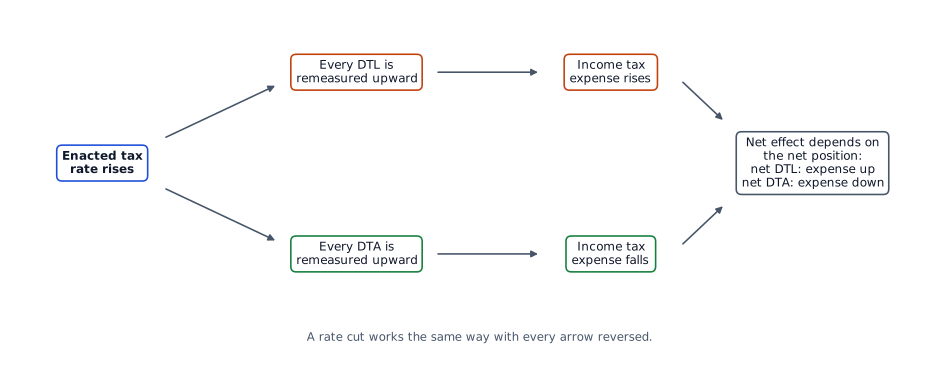
Example. Orla Freight has a DTL of $64,000 and a DTA of $16,000, both measured at 20%. The rate rises to 25%. The underlying differences are 64,000/0.20 = 320,000 and 16,000/0.20 = 80,000. The new DTL is 80,000 (up 16,000) and the new DTA is 20,000 (up 4,000). Income tax expense rises by 16,000 − 4,000 = $12,000, so net income falls by $12,000.
When new temporary differences arise in the same year as a rate change, work in this order:
- Taxes payable = taxable income × the rate in force this year.
- Cumulative temporary difference at year-end = beginning difference (beginning DTL ÷ old rate) + the difference created this year.
- Ending DTL = cumulative difference × the rate enacted for the years in which it will reverse.
- Income tax expense = taxes payable + (ending DTL − beginning DTL).
Example. Harlan Mills begins the year with a DTL of $90 from accelerated tax depreciation, measured at 30%. This year pretax income is $1,000 and taxable income is $800; the $200 gap is a new taxable temporary difference. The rate for this year is 30%, and a cut to 25%, effective from next year, is enacted during the year. Taxes payable are . The cumulative difference is , so the ending DTL is . Income tax expense is . Without the rate cut it would have been , which is 30% of pretax income.
Common exam traps
- Confusing taxes payable (tax return) with income tax expense (income statement).
- Treating a permanent difference as if it created a DTA or DTL. It changes the effective tax rate instead.
- Getting the direction wrong. A tax deduction taken earlier than the book expense creates a DTL; a book expense recognized earlier than the tax deduction creates a DTA.
- A tax rate change remeasures existing deferred balances. It does not by itself create a new DTA.
- After a rate change, compute the changes in the DTL and the DTA separately. The net effect on tax expense is ΔDTL − ΔDTA. For Orla Freight, adding the two increases gives a $20,000 rise in tax expense instead of $12,000.
Exam shortcuts
- If a temporary difference first makes taxable income lower than pretax accounting profit, it creates a DTL; if it first makes taxable income higher, it creates a DTA.
- After an increase in the enacted tax rate, the direction of the change in income tax expense follows from the net position alone: it rises for a firm with a net DTL and falls for a firm with a net DTA.
Bottom line
- Taxes payable are computed from taxable income on the tax return, while income tax expense, the income statement charge, equals taxes payable + ΔDTL − ΔDTA.
- A DTL arises when revenues or gains reach the income statement before they are taxed, or when expenses or losses are deducted for tax before they are expensed; a DTA arises in the reverse cases and from tax loss carryforwards.
- An asset whose carrying value exceeds its tax base, or a liability whose carrying value is below its tax base, gives a DTL; the opposite cases give a DTA, equal to the absolute value of (carrying value − tax base) × tax rate.
- Permanent differences never reverse, create no DTA or DTL, and make the effective tax rate differ from the statutory rate.
- When the enacted tax rate changes, existing DTAs and DTLs are remeasured at the new rate, and the remeasurement flows through income tax expense.
Quick check
When pretax income reported in the financial statements differs from taxable income because of a temporary difference, the most likely consequence is:
Show answer and explanation
Correct answer: A
A temporary difference creates a deferred tax item: a DTL if income tax expense (financial reporting) exceeds taxes payable (tax reporting), or a DTA if taxes payable exceed income tax expense. Permanent differences, rather than temporary ones, are what make the effective tax rate differ from the statutory rate.
Why the other options are wrong
- B. Neither temporary nor permanent differences generate a gain or loss; they affect tax balances and tax expense.
- C. Temporary differences typically do not make the effective and statutory rates differ, because the deferred tax expense adjusts income tax expense to the statutory rate on pretax income. Permanent differences cause that gap.
Key takeaway A temporary difference creates a deferred tax item. A permanent difference makes the effective rate differ from the statutory rate.
Module 35.2
Deferred Tax Assets and Liabilities
LOS 35.b — Creating deferred tax balances and treating them in analysis
How the balances build up and reverse
Measuring a deferred tax balance at any date depends on precise definitions of carrying value and tax base.
For a depreciable asset, the carrying value is cost less accumulated book depreciation. The tax base is cost less accumulated tax depreciation, which equals the tax depreciation still to be deducted in future returns. Liabilities follow the tax-base rule given under LOS 35.a, with one exception: revenue received in advance is taxed on receipt, so its tax base is the carrying value less amounts that will not be taxable in future.
Example. Linnet Packaging buys a machine for $48,000 with a four-year life and no residual value. The books use straight-line depreciation ($12,000 a year). For tax, the machine is depreciated straight-line over two years ($24,000 a year). The tax rate is 20%.
| End of year | Carrying value | Tax base | Difference | DTL (20%) | Change in DTL |
|---|---|---|---|---|---|
| 1 | 36,000 | 24,000 | 12,000 | 2,400 | +2,400 |
| 2 | 24,000 | 0 | 24,000 | 4,800 | +2,400 |
| 3 | 12,000 | 0 | 12,000 | 2,400 | −2,400 |
| 4 | 0 | 0 | 0 | 0 | −2,400 |
The DTL builds while tax depreciation runs ahead of book depreciation. It then reverses to zero once tax deductions stop but book depreciation continues. In Years 1–2 income tax expense exceeds taxes payable by $2,400 a year; in Years 3–4 it is $2,400 lower.
Warranties. The provision is recognized at the time of sale under the matching principle, while the tax deduction waits until repair costs are incurred. The liability's tax base is therefore zero (LOS 35.a).
Receivables. A receivable of $50,000 carries a bad-debt allowance of $4,000, so its carrying value is $46,000. If bad debts are deductible only when they are written off, the tax base is the full $50,000. The asset's carrying value is below its tax base, so at a 25% tax rate there is a DTA of .
Realizability of deferred tax assets
Deferred tax balances are not discounted to present value. A DTA has value only if the firm will earn enough future taxable income to use it, so DTAs are reviewed at every balance sheet date.
Key concept
| IFRS | US GAAP | |
|---|---|---|
| Doubt about recovering a DTA | The DTA is reduced directly (a smaller DTA is reported) | The full DTA is kept, and a valuation allowance is deducted if it is more likely than not that some of it will not be realized |
| Effect on earnings | Reduction increases income tax expense | Creating or increasing the allowance increases income tax expense and reduces net income; reducing it does the opposite |
Management must be able to support the carrying amount of every DTA. Evidence against realization includes cumulative recent losses and a history of tax loss carryforwards expiring unused. Evidence for realization includes order backlogs and existing profitable contracts. The judgement is subjective, so changes in the valuation allowance are a potential tool of earnings management: a surprise reduction in the allowance boosts earnings.
Example. A US GAAP firm reports taxes payable of $260, an increase in its DTL of $18, an increase in its gross DTA of $12 and an increase in its valuation allowance of $5. The net DTA rises by only 12 − 5 = 7, so income tax expense is .
Treatment for analytical purposes
The central question is whether, and when, the DTL will reverse.
Key concept
| Expectation | Analytical treatment |
|---|---|
| DTL expected to reverse (e.g., capital spending flat or falling) | Treat as a liability |
| DTL not expected to reverse in the foreseeable future (typically because capital expenditures keep growing, so new timing differences replace the reversing ones) | Treat as equity: reduce liabilities and increase equity by the same amount |
In practice treatments vary, so the analyst decides case by case whether, and when, each DTL will reverse.
Reclassifying a DTL as equity leaves total assets unchanged, lowers liabilities and raises equity. The debt-to-equity ratio and the financial leverage ratio (assets/equity) therefore fall. Return on equity also falls because its denominator is larger. Return on assets is unaffected, since neither net income nor total assets changes.
Common exam traps
- A DTL that is expected not to reverse is treated as equity. It is neither ignored nor offset by a valuation allowance.
- A valuation allowance applies to DTAs only. Increasing it raises tax expense. In the example, ignoring the $5 increase in the allowance gives tax expense of $266 instead of $271.
- Under IFRS there is no separate valuation allowance account; the DTA is reduced directly.
- Deferred taxes are not discounted.
- Reclassifying a DTL to equity lowers leverage ratios, while ROA does not change.
- The DTL at a date is (carrying value − tax base) × rate, using the balances at that date. The change during the year is a different number. For Linnet at the end of Year 2, reporting the year's change gives $2,400 instead of the DTL of $4,800.
Exam shortcuts
- Reclassifying a DTL as equity changes neither net income nor total assets, so an answer in which ROA changes can be ruled out.
Bottom line
- For a depreciable asset, the carrying value is cost less accumulated book depreciation and the tax base is cost less accumulated tax depreciation.
- Deferred tax assets and liabilities are not discounted to present value.
- Under US GAAP a DTA is kept in full and reduced by a valuation allowance when it is more likely than not that part of it will not be realized, while IFRS reduces the DTA directly; either reduction raises income tax expense.
- Because realizing a DTA is a subjective judgment, changes in the valuation allowance are a potential tool of earnings management, and a surprise reduction boosts earnings.
- A DTL expected to reverse is treated as a liability, while one not expected to reverse in the foreseeable future is treated as equity, and the analyst decides case by case.
- Reclassifying a DTL as equity lowers the debt-to-equity ratio, the financial leverage ratio and ROE, and leaves ROA unchanged.
Quick check
An analyst reclassifies a company's deferred tax liability from liabilities to equity. Which of the following ratios is least likely to be affected by this reclassification?
Show answer and explanation
Correct answer: A
Reclassifying a DTL moves an amount from liabilities to equity; total assets and net income are unchanged, so return on assets is unaffected. Equity rises, which changes every ratio that uses equity in the numerator or denominator.
Why the other options are wrong
- B. The debt-to-equity ratio falls because liabilities decrease and equity increases.
- C. Return on equity falls because the equity denominator becomes larger while net income is unchanged.
Key takeaway Reclassifying a DTL as equity lowers leverage ratios and ROE but leaves ROA unchanged.
Module 35.3
Tax Rates and Disclosures
LOS 35.c — Statutory, effective and cash tax rates
Three tax rates measure different things:
Key concept
| Rate | Definition | What it shows |
|---|---|---|
| Statutory tax rate | The corporate income tax rate of the jurisdiction where the company is domiciled | The "headline" rate set by law |
| Effective tax rate | The tax charge actually reported per unit of accounting profit; the most useful rate for forecasting earnings | |
| Cash tax rate | The cash burden of taxes; useful for forecasting cash flows |
The effective and cash tax rates both use pretax (accounting) income as the denominator. The statutory rate is not computed from the financial statements at all; it is set by tax law and applied to taxable income. When only net income is given, add income tax expense back first: pretax income = net income + income tax expense.
Why the effective rate differs from the statutory rate
- Different tax rates in different jurisdictions (foreign operations)
- Permanent differences: tax credits, tax-exempt income, nondeductible expenses, and different tax treatment of capital gains versus operating income
- New tax legislation or changed tax rates
- Tax holidays granted in some countries
Temporary differences typically do not make the effective and statutory rates differ, because deferred tax expense adjusts income tax expense back toward statutory rate × pretax income. They do, however, make the cash tax rate differ from the effective rate.
Example. Rennick Foods earns pretax income of $500 at home (tax rate 28%) and $300 in a subsidiary abroad (tax rate 16%). Income tax expense is . The effective tax rate is , below the 28% statutory rate because of the low-tax foreign operations.
Example. Pretax income is $400, including $20 of tax-exempt interest. The statutory rate is 30% and there are no other differences. Income tax expense is , and the effective rate is .
Using the rate reconciliation
The footnotes must reconcile the statutory rate to the effective rate. Understanding why reported income tax expense differs from tax at the statutory rate helps the analyst forecast earnings and cash flows. For each reconciling item, look at its relative size, its trend so far and the direction it is expected to take; the footnotes and management's discussion and analysis are the sources. Percentages can be converted into amounts when that helps. When studying trends and forecasting, include only reconciliation items that are continuous in nature and set aside those that are sporadic:
| Usually continuous | Usually sporadic |
|---|---|
| Different tax rates in different countries | Large asset sales |
| Tax-exempt income | Tax holiday savings |
| Nondeductible expenses | Other one-off "special items" |
For a tax holiday (a temporary exemption from tax in a jurisdiction), find out when it ends and whether accumulated taxes become payable at that point. Volatile reconciliation items make the effective rate hard to forecast and reduce comparability with peers.
LOS 35.d — Deferred tax disclosures and their analytical use
Common temporary differences
Key concept
| Source | Result | Why |
|---|---|---|
| Accelerated tax depreciation, straight-line in the books | DTL | Tax deductions come first; consider the firm's growth and capex before assuming reversal |
| Impairments | DTA | Write-down expensed now; tax deduction usually only on sale/disposal |
| Restructuring charges | DTA | Expensed when announced; deducted when paid (large cash outflows follow, net of tax savings) |
| Inventory cost flow method | Usually none in the US (LIFO conformity); can arise elsewhere | Book and tax methods may differ outside the US |
| Post-employment benefits, deferred compensation | DTA | Expensed when earned by employees; deducted when paid |
| Unrealized gains/losses on available-for-sale securities | Deferred tax adjustment in equity | Gains go directly to equity; tax only when realized |
Exam convention: the future tax on unrealized gains and losses from available-for-sale securities is recorded as a deferred tax adjustment to stockholders' equity, and the balance sheet shows no DTL for it. Current practice: for available-for-sale debt securities (US GAAP) and FVOCI assets (IFRS 9), ASC 740 and IAS 12 recognize the deferred tax liability (or asset) on the balance sheet and charge the related tax to other comprehensive income, so the income statement tax expense is unaffected. Unrealized gains on these securities therefore appear among deferred tax liabilities in disclosure tables.
On the balance sheet, deferred tax assets and liabilities are classified as noncurrent under both IFRS and US GAAP. They are not split into current and noncurrent portions by expected reversal date.
What is typically disclosed
- DTLs, DTAs, any valuation allowance and the net change in the allowance during the period
- Any unrecognized deferred tax liability (DTL) that relates to earnings retained by subsidiaries or joint ventures
- For each kind of temporary difference, its tax effect in the current year
- The components of income tax expense (current and deferred)
- A reconciliation between reported income tax expense and tax computed at the statutory rate
- Tax loss carryforwards and credits
Reading the disclosures
- If income tax expense keeps exceeding taxes payable, DTLs are growing faster than DTAs (deferred tax expense is positive).
- A decrease in the valuation allowance lowers deferred tax expense and raises reported earnings. It signals that management now expects more future taxable income, so check that it is justified.
- With a straight-line book schedule and an accelerated tax schedule, taxes payable can be computed year by year. Taxable income is pretax income before depreciation minus tax depreciation, and taxes payable are taxable income × rate. When only temporary differences exist and the tax rate does not change, income tax expense is pretax accounting income × rate.
Example. Book depreciation is 40 a year and tax depreciation is 60 in Year 1. Income before depreciation is 250 and the tax rate is 20%. Taxes payable are . Income tax expense is . The DTL rises by .
Common exam traps
- Effective and cash tax rates divide by pretax income. Net income and taxable income are the wrong denominators. For Rennick, dividing by net income of $612 gives an effective rate of 30.7% instead of 23.5%.
- Taxes payable use tax depreciation; income tax expense uses book depreciation. In the depreciation example, swapping the two gives taxes payable of 42 and income tax expense of 38 instead of 38 and 42.
- Changes in DTAs and DTLs from temporary differences at an unchanged tax rate, and higher cash taxes, do not by themselves make the effective rate differ from the statutory rate. Permanent differences and foreign rates do.
- Tax holidays are sporadic items; identify the end date.
Exam shortcuts
- When only temporary differences exist and the tax rate does not change, income tax expense is pretax accounting income × the tax rate, so no deferred tax schedule is needed to find it.
Bottom line
- The effective tax rate is income tax expense divided by pretax income, the cash tax rate is cash taxes paid divided by pretax income, and the statutory rate is set by law in the jurisdiction where the company is domiciled.
- The effective rate differs from the statutory rate because of different rates in foreign jurisdictions, permanent differences, new legislation or rate changes, and tax holidays; temporary differences typically do not cause the gap but make the cash tax rate differ from the effective rate.
- When forecasting from the rate reconciliation, an analyst includes continuous items such as foreign rate differences, tax-exempt income and nondeductible expenses, and sets aside sporadic items, for example tax holiday savings or a large asset sale.
- Accelerated tax depreciation with straight-line book depreciation creates a DTL, while impairments, restructuring charges and post-employment benefits create DTAs.
- Deferred tax assets and liabilities are classified as noncurrent under both IFRS and US GAAP.
- Income tax expense that keeps exceeding taxes payable means DTLs are growing faster than DTAs, and a decrease in the valuation allowance raises reported earnings.
Quick check
An analyst reviewing Kittredge Pharma notes that its effective tax rate is 6 percentage points below its statutory rate. Almost all of the gap comes from a tax holiday granted for a new plant in Malaysia. This reconciliation item is most likely:
Show answer and explanation
Correct answer: C
A tax holiday is a temporary exemption from tax in a particular jurisdiction, so it is a sporadic reconciliation item. The key analytical task is to establish when the holiday will expire and how its expiry (including any requirement to pay accumulated taxes) will affect future taxes payable and the effective rate.
Why the other options are wrong
- A. A tax holiday is temporary, so it is a sporadic item. Its termination date is the main thing the analyst needs to find out.
- B. Nothing suggests the holiday's benefit is routinely offset by home-country taxes. The analyst's focus is the end date and any taxes that become payable then.
Key takeaway A tax holiday is a sporadic item. Find its end date and any catch-up tax.
Practice Questions
Which of the following is most likely to cause a deferred tax asset to be created?
Show answer and explanation
Correct answer: B
Unearned revenue (cash received in advance) is usually taxed when received but recognized in the income statement only later, when earned. Taxes payable therefore exceed income tax expense now, and a deferred tax asset is created that reverses when the revenue is recognized.
Why the other options are wrong
- A. Accelerated depreciation on the tax return (with straight-line depreciation in the financial statements) makes the tax deduction come before the book expense, so taxable income is initially lower than pretax income and a deferred tax liability is created. Other combinations of book and tax depreciation methods can produce either type of deferred tax item, but this pairing is the classic DTL case.
- C. A change in the enacted rate only remeasures existing deferred balances; a decrease reduces existing DTAs and DTLs rather than creating a DTA.
Key takeaway Typical DTA sources: unearned revenue, warranty provisions, post-employment benefits, tax loss carryforwards.
Lochmere Outfitters has built up large tax loss carryforwards. Its deferred tax balances at the start of the year, measured at the 24% income tax rate then enacted, are shown below.
| Deferred tax item | Balance ($ thousands) |
|---|---|
| Deferred tax asset (tax loss carryforwards and warranty provisions) | 360 |
| Deferred tax liability (accelerated tax depreciation) | 150 |
During the year the legislature enacts an increase in the income tax rate to 28%, applying from next year onward, when all of these differences are expected to reverse. No temporary differences arise or reverse during the year. As a result of the rate change, Lochmere's income tax expense for the year will:
Show answer and explanation
Correct answer: C
Deferred tax assets and liabilities are measured at the tax rate expected to apply when the differences reverse, so an enacted rate change remeasures both balances and the adjustment flows through income tax expense in the period of enactment. A higher rate raises both the DTA and the DTL. Lochmere's DTA is larger than its DTL, so the DTA rises by more, and income tax expense falls.
Underlying temporary differences: DTA ; DTL (thousands of dollars).
Remeasured at 28%: DTA , so ; DTL , so .
Income tax expense falls by $35,000 and net income rises by the same amount.
Why the other options are wrong
- A. An increase of $25,000 remeasures only the deferred tax liability. The deferred tax asset is remeasured too, and its $60,000 increase reduces tax expense by more than the liability adds.
- B. The balances must reflect the rate expected when they reverse. Once the higher rate is enacted they are remeasured at once, and the change is recognized in this year's income tax expense even though the new rate applies to later tax returns.
Key takeaway A higher enacted tax rate increases both DTAs and DTLs. Income tax expense rises for a company with a net DTL and falls for a company with a net DTA, so a rate increase does not always raise tax expense.
This reading has 41 questions in the full bank. Practice all of them.
Key Takeaways
- A temporary difference creates a deferred tax item. A permanent difference makes the effective rate differ from the statutory rate.
- Typical DTA sources: unearned revenue, warranty provisions, post-employment benefits, tax loss carryforwards.
- A higher enacted tax rate increases both DTAs and DTLs. Income tax expense rises for a company with a net DTL and falls for a company with a net DTA, so a rate increase does not always raise tax expense.
- Reclassifying a DTL as equity lowers leverage ratios and ROE but leaves ROA unchanged.
- A tax holiday is a sporadic item. Find its end date and any catch-up tax.