Financial Statement Analysis · Reading 34
Finance Lease vs Operating Lease
CFA Level I · Financial Statement Analysis · Reading 34: Topics in Long-Term Liabilities and Equity · about 1 h 1 min
What you'll learn
- LOS 34.a Explain how lessees and lessors report finance and operating leases under IFRS and US GAAP.
- LOS 34.b Explain the reporting of defined contribution, defined benefit and share-based compensation plans.
- LOS 34.c Describe the presentation and disclosure of leases, pensions and share-based compensation.
Module 34.1
Leases
This reading covers lease accounting by lessees and lessors, defined contribution and defined benefit pension plans, share-based compensation, and the disclosures required for each. A candidate must be able to classify a lease, measure the lessee's lease liability and right-of-use asset over the lease term, compute a pension plan's funded status and measure the expense of a share-based award.
LOS 34.a — Financial reporting of leases by lessees and lessors
What a lease is and why firms lease
In a lease, the lessee buys the right to use a specific asset owned by the lessor for a period, in exchange for periodic payments. A contract is a lease only if it (1) refers to a specific asset, (2) gives the lessee effectively all of the asset's economic benefits during the term, and (3) gives the lessee the right to direct how the asset is used.
Leasing is an alternative to borrowing and buying. Typical advantages for the lessee:
- Less initial cash outflow. A lease needs little or no down payment.
- Less costly financing. The lease is effectively secured by the asset, so the implicit rate can be below the rate on a loan to buy it.
- Less risk of obsolescence. The asset usually goes back to the lessor, which bears the residual-value risk and prices it into the implicit rate. If the lessee guarantees a residual value, that risk stays with the lessee.
What the lessee gives up is ownership. It normally does not benefit if the asset rises in value, unless it holds a purchase option.
Classification: finance lease vs. operating lease
Key concept
A finance lease transfers substantially all the benefits and risks of ownership to the lessee. If either the benefits or the risks are not substantially transferred, the lease is an operating lease. Lessee and lessor classify a given lease the same way. A lease is a finance lease if any one of these conditions holds:
- Ownership transfers to the lessee by the end of the term.
- The lessee holds a purchase option that it is expected to exercise.
- The lease covers most of the asset's useful life.
- The present value of the lease payments is at least equal to the asset's fair value.
- The asset is so specialized that the lessor has no other use for it.
A long term alone does not decide the classification, because the test compares the term with the asset's useful life. The payment test uses the present value of the payments, not their undiscounted sum.
Exam convention: the purchase option counts when the lessee is expected to exercise it, and the payment test is met when the lease payments have a present value at least equal to the asset's fair value. Current practice: IFRS 16 and ASC 842 require exercise of the purchase option to be reasonably certain, include any residual value guaranteed by the lessee in the payments, and ask whether their present value amounts to substantially all of the fair value. A present value at or above fair value always passes, and one slightly below fair value can also pass.
Lessee accounting
At commencement the lessee records a right-of-use (ROU) asset and a lease liability. Both equal the present value of the lease payments, discounted at the rate implicit in the lease. The ROU asset is the lessee's right to use the underlying asset; the physical asset stays with the lessor. The lease liability is then carried like an amortizing loan: each payment is split into interest (liability × rate) and principal.
Exam convention: the ROU asset is an intangible asset, not PP&E. Current practice: IFRS 16 lets the lessee present it as a separate line item or within the line where the same kind of asset would appear if owned (for example, PP&E), with disclosure of which lines include ROU assets.
Key concept
| IFRS (all leases) and US GAAP finance lease | US GAAP operating lease | Short-term leases (both) and low-value leases (IFRS) | |
|---|---|---|---|
| Balance sheet | ROU asset + lease liability | ROU asset + lease liability | Nothing recognized |
| ROU asset | Amortized straight-line | Reduced by the principal repayment each period, so ROU asset = liability throughout | n/a |
| Income statement | Amortization + interest expense reported separately | Single lease expense = the lease payment (straight-line) | Rent expense, straight-line |
| Cash flow statement | Principal → CFF; interest → CFO (US GAAP) or CFO/CFF (IFRS) | Entire payment → CFO | Entire payment → CFO |
Exam convention: an IFRS lessee may report the interest part of a lease payment in CFO or CFF (the IAS 7 choice). Current practice: IFRS 18, effective for annual periods beginning on or after 1 January 2027, removes that choice for companies whose main business is not financing; they report interest paid in CFF.
Under IFRS, a short-term lease is one of 12 months or less, and a low-value lease is roughly USD 5,000 or less. Every other IFRS lease, whatever its classification, is accounted for by the lessee like a finance lease.
Exam convention: lease payments are made at the end of each period (in arrears). Current practice: most leases call for payment at the start of each period.
At inception the lease liability is the present value of the remaining lease payments, discounted at the rate implicit in the lease. With equal payments at the end of each of periods and a periodic rate :
Each period, interest expense is times the opening liability, and the rest of the payment reduces the liability.
Example. A lessee leases a machine for 3 years, paying $40,000 at the end of each year. The implicit rate is 8%.
On the calculator: N = 3, I/Y = 8, PMT = −40,000, FV = 0, CPT PV. Straight-line amortization is a year.
| Year | Interest (8%) | Principal | Ending liability | Finance lease: ROU asset | Finance lease: total expense | US GAAP operating: expense |
|---|---|---|---|---|---|---|
| 1 | 8,247 | 31,753 | 71,331 | 68,723 | 42,608 | 40,000 |
| 2 | 5,706 | 34,294 | 37,037 | 34,361 | 40,068 | 40,000 |
| 3 | 2,963 | 37,037 | 0 | 0 | 37,324 | 40,000 |
Under the finance lease method the ROU asset falls faster than the liability in the early years, because the principal repaid early on is smaller than the straight-line amortization. Total expense is front-loaded. Over the whole lease both methods expense the same $120,000.
The cash paid is $40,000 a year under either method; only its classification differs. In Year 1 a US GAAP finance-lease lessee reports the $8,247 of interest in CFO and the $31,753 of principal in CFF. A US GAAP operating-lease lessee reports the whole $40,000 in CFO.
Key concept
| Effect (lessee) | Finance lease | US GAAP operating lease |
|---|---|---|
| ROU asset | Lower | Higher |
| Lease liability | Same | Same |
| Net income, early years / later years | Lower / higher | Higher / lower |
| EBIT | Higher (interest is below EBIT) | Lower |
| Interest expense | Higher | Lower (none reported) |
| CFO | Higher | Lower |
| CFF | Lower | Higher |
Lessor accounting
In a finance lease, the lessor derecognizes the leased asset and recognizes a lease receivable. Its initial amount is the net investment in the lease: the present value of the lease payments plus the present value of the expected residual value. The receivable is amortized with the effective interest method, and the lessor reports interest income; for a manufacturer or dealer this interest income is part of revenue. A profit or loss arises at inception only if the lease's value differs from the asset's carrying amount.
The net investment in the lease equals the asset's fair value, because the rate implicit in the lease is defined as the discount rate at which the payments plus the residual value are worth the asset's fair value. By the end of the term the receivable has fallen to the expected residual value. If the lessor later disposes of the asset for a different amount, it reports a further gain or loss.
- In a sales-type lease the lessor is a manufacturer or dealer. Revenue is the present value of the lease payments, and cost of sales is the carrying value minus the present value of the residual. The selling profit is recognized at inception, as with a sale of inventory.
- In a direct financing lease the lessor is a financing company. Exam convention: no gain or loss is recognized at inception; a gain is deferred and recognized as interest income over the term, and a loss is deferred and recognized as an expense over the term. Current practice: under ASC 842 a selling profit on a direct financing lease is deferred and earned through interest income, but a selling loss is recognized at commencement. IFRS 16 does not use the term direct financing lease, and it allows selling profit or loss at commencement only for manufacturer or dealer lessors.
In an operating lease, the lessor keeps the asset on its balance sheet (usually in PP&E) and continues to depreciate it. It reports the lease payments as income on a straight-line basis, with depreciation and other costs as expenses. No receivable is created.
For the lessor, all lease cash inflows are CFO under either classification. Total income over the lease is the same under both methods; only the timing differs.
The figure brings both sides together. For the lessee, the model depends on the reporting framework as well as the classification; for the lessor, it depends on the classification alone.
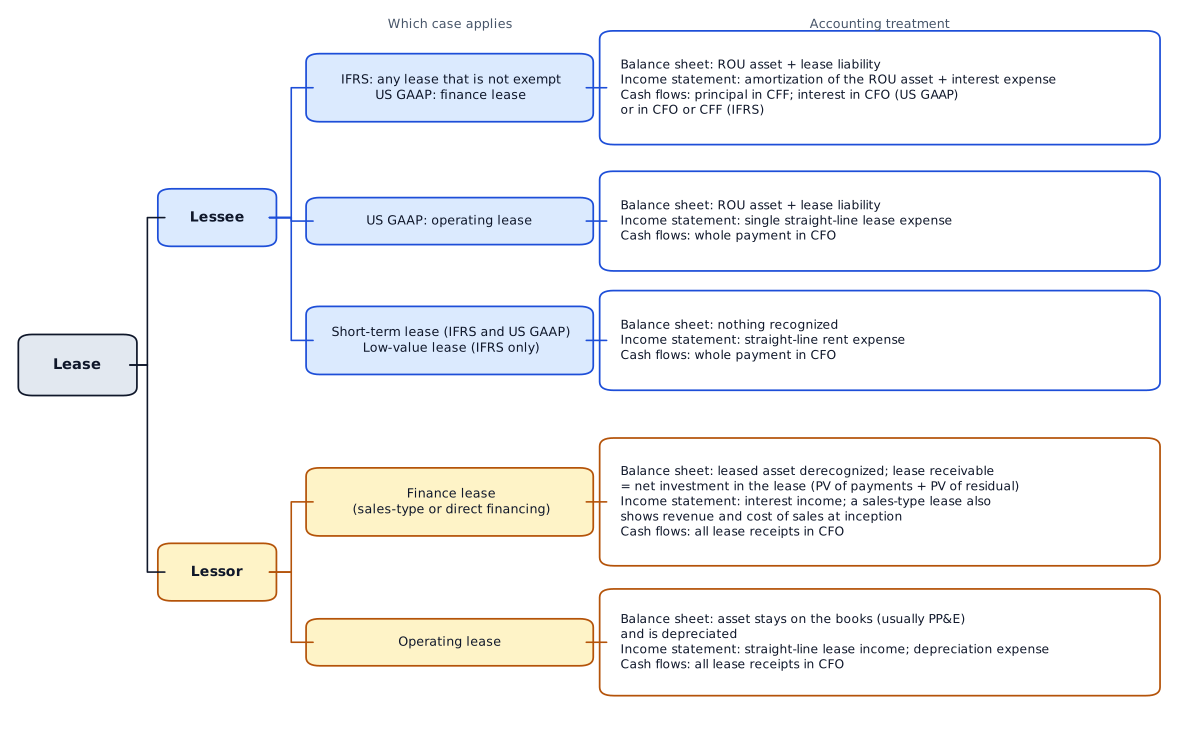
Common exam traps
- At commencement the lessee's ROU asset equals the lease liability. Both equal the present value of the payments, which is neither the fair value nor the undiscounted total. For the machine lease, this is $103,084, not the undiscounted $120,000.
- Lessees with operating leases still recognize an ROU asset and a lease liability under IFRS and US GAAP. The exceptions are short-term leases and, under IFRS, low-value leases.
- In an operating lease the physical asset stays on the lessor's books. The lessee shows only an ROU asset.
- The principal portion of a lessee's finance lease payment is a financing outflow. For a US GAAP operating lease the whole payment is an operating outflow.
- Sales-type and direct financing leases are both kinds of finance lease. In both, the lessor derecognizes the asset and earns interest income.
Exam shortcuts
- For a US GAAP operating lease, the lessee's single lease expense equals the lease payment and the ROU asset equals the lease liability throughout, so the expense needs no split into interest and amortization.
Bottom line
- Exam convention: a lease is a finance lease if any one of these holds: title passes to the lessee by the end of the term, the lessee has a purchase option it is expected to exercise, the term covers most of the asset's useful life, the lease payments have a present value at least equal to the asset's fair value, or the asset is so specialized that the lessor has no other use for it.
- Current practice under IFRS 16 and ASC 842 requires exercise of the purchase option to be reasonably certain, includes any lessee-guaranteed residual value in the lease payments, and asks whether their present value amounts to substantially all of the asset's fair value.
- At commencement a lessee records a right-of-use asset and a lease liability, each measured as the lease payments discounted at the rate implicit in the lease, except for short-term leases and, under IFRS, low-value leases.
- Under IFRS (other than for short-term and low-value leases) and for US GAAP finance leases, the lessee reports straight-line amortization of the ROU asset and interest expense separately, with the principal repaid in CFF; for a US GAAP operating lease it reports one straight-line lease expense and the whole payment in CFO.
- In a finance lease the lessor derecognizes the asset, records a lease receivable equal to the net investment in the lease (present value of the lease payments plus present value of the expected residual value) and reports interest income; a sales-type lessor also recognizes the selling profit at inception.
- In an operating lease the lessor keeps the asset on its balance sheet, continues to depreciate it and reports the lease payments as income on a straight-line basis.
Quick check
Which of the following is the least likely reason for Northgate Printing to lease a new press rather than purchase it?
Show answer and explanation
Correct answer: C
A lessee usually returns the asset at the end of the lease, so it does not benefit from any appreciation (unless the lease includes a purchase option). Capturing gains in the asset's value is a reason to own the asset rather than lease it.
Why the other options are wrong
- A. Since the leased asset effectively serves as collateral, the implicit lease rate may be below what a lender would charge to finance a purchase. This is a genuine reason to lease.
- B. Leases typically require a small initial payment, if any, so leasing conserves cash at inception compared with a purchase. This is also a genuine reason to lease.
Key takeaway Advantages of leasing: smaller initial outflow, cheaper financing, less obsolescence risk. Appreciation belongs to the owner (the lessor).
Module 34.2
Deferred Compensation and Disclosures
LOS 34.b — Defined contribution, defined benefit and share-based compensation plans
Pensions and share-based compensation are forms of deferred compensation: employees earn them now but receive them later, so their accounting relies on management estimates.
Defined contribution vs. defined benefit plans
Key concept
| Defined contribution plan | Defined benefit plan | |
|---|---|---|
| Employer's promise | Contribute an agreed amount each period (e.g., a % of salary) | Pay a defined benefit after retirement (e.g., 1.5% × final salary × years of service) |
| Who bears investment risk | Employee | Employer |
| Income statement | Pension expense = employer's contribution for the period | Components of the change in funded status (see below) |
| Balance sheet | Nothing once the contribution is paid | Net pension asset or liability (funded status) |
A defined benefit plan creates a balance sheet item because the employer has promised the retirement benefit itself rather than a fixed contribution. Each year of service adds to that promise, and the obligation remains until the benefits are paid.
The funded status of a defined benefit plan is
Key concept
A positive amount means the plan is overfunded and the sponsor reports a net pension asset. A negative amount means it is underfunded and the sponsor reports a net pension liability.
The sponsor usually funds a defined benefit plan by transferring assets to a separate legal entity, typically a trust, which invests them to meet the benefits as they fall due. The fair value of plan assets is the current value of that pool. The obligation is the present value, at the balance sheet date, of the benefits earned to date that will be paid from retirement until death. IFRS calls it the present value of the defined benefit obligation (PVDBO); US GAAP calls it the projected benefit obligation (PBO). Both terms describe the same obligation. Estimating the obligation requires external actuaries and assumptions about future compensation (salary growth), employee turnover, retirement age, mortality and the discount rate. Post-retirement health care plans are typically not prefunded with plan assets, so they appear as a liability. Analysts treat a net pension liability like debt when computing leverage.
Example. Plan assets of $780 million and a benefit obligation of $860 million give a funded status of −$80 million, which is a net pension liability of $80 million. If that is the net liability at the start of a year and the discount rate is 5%, IFRS net interest expense for the year is million.
Where the change in funded status goes
Key concept
| Component | IFRS | US GAAP |
|---|---|---|
| Service cost (current period) | Income statement | Income statement |
| Past service cost | Income statement (part of service cost) | OCI, then amortized into income over the service period |
| Interest | Net interest = discount rate × net pension asset/liability, in the income statement (income if the plan starts the year overfunded, expense if underfunded) | Interest cost (growth of the obligation with the passage of time), in the income statement |
| Return on plan assets | Netted against interest cost inside net interest; the difference between actual and expected return is a remeasurement | Expected return on plan assets shown separately (it can use a different rate) and reduces expense in the income statement |
| Remeasurements / actuarial gains and losses | OCI (never recycled) | OCI, generally amortized into income (immediate recognition allowed) |
US GAAP therefore has five components: three in the income statement and two in OCI. Given the same actuarial assumptions, the total periodic cost of the plan is the same under both standards. The standards differ only in how that cost is divided between the income statement and OCI. Manufacturers allocate pension expense to inventory (and so to COGS) and to SG&A, so the full amount may be visible only in the financial statement notes.
Share-based compensation
Share-based pay aligns managers' and shareholders' interests without an immediate cash outflow. Newly issued shares, however, dilute existing owners and reduce EPS. The main criticisms are that employees have limited control over the share price, that share grants can make managers too risk-averse while options (with their asymmetric payoff) can encourage excessive risk taking, and that performance shares based on accounting metrics can invite manipulation.
For equity-settled awards (stock grants, restricted stock units, performance shares, employee stock options), both IFRS and US GAAP require the company to measure the fair value at the grant date and to expense it over the vesting period (service period). The vesting period runs from the grant date until the employee receives the shares or is first able to exercise the option. The grant-date value is not updated afterward, so a rise or fall in the share price after the grant does not change the expense. If vesting is immediate, the whole fair value is expensed at grant, and common stock and APIC rise by the same amount.
The timeline follows an award of 40,000 employee stock options with a grant-date fair value of $6.00 each and a three-year vesting period.
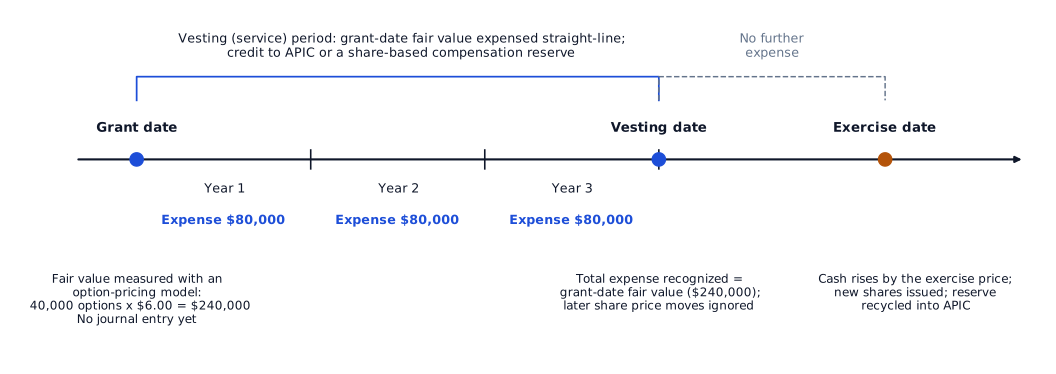
| Instrument | Fair value at grant | Accounting |
|---|---|---|
| Stock grants (awarded outright, with restrictions, or contingent on performance); restricted stock units (grants that vest only after service or performance criteria are met); performance shares (grants tied to a target such as ROE rather than the share price) | Share price on the grant date | Expense straight-line over the service period; credit an equity reserve or APIC; at vesting the reserve is recycled into common stock and APIC |
| Employee stock options | Option-pricing model (e.g., Black-Scholes-Merton, binomial); inputs such as volatility are subjective | No entry at grant; expense straight-line over the vesting period with a credit to APIC or a share-based compensation reserve; on exercise the company issues new shares, cash rises by the exercise price, equity rises by the same amount (common stock at par and APIC), and any reserve is recycled into APIC; if vested options expire unexercised, no adjustment is made |
| Stock appreciation rights (SARs) / phantom stock (usually cash-settled) | Payoff linked to the change in the share price; the holder does not need to own the stock | Paid in cash, so there is no dilution but there is a cash outflow when the stock does well; option-like payoffs avoid the risk-aversion bias of share grants; phantom stock, used by firms whose shares are not exchange traded, pays according to a hypothetical stock |
Exam convention: share-based pay is measured at grant-date fair value and expensed over the service period; the expense lowers retained earnings and the offsetting credit to APIC or a reserve leaves total equity unchanged. Current practice: this holds for equity-settled awards, while cash-settled awards such as SARs and phantom stock are carried as a liability that is remeasured to fair value at each reporting date until settlement, with the changes in profit or loss, so total equity falls by the expense. Both kinds of award are measured at fair value. Intrinsic value (share price − exercise price) is not used, and an at-the-money or out-of-the-money option still has a positive grant-date fair value.
Example. A company grants 20,000 restricted stock units when the share price is $30, vesting after three years. The expense is per year.
LOS 34.c — Presentation and disclosures for leases, pensions and share-based pay
Lease disclosures (IFRS 16)
Lease disclosures help users assess the effect of leases on the entity's financial position, its performance and its cash flows. Lessees and lessors provide both qualitative and quantitative information. IFRS and US GAAP set the objectives; companies have discretion over how to meet them, within the guidance the standards give.
| Lessee | Lessor, finance leases | Lessor, operating leases |
|---|---|---|
| Carrying amount of ROU assets by class; additions to ROU assets | Selling profit or loss on derecognition | Lease income, variable payments shown separately |
| Interest expense on lease liabilities; ROU amortization by class | Finance income on the net investment in the lease | Maturity analysis of lease payments receivable (each of next 5 years + thereafter) |
| Total lease cash outflows; expenses for short-term and low-value leases and for variable payments | Income from variable payments not in the net investment | Leased asset stays on the books, so PP&E disclosures (IAS 16) by class and impairment disclosures (IAS 36) apply |
| Maturity analysis of lease liabilities; split into current and noncurrent | Explanation of significant changes in the net investment | |
| Nature of leasing activities, residual value guarantees, restrictions and covenants imposed by leases, sale and leaseback transactions | Maturity analysis of lease payments receivable; reconciliation of undiscounted payments to the net investment |
A maturity analysis is the item common to lessees and both types of lessor. In the lessee's balance sheet, the principal due within the next year is a current liability and the remaining principal is long-term.
Variable lease payments come in two types. Payments linked to an index or rate (such as an inflation index or a market reference rate) are included in the lease liability and ROU asset at the current index level. The liability and the ROU asset are remeasured when the index changes. Payments that depend on the lessee's future sales or on how much the asset is used are left out of the liability and expensed as incurred.
Pension disclosures (IAS 19)
- Defined contribution plans. The only requirement is to disclose separately the employer's contribution expensed in the income statement.
- Defined benefit plans. The disclosures have three objectives: (1) explain the characteristics and risks of the plan; (2) identify the amounts in the financial statements arising from it; (3) describe how it affects the amount, timing and uncertainty of future cash flows, which mainly means employer contributions. Minimum disclosures include the plan's nature, governance and risks; reconciliations of plan assets, obligation and funded status; a sensitivity analysis of the obligation to key actuarial assumptions; the composition of plan assets; expected employer contributions for the next period; and the maturity profile of the obligation.
Share-based compensation disclosures
These disclosures help users understand the nature and extent of the arrangements and their effect on current and future cash flows. Companies must disclose the nature and key terms of the plans (grant date, vesting date, service period, settlement in shares or cash), how grant-date fair value was determined, and the effect on earnings and financial position (income statement and balance sheet).
Common exam traps
- Only defined benefit plans create a net pension asset or liability on the balance sheet.
- Under IFRS, remeasurements (actuarial gains and losses) go to OCI and never pass through the income statement.
- IAS 19's third objective concerns future cash flows. Future net income is not one of the objectives.
- Equity-settled share-based pay is measured at grant-date fair value and expensed over the vesting period under both IFRS and US GAAP. Cash-settled SARs and phantom stock are instead a liability remeasured each period. The share price at the reporting date is not a required disclosure.
- Lessor operating lease disclosures include impairment of the leased asset. Selling profit and finance income are finance lease disclosures.
Bottom line
- In a defined contribution plan the employee bears the investment risk and pension expense equals the employer's contribution; in a defined benefit plan the employer bears the investment risk and reports the plan's funded status on the balance sheet.
- Funded status equals the fair value of plan assets minus the PVDBO (called the PBO under US GAAP); a positive amount is a net pension asset and a negative amount a net pension liability.
- Under IFRS, service cost (including past service cost) and net interest, the discount rate times the net pension asset or liability, go to the income statement, while remeasurements go to OCI and are never recycled.
- Given the same actuarial assumptions, IFRS and US GAAP give the same total periodic cost for a defined benefit plan and differ only in how it is split between the income statement and OCI.
- Equity-settled share-based pay is measured at fair value on the grant date and expensed over the vesting period under both IFRS and US GAAP, and later share price changes do not change the expense.
- IAS 19 disclosures for a defined benefit plan explain its characteristics and risks, identify the amounts it creates in the financial statements, and describe its effect on the amount, timing and uncertainty of future cash flows.
Quick check
Marrick Semiconductor grants employee stock options on the terms below and expects all of them to vest.
| Item | Value |
|---|---|
| Options granted | 60,000 |
| Share price on grant date | $38.00 |
| Exercise price | $40.00 |
| Fair value per option on grant date (option-pricing model) | $7.50 |
| Vesting period | 4 years (all options vest together) |
The compensation expense Marrick recognizes in the first year is closest to:
Show answer and explanation
Correct answer: B
Both IFRS and US GAAP measure an employee stock option at its fair value on the grant date, estimated with an option-pricing model, and recognize that amount straight-line over the vesting period as compensation expense (with a matching credit to equity).
Each year: compensation expense $112,500; equity (APIC or a share-based compensation reserve) +$112,500, so total equity is unchanged.
Why the other options are wrong
- A. $450,000 is the total grant-date fair value (), which would be expensed at once only if the options vested immediately. Here it is spread over four years.
- C. $0 uses the intrinsic value at grant (the share price of $38 is below the $40 exercise price). The expense is based on the options' grant-date fair value, which is positive even though they are out of the money.
Key takeaway Option expense equals grant-date fair value divided by the vesting years. It is not based on intrinsic value and is not remeasured for later share price changes.
Practice Questions
Aerolinea Sur leases a regional jet from Skyward Capital under an arrangement classified as an operating lease. The jet itself is reported as a physical asset on the balance sheet of:
Show answer and explanation
Correct answer: C
In an operating lease the underlying asset stays on the lessor's balance sheet (usually in PP&E), and the lessor depreciates it. The lessee instead recognizes a right-of-use asset and a lease liability, both initially equal to the present value of the lease payments; the ROU asset represents Aerolinea's right to use the jet, not the jet itself.
Why the other options are wrong
- A. The lessor still owns and reports the jet in an operating lease, so it does appear on a balance sheet.
- B. The lessee reports a right-of-use asset (its right to use the jet over the lease term) and a lease liability. The physical jet is owned and reported by the lessor.
Key takeaway Operating lease: physical asset on lessor's books; ROU asset and lease liability on lessee's books.
Which of the following items is least likely to be a required disclosure about Tavener Systems' share-based compensation plans?
Show answer and explanation
Correct answer: C
Required share-based compensation disclosures are the nature and key terms of the plans (grant date, vesting date, service period, settlement features), how grant-date fair value was determined, and the effect of the arrangements on earnings and financial position. The share price at the reporting date may help users but is not a required disclosure.
Why the other options are wrong
- A. The method used to determine grant-date fair value is a required disclosure, because the expense rests on it.
- B. Companies must disclose the effect of share-based transactions on both the income statement and the balance sheet.
Key takeaway Share-based pay disclosures: plan nature and terms, how grant-date fair value was set, effects on the income statement and balance sheet.
This reading has 31 questions in the full bank. Practice all of them.
Key Takeaways
- Advantages of leasing: smaller initial outflow, cheaper financing, less obsolescence risk. Appreciation belongs to the owner (the lessor).
- Operating lease: physical asset on lessor's books; ROU asset and lease liability on lessee's books.
- Option expense equals grant-date fair value divided by the vesting years. It is not based on intrinsic value and is not remeasured for later share price changes.
- Share-based pay disclosures: plan nature and terms, how grant-date fair value was set, effects on the income statement and balance sheet.