Financial Statement Analysis · Reading 33
Straight Line Depreciation
CFA Level I · Financial Statement Analysis · Reading 33: Analysis of Long-Term Assets · about 59 min
What you'll learn
- LOS 33.a Compare the accounting for intangible assets that are purchased, developed internally, or acquired in a business combination.
- LOS 33.b Explain and evaluate how impairment, revaluation and derecognition of PP&E and intangible assets affect the financial statements and ratios.
- LOS 33.c Analyze and interpret disclosures about PP&E and intangible assets, including estimates of average age and useful lives.
Module 33.1
Intangible Long-Lived Assets
This reading covers how intangible assets are recognized according to how they were obtained, how PP&E and intangibles are impaired, revalued and derecognized, and what the disclosures about them show. A candidate must be able to measure an impairment loss under IFRS and US GAAP, compute the gain or loss when an asset is derecognized, and estimate average age, total useful life and remaining useful life from the disclosures.
LOS 33.a — Intangible assets: purchased, internally developed, and acquired in a business combination
Review of assumed knowledge: capitalizing a long-lived asset
This reading assumes that the capitalize-versus-expense decision is already familiar. A cost is capitalized (recorded as part of an asset) when it brings future benefits, and expensed when its benefit is used up in the current period. For a long-lived asset, the costs of getting it ready for its intended use are capitalized; the costs of running it are expensed as incurred.
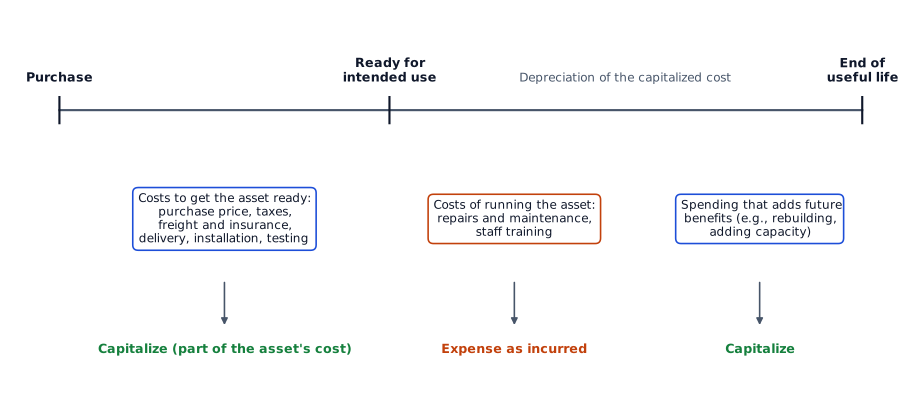
Long-lived assets are then measured after acquisition under the cost model (cost less accumulated depreciation and impairment), which US GAAP requires. IFRS lets a company choose the cost model or the revaluation model for each class of asset.
What an intangible asset is
Intangible assets are long-term assets without physical substance, such as patents, copyrights, brand names, trademarks, licenses, franchise rights and customer lists. Two classifications drive the accounting:
Key concept
| Classification | Meaning | Accounting consequence |
|---|---|---|
| Finite-lived intangible asset | Benefits end at a predictable date (legal, contractual or economic limit) | Cost is amortized over the useful life |
| Indefinite-lived intangible asset | No foreseeable limit to the period of benefit (e.g., goodwill, a trademark or license renewable at minimal cost) | Not amortized; tested for impairment at least annually |
| Identifiable intangible asset | Separable (or arises from contractual/legal rights), controlled by the firm, expected to give probable future benefits, cost reliably measurable | Can be recognized separately |
| Unidentifiable intangible asset | Cannot be bought or sold separately from the business | Main example: goodwill |
A purchased patent or a franchise with a fixed contractual term is finite-lived and is amortized over its remaining useful life until it is derecognized. A patent whose protection lapses later this year is still an asset and is amortized for the months that remain. Only a right that has already expired and brings no further benefit fails to qualify as an asset.
How the asset was obtained decides whether it is on the balance sheet
| Source of the intangible | Treatment |
|---|---|
| Purchased from another party | Recorded at cost (normally fair value at purchase); a group purchase is allocated by relative fair values |
| Internally developed | Costs generally expensed as incurred, so internally created brands, trademarks and "goodwill" do not appear on the balance sheet |
| Acquired in a business combination | Acquisition method: purchase price allocated to the fair values of the target's identifiable assets and liabilities, including identifiable intangibles the target built internally and had expensed; the remainder is goodwill |
Internally built intangibles rarely pass the recognition tests. The future benefits of building a brand or a customer base are hard to show as probable, and the cost is hard to measure reliably because it is mixed in with ordinary operating spending. A purchase or a business combination fixes a measurable amount for each identifiable item, so the same kind of asset can then be capitalized.
Goodwill
Recognizing more identifiable intangibles at acquisition leaves less of the price allocated to goodwill, because goodwill is the residual.
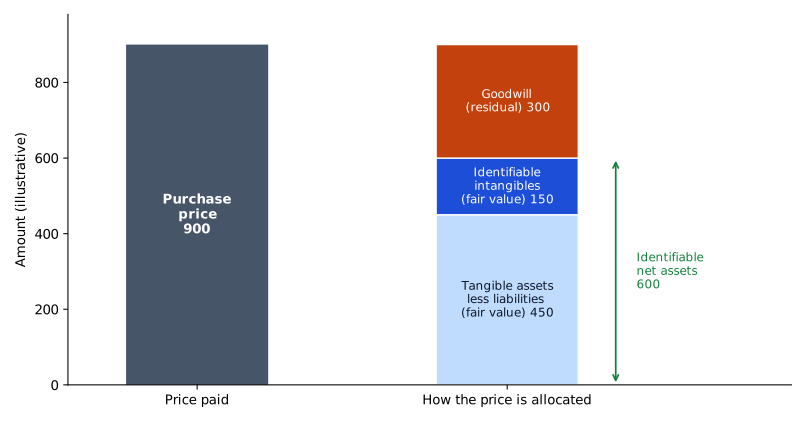
When intangibles are bought as a group, the analyst usually cares more about what kind of asset was acquired than about the amount allocated to it. Newly acquired franchise rights, for instance, say something about future operating performance whatever value they are booked at.
Research, development and software
Key concept
| Cost | IFRS | US GAAP |
|---|---|---|
| Research costs (discovering new knowledge) | Expensed | Expensed |
| Development costs (turning research into a product or process plan) | May be capitalized once criteria are met (e.g., the firm can complete the asset and intends to use or sell it) | Generally expensed |
| Software developed for sale | Development-cost rules | Expensed until technological feasibility is established, capitalized afterward |
| Software developed for internal use | Development-cost rules | Expensed until it is probable the project will be completed and the software used as intended, capitalized afterward |
Technological feasibility is a harder hurdle than "probable completion", so software for sale tends to have more of its costs expensed.
Capitalizing versus expensing — effects on the statements
When a cost is capitalized, it becomes an asset and flows to the income statement later as amortization (or depreciation). Compared with expensing the same cost:
Key concept
| Item | Year the cost is incurred | Later years of the asset's life |
|---|---|---|
| Net income | Higher | Lower (amortization expense) |
| Total assets and equity | Higher | Higher (until fully amortized) |
| ROA and ROE | Usually higher | Lower (lower numerator, higher denominator) |
| Cash flow from operations (CFO) | Higher; the outlay is an investing outflow | Unchanged for a single outlay; amortization is noncash (added back) |
| Cash flow from investing (CFI) | Lower | No effect |
| Debt-to-assets, debt-to-equity | Lower | Lower |
Total cash flow is identical; only the classification differs (ignoring any tax differences). A firm that capitalizes new outlays every year reports higher CFO every year, because each year's outlay is an investing outflow.
Example. Kestrel Apps spends $300,000 in Year 1 on development that qualifies for capitalization and amortizes it straight-line over three years. Capitalizing, Year 1 expense is instead of $300,000, so Year 1 pre-tax income is $200,000 higher. In Years 2 and 3 the capitalizer reports $100,000 of amortization while the expenser reports nothing, so its income is lower, and because its assets are also higher, its ROA in those years is lower.
A company that develops its intangibles internally shows lower assets than an otherwise identical company that buys them, and analysts should adjust for this when comparing the two.
Common exam traps
- Internally developed trademarks, brands and goodwill are expensed; the same items bought or acquired in a business combination are capitalized.
- Indefinite-lived intangibles (including goodwill and cheaply renewable trademarks) are not amortized; they are tested for impairment instead.
- US GAAP generally expenses R&D, with software as the exception; for software to be sold the trigger is technological feasibility.
- "Capitalizing raises net income" is true only in the first year; afterward net income and ROA are lower.
- Capitalized outlays are investing cash outflows, so CFO is higher under capitalization in the period the outlay is paid. Later amortization is noncash and does not raise CFO again.
Bottom line
- Finite-lived intangibles are amortized over their useful life, while indefinite-lived intangibles, such as goodwill, are not amortized and are tested for impairment at least annually.
- Purchased intangibles are recorded at cost, and internally developed intangibles are generally expensed as incurred, so internally created brands, trademarks and goodwill are not on the balance sheet.
- In a business combination the price is allocated to the fair values of the target's identifiable assets and liabilities, including identifiable intangibles the target built and expensed, and the remainder is goodwill.
- Research costs are expensed under both IFRS and US GAAP; development costs may be capitalized under IFRS once the criteria are met and are generally expensed under US GAAP.
- Under US GAAP, software developed for sale is capitalized once technological feasibility is established, and software for internal use once it is probable the project will be completed and the software used as intended.
- Compared with expensing, capitalizing a cost gives higher net income, assets, equity and CFO and lower CFI in the year it is incurred, then lower net income and ROA in later years, with total cash flow identical apart from any tax differences.
Quick check
Holloway Brands owns three trademarks, each with a finite useful life. One was bought from a competitor, one was recognized when Holloway acquired Pinecrest Foods, and one was created by Holloway's own marketing department. Which trademark is least likely to be carried on Holloway's balance sheet at amortized cost?
Show answer and explanation
Correct answer: C
The costs of creating an intangible asset such as a trademark internally are generally expensed as incurred, so no asset is recognized and there is nothing to amortize. A trademark bought from another party is recorded at cost, and one obtained in a business combination is recorded at its fair value under the acquisition method; both are then amortized because they have finite lives.
Why the other options are wrong
- A. A purchased intangible asset is recognized at cost (its fair value when bought). Because this trademark has a finite life, that cost is amortized, so it does appear at amortized cost.
- B. Under the acquisition method, identifiable intangibles of the target are recognized at fair value on the acquisition date, even if the target built them itself. A finite-lived trademark recognized this way is then amortized.
Key takeaway Intangibles that are purchased or acquired in a business combination are on the balance sheet; those created internally are expensed, apart from the R&D and software exceptions.
Module 33.2
Impairment and Derecognition
LOS 33.b — Impairment and derecognition of PP&E and intangible assets
Depreciation and amortization allocate an asset's cost over the periods that benefit from it. An impairment is an unexpected decline in value that pushes the asset's value below its carrying value (cost − accumulated depreciation − any earlier impairment). Derecognition removes the asset when it is sold, exchanged, abandoned or distributed.
Impairment of assets held for use: IFRS and US GAAP
These rules cover long-lived assets, tangible or intangible, that have finite lives and are still in use. Both frameworks recognize an impairment as a loss in the income statement.
Key concept
| IFRS | US GAAP | |
|---|---|---|
| When tested | Assess every year whether there are indicators of impairment | Only when events or circumstances suggest the carrying value may not be recoverable |
| Test | Carrying value > recoverable amount; the same comparison measures the loss | Step 1, recoverability test: carrying value > undiscounted future cash flows |
| Recoverable amount | Greater of fair value less costs to sell and value in use (PV of future cash flows) | — |
| Loss measured as | Carrying value − recoverable amount | Step 2: carrying value − fair value (or discounted future cash flows if fair value is unknown) |
| Later reversal | Allowed, limited to the original loss (carrying value cannot exceed what it would have been without the impairment) | Not permitted for assets held for use |
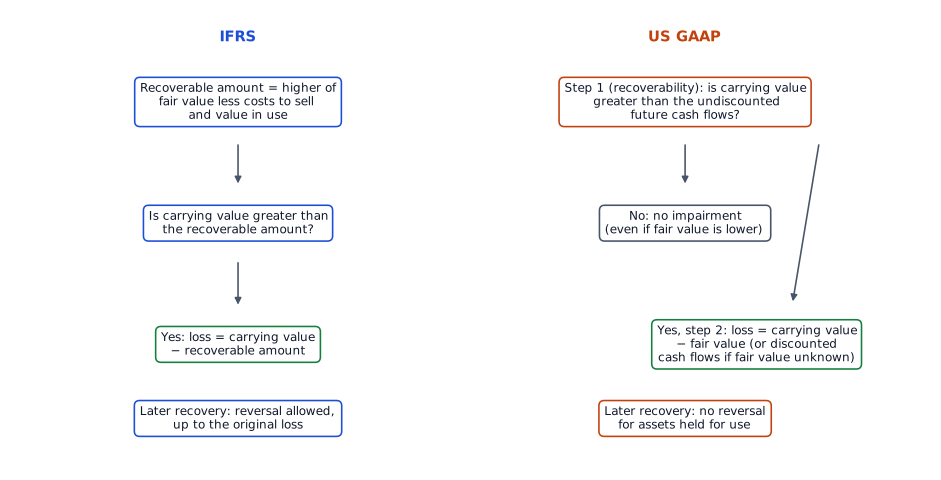
The recoverable amount is the higher of the two measures because the owner can either sell the asset or keep using it and would pick whichever brings in more cash. The asset is impaired only if even the better of the two cannot recover its carrying value.
Key concept
Example. A machine cost $2,000,000 and has accumulated depreciation of $800,000, so . Fair value is $1,105,000, costs to sell are $15,000, value in use is $1,130,000 and undiscounted expected cash flows are $1,150,000.
- IFRS: recoverable amount ; loss .
- US GAAP: in step 1, undiscounted cash flows of $1,150,000 are below $1,200,000, so the asset fails recoverability; in step 2, the loss is .
If undiscounted cash flows had exceeded the carrying value, US GAAP would record no loss even if fair value were lower. Because the test uses undiscounted flows, rising interest rates alone do not trigger impairments. The US GAAP loss is measured against fair value itself, not fair value less costs to sell; the discounted cash flows used when fair value is unknown correspond to value in use under IFRS. Both value in use and the undiscounted cash flow estimate depend heavily on management's forecasts (and, for value in use, on the choice of discount rate).
Effects of an impairment on the statements and ratios
Key concept
| Item | Year of impairment | Later years |
|---|---|---|
| Net income | Lower (loss; shown as an unusual or infrequent item if material) | Higher (smaller depreciation base) |
| Total assets, equity | Lower | Lower |
| ROA, ROE | Lower | Higher (higher NI, smaller denominators) |
| Asset turnover | Higher | Higher |
| Debt-to-equity, debt-to-assets | Higher (debt unchanged, equity/assets lower) | Higher |
| Cash flow | No effect; the loss is not tax-deductible until disposal | No effect |
| Deferred tax liability | The tax base is unchanged while the book value falls, so any DTL on the asset decreases | Stays below the no-impairment amount; the gap narrows as the lower book depreciation catches up |
An impairment signals that past depreciation was too low, so past earnings were overstated. Because impairments require judgment, managers can time them. Delaying a loss until a year of strong earnings smooths reported results. Alternatively, management may take a "big bath" when results are already poor for external reasons or when new management arrives, so the low earnings are not blamed on them; the smaller asset and equity base then boosts future ROA and ROE.
Revaluation model (IFRS only)
IFRS lets a firm carry a class of PP&E at fair value (revaluation model); US GAAP requires the cost model and prohibits upward revaluation of assets held for use.
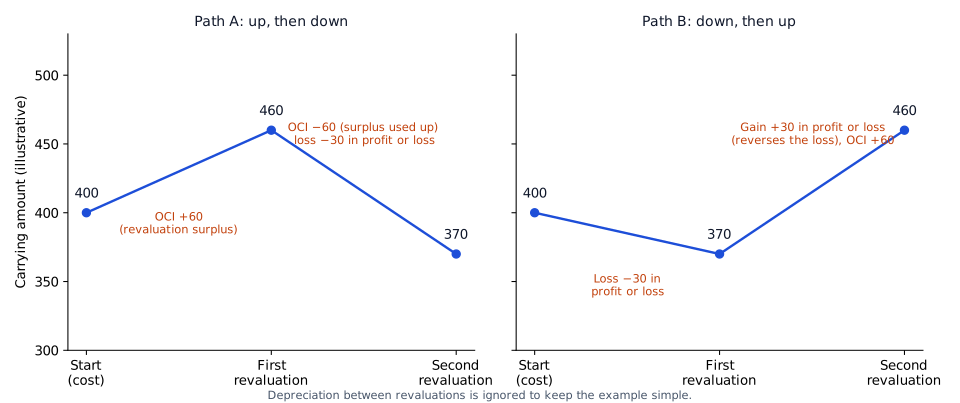
- An increase goes to other comprehensive income as a revaluation surplus. The exception is the part that reverses an impairment previously charged to the income statement, which is recognized as a gain in the income statement.
- A decrease is charged to profit or loss, except to the extent it reverses an existing revaluation surplus (then it reduces OCI).
The order of the changes decides where each one goes. In the figure, the same asset ends at different amounts after two revaluations. Each step first undoes whatever the previous step recorded, in the same place, and only the rest goes to the other place.
- After an upward revaluation, assets and equity are higher, so solvency ratios (debt-to-equity, debt-to-assets) are lower and asset turnover is lower. The larger depreciable base raises future depreciation, so future net income, ROA and ROE are lower.
Indefinite-lived intangibles and assets held for sale
- Indefinite-lived intangibles are not amortized and are tested for impairment at least annually. Exam convention: the asset is impaired when its carrying amount is above its fair value, and the loss equals the difference; there is no undiscounted cash flow screen. Current practice: US GAAP applies this fair-value comparison, while IFRS (IAS 36) compares the carrying amount with the recoverable amount, the greater of fair value less costs to sell and value in use. With a carrying amount of 100, fair value of 80 and value in use of 110, US GAAP records a loss of 20 and IFRS records none.
- For an asset held for sale (intent to sell, sale probable, asset available immediately), depreciation stops, and the asset is impaired if carrying value exceeds fair value less costs to sell; it is then written down to that amount, with the loss in the income statement. Under both IFRS and US GAAP the loss can be reversed, but not above the original carrying value.
Derecognition
| Event | Accounting |
|---|---|
| Sale | Gain or loss = proceeds − carrying value (cost − accumulated depreciation − impairments), reported with other gains and losses or separately if material; with the indirect method the gain/loss is removed from net income in CFO, and the proceeds are an investing inflow |
| Abandonment | Loss equal to the carrying value (no proceeds) |
| Exchange | Gain or loss = fair value of old asset (or of new asset if more clearly evident) − carrying value of old asset; new asset recorded at fair value (at the old asset's carrying value if no reliable fair value) |
| Spinoff | A division or subsidiary is placed in a new legal entity whose shares go to the parent's shareholders, who give up no parent shares; the spinnee then leaves the parent's consolidated accounts. Classification before the distribution and any gain or loss: see below |
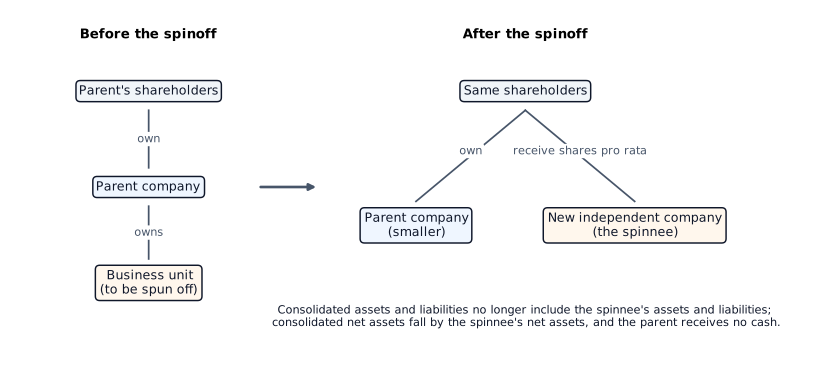
Exam convention: once a spinoff is probable, the spinnee's assets and liabilities are reclassified as held for sale (also called held for distribution), and no gain or loss is recorded on the distribution. Current practice: IFRS 5 classifies them as held for distribution once the distribution is highly probable, and IFRIC 17 measures a pro rata non-cash distribution to owners at fair value, so a gain or loss can arise unless the entity is under common control. US GAAP keeps them as held and used until the distribution and records the spinoff at carrying amount, with no gain or loss.
Example. Equipment costing $500,000 with $320,000 accumulated depreciation is sold for $150,000: loss .
Example. A delivery van that cost $70,000 and has accumulated depreciation of $44,000 (carrying value $26,000) is traded for a forklift. The van's fair value is $31,000. The van is removed from the balance sheet, the forklift is recorded at $31,000 and a gain of is reported. If neither fair value could be measured reliably, the forklift would be recorded at $26,000 and no gain or loss would arise.
Common exam traps
- US GAAP uses undiscounted cash flows to test for impairment but fair value to measure the loss. For the machine, measuring the loss against the undiscounted cash flows gives $50,000 instead of $95,000.
- Under IFRS, the recoverable amount is the higher of two measures: fair value less costs to sell, and value in use. For the machine, using the lower measure, fair value less costs to sell, gives a loss of $110,000 instead of $70,000.
- Impairment raises future ROA and ROE and raises leverage ratios; it has no cash flow effect.
- US GAAP allows no reversal and no upward revaluation for assets in use, so a higher appraisal changes nothing.
- An upward revaluation lowers future profitability (more depreciation) and lowers solvency ratios.
Exam shortcuts
- Under US GAAP, when undiscounted future cash flows are at or above carrying value there is no impairment, whatever the fair value, so step 2 is not needed.
- Because the US GAAP recoverability test uses undiscounted cash flows, a rise in interest rates alone does not trigger an impairment.
Bottom line
- Under IFRS, a long-lived asset held for use is impaired when its carrying value exceeds its recoverable amount, the greater of fair value less costs to sell and value in use; the loss is the difference, and a later reversal is allowed up to the original loss.
- Under US GAAP, an asset held for use is impaired only if its carrying value exceeds its undiscounted future cash flows; the loss is carrying value minus fair value (or discounted cash flows if fair value is unknown), and no reversal is permitted.
- In the year of an impairment, net income, assets and equity fall and leverage ratios rise; in later years net income, ROA and ROE are higher; the impairment itself has no cash flow effect.
- Under the IFRS revaluation model, an increase goes to OCI as a revaluation surplus unless it reverses an impairment previously charged to the income statement, and a decrease is charged to profit or loss unless it reverses an existing revaluation surplus.
- An asset held for sale is no longer depreciated and is written down if its carrying value exceeds fair value less costs to sell; under both IFRS and US GAAP the loss can be reversed, but not above the original carrying value.
- On a sale, the gain or loss is proceeds minus carrying value; on an exchange, it is the fair value of the old asset (or of the new asset if that is more clearly evident) minus the carrying value of the old asset.
Quick check
Tamarind Beverages reports under US GAAP. It owns a beverage brand that it acquired several years ago, and management has concluded that the brand has an indefinite useful life. The annual impairment review of the brand produces the following estimates.
| Item | $ millions |
|---|---|
| Carrying amount | 64 |
| Undiscounted expected future cash flows | 90 |
| Present value of expected future cash flows (value in use) | 58 |
| Fair value | 52 |
| Costs to sell | 3 |
The impairment loss that Tamarind recognizes on the brand is closest to:
Show answer and explanation
Correct answer: A
An intangible asset with an indefinite useful life is not amortized. It is tested for impairment at least annually, and an impairment loss is recognized when its carrying amount exceeds its fair value. Under US GAAP there is no recoverability screen based on undiscounted cash flows for such an asset, so the $64 million carrying amount is compared directly with the $52 million fair value. The loss of $12 million is measured against fair value itself, with no deduction for costs to sell.
The brand is written down to $52 million and the $12 million loss is reported in the income statement.
For comparison, the two tests that do not apply here:
| Test | Calculation | Result |
|---|---|---|
| US GAAP recoverability test for PP&E held for use | undiscounted cash flows 90 > carrying amount 64 | no impairment |
| IFRS recoverable amount | ; loss | loss of 6 |
Why the other options are wrong
- B. $6 million uses the IFRS recoverable amount, the higher of fair value less costs to sell ($49 million) and value in use ($58 million). Tamarind reports under US GAAP, which measures the loss against fair value.
- C. $0 applies the US GAAP recoverability test used for PP&E and finite-lived assets held for use: undiscounted cash flows of $90 million exceed the carrying amount, so that test would stop there. An indefinite-lived intangible asset is compared directly with its fair value, so the undiscounted cash flows do not matter.
Key takeaway Under US GAAP, PP&E held for use passes an undiscounted cash flow test before any loss is measured. An indefinite-lived intangible asset skips that screen: whenever its carrying amount exceeds fair value, the excess is an impairment loss, even if undiscounted cash flows are well above the carrying amount.
Module 33.3
Long-Term Asset Disclosures
LOS 33.c — Disclosures about PP&E and intangible assets, and what an analyst does with them
Required disclosures
| IFRS | US GAAP | |
|---|---|---|
| PP&E, per class | Measurement basis, depreciation method, useful lives or rates, depreciation expense, gross carrying amount and accumulated depreciation at the start and end of the period, reconciliation of opening to closing carrying amount | Depreciation expense for the period, balances of major classes of assets (land, buildings, machinery …), accumulated depreciation by class or in total, general description of depreciation methods |
| Other PP&E items | Title restrictions and assets pledged as collateral, agreements to acquire PP&E | Not listed separately, but title restrictions and assets pledged as collateral are generally disclosed under both frameworks |
| Revalued assets (IFRS only) | Revaluation date, how fair value was determined, carrying amount under the cost model, revaluation surplus in OCI | Not applicable (no revaluation) |
| Intangible assets | Like PP&E, plus whether useful lives are finite or indefinite | Like PP&E, plus estimated amortization expense for each of the next five years |
| Impairments | Losses and reversals by class, where they sit in the income statement, circumstances causing them | Description of the impaired asset, circumstances, how fair value was determined, amount of loss, where it sits in the income statement (no reversals to disclose for assets held for use, because US GAAP does not permit them) |
Presentation. IFRS income statements "by nature" show depreciation and amortization on the face; statements "by function" include them in cost of sales and SG&A. Under the indirect method, depreciation and amortization are added back as noncash charges in CFO; purchases and disposal proceeds of long-lived assets are investing cash flows. US GAAP firms using the direct method must still disclose the indirect reconciliation in the notes. Average age is not a required disclosure; the analyst estimates it.
Review of assumed knowledge: depreciation methods
The reading also assumes the common depreciation methods are known. Depreciation spreads the depreciable cost (cost less residual value) over the periods that use the asset.
| Method | Annual depreciation | Year 1 example | Pattern |
|---|---|---|---|
| Straight-line | (Cost − residual value) ÷ useful life | (50,000 − 5,000) ÷ 5 = $9,000 | Same amount every year |
| Double-declining balance | (2 ÷ useful life) × carrying value at the start of the year, never taking carrying value below residual value | (2 ÷ 5) × 50,000 = $20,000 | High early, falling later |
| Units-of-production | (Cost − residual value) × units produced ÷ total expected units | 45,000 × 22,000 ÷ 90,000 = $11,000 | Follows usage |
Two details are often tested. Double-declining balance applies its rate to the whole carrying value, not to cost less residual value, but it stops once the carrying value reaches the residual value, so the last year's charge is often a plug. Choosing a longer useful life or a higher residual value lowers depreciation expense, which raises net income and the carrying value of the assets and lowers asset turnover.
Ratios built from the disclosures
Fixed asset turnover measures revenue generated per dollar of fixed assets; a higher ratio indicates more efficient use of long-term assets.
Assuming straight-line depreciation and zero salvage value:
Key concept
Key concept
| Ratio | Numerator | What it tells the analyst |
|---|---|---|
| Average age | Accumulated depreciation | How old the asset base is (see the two uses below) |
| Total useful life | Gross PP&E (historical cost) | Typical life of the asset base when new |
| Remaining useful life | Net PP&E | Roughly when major replacement spending will be needed |
| Capex / depreciation | Capital expenditures | Whether the firm is replacing capacity as fast as it wears out (≈ 1 or more) |
Average age is useful in two ways. A company running older, less efficient assets may be at a competitive disadvantage, and the estimate helps predict the timing of major capital expenditures and therefore the company's future (near-term) financing requirements.
Example. Gross PP&E is $1,200 million, accumulated depreciation $450 million and depreciation expense $75 million.
- Average age years
- Total useful life years
- Remaining useful life years
Limitations. The estimates are rough: assets are grouped in broad classes, accelerated methods and material salvage values distort them, and the asset mix matters.
Common exam traps
- Matching the numerator to the question: accumulated depreciation gives average age, gross PP&E gives total life, and net PP&E gives remaining life. In the example, dividing net PP&E by depreciation gives an "average age" of 10 years instead of 6, and dividing gross PP&E gives a "remaining life" of 16 years instead of 10.
- The ratios use end-of-year balances with the year's depreciation expense.
- Average age is used to anticipate capital spending and financing needs, not to measure earnings potential.
- Only US GAAP requires the five-year amortization forecast; only IFRS has revaluation disclosures, and only IFRS permits (and so discloses) impairment reversals for assets held for use.
Exam shortcuts
- Remaining useful life equals total useful life minus average age, so once two of the three estimates are known the third needs no further division.
Bottom line
- Assuming straight-line depreciation and zero salvage value, average age is about accumulated depreciation divided by annual depreciation expense, total useful life is about gross PP&E divided by it, and remaining useful life is about net PP&E divided by it.
- Fixed asset turnover is revenue divided by average fixed assets, and a higher ratio indicates more efficient use of long-term assets.
- Average age helps show whether a company runs older, less efficient assets and helps predict the timing of major capital spending and the related financing needs.
- Only US GAAP requires estimated amortization expense for each of the next five years, while only IFRS has revaluation disclosures and permits, and so discloses, impairment reversals for assets held for use.
- A longer useful life or a higher residual value lowers depreciation expense, which raises net income and the carrying value of the assets and lowers asset turnover.
Quick check
Harrowgate Freight uses straight-line depreciation with negligible salvage values. Selected data from its PP&E note are shown below.
| Item | Amount |
|---|---|
| Gross PP&E, end of year | 840 |
| Accumulated depreciation, end of year | 336 |
| Depreciation expense for the year | 48 |
The estimated remaining useful life of Harrowgate's PP&E is closest to:
Show answer and explanation
Correct answer: B
Remaining useful life is net PP&E (gross PP&E minus accumulated depreciation) divided by annual depreciation expense.
Check: total useful life ; average age ; .
Why the other options are wrong
- A. 7.0 years is the average age (accumulated depreciation / depreciation expense = 336 / 48).
- C. 17.5 years is the total useful life (gross PP&E / depreciation expense = 840 / 48).
Key takeaway Remaining life = total life − average age; computing all three is a quick consistency check.
Practice Questions
Two otherwise identical companies each spend the same amount on a long-lived asset in Year 1. Brackley Tools capitalizes the outlay and depreciates it; Ostrander Tools expenses it immediately. For the years that follow Year 1, Brackley, compared with Ostrander, will most likely report:
Show answer and explanation
Correct answer: B
After the year of the outlay, the capitalizing firm still deducts depreciation, while the expensing firm has already charged the full amount, so the capitalizer's net income is lower. Its total assets are also higher because the capitalized cost is still on the balance sheet. A lower numerator over a higher denominator gives a lower return on assets (net income / total assets).
Why the other options are wrong
- A. Net income is lower, but ROA cannot be higher: the capitalizer has both a smaller numerator and a larger asset base.
- C. Net income is higher only in the year the cost is incurred (when capitalizing avoids the full expense). In later years depreciation makes it lower.
Key takeaway Compared with expensing, capitalizing gives higher net income and higher CFO in the first year, because the outlay is an investing flow. In later years it gives lower net income and lower ROA and ROE, while CFO is unchanged for a single outlay because amortization and depreciation are noncash.
This reading has 25 questions in the full bank. Practice all of them.
Key Takeaways
- Intangibles that are purchased or acquired in a business combination are on the balance sheet; those created internally are expensed, apart from the R&D and software exceptions.
- Compared with expensing, capitalizing gives higher net income and higher CFO in the first year, because the outlay is an investing flow. In later years it gives lower net income and lower ROA and ROE, while CFO is unchanged for a single outlay because amortization and depreciation are noncash.
- Under US GAAP, PP&E held for use passes an undiscounted cash flow test before any loss is measured. An indefinite-lived intangible asset skips that screen: whenever its carrying amount exceeds fair value, the excess is an impairment loss, even if undiscounted cash flows are well above the carrying amount.
- Remaining life = total life − average age; computing all three is a quick consistency check.