Financial Statement Analysis · Reading 38
Pro Forma Financial Statements
CFA Level I · Financial Statement Analysis · Reading 38: Introduction to Financial Statement Modeling · about 26 min
What you'll learn
- LOS 38.a Demonstrate the development of a sales-based pro forma company model.
- LOS 38.b Explain how behavioral biases affect analyst forecasts and recommend remedies.
- LOS 38.c Explain how a company's competitive position under Porter's five forces affects its prices and costs.
- LOS 38.d Explain how to forecast industry and company sales and costs under price inflation or deflation.
- LOS 38.e Explain the choice of an explicit forecast horizon and how to project results beyond the short term.
Module 38.1
Financial Statement Modeling
This reading shows how to build a sales-based pro forma model, how behavioral biases distort forecasts, and how competitive forces, input-price inflation or deflation and the choice of forecast horizon shape long-term projections. A candidate must be able to project an income statement from a revenue forecast and explain the effect of each bias and each competitive force on the forecast.
LOS 38.a — Building a sales-based pro forma model
Financial statement analysis studies a company's current and past statements. Financial statement modeling projects its future statements, which the analyst then uses to value the company and its securities. A sales-based pro forma company model is a set of projected financial statements driven by the analyst's forecast of future revenue. The sequence matters because each statement feeds the next:
Key concept
| Step | Task | Notes |
|---|---|---|
| 1 | Estimate revenue growth and future revenue | From market growth and market share, a trend growth rate, or growth relative to GDP |
| 2 | Estimate COGS | As a percentage of sales, or in more detail from strategy and competition; COGS need not grow exactly with sales because of fixed elements and input-price changes |
| 3 | Estimate SG&A | Fixed, growing with revenue (e.g., sales-related labor), or another method |
| 4 | Estimate financing costs | Interest rates, debt levels, planned capex and changes in financial structure |
| 5 | Estimate income tax expense and cash taxes | Historical effective rates and trends, segment/jurisdiction mix, changes in deferred tax items |
| 6 | Model the balance sheet | Working capital accounts that flow from the income statement (receivables, inventory, payables) |
| 7 | Estimate capital expenditures and net PP&E | From depreciation and capital expenditures (for maintenance and for growth) |
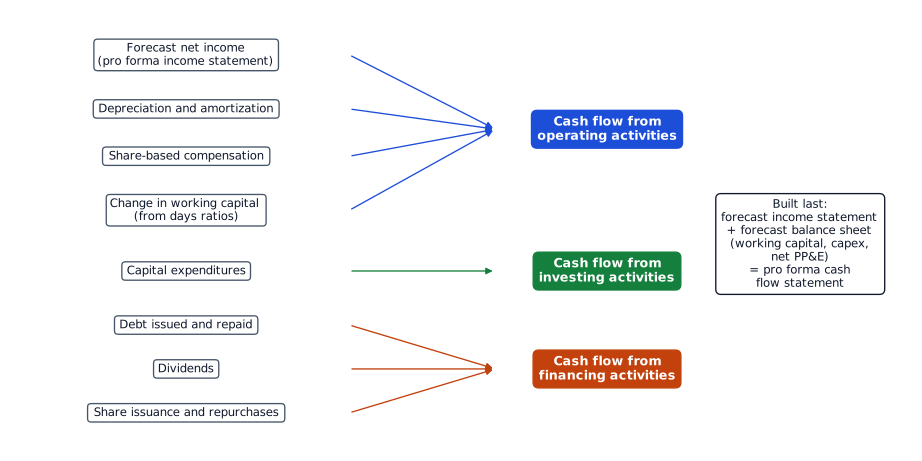
| 8 | Build the pro forma cash flow statement | Last: it is derived from the pro forma income statement and balance sheet |
Example. Last year Corliss Tools had revenue of $400 million. The analyst expects 5% revenue growth, a 38% gross margin, SG&A of $30 million fixed plus 10% of revenue, debt of $150 million at 6% interest and a 25% effective tax rate.
- Revenue .
- COGS , so gross profit is 159.6.
- SG&A , so operating profit is 87.6.
- Interest expense , so pretax income is 78.6.
- Income tax expense , so forecast net income is $58.95 million.
A change in expected unit sales mainly moves the working capital accounts tied to sales: accounts receivable, because credit sales change with volume, and inventory, because the number of units the firm needs on hand changes (and stock builds up or runs down if purchasing does not adjust). Prepaid expenses are payments for future-period expenses and are unrelated to purchases for resale, so they are largely unaffected.
LOS 38.b — Behavioral biases in forecasting
Key concept
| Bias | What it looks like | Remedy |
|---|---|---|
| Overconfidence bias | Too much faith in one's own forecasts; confidence intervals too narrow (more common in analysts who go against the consensus) | Share forecasts and invite critique; review past forecast errors; use scenario analysis to produce a range |
| Illusion of control bias | Overestimating what one can control: seeking "expert" opinions to justify a view, adding more and more variables (overfitting); overfitted models forecast poorly out of sample and can hide assumptions that need updating | Use only variables with known explanatory power; seek outside opinions only from those with a relevant perspective |
| Conservatism bias (also called anchoring) | Only small adjustments to prior forecasts when new information arrives; slow to reflect news (usually negative, sometimes positive) | Periodically evaluate forecast errors; use simpler models that are easy to update |
| Representativeness bias | Relying on known classifications; one form is base-rate neglect — ignoring the rate of incidence in the wider population in favor of company-specific facts | Consider both the inside view (company-specific) and the outside view (the base rate for the industry or peer group) |
| Confirmation bias | Seeking data that support one's view, discounting contrary evidence (including taking management's upbeat comments at face value) | Read research from analysts with opposite views; ask colleagues with no emotional stake |
LOS 38.c — Porter's five forces, prices and costs
A firm's competitive position is probably the most important driver of its future revenue and profitability. Porter's five forces:
Key concept
| Force | Pricing power / margins are higher when… |
|---|---|
| Threat of substitute products | the threat is low and switching costs are high |
| Intensity of industry rivalry | rivalry is low (rivalry is intense with many competitors, high fixed costs and exit barriers, slow or negative growth, undifferentiated products) |
| Bargaining power of suppliers | supplier power is low (less pressure on input costs; when suppliers are few, they can capture more of the value added) |
| Bargaining power of customers | customer power is low (not a few large buyers; high switching costs) |
| Threat of new entrants | the threat is low, i.e., barriers to entry are high, which lets incumbents sustain economic profits |
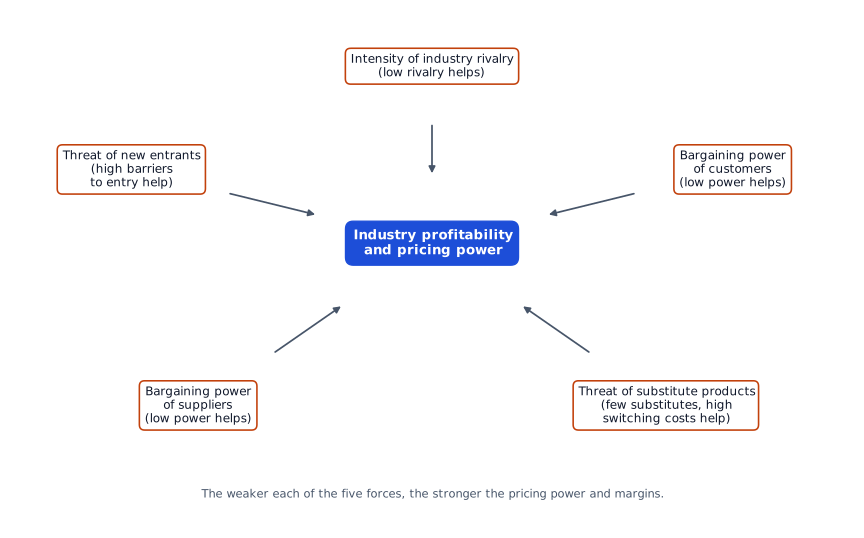
Favorable forces support optimistic revenue and margin forecasts.
LOS 38.d — Forecasting under input-price inflation or deflation
- Hedging with derivatives or fixed-price contracts delays and smooths the effect of input-price changes; vertical integration reduces exposure to input costs.
- Without either, the analyst must judge how fast and how far cost increases can be passed on to customers, and the effect of higher prices on volume. Production costs should be tracked by product category and geographic location. Input prices in turn respond to weather, to taxes and other government rules, to tariffs and to the way each input market is structured. The firm's hedging activities and its vertical structure belong in the same review.
- Firms may switch to a substitute input when one input's price rises.
- If input-cost increases are temporary (short term), cutting other costs (e.g., advertising) to protect operating margins can be sensible; for long-term increases this is not appropriate.
- Elasticity of demand: with elastic demand, the percentage fall in units exceeds the percentage rise in price, so a price increase reduces revenue. The main influence on elasticity is the availability of substitute products.
- A first mover on price increases loses more volume than a follower; a firm that delays may gain share but suffers lower gross margins in the meantime.
Example. A firm sells units at $60 with unit COGS of $36 (gross margin ). Unit input cost rises by $3 and the firm raises its price by exactly $3, with no change in volume. Gross profit per unit stays at $24, but gross margin falls to . Passing through the money amount of a cost increase preserves gross and operating profit if volume holds (which is unlikely), but it lowers the gross, operating and net margins because revenue is larger.
LOS 38.e — Forecast horizon and long-term projections
- Buy-side: the horizon can be the expected holding period. Average holding period ≈ 1 / annual portfolio turnover (a turnover of 20% gives about 5 years).
- Cyclical companies: choose a horizon that reaches at least the middle of the business cycle, so the forecast reflects midcycle sales and profits rather than the current phase. Normalized earnings = expected midcycle earnings (or earnings free of temporary effects).
- Acquisitions, mergers and restructurings: the horizon should be long enough for their benefits to be realized (or not). A manager may also dictate the horizon.
- Beyond the short term, a common approach assumes the prior cycle's trend revenue growth continues.
- Terminal value: by a multiples approach or a DCF approach. A multiple must be consistent with the expected growth rate and required return. Using a 10-year average P/E assumes the next period's growth and required return will match the past 10 years on average. In a DCF, the earnings or cash flow used should be normalized to a midcycle level free of temporary effects. The terminal value is a growing perpetuity, so small changes in the long-term growth rate have large effects on value.
- Inflection points are times when the future will not resemble the past: a shift in the economic environment or in the stage of the business cycle, government regulation, or technology.
Common exam traps
- Conservatism bias and confirmation bias can both look like sticking to a view. Conservatism is under-reaction to news that has been acknowledged; confirmation bias is selective attention to evidence that agrees with the view.
- Seeking expert opinions to justify a forecast is illusion of control, not a remedy; the remedy is to consult only people with a directly relevant perspective.
- For a cyclical firm, the test is whether the horizon reaches midcycle, not whether it covers one or more full cycles.
Bottom line
- A sales-based pro forma model starts from the revenue forecast, estimates COGS, SG&A, financing costs and taxes, then the balance sheet and capital expenditures, and derives the pro forma cash flow statement last from the projected income statement and balance sheet.
- Overconfidence bias shows up as confidence intervals that are too narrow and is countered by inviting critique of the forecasts, reviewing past forecast errors and using scenario analysis to produce a range.
- Conservatism bias, also called anchoring, is making only small adjustments to prior forecasts when new information arrives, while confirmation bias is seeking data that support one's view and discounting contrary evidence.
- Illusion of control bias includes seeking expert opinions to justify a view and overfitting a model with ever more variables, and representativeness bias includes base-rate neglect, which is countered by weighing the outside view with the inside view.
- Under Porter's five forces, pricing power and margins are higher when the threat of substitutes, the intensity of rivalry, the bargaining power of suppliers and of customers, and the threat of new entrants are low.
- With elastic demand the percentage fall in units sold exceeds the percentage rise in price, so a price increase reduces revenue, and the main influence on elasticity is the availability of substitutes.
- Passing through the money amount of an input-cost increase preserves gross and operating profit if volume holds, but it lowers the gross, operating and net margins because revenue is larger.
- For a cyclical company the forecast horizon should reach at least the middle of the business cycle, and a terminal value is very sensitive to the long-term growth rate because it is a growing perpetuity.
Quick check
An analyst building sales-based pro forma financial statements will most likely carry out which of these tasks first?
Show answer and explanation
Correct answer: B
The income statement is modeled first: revenue, then COGS, then SG&A, financing costs and taxes. Balance sheet items such as capital expenditures and net PP&E come after, and the cash flow statement is built last because it is derived from the pro forma income statement and balance sheet.
Why the other options are wrong
- A. The pro forma cash flow statement is the final step; it cannot be constructed until the income statement and balance sheet are complete.
- C. Capital expenditures and net PP&E are balance sheet items estimated after the income statement has been modeled.
Key takeaway The order is revenue, COGS, SG&A, financing costs and taxes, then the balance sheet (working capital, capex and PP&E), and finally the cash flow statement.
Practice Questions
Since finishing her earnings forecast for Brenton Mining, Clara Voss has seen the company announce a new product line and a reorganization of its divisions. She had anticipated some of these developments in her forecast but not others. Nonetheless, she is unwilling to revise her forecast. Voss is most likely displaying:
Show answer and explanation
Correct answer: B
Conservatism bias (also called anchoring) is the tendency to make only small adjustments, or none, to a prior forecast when new information becomes available. Voss's reluctance to update despite new announcements fits this bias.
Why the other options are wrong
- A. Confirmation bias means seeking out evidence that supports an existing view and discounting contrary evidence. The scenario does not say whether the news supports or contradicts her view, only that she will not update.
- C. Representativeness bias is the tendency to rely on known classifications of past information; nothing in the scenario involves classifying the company based on superficial similarity.
Key takeaway Reluctance to update a forecast after new information is conservatism bias (anchoring).
Sorrel Audio sells 2,000 speakers a year at $80 each; unit COGS is $50 and SG&A is a fixed $30,000. Next year the input cost per speaker will rise by $4. Sorrel plans to raise its selling price by exactly $4 and expects unit sales to be unaffected. Sorrel's gross margin next year is closest to:
Show answer and explanation
Correct answer: A
Adding the money amount of the cost increase to the price keeps gross profit per unit (and operating profit) unchanged, but because sales revenue is higher, gross, operating and net margins all fall.
This year: gross margin .
Next year: price , unit COGS , gross profit per unit .
Operating profit is unchanged: in both years; operating margin falls from to .
Why the other options are wrong
- B. 37.5% is this year's gross margin (30/80); it assumes margins are unaffected by a full pass-through, but the same gross profit is now spread over higher revenue.
- C. 40.5% raises the price to $84 but forgets the $4 increase in unit COGS ((84 − 50)/84).
Key takeaway Full money pass-through of a cost increase with stable volume: profit unchanged, margins lower.
When choosing an explicit forecast horizon for a company whose earnings swing sharply with the economy, an analyst should most appropriately extend the forecast:
Show answer and explanation
Correct answer: B
The horizon for a cyclical company should be long enough that the current phase of the cycle does not drive above- or below-trend results. Extending the forecast to midcycle captures a midcycle (normalized) level of sales and profits.
Why the other options are wrong
- A. A one-year forecast may be more precise, but it reflects wherever the company currently is in the cycle, so earnings will be above or below trend.
- C. Two full cycles would be informative in principle, but forecasts that far out are unlikely to be accurate enough to be useful.
Key takeaway For a cyclical firm, forecast through midcycle to capture normalized earnings.
This reading has 23 questions in the full bank. Practice all of them.
Key Takeaways
- The order is revenue, COGS, SG&A, financing costs and taxes, then the balance sheet (working capital, capex and PP&E), and finally the cash flow statement.
- Reluctance to update a forecast after new information is conservatism bias (anchoring).
- Full money pass-through of a cost increase with stable volume: profit unchanged, margins lower.
- For a cyclical firm, forecast through midcycle to capture normalized earnings.