Fixed Income · Reading 57
Credit Spread
CFA Level I · Fixed Income · Reading 57: Yield and Yield Spread Measures for Fixed-Rate Bonds · about 33 min
What you'll learn
- LOS 57.a Calculate a bond's annual yield for different compounding periods (periodicity, street vs. true yield, current, simple, YTM, yield to call and yield to worst, option-adjusted yield).
- LOS 57.b Compare, calculate and interpret yield spread measures: G-spread, I-spread, Z-spread and option-adjusted spread.
Module 57.1
Yield and Yield Spread Measures for Fixed-Rate Bonds
This reading covers the yield measures quoted for fixed-rate bonds and the spreads that compare a bond's yield with a benchmark. A candidate must be able to restate a yield for a different periodicity, compute current yield, simple yield, yield to call and yield to worst, and calculate or interpret G-spreads, I-spreads, Z-spreads and option-adjusted spreads.
LOS 57.a — Annual yields for different compounding periods
Yield to maturity and the semiannual bond basis
The yield to maturity (YTM) is the single discount rate that makes the present value of all of a bond's promised cash flows equal to its market price. It is an internal rate of return, so on the calculator it is found by solving for I/Y given the price, the coupon, the number of periods and the redemption value.
For a bond that pays coupons more than once a year, the calculator gives a periodic rate. By convention the quoted YTM is the periodic rate multiplied by the number of periods per year. For a semiannual-pay bond, the quoted YTM is the semiannual rate. Such a yield is quoted on a semiannual bond basis.
Calculator (TI BA II Plus), semiannual bond. Set P/Y = C/Y = 1 and END mode, then N = years , PMT = annual coupon / 2, FV = par, PV = −price (cash paid out is negative), CPT I/Y, and multiply the result by 2.
Periodicity and the effective annual yield
The number of coupon payments per year is the bond's periodicity. For a given stated yield, more compounding periods per year produce a higher effective annual yield (EAY):
Key concept
where is the periodicity. The same relationship links any stated annual rate (also called the nominal rate or APR) with its effective annual rate (EAR): the stated rate divided by is the periodic rate, and compounding the periodic rate times gives the EAR. The stated rate does not adjust for compounding; the EAR does.
To restate a yield for a different periodicity, keep the EAY fixed:
Example. A bond yields 6% on a semiannual bond basis, which is 3% per half-year.
| Basis | Calculation | Yield |
|---|---|---|
| Annual-pay equivalent (EAY) | 6.09% | |
| Semiannual bond basis | given | 6.00% |
| Quarterly basis | 5.96% |
All three describe the same return. Holding the EAY constant, higher periodicity means a lower stated yield. Holding the stated yield constant, higher periodicity means a higher EAY. An annual-pay bond's YTM already is an effective annual yield.
Street convention and true yield
A yield computed with the scheduled coupon dates follows the street convention. When a scheduled date falls on a weekend or holiday the cash actually arrives on the next business day; a yield computed with these actual payment dates is the true yield. Because cash arrives slightly later, the true yield is usually slightly lower than the street convention yield, by a few basis points, and equal to it when no payment date moves.
Current yield and simple yield
Current yield (also income yield or running yield) considers only coupon income:
It ignores capital gains or losses and reinvestment income, and it is the same for annual-pay and semiannual-pay bonds with the same coupon rate and price. Example. A 5% bond priced at 96 has a current yield of .
Simple yield adds (subtracts) the straight-line amortization of a discount (premium) to the coupon:
Example. A 3-year 5% bond at 97 amortizes per year, so the simple yield is .
Ranking for option-free bonds:
Key concept
| Bond priced at | Ranking |
|---|---|
| Discount (price < par) | coupon rate < current yield < YTM |
| Par | coupon rate = current yield = YTM |
| Premium (price > par) | coupon rate > current yield > YTM |
Yield to call and yield to worst
For a callable bond, the yield to call is found like a YTM but with N = periods to the call date and FV = the call price instead of par. A yield to call can be computed for each call date. The lowest of the YTM and all the yields to call is the yield to worst, the conservative yield to rely on. For a premium bond callable at or near par, a call cuts short the period over which the premium is amortized, so a yield to call is usually the lowest.
Example. A 4-year, 5.5% semiannual bond at 103 is callable at 101 in 2 years. YTM: N = 8, PMT = 2.75, FV = 100, PV = −103, CPT I/Y = 2.335, so the YTM is 4.67%. Yield to call: N = 4, FV = 101, same PMT and PV, CPT I/Y = 2.200, so the yield to call is 4.40%. The yield to worst is 4.40%.
Option-adjusted price and option-adjusted yield
A callable bond equals a straight bond minus the call option the investor has sold to the issuer:
Adding the call value back gives the option-adjusted price (the value of the equivalent option-free bond); the yield computed from it is the option-adjusted yield. For a callable bond the option-adjusted yield is lower than the bond's YTM, because investors demand extra yield for bearing the call. "Option-adjusted" means the option has been removed. Because the option's effect is stripped out, option-adjusted yields put bonds with different embedded options, and comparable option-free bonds, on a like-for-like footing.
Common exam traps
- Forgetting to double the semiannual
I/Y, or doubling it for an annual-pay bond. In the callable-bond example, the undoubled figure is 2.335% instead of a YTM of 4.67%. - Using par instead of the call price as
FVin a yield to call. In the callable-bond example, FV = 100 gives a yield to call of 3.93% instead of 4.40%. - Using years instead of periods for
N, or the time to maturity instead of the time to the call date. In the callable-bond example, N = 2 for the call date gives a yield to call of 3.41% instead of 4.40%. - Converting in the wrong direction: the annual-pay equivalent of a semiannual-basis yield is higher. For the 6% semiannual-basis yield in the example, converting the wrong way gives 5.91% instead of 6.09%.
- Expecting a negative yield to move toward zero at a higher periodicity. Holding the EAY constant, the stated yield still falls, so a negative yield becomes more negative.
- Treating the current yield as a total return: it ignores the pull to par.
LOS 57.b — Yield spreads for fixed-rate bonds
Benchmark spreads: G-spread and I-spread
A yield spread (or benchmark spread) is the bond's yield minus a benchmark yield, usually in basis points. When the benchmark is a government bond, typically the on-the-run issue of the same or nearest maturity, the spread is a G-spread. If no government bond has exactly the same maturity, the benchmark yield is interpolated.
Example. Two-year and 5-year government yields are 3.2% and 3.8%. A 4-year corporate bond yields 5.1%. Interpolated 4-year yield , so the G-spread is 150 bp.
A spread measured against swap rates of the same currency and tenor is an interpolated spread (I-spread). It measures the bond's extra return over the interbank market reference rates (MRRs) used in swaps. I-spreads are common for euro-denominated bonds.
If a bond's yield rises and its spread is unchanged, the benchmark yield rose too. Macroeconomic factors moved yields in general; the benchmark yield is made up of the real risk-free rate plus expected inflation. If the spread widens, microeconomic factors are at work, such as higher issuer credit risk or poorer liquidity. Differences in taxation can also affect spreads.
Z-spread
G- and I-spreads compare the bond's YTM with a single benchmark yield, so they ignore the shape of the curve. Individual cash flows are discounted at different spot rates, and a YTM is only a kind of weighted average of them. The zero-volatility spread (Z-spread) is the constant spread that, added to each benchmark spot rate, discounts the bond's cash flows to a present value equal to its market price. The figure shows the idea: one spread is added to every point of the spot curve.
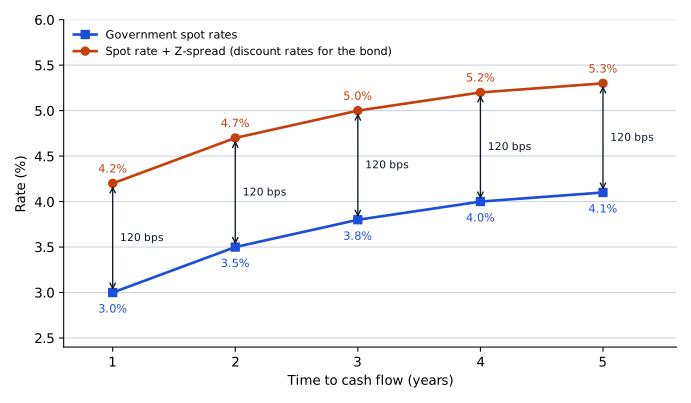
It is found by trial and error:
The search runs in four steps:
- Guess a spread .
- Add it to every spot rate and discount each cash flow at its own .
- Compare the total with the market price. A total above the price means the guess is too small; a total below the price means it is too large.
- Adjust and repeat until the present value equals the price.
Example. Spot rates are 3.0% (1 year) and 3.5% (2 years), and a 2-year 5% annual-pay bond trades at 100.58. A first guess of 100 bp gives , which is above the price, so the spread must be larger. At 120 bp the value is , equal to the price, so the Z-spread is 120 bp.
When the spot curve is flat, every spot rate equals the benchmark YTM, so the G-spread and the Z-spread are the same. YTM-based spreads are theoretically correct only for a flat spot curve.
Option-adjusted spread (OAS)
The option-adjusted spread (OAS) is the spread over the benchmark spot curve that remains once the effect of the embedded option is removed. It equals the Z-spread minus the option value (also called the option cost), the part of the spread that reflects the embedded option:
For a callable bond the option works against the investor, so the investor demands extra spread and the OAS is below the Z-spread. The difference, the option value, is the extra yield that compensates bondholders for the call. Example. A Z-spread of 145 bp and an option value of 40 bp give an OAS of 105 bp. The Z-spread compensates for credit, liquidity, taxation and optionality risk, while the OAS compensates for credit, liquidity and taxation risk only. For an option-free bond, . An option that benefits the bondholder (a conversion or put feature) makes the bond trade at a lower spread than an otherwise identical straight bond.
Key concept
| Measure | Benchmark | Accounts for curve shape? | Removes option? |
|---|---|---|---|
| G-spread | Government bond YTM (interpolated if needed) | No | No |
| I-spread | Swap rate of same tenor | No | No |
| Z-spread | Each government spot rate | Yes | No |
| OAS | Each government spot rate | Yes | Yes |
Common exam traps
- Measuring the option value as the G-spread minus the OAS. The G-spread stands in for the Z-spread only when the curve is flat.
- Expecting a callable bond's OAS to exceed its Z-spread. That ordering fits a bond whose option helps the investor, such as a putable bond.
- Comparing a bond with a benchmark of a different maturity. Interpolate instead.
- Subtracting two yields quoted at different periodicities. Restate them on the same periodicity first; for example, a quarterly-basis yield must be converted to a semiannual basis before it is compared with a semiannual-basis yield.
- Blaming the issuer for a higher yield when the spread is unchanged. The benchmark moved, so macro factors caused the rise.
Exam shortcuts
- For an option-free bond, the price relative to par fixes the order of coupon rate, current yield and YTM, so a ranking question needs no yield calculation.
- A yield to call reuses the YTM inputs; only N, set to the periods to the call date, and FV, set to the call price, change.
- When the spot curve is flat, the Z-spread equals the G-spread, so no trial-and-error search is needed.
Bottom line
- For a bond that pays more than once a year, the quoted YTM is the periodic yield times the number of periods per year; for a semiannual-pay bond this is the semiannual bond basis.
- ; holding the EAY constant, a higher periodicity means a lower stated yield, and holding the stated yield constant, a higher periodicity means a higher EAY.
- Current yield is the annual cash coupon divided by the flat price and ignores capital gains, losses and reinvestment income; simple yield adds the straight-line amortization of a discount, or subtracts that of a premium, before dividing by the flat price.
- For an option-free bond priced at a discount, coupon rate < current yield < YTM; at a premium the order reverses, and at par all three are equal.
- A yield to call uses the periods to the call date and the call price in place of maturity and par, and the yield to worst is the lowest of the YTM and all the yields to call.
- A G-spread is the bond's yield minus a government benchmark yield of the same maturity, interpolated if needed, while an I-spread is measured against the swap rate of the same currency and tenor.
- The Z-spread is the constant spread that, added to every benchmark spot rate, discounts the bond's cash flows to its market price, and it equals the G-spread when the spot curve is flat.
- ; for a callable bond the OAS is below the Z-spread, and for an option-free bond the two are equal.
Quick check
An analyst discounts every cash flow of a bond at one uniform rate, choosing the rate so that the total present value equals the bond's market price. This rate is the bond's:
Show answer and explanation
Correct answer: A
The yield to maturity is the single discount rate that sets the present value of all of a bond's cash flows equal to its price. It is the bond's internal rate of return.
Why the other options are wrong
- B. Current yield is the annual coupon divided by the price; it does not discount any cash flows.
- C. Simple yield adds straight-line amortization of a discount (or subtracts that of a premium) to the coupon and divides by the price; it is not a discount rate.
Key takeaway YTM = IRR of the bond's cash flows at the market price.
Practice Questions
Delmont Paper's $1,000 par value bonds carry a 9% coupon rate and are quoted at a price of $962. The bonds' current yield is closest to:
Show answer and explanation
Correct answer: C
Current yield is the annual cash coupon divided by the bond's price. It considers only coupon income.
Annual coupon
Why the other options are wrong
- A. 8.66% multiplies the coupon by the price as a fraction of par () instead of dividing the coupon by the price.
- B. 9.00% is the coupon rate, which divides the coupon by par rather than by the market price.
Key takeaway A bond priced below par has a current yield above its coupon rate.
An analyst calculates a bond's yield to maturity using its scheduled coupon dates. Two of those dates fall on a Sunday, so the issuer will pay on the following Monday. The analyst then recalculates the yield using the dates on which the cash will actually be received. The recalculated figure is best described as:
Show answer and explanation
Correct answer: C
A yield based on the scheduled coupon dates follows the street convention; a yield based on the actual payment dates, after moving payments past weekends and holidays, is the true yield. Because some cash arrives later, the true yield is usually slightly lower (by a few basis points) than the street convention yield.
Why the other options are wrong
- A. The label is correct, but delaying cash flows lowers the yield on a given price.
- B. The street convention yield is the first figure, based on scheduled dates; the figure based on actual payment dates is the true yield.
Key takeaway Street convention = scheduled dates; true yield = actual payment dates, usually a little lower.
Which description of a callable bond's yield to worst is most accurate? It is the:
Show answer and explanation
Correct answer: B
A callable bond has a yield to call for every possible call date as well as a yield to maturity. The yield to worst is the lowest of all these yields. It is the most conservative return the investor can expect if the issuer acts in its own interest.
Why the other options are wrong
- A. The yield to worst is not a default measure; all the yields compared assume that every promised payment is made.
- C. The yield to worst is chosen among yields computed at the current price for each possible redemption date. Historical prices play no part.
Key takeaway Yield to worst = min(YTM, YTC at each call date).
A callable corporate bond has a zero-volatility spread of 160 basis points, and its embedded call option has a positive value. The bond's option-adjusted spread (OAS) is most likely:
Show answer and explanation
Correct answer: C
For a callable bond, part of the Z-spread is extra yield that compensates the investor for the issuer's call option. The OAS removes that option component, so , which is below 160 bp when the option has value.
Why the other options are wrong
- A. An OAS above the Z-spread would require an option that benefits the investor (for example, a put). A call held by the issuer works the other way.
- B. The OAS equals the Z-spread only for an option-free bond or an option with zero value.
Key takeaway Callable bond: ; the gap is the option value.
This reading has 61 questions in the full bank. Practice all of them.
Key Takeaways
- YTM = IRR of the bond's cash flows at the market price.
- A bond priced below par has a current yield above its coupon rate.
- Street convention = scheduled dates; true yield = actual payment dates, usually a little lower.
- Yield to worst = min(YTM, YTC at each call date).
- Callable bond: ; the gap is the option value.