Fixed Income · Reading 56
Yield to Maturity
CFA Level I · Fixed Income · Reading 56: Fixed-Income Bond Valuation: Prices and Yields · about 36 min
What you'll learn
- LOS 56.a Calculate a bond's price from its yield to maturity on a coupon date or between coupon dates (accrued interest, flat and full price).
- LOS 56.b Identify how price relates to coupon rate, maturity and yield to maturity, including convexity and pull to par.
- LOS 56.c Describe matrix pricing for bonds that are not traded or trade infrequently.
Module 56.1
Fixed-Income Bond Valuation: Prices and Yields
This reading values a fixed-rate bond as the present value of its promised cash flows, on a coupon date and between coupon dates, and links its price to its coupon rate, maturity and yield. A candidate must be able to compute a bond's price or YTM for any coupon frequency, split a full price into flat price and accrued interest, explain why prices move toward par, and estimate an illiquid bond's yield by matrix pricing.
LOS 56.a — Pricing a bond on and between coupon dates
Price = present value of the promised cash flows
A bond's value is the sum of the present values of every promised coupon and the principal. The single discount rate that makes this sum equal to the market price is the yield to maturity (YTM), also called the market discount rate. Given the YTM, the price can be computed; given the price, the YTM can be solved for.
For an annual-pay bond with years left, coupon and par :
For a semiannual-pay bond, use the semiannual coupon , the periodic rate and periods:
Key concept
The same logic works for any periodicity: a quarterly-pay bond uses , and periods. A quoted YTM is a stated annual rate: the periodic yield times the number of periods per year. It is an effective annual rate only if the bond pays annually. For a semiannual bond the periodic yield is therefore the quoted YTM divided by 2, and no square root is taken.
A zero-coupon bond has only one cash flow, so , where is the number of periods per year.
Example (annual vs. semiannual). A 6-year, 4.5% bond is valued at a YTM of 5.5% per 100 of par.
- Annual pay:
N = 6, I/Y = 5.5, PMT = 4.5, FV = 100, CPT PV = −95.00, so the price is 95.00. - Semiannual pay:
N = 12, I/Y = 2.75, PMT = 2.25, FV = 100, CPT PV = −94.95, so the price is 94.95.
On the TI BA II Plus, keep P/Y = C/Y = 1 and END mode, enter the periodic values, and clear the worksheet first ([2ND] [CLR TVM]). The PV comes out negative: it is the cash the buyer pays, while PMT and FV are cash received. Enter the rate as a percentage figure (5.5 for 5.5%).
Example (solving for YTM). An 8-year, 3% semiannual bond trades at 94.00: N = 16, PV = −94, PMT = 1.5, FV = 100, CPT I/Y = 1.94. That is the semiannual yield, so the stated YTM . If the PV is entered with the same sign as PMT and FV, the calculator returns an error.
An investor actually earns the YTM only if (1) the bond is held to maturity, (2) the issuer makes every promised payment, and (3) each coupon is reinvested at that same YTM.
Accrued interest, flat price and full price
Trades usually settle between coupon dates. The buyer receives the entire next coupon, but part of it was earned by the seller. That part is the accrued interest:
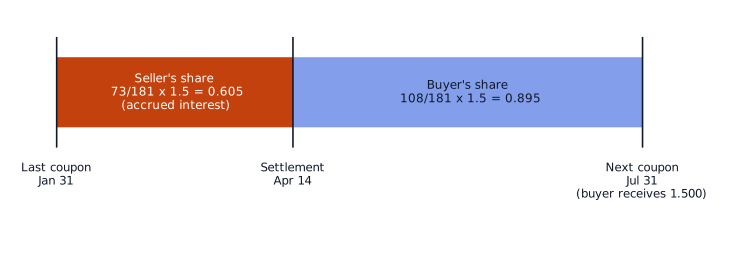
Here is the number of days from the last coupon date to the settlement date, and is the number of days in the coupon period. The figure uses the example below.
| Day-count convention | How days are counted | Typical use |
|---|---|---|
| Actual/actual | actual calendar days in the accrual period and in the coupon period | government bonds |
| 30/360 | every month has 30 days, the year has 360 days | corporate bonds |
Example. An annual 3.6% bond paid its coupon on October 12, 2025, and a trade settles on January 3, 2026. Under 30/360 the accrued days are , so per 100. Under actual/actual they are , so .
- The flat price (also called the clean price or quoted price) excludes accrued interest. Quoting flat prices stops the price from rising every day and dropping on each payment date.
- The full price (also called the invoice price or dirty price) is what the buyer actually pays: full price = flat price + accrued interest, so flat price = full price − accrued interest.
Key concept
To value a bond between coupon dates, compute the full price first and then subtract AI:
- Price the bond on the last coupon date (), using the remaining coupons.
- Compound that value forward at the periodic YTM for the fraction of the period elapsed: .
- Flat price .
Example. A 3% semiannual government bond has coupons on January 31 and July 31 and a YTM of 3.4%. A trade settles on April 14, 2026, with 8 coupons remaining. Actual days are and .
: N = 8, I/Y = 1.7, PMT = 1.5, FV = 100, CPT PV = −98.516. Full price . . Flat price . The flat price differs from .
Worked example: full and flat price of a corporate bond
A corporate bond pays a 5.4% coupon semiannually on March 15 and September 15, uses the 30/360 day count and matures on September 15, 2030. A trade settles on June 27, 2026, at a YTM of 4.6%. Compute the accrued interest, the full price and the flat price per 100 of par.
Step 1. The last coupon was paid on March 15, 2026, so 9 semiannual coupons of 2.7 remain. Under 30/360 the accrued days are out of 180.
Step 2. Value on the last coupon date, at a periodic yield of : N = 9; I/Y = 2.3; PMT = 2.7; FV = 100; CPT PV = −103.22.
Step 3. Full price .
Step 4. Accrued interest .
Step 5. Flat price .
Result. The buyer pays the full price of 104.56 per 100 of par, and the bond is quoted at a flat price of 103.03. Both are above par, as expected for a coupon (5.4%) above the YTM (4.6%).
Common exam traps (56.a)
- Using annual N, I/Y and PMT for a semiannual or quarterly bond: all three must be converted to per-period values. For the 6-year, 4.5% semiannual bond at 5.5% in the example, annual inputs give 95.00 instead of 94.95.
- Counting years from issuance instead of the remaining maturity. When a question asks for a future price, price the bond with the periods left at that future date; the original purchase price is irrelevant.
- Treating the quoted price as the amount paid. The seller receives the full price, which is the quote plus accrued interest.
- Adding accrued interest to the value on the last coupon date, or discounting accrued interest along with the cash flows. Neither is correct. In the April 14 example, adding AI to gives a full price of 99.121 instead of 99.188.
- Valuing a deferred coupon bond as if its coupons started in Year 1. Discount each coupon from the year in which it is actually paid; the deferral pushes the price well below that of an otherwise identical bond whose coupons start at once.
LOS 56.b — How price, coupon, maturity and yield are related
Key concept
| Coupon rate vs. YTM | Price vs. par | Label |
|---|---|---|
| coupon rate > YTM | price > par | premium bond |
| coupon rate = YTM | price = par | par bond |
| coupon rate < YTM | price < par | discount bond |
A coupon below the YTM is sometimes called a deficient coupon, and a coupon above the YTM an excessive coupon.
The key relationships for option-free bonds, other things equal:
- Inverse relationship. A higher YTM means a lower price, and a lower YTM means a higher price.
- Coupon effect. A lower-coupon bond's price is more sensitive to a given yield change than a higher-coupon bond's price.
- Maturity effect. A longer-maturity bond's price is more sensitive to a given yield change than a shorter-maturity bond's price.
- Convexity. The price-yield curve is convex. For equal yield changes, the price rise when yields fall is larger than the price drop when yields rise. As yield increases, price decreases at a decreasing rate.
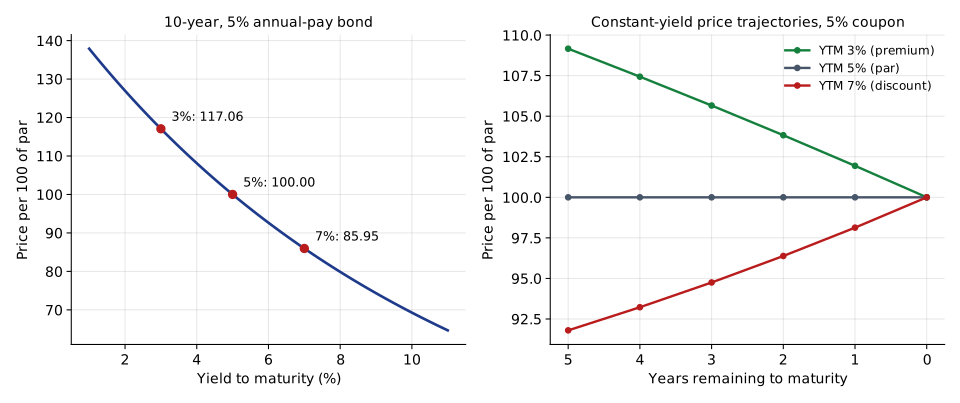
In the left panel, the 10-year, 5% annual bond is worth 117.06 at a 3% YTM, 100.00 at 5% and 85.95 at 7%. A 2-point fall in yield adds 17.06, while a 2-point rise takes away only 14.05.
Pull to par: whatever its yield, a bond's price converges to par as maturity approaches. If the YTM stays constant, the path the price follows is the constant-yield price trajectory:
- A premium bond's price falls toward par over time. In the right panel (YTM 3%) it goes from 109.16 to 107.43 and on down to 100.
- A discount bond's price rises toward par. At a YTM of 7% it goes from 91.80 to 93.23 and on up to 100.
- A par bond stays at par while its YTM equals its coupon rate.
- At a positive yield a zero-coupon bond is a discount bond, so with an unchanged yield its price rises steadily toward par.
The same logic runs in reverse. If a discount bond's price is unchanged after some time has passed, its YTM must have risen. The constant-yield price would have moved up, so an unchanged price implies a higher yield. For a premium bond with an unchanged price, the YTM must have fallen.
Common exam traps (56.b)
- Mixing up the sensitivity directions. A low coupon and a long maturity give higher price sensitivity.
- Thinking prices are more sensitive to yield rises than to yield falls. Convexity makes the opposite true.
- Assuming a bond keeps its issue-date premium or discount status. What matters is today's YTM compared with the coupon rate.
- Forgetting that time alone changes the price of a non-par bond even if the yield is unchanged.
LOS 56.c — Matrix pricing
Matrix pricing estimates the YTM (and therefore the price) of a bond that is not traded or trades infrequently, i.e., a bond with low liquidity. It uses the observed YTMs of actively traded bonds with the same or very similar credit quality and similar coupon and maturity. When no comparable bond has exactly the same maturity, the analyst uses linear interpolation:
The procedure has four steps:
- Select the comparable traded bonds and record their YTMs.
- If several comparable bonds share a maturity, average their yields.
- Interpolate between the two maturities that bracket the target bond's maturity.
- Price the target bond by discounting its cash flows at the estimated YTM.
Example. A thinly traded 4-year, 5% annual bond is to be priced. Comparable bonds with the same rating yield 3.9% (a 3-year bond) and 5.0% and 5.2% (two 7-year bonds). The 7-year average is 5.1%, the interpolated yield is , and the price is N = 4, I/Y = 4.2, PMT = 5, FV = 100, CPT PV = −102.89.
A spread-based variant is used to set the yield on a new bond:
- Find an existing bond of similar credit quality from the same issuer or sector.
- Measure its spread over a benchmark government yield of the same maturity, interpolating the benchmark if needed.
- Add that spread to the benchmark yield at the new bond's maturity.
Example. Two-year and 4-year government bonds yield 1.60% and 2.20%, and an existing 3-year AA corporate bond yields 3.05%. The interpolated 3-year government yield is 1.90%, so the spread is 1.15%. A new 4-year AA issue should yield about .
Common exam traps (56.c)
- Basing a matrix price on the issuer's cost of capital or on a default-probability model instead of the yields of comparable traded bonds.
- Interpolating from the wrong end, or simply averaging two yields when the target maturity is not the midpoint. In the 4-year example, averaging 3.9% and 5.1% gives 4.5% instead of 4.2%.
- In the spread method, measuring the spread against a benchmark of the wrong maturity. Measuring the 3-year AA bond's spread against the 4-year government yield gives 0.85% and a new-issue yield of 3.05%, instead of 1.15% and 3.35%.
Exam shortcuts
- Comparing the coupon rate with the YTM shows whether the price is above, at or below par before any calculation, so answer choices on the wrong side of par can be ruled out at once.
- If a discount bond's price is unchanged after time has passed, its YTM must have risen, and if a premium bond's price is unchanged, its YTM must have fallen; no repricing is needed to answer the direction question.
Bottom line
- A bond's price is the present value of its coupons and principal discounted at the YTM; a semiannual bond uses the coupon , the periodic rate and periods.
- A quoted YTM is a stated annual rate, the periodic yield times the number of periods per year, and it is an effective annual rate only for an annual-pay bond.
- An investor earns the YTM only if the bond is held to maturity, the issuer makes every promised payment and each coupon is reinvested at that same YTM.
- Between coupon dates, the full price is the value on the last coupon date compounded at the periodic YTM, ; accrued interest is , and subtracting accrued interest from the full price gives the flat (quoted) price.
- Accrued interest is usually counted on an actual/actual basis for government bonds and on a 30/360 basis for corporate bonds.
- A bond whose coupon rate is above its YTM trades at a premium, one whose coupon equals its YTM trades at par, and one whose coupon is below its YTM trades at a discount.
- For option-free bonds, other things equal, a lower coupon and a longer maturity make the price more sensitive to a yield change, and convexity makes the price rise from a yield fall larger than the price drop from an equal yield rise.
- Matrix pricing estimates the YTM of a bond that is not traded or trades infrequently from the yields of traded bonds with very similar credit quality, coupon and maturity, interpolating linearly between the maturities that bracket the target.
Quick check
Five years ago, Kessler Freight Lines sold 25-year bonds with a 5.5% annual coupon, paid semiannually, to finance new rail terminals. The bonds now yield 5.2%. The price of the bonds per 100 of par is closest to:
Show answer and explanation
Correct answer: A
Only the remaining 20 years (40 semiannual periods) of cash flows matter. Because the 5.5% coupon exceeds the 5.2% yield, the bond trades at a premium.
Remaining maturity years, so ; ; periodic yield .
BA II Plus (P/Y = C/Y = 1, END mode; clear with [2ND] [CLR TVM]): N = 40; I/Y = 2.6; PMT = 2.75; FV = 100; CPT PV = −103.70.
Why the other options are wrong
- B. 102.32 uses , the number of remaining years, as the number of semiannual periods. It should be 40.
- C. 96.39 swaps the coupon and the yield (a 5.2% coupon discounted at 2.75% per half-year). This produces a discount price for what is actually a premium bond.
Key takeaway Count the remaining maturity from today and convert it to periods. The issue date does not matter.
Practice Questions
With respect to a bond traded between coupon dates, accrued interest:
Show answer and explanation
Correct answer: A
Accrued interest is the seller's share of the next coupon: the coupon times the fraction of the coupon period from the previous coupon date to the settlement date. The buyer pays it to the seller as part of the full price because the buyer will receive the whole next coupon.
where = days from the last coupon to settlement and = days in the coupon period.
Why the other options are wrong
- B. The part of the next coupon that the seller has not earned belongs to the buyer. Accrued interest is the part the seller has earned.
- C. Accrued interest is not a separate cash flow that gets discounted. The full price is the PV on the last coupon date compounded forward to settlement, and accrued interest is then subtracted from it to get the flat price.
Key takeaway Accrued interest = seller's earned share of the current coupon; full price = flat price + AI.
Holding all other features constant, which of the following statements about option-free bonds is most accurate?
Show answer and explanation
Correct answer: A
Other things equal, a longer maturity means more of the bond's value comes from distant cash flows, so its price reacts more to a given change in yield. Low-coupon bonds are also more sensitive than high-coupon bonds.
Sensitivity summary for option-free bonds:
- A longer maturity makes the price more sensitive.
- A lower coupon makes the price more sensitive.
- Because of convexity, the price gain from a yield decrease exceeds the price loss from an equal yield increase.
Why the other options are wrong
- B. Because the price-yield relationship is convex, prices are more sensitive to yield decreases than to equal yield increases: a bond's price sensitivity rises as yields fall.
- C. The relationship runs the other way. The low-coupon bond is the more sensitive one, because a larger share of its value comes from the principal paid at maturity.
Key takeaway Long maturity and low coupon = high price sensitivity; convexity favors yield decreases.
Marguerite Olsen wants to estimate the yield to maturity of a non-traded 7-year, annual-pay bond rated A. Actively traded A-rated bonds yield 4.10% at a 5-year maturity and 5.60% at a 10-year maturity. Using matrix pricing, the estimated YTM for the non-traded bond is closest to:
Show answer and explanation
Correct answer: C
Matrix pricing interpolates linearly between the yields of comparable traded bonds with the same rating. The 7-year maturity is two-fifths of the way from 5 to 10 years.
Why the other options are wrong
- A. 5.00% applies the two-fifths weight from the wrong end ().
- B. 4.85% is the simple average of the two yields. That would be right only if 7 years were the midpoint between 5 and 10 years.
Key takeaway Interpolate in proportion to the distance from the shorter maturity.
This reading has 53 questions in the full bank. Practice all of them.
Key Takeaways
- Count the remaining maturity from today and convert it to periods. The issue date does not matter.
- Accrued interest = seller's earned share of the current coupon; full price = flat price + AI.
- Long maturity and low coupon = high price sensitivity; convexity favors yield decreases.
- Interpolate in proportion to the distance from the shorter maturity.