Fixed Income · Reading 63
Curve-Based and Empirical Fixed-Income Risk Measures
CFA Level I · Fixed Income · Reading 63 · about 27 min
What you'll learn
- LOS 63.a Explain why effective duration and effective convexity (measured against benchmark curve shifts) are the right risk measures for bonds with embedded options.
- LOS 63.b Estimate a bond's percentage price change for a benchmark yield change using effective (or modified) duration and convexity.
- LOS 63.c Define key rate duration and use it to measure sensitivity to nonparallel changes in the benchmark yield curve.
- LOS 63.d Describe the difference between empirical duration and analytical duration.
Module 63.1
Curve-Based and Empirical Fixed-Income Risk Measures
This reading measures interest rate risk against the benchmark yield curve instead of a bond's own yield, which is needed when cash flows depend on future rates. A candidate must be able to compute and use effective duration and effective convexity, explain negative convexity in callable bonds, use key rate durations to measure shaping risk, and contrast empirical with analytical duration.
LOS 63.a — Why effective duration and effective convexity for bonds with embedded options
Yield-based measures (Macaulay duration, modified duration, approximate modified duration, convexity) assume the bond's cash flows are fixed and known. A bond with an embedded option does not satisfy that assumption:
- From the investor's perspective, a callable bond = option-free bond − a call option: the investor is short the embedded call and the issuer holds (is long) the call right; the issuer redeems early when rates fall.
- A putable bond = option-free bond + a long put held by the investor; the investor sells back when rates rise.
- A mortgage-backed security (MBS) behaves like a callable bond because borrowers can prepay.
Because the cash flows (and their timing) depend on the level and path of future interest rates, such a bond has no single well-defined yield (for example, yield to maturity versus yield to each call date). Interest rate risk is therefore measured against shifts in a benchmark yield curve (e.g., government par rates), with a pricing model producing the values and :
Key concept
Effective duration separates benchmark-rate risk from spread risk: it measures sensitivity to the benchmark curve only and holds the credit and liquidity spread constant. Modified duration makes no such distinction. Because effective duration is a curve-based measure, it can be used for option-free bonds too; for an option-free bond, modified and effective duration are close but not identical unless the curve is flat (a parallel shift in the par curve moves the spot rates by different amounts).
Worked example. A callable bond is worth 99.10. A 50 bp parallel fall in the benchmark curve lifts its model value to 101.60; a 50 bp rise lowers it to 96.40.
EffDur . EffCon , which is negative convexity.
Callable and putable bonds
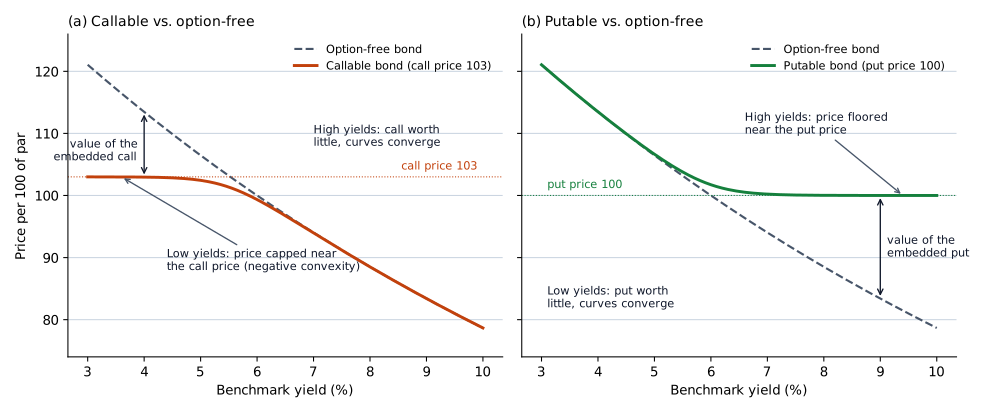
In panel (a), the vertical gap between the curves is the value of the embedded call, which the investor has sold; it widens as yields fall. In panel (b) the gap is the value of the embedded put, which the investor owns; it widens as yields rise. At the other end of the yield range the option is worth little and each bond trades close to the option-free bond.
Key concept
| Feature | Callable bond | Putable bond |
|---|---|---|
| Option held by | Issuer | Investor |
| When the option matters | Low yields (call likely) | High yields (put likely) |
| Convexity | Negative convexity at low yields; positive at high yields | Always positive convexity |
| Effective duration vs. option-free bond | Lower at low yields (price capped near the call price) | Lower at high yields (price floored near the put price) |
With negative convexity, the price gain from a fall in yield is smaller than the price loss from an equal rise in yield.
Common exam traps
- A negative effective convexity is the expected result for a callable bond or an MBS at low yields, not a calculation error.
LOS 63.b — Percentage price change for a change in the benchmark yield
The estimate has the same form as with yield-based measures:
and for an option-free bond with yield-based measures, . The first term is the duration effect; the second is the convexity effect (positive for positive convexity, whatever the direction of the rate change). Convert basis points to decimals (35 bp = 0.0035).
Worked example. A bond has EffDur 7.1 and EffCon 62, and the benchmark curve falls 90 bp: duration effect ; convexity effect ; estimate . With duration alone the estimate would be , too low.
Worked example (negative convexity). The callable bond from LOS 63.a has EffDur 5.25 and EffCon −80.7. For a 100 bp parallel shift the convexity effect is in both directions. A rise in the benchmark curve gives ; a fall gives , the asymmetry described in LOS 63.a.
To get a price, multiply the current price by ; to get a currency change, multiply the current value by .
Unlike yield-based measures, effective duration and convexity do not necessarily give better estimates for smaller rate changes, because factors other than the level of benchmark rates (credit spreads on a corporate bond, the principal outstanding on a mortgage) affect whether the option is exercised.
Common exam traps
- Forgetting the , or giving the convexity effect the sign of the rate change instead of the sign of convexity. For the 90 bp fall in the example (EffDur 7.1, EffCon 62), leaving out the gives +6.8922%, and giving the convexity effect a negative sign gives +6.1389%, instead of +6.6411%.
- Sign errors in the duration effect: a fall in rates raises prices. In the same example, reversing the duration effect gives −6.1389% instead of +6.6411%.
- Using modified duration for a callable bond when an effective duration is given.
LOS 63.c — Key rate duration and shaping risk
Effective duration captures only parallel shifts of the benchmark curve. A key rate duration (also called a partial duration) is the sensitivity of a bond's or portfolio's value to a change in the benchmark yield at one specific maturity, holding all other yields constant. The key rate durations sum to the effective duration.
Key rate durations measure shaping risk: the effect of a nonparallel shift (steepening, flattening, twist) on a portfolio. The effect of each key rate's change is estimated separately and the effects are added:
For a portfolio of cash flows, the key rate duration at a maturity is the modified duration of the cash flow at that maturity multiplied by its weight in the portfolio.
Worked example. Half the portfolio is in a 2-year zero yielding 3%, half in a 7-year zero yielding 4.5% (annual compounding). KRD(2) ; KRD(7) . If the 2-year yield rises 40 bp and the 7-year yield falls 10 bp: .
The two key rate durations add up to , the portfolio's effective duration. A parallel 40 bp rise would cost about . The twist costs far less because the two key rates moved in opposite directions.
Example: same effective duration, different shaping risk. The three portfolios below all have an effective duration of 5.00, so a parallel shift affects them equally.
| Key rate maturity | Portfolio X | Portfolio Y | Portfolio Z |
|---|---|---|---|
| 2-year | 2.10 | 0.50 | 1.25 |
| 5-year | 0.30 | 0.60 | 1.25 |
| 10-year | 0.20 | 3.40 | 1.25 |
| 20-year | 2.40 | 0.50 | 1.25 |
| Sum = effective duration | 5.00 | 5.00 | 5.00 |
Suppose only the 5-year and 10-year key rates rise by 20 bp. Each portfolio loses about : X loses , Y loses and Z loses . A manager expecting this change would prefer X, whose exposure sits at the maturities that do not move.
Key concept
| Measure | Yield change it captures |
|---|---|
| Macaulay duration | None directly: a weighted-average time in years, the horizon at which price and reinvestment risk offset |
| Modified duration | Change in the bond's own YTM |
| Money duration and PVBP | Change in the bond's own YTM, measured in currency units |
| Effective duration | Parallel shift in the benchmark curve |
| Key rate duration | Change in one maturity's benchmark rate |
| Empirical duration (LOS 63.d) | Benchmark changes as observed in historical prices, including any spread moves that came with them |
LOS 63.d — Empirical versus analytical duration
Macaulay, modified and effective duration are analytical durations: they come from mathematical analysis of the bond's cash flows and assume, for credit-risky bonds, that the spread does not change when benchmark yields move (spread and benchmark changes are uncorrelated). Empirical duration is estimated statistically from observed data, that is, from how bond prices have actually responded to past changes in benchmark yields.
When the uncorrelated-spread assumption fails, empirical duration is more appropriate. In a flight to quality, government yields fall while credit spreads widen, so corporate bond prices rise less than analytical duration predicts (or even fall). The empirical duration of a corporate bond portfolio is then lower than its analytical duration. For a portfolio of government bonds, spreads are not a factor, so empirical and analytical durations should be similar and analytical duration remains appropriate.
Common exam traps
- Treating effective duration as empirical because it comes from a pricing model. It is analytical; only a duration estimated from historical price data (for example, by regression) is empirical.
Exam shortcuts
- For a portfolio of zero-coupon bonds with annual compounding, each key rate duration is the zero's portfolio weight times its maturity divided by one plus its yield, as in the 2-year and 7-year example, so no repricing is needed.
Bottom line
- Yield-based duration and convexity assume fixed, known cash flows, so callable bonds, putable bonds and mortgage-backed securities are measured with effective duration and effective convexity against shifts in a benchmark yield curve.
- and , with and produced by a pricing model.
- Effective duration measures sensitivity to the benchmark curve only and holds the credit and liquidity spread constant, while modified duration does not separate benchmark changes from spread changes.
- A callable bond has negative convexity and a lower effective duration than the option-free bond at low yields, where the call price caps its price; a putable bond always has positive convexity and has a lower effective duration at high yields, where the put price floors its price.
- , and the convexity effect takes the sign of the convexity whatever the direction of the rate change.
- A key rate duration is the sensitivity of value to the benchmark yield at one maturity with all other yields held constant; key rate durations sum to effective duration and measure shaping risk from nonparallel shifts.
- Analytical durations assume that credit spreads do not change when benchmark yields move, while empirical duration is estimated from historical prices; in a flight to quality a corporate bond portfolio's empirical duration is lower than its analytical duration, and for government bonds the two should be similar.
Quick check
Effective duration is a better measure than modified duration of a bond's price sensitivity to interest rates when:
Show answer and explanation
Correct answer: B
Effective duration uses model values that reflect how an embedded option changes expected cash flows as rates move; modified duration ignores that effect. For option-free bonds the two measures are similar. Both, however, assume a parallel shift in the curve.
Why the other options are wrong
- A. Neither effective nor modified duration handles nonparallel shifts; key rate durations do.
- C. A long maturity and low coupon raise duration and convexity, but for an option-free bond modified duration is still appropriate.
Key takeaway Effective duration matters when cash flows depend on rates (embedded options).
Practice Questions
Interest rates fall by 65 basis points. Given a modified duration of 6.72 and a convexity of 55.30, the estimated percentage change in the bond's price is closest to:
Show answer and explanation
Correct answer: A
The estimated change is the duration effect plus the convexity effect.
Why the other options are wrong
- B. 4.37% is the duration effect alone.
- C. 4.25% subtracts the convexity effect.
Key takeaway Square the decimal yield change: .
A key rate duration measures the sensitivity of a bond's value to a:
Show answer and explanation
Correct answer: C
A key rate (partial) duration tells how much the value of a bond or portfolio moves when the benchmark rate at just one maturity changes and every other rate stays put. Summed across maturities, key rate durations equal the effective duration.
Why the other options are wrong
- A. Sensitivity to a parallel shift of the whole curve is measured by effective duration.
- B. Key rate duration is a rate sensitivity. It does not measure changes in a bond's cash flows.
Key takeaway Key rate duration covers one point on the curve; effective duration covers the whole curve moving in parallel.
To estimate the interest rate sensitivity of a corporate bond fund, an analyst regresses the fund's past returns on past changes in benchmark government yields. The resulting measure is best described as:
Show answer and explanation
Correct answer: C
Empirical duration is a statistical estimate: it measures how bond prices have actually moved in the past when benchmark yields changed. It is useful for credit-risky portfolios, whose spreads may move with benchmark yields.
Why the other options are wrong
- A. Modified duration is calculated mathematically from the bond's cash flows and yield. It does not use historical data.
- B. Analytical durations (Macaulay, modified, effective) come from mathematical analysis of cash flows rather than from historical price data.
Key takeaway A duration estimated from historical data (for example, by regression) is empirical; a formula-based duration is analytical.
This reading has 34 questions in the full bank. Practice all of them.
Key Takeaways
- Effective duration matters when cash flows depend on rates (embedded options).
- Square the decimal yield change: .
- Key rate duration covers one point on the curve; effective duration covers the whole curve moving in parallel.
- A duration estimated from historical data (for example, by regression) is empirical; a formula-based duration is analytical.