Fixed Income · Reading 61
Macaulay Duration
CFA Level I · Fixed Income · Reading 61: Yield-Based Bond Duration Measures and Properties · about 28 min
What you'll learn
- LOS 61.a Define, calculate, and interpret modified duration (exact and approximate), money duration, and the price value of a basis point (PVBP).
- LOS 61.b Explain how maturity, coupon rate, yield level (and embedded options) affect a bond's duration and interest rate risk.
Module 61.1
Yield-Based Bond Duration Measures and Properties
This reading turns duration into measures of price sensitivity and explains what makes a bond's price more or less sensitive to yield changes. A candidate must be able to compute modified duration, approximate modified duration, money duration and the PVBP, estimate a price change from them, and explain how maturity, coupon, yield level and embedded options affect interest rate risk.
LOS 61.a — Modified duration, money duration and the PVBP
Modified duration
Modified duration (ModDur) converts Macaulay duration (Reading 60) into a measure of price sensitivity. Divide Macaulay duration by one plus the bond's periodic yield:
Whenever the yield is positive, modified duration is smaller than Macaulay duration.
Modified duration is the approximate percentage change in price for a 1% (100 bp) change in YTM:
Key concept
Example. A 6-year, 4% annual-pay bond priced at 94.924 to yield 5% has a Macaulay duration of 5.435. . If the YTM rises by 30 bp, the price should fall by about . For a semiannual bond with MacDur 7.2 years and a 6% YTM, .
The conversion also runs backward: . This is the step needed when a question gives modified duration but asks about the duration gap (Reading 60), which uses Macaulay duration. Example. A semiannual-pay bond with a 5% YTM has a modified duration of 9.20, so its Macaulay duration is years. An investor with a 7-year horizon has a duration gap of years and is exposed mainly to rising rates.
Approximate modified duration
Modified duration can be estimated by repricing the bond at a slightly lower and a slightly higher yield:
Key concept
- = price if the YTM falls by YTM; = price if it rises by YTM; = current price.
- The 2 averages the price rise and the price fall; turns the change into a percentage.
Geometrically, the straight line joining the two repriced points has almost the same slope as the tangent to the price-yield curve at the current price. Dividing the size of that slope by therefore approximates modified duration, and the approximation improves as the yield shift gets smaller.
For the 6-year bond: at 4.9% the price is 95.4172, at 5.1% it is 94.4345, so .
Duration is a straight-line estimate
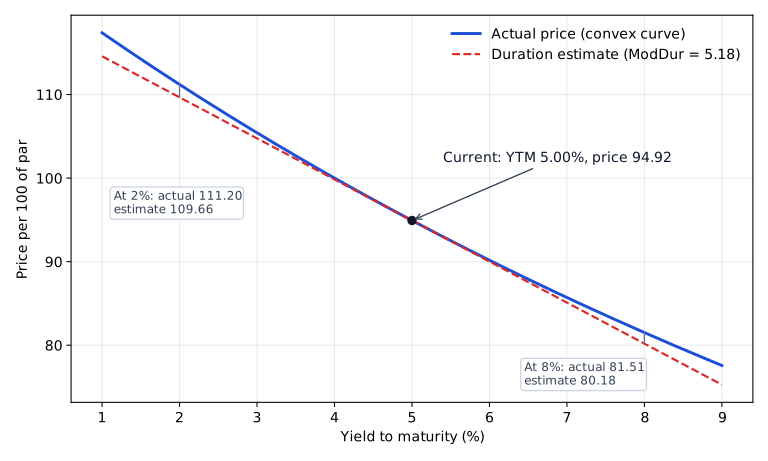
The true price-yield relationship of an option-free bond is convex. Duration draws a straight tangent line at the current yield, so it works well for small yield changes and less well for large ones. For large changes, duration alone underestimates the price increase when yields fall and overestimates the price decrease when yields rise.
Money duration and PVBP
Money duration (also called dollar duration) expresses sensitivity in currency units:
The price value of a basis point (PVBP) is the currency change in a bond's full price for a 1 bp change in YTM. Reprice at ±1 bp and average:
When and are prices per 100 of par, the PVBP of a position is .
Example. For the 6-year bond, with the unrounded modified duration of 5.176, money duration per 100 of par . A $3 million par position is worth $2,847,720 and has a money duration of about $14.74 million, so a 1 bp rise cuts its value by about $1,474 (the PVBP).
Common exam traps
- Express YTM as a decimal: 50 bp = 0.005. Entering it as 0.05 makes the duration 10 times too small, and entering it as 0.5 makes it 100 times too small. For the 6-year bond, entering the 10 bp shift as 0.01 gives 0.518 instead of 5.18.
- Do not forget the 2 in the approximate ModDur denominator, and use (not or ) as the base. For the 6-year bond, leaving out the 2 gives 10.35, and using as the base gives 5.15, instead of 5.18.
- For semiannual bonds, reprice with N = years × 2 and I/Y = YTM/2, but state the yield shift in annual terms. For the PVBP, a 1 bp shift in the annual yield moves the periodic rate by only 0.5 bp, and YTM in the approximate ModDur formula is the annual change.
- Modified duration uses the YTM in the denominator. The coupon rate plays no part in the divisor. For the 6-year, 4% bond, dividing by 1.04 gives 5.23 instead of 5.18.
- Using par value instead of the full price misstates money duration whenever the bond does not trade at par. For the $3 million par position in the example, using par gives about $15.53 million instead of $14.74 million.
Worked example: approximate modified duration and PVBP of a semiannual bond
A 5-year bond pays a 4.4% coupon semiannually and yields 5.6% on a semiannual bond basis. It is valued on a coupon date, so its full price equals its quoted price. An investor holds $2,000,000 of par. Estimate the bond's modified duration by repricing it at yields 10 bp below and 10 bp above the current yield, then compute the position's money duration and PVBP.
Step 1. Current price: N = 10; I/Y = 2.8; PMT = 2.2; FV = 100; CPT PV = −94.8292.
Step 2. At a YTM of 5.5% the periodic rate is 2.75%: N = 10; I/Y = 2.75; PMT = 2.2; FV = 100; CPT PV = −95.2480. At 5.7% it is 2.85%: N = 10; I/Y = 2.85; PMT = 2.2; FV = 100; CPT PV = −94.4127.
Step 3. . The shift enters as 0.001, the annual change, although each periodic rate moved by only 5 bp.
Step 4. Position value . Money duration .
Step 5. PVBP .
Result. The approximate modified duration is 4.40, the position's money duration is about $8.35 million, and a 1 bp change in yield changes its value by about $835.
LOS 61.b — What drives interest rate risk
Other things equal:
Key concept
| Feature | Effect on duration / interest rate risk | Why |
|---|---|---|
| Longer maturity | Usually higher | Distant cash flows are more sensitive to discount-rate changes |
| Higher coupon rate | Lower | More value comes from early cash flows |
| Higher yield to maturity | Lower | The price-yield curve is flatter at higher yields |
| Passage of time | Duration falls smoothly between coupon dates, then jumps up slightly on each coupon date | Time to the next payment resets to a full period |
The slope of the price-yield curve is a picture of interest rate risk. When bonds on one chart have the same price at the current yield (for example, all at par), the one whose curve is steepest there has the highest modified duration.
- A zero-coupon bond's Macaulay duration equals its maturity, so for the same maturity and yield it has more interest rate risk than any coupon bond.
- The maturity effect holds only usually: for discount bonds at long maturities, duration can fall as maturity rises, approaching the duration of a perpetuity, . For example, at an 8% yield a perpetuity's Macaulay duration is .
- A floating-rate note (FRN) resets its coupon to a market reference rate (MRR), so it has little price risk. Its Macaulay duration is roughly the time until the next reset date. Example. An FRN resets every three months and one month of the current period has passed. Its Macaulay duration is about 2 months, or year, whatever its final maturity.
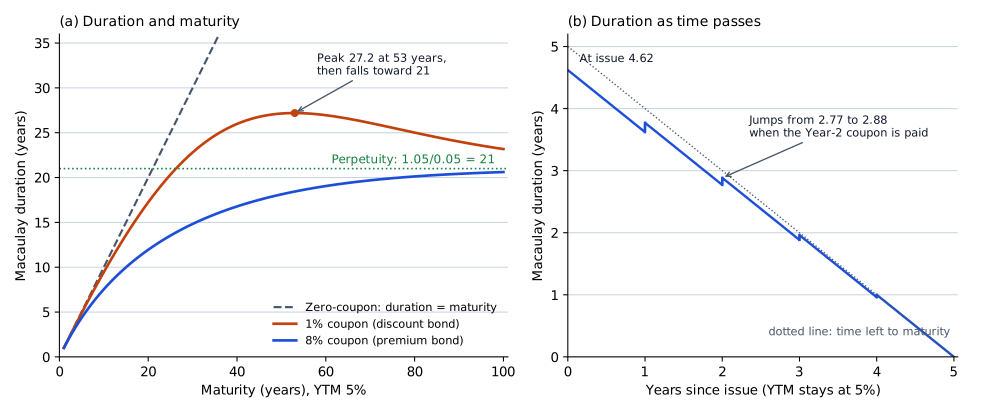
Panel (a) shows the maturity effect for annual-pay bonds at a 5% YTM, with the zero-coupon bond as the reference line. A premium bond's duration rises more slowly and approaches the perpetuity value of 21. A deep-discount bond's duration overshoots that value, peaking at about 27.2 for a 53-year maturity, and then declines toward 21. Panel (b) shows the saw-tooth path of a 5-year, 4% bond's Macaulay duration as time passes with its YTM unchanged.
Bonds with embedded options (preview of Reading 63)
A callable bond has less interest rate risk (lower duration) than an otherwise identical option-free bond. When yields fall, the call price acts as a ceiling on the bond's price. This limits price gains and exposes the investor to reinvestment risk if the bond is called. A putable bond has less price volatility at high yields, because the put becomes valuable and acts as a floor on the price. At low yields the put is worth little and the bond behaves like an option-free bond.
Common exam traps
- When bonds differ in more than one feature, weigh the drivers together. A large maturity difference usually outweighs a small coupon difference.
- Final maturity alone can mislead. An FRN with a long final maturity has very little duration, and a zero-coupon bond can have a higher duration than a coupon bond that matures somewhat later.
Exam shortcuts
- A floating-rate note's Macaulay duration is roughly the time to its next reset date, whatever its final maturity, so no cash flow weighting is needed.
- When bonds on one price-yield chart have the same price at the current yield, the bond whose curve is steepest at that yield has the highest modified duration.
Bottom line
- , where is the periodic yield ( for a semiannual-pay bond with durations in years), so with a positive yield modified duration is smaller than Macaulay duration.
- ; this straight-line estimate works well for small yield changes, and for large changes it understates the price rise when yields fall and overstates the price fall when yields rise.
- , with entered as the annual yield change in decimal form.
- Money duration is modified duration times the full price of the position, , and the PVBP, the change in full price for a 1 bp yield change, is approximately money duration × 0.0001.
- Other things equal, a higher coupon rate or a higher YTM lowers duration, and a longer maturity usually raises it; for discount bonds at long maturities, duration can fall as maturity rises toward the perpetuity duration .
- A zero-coupon bond's Macaulay duration equals its maturity, so for the same maturity and yield it has more interest rate risk than any coupon bond.
- A callable bond has a lower duration than an otherwise identical option-free bond, and a putable bond has less price volatility at high yields, where the put acts as a floor on its price.
Quick check
A 7-year, option-free, annual-pay bond with a 5% coupon is priced at $944.18 for each $1,000 of face value. Its Macaulay duration is 6.0444. Its modified duration is closest to:
Show answer and explanation
Correct answer: C
Modified duration is Macaulay duration divided by one plus the bond's periodic yield. The YTM must first be found from the price; for an annual-pay bond the periodic yield is the YTM itself.
YTM (P/Y = C/Y = 1, END): N = 7, PV = −944.18, PMT = 50, FV = 1,000, CPT I/Y = 6.00.
Why the other options are wrong
- A. 5.868 divides by , a semiannual adjustment; this bond pays annually.
- B. 5.757 divides by one plus the coupon rate (1.05) instead of one plus the YTM (1.06).
Key takeaway ModDur divides by one plus the periodic yield (the coupon rate plays no part), and the periodic yield matches the payment frequency.
Practice Questions
An analyst uses modified duration alone to estimate how an option-free bond's price will respond to a 150 basis point decline in its yield. Compared with the actual price change, the estimate will most likely:
Show answer and explanation
Correct answer: A
Duration is a linear (tangent-line) approximation, but the price-yield curve of an option-free bond is convex. For a large fall in yield the actual price rises more than the straight line predicts, so a duration-only estimate understates the gain; for a large rise in yield it overstates the loss.
Why the other options are wrong
- B. The curve lies above the tangent line, so the actual increase is larger than the estimate.
- C. Duration captures only the slope of the price-yield curve. It misses the curvature (convexity). For a large 150 bp change the error is noticeable.
Key takeaway Duration alone: underestimates price increases and overestimates price decreases for large yield changes.
A portfolio holds $6 million par value of an option-free bond with a full price of 98.75 per 100 of par and an annual modified duration of 5.4. If the bond's yield to maturity rises by 15 basis points, the estimated change in the value of the position, based on its money duration, is closest to:
Show answer and explanation
Correct answer: C
Money duration is modified duration times the full value of the position. Multiplying it by the yield change (as a decimal) estimates the currency change in value, and a rise in yield lowers the value.
Full value .
Link to PVBP: per basis point, and .
Why the other options are wrong
- A. −$479,925 enters 15 bp as 0.015 instead of 0.0015.
- B. −$48,600 applies modified duration to the $6 million par value instead of the $5,925,000 full value.
Key takeaway ; .
An option-free 20-year bond trades at a premium to par. If market interest rates rise, the bond's modified duration:
Show answer and explanation
Correct answer: C
Other things equal, a higher yield lowers duration. The price-yield curve is convex and flatter at higher yields, so the same yield change produces a smaller percentage price change. This holds whether the bond trades at a premium or a discount.
Why the other options are wrong
- A. Duration increases when yields fall. A rise in yields shortens it.
- B. Modified duration depends on the yield level through both the PV weights and the divisor, so it changes when yields change.
Key takeaway For option-free bonds, a higher yield lowers duration and a lower yield raises it.
Relative to an otherwise identical option-free bond, which statement about a bond with an embedded call feature is least accurate? The call feature:
Show answer and explanation
Correct answer: C
A call feature shortens a bond's duration and lowers its price risk. The issuer tends to redeem the bond once yields have fallen enough to refinance more cheaply, so the bond's expected life can be much shorter than its stated maturity and its cash flows become less predictable. Because the investor can be forced to surrender the bond at the call price, the price has little room to rise above that level when yields fall. The other two statements describe genuine drawbacks of callable bonds for investors.
Effects of an embedded call on the bondholder, compared with an otherwise identical option-free bond:
- Duration and price risk: lower. The likely early redemption shortens the expected life, and the call price limits how far the price can rise.
- Price appreciation: capped. As yields fall, the price is compressed near the call price (a price ceiling).
- Reinvestment risk: higher. Bonds are called after yields have dropped, so the principal comes back when only lower-yielding replacements are available.
- Cash flows: uncertain. The timing of the principal repayment depends on the future path of interest rates.
Why the other options are wrong
- A. Accurate: as yields fall the call becomes more valuable to the issuer and the call price acts as a ceiling, so the callable bond's price stays close to the call price instead of rising as much as an option-free bond's would.
- B. Accurate: bonds are typically called after yields have fallen significantly, so the investor gets the principal back early and must reinvest it at lower rates, which disrupts the expected cash flows and reduces the return earned.
Key takeaway A call feature brings shorter duration and lower price risk, a capped upside (price ceiling), more reinvestment risk and less predictable cash flows.
This reading has 40 questions in the full bank. Practice all of them.
Key Takeaways
- ModDur divides by one plus the periodic yield (the coupon rate plays no part), and the periodic yield matches the payment frequency.
- Duration alone: underestimates price increases and overestimates price decreases for large yield changes.
- ; .
- For option-free bonds, a higher yield lowers duration and a lower yield raises it.
- A call feature brings shorter duration and lower price risk, a capped upside (price ceiling), more reinvestment risk and less predictable cash flows.