Fixed Income · Reading 60
Interest Rate Risk and Return
CFA Level I · Fixed Income · Reading 60 · about 30 min
What you'll learn
- LOS 60.a Calculate and interpret the sources of return from a fixed-rate bond: coupons and principal, reinvestment income, and capital gains or losses relative to carrying value.
- LOS 60.b Describe how a bond's holding period return depends on its Macaulay duration relative to the investment horizon (duration gap).
- LOS 60.c Define, calculate, and interpret Macaulay duration as the present-value-weighted average time to receipt of a bond's cash flows.
Module 60.1
Interest Rate Risk and Return
This reading traces the sources of return on a fixed-rate bond and shows how market price risk and reinvestment risk trade off over the investment horizon. A candidate must be able to compute a horizon yield and a capital gain or loss measured against carrying value, explain the duration gap, and calculate and interpret Macaulay duration.
LOS 60.a — Where a fixed-rate bond's return comes from
An investor in a fixed-rate bond can earn return from three sources:
- Coupon and principal payments promised by the issuer.
- Reinvestment income: the interest earned by reinvesting coupons over the investor's holding period.
- A capital gain or loss if the bond is sold before it matures.
Throughout this reading we assume the issuer makes every payment on time (no credit risk) and that coupons are reinvested at the bond's prevailing yield to maturity (YTM).
Horizon yield
The investment horizon is how long the investor plans to hold the bond; it can be shorter than the bond's maturity. The horizon yield (annualized horizon return) is the compound annual rate that turns the purchase price into the total value at the horizon:
where is the horizon in years. Coupons plus reinvestment income equal the future value of the coupon annuity at the reinvestment rate. Working backward, the reinvestment income needed to reach a target yield is the purchase price compounded at that yield over the horizon, minus the coupons and the principal (or sale price) received.
Example. A 4-year, 3% annual-coupon bond is bought at a YTM of 4%, so its price is 96.370 (N = 4, I/Y = 4, PMT = 3, FV = 100, CPT PV). Held to maturity with coupons reinvested at 4%, the coupons grow to , of which is reinvestment income. Ending value , and , the YTM at purchase.
Five key results
Key concept
| Situation (any change in YTM occurs before the first coupon date) | Realized return vs. YTM at purchase |
|---|---|
| YTM unchanged, bond held to maturity | Equal to the YTM |
| YTM unchanged, bond sold before maturity | Equal to the YTM (sale at the carrying value) |
| YTM rises (falls), bond held to maturity | Higher (lower); only reinvestment income changes |
| YTM rises, short horizon (below the bond's Macaulay duration, LOS 60.b) | Lower; the lower sale price dominates |
| YTM falls, long horizon (beyond the bond's Macaulay duration, LOS 60.b) | Lower; lost reinvestment income dominates |
Continuing the example: if the YTM moves to 4.75% immediately after purchase and the bond is held to maturity, coupons grow to 12.882 and the realized return is 4.03% (> 4%). If instead the bond is sold after one year, its price is 95.212 and the one-year return is (< 4%). With a move to 3.25%, the hold-to-maturity return is 3.97% but the one-year return is . In every hold-to-maturity case the realized return lies between the original YTM and the new reinvestment rate.
Two sources of interest rate risk
- Market price risk (price risk): uncertainty about the price at which the bond can be sold at the horizon. Higher yields mean lower prices.
- Reinvestment risk: uncertainty about the income from reinvesting coupons. Higher yields mean more reinvestment income.
A rise in yields therefore hurts the sale price but helps reinvestment income, and a fall does the opposite. The investment horizon decides which effect is larger. An investor who holds to maturity has no price risk (the bond pays par), only reinvestment risk. An investor who sells on the first coupon date has not yet earned any interest on reinvested coupons, so that investor faces price risk only.
| Horizon | Dominant risk |
|---|---|
| Short | Market price risk > reinvestment risk |
| Long (to maturity) | Reinvestment risk > market price risk |
Other things equal, reinvestment risk is greater for bonds with higher coupons (more cash to reinvest) and longer maturities (a longer reinvestment period). A zero-coupon bond held to maturity has no reinvestment risk.
Capital gains and losses: carrying value
If the YTM does not change, a bond's price moves along its constant-yield price trajectory toward par: a discount bond's price rises toward par and a premium bond's price falls toward par. The price on that path at any date is the bond's carrying value: the purchase price plus the amortized discount (or minus the amortized premium). A capital gain or loss is measured as sale price minus carrying value, not sale price minus purchase price. Movement along the trajectory is part of interest income (it adds to a discount bond's interest and reduces a premium bond's), so it never counts as a capital gain or loss.
Example. A 10-year, 6% semiannual-coupon bond is bought at a YTM of 7%. Three years later (14 semiannual periods left) it is sold for 96.10. Carrying value: N = 14, I/Y = 3.5, PMT = 3, FV = 100, CPT PV = −94.54. Capital gain per 100 of par. A bond held to maturity, or sold at the purchase YTM, has no capital gain or loss.
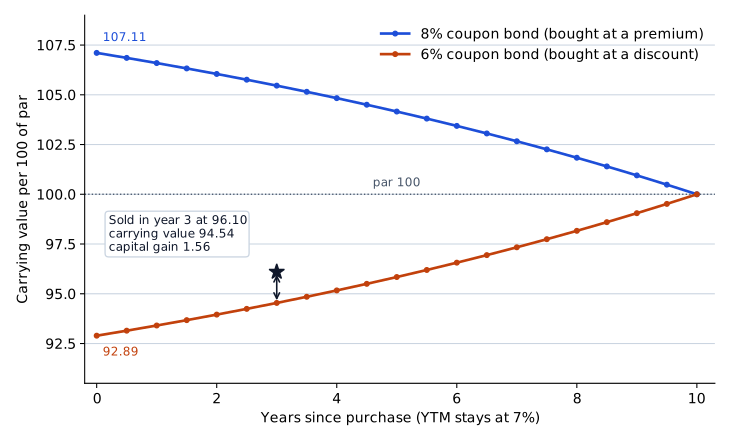
The figure shows both paths for 10-year bonds bought at a 7% YTM, together with the sale from the example.
A zero-coupon bond follows the same rule: the accretion toward face value is interest income, and a sale before maturity produces a capital gain or loss only if a change in YTM has moved the price away from the carrying value.
Common exam traps
- Assuming the YTM is earned whatever the reinvestment rate. Held to maturity with coupons reinvested at the coupon rate, a premium bond earns more than its YTM and a discount bond less.
- Measuring a capital gain against the purchase price or par. The 8% bond in the figure, bought at 107.11 and sold after three years at 106.00, shows a capital gain of even though it was sold below its purchase price. For the 10-year, 6% bond in the carrying-value example, measuring against the purchase price of 92.89 gives a gain of 3.21, and measuring against par gives a loss of 3.90, instead of a gain of 1.56.
- Expecting a rise in YTM to lower the return on a bond held to maturity. Only reinvestment income changes, so the return rises.
LOS 60.b — Holding period return, Macaulay duration and the investment horizon
Because price risk and reinvestment risk move in opposite directions, there is an investment horizon at which they roughly cancel. That horizon is the bond's Macaulay duration, the weighted average time until its cash flows are received (calculated under LOS 60.c). If the horizon equals the Macaulay duration, a one-time change in YTM right after purchase leaves the horizon yield approximately equal to the YTM at purchase: the gain (loss) on reinvestment income offsets the loss (gain) on the sale price.
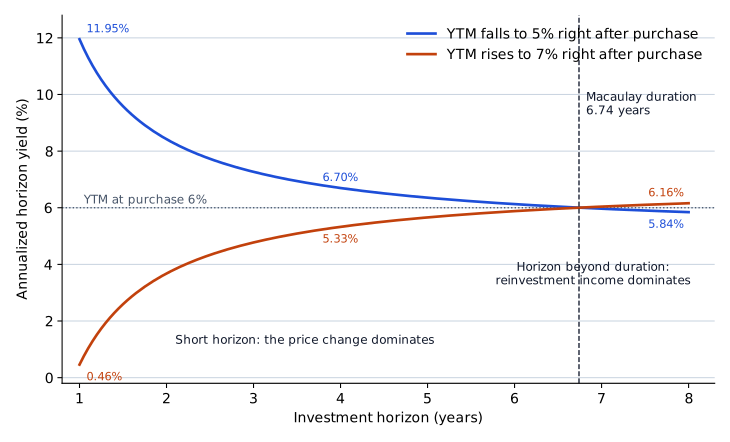
The figure follows an 8-year, 5% annual-coupon bond bought at a 6% YTM (price 93.79, Macaulay duration 6.74 years) whose YTM moves to 5% or to 7% right after purchase. Over a one-year horizon the change in price dominates: the horizon yield is 11.95% if the YTM falls and 0.46% if it rises. As the horizon lengthens, the price effect shrinks because the bond is sold closer to maturity, when its price is nearer par. The reinvestment effect grows because more coupons are reinvested for longer. The two effects cancel at a horizon equal to the Macaulay duration, where both lines pass through 6%. Beyond that point the ranking reverses, and held to maturity the bond earns 6.16% if the YTM rose and 5.84% if it fell.
The duration gap is:
Key concept
| Duration gap | Horizon vs. MacDur | Main exposure | Hurt by |
|---|---|---|---|
| Positive duration gap | Horizon < MacDur | Market price risk | Rising rates |
| Zero | Horizon = MacDur | Risks roughly offset | — |
| Negative duration gap | Horizon > MacDur | Reinvestment risk | Falling rates |
Example. An investor with a 7-year horizon holds bonds with a Macaulay duration of 5.5 years. The gap is years (negative). A fall in yields lowers the realized return, because reinvestment income falls by more than the sale price rises.
Common exam traps
- A horizon shorter than maturity does not by itself mean price risk dominates; compare the horizon with Macaulay duration.
- A negative duration gap means falling rates are the threat; it does not minimize reinvestment risk.
- Any nonzero duration gap leaves an exposure. Only a horizon equal to the Macaulay duration makes the two risks roughly offset.
LOS 60.c — Calculating and interpreting Macaulay duration
The (annual) Macaulay duration is a weighted average of the number of years until each promised cash flow is paid. Each weight is the present value of a cash flow (discounted at the YTM) divided by the bond's full price:
Key concept
Each cash flow contributes its weight times the number of years until it is paid. For a typical coupon bond, the final payment (last coupon plus principal) has the largest weight and contributes most to the duration.
Steps. (1) Price the bond at its YTM. (2) Discount each cash flow at the YTM. (3) Divide each present value by the price to get its weight; the weights sum to 1. (4) Multiply each weight by the time until its cash flow and add the products.
Example (the 4-year, 3% bond at 4%, price 96.370):
| Year | Cash flow | PV at 4% | Weight |
|---|---|---|---|
| 1 | 3 | 2.885 | 0.0299 |
| 2 | 3 | 2.774 | 0.0288 |
| 3 | 3 | 2.667 | 0.0277 |
| 4 | 103 | 88.045 | 0.9136 |
years.
For a semiannual-pay bond, the same calculation gives a duration in semiannual periods; divide by 2 to state it in years. The Macaulay duration of a zero-coupon bond equals its maturity; a coupon bond's is shorter than its maturity.
Interpretations
| Measure | Meaning |
|---|---|
| Macaulay duration | Weighted average time to receipt of the cash flows; the horizon at which price risk and reinvestment risk offset |
| Modified duration (Reading 61) | Approximate percentage price change for a 1% change in YTM |
Why the offset happens at this horizon: a zero-coupon bond held to its maturity has neither risk, because nothing is reinvested and nothing is sold early. Macaulay duration condenses a coupon bond's cash flows into one equivalent payment date, so an investor whose horizon matches that date is roughly in the position of a zero-coupon holder.
Common exam traps
- Macaulay duration is a time measure (years) and is the duration matched to the investment horizon. The "percentage price change per 1% yield change" reading belongs to modified duration.
- Macaulay duration is not the time needed to recover the principal. The principal comes back at maturity.
- Use present-value weights rather than undiscounted cash flows, and do not divide the result by (that gives modified duration). For the 4-year, 3% bond in the example, undiscounted weights give 3.84 years and dividing by 1.04 gives 3.68, instead of 3.82 years.
Exam shortcuts
- For a bond held to maturity after a one-time change in YTM right after purchase, the realized return lies between the original YTM and the new reinvestment rate, so any answer outside that range can be ruled out.
- A zero-coupon bond's Macaulay duration equals its maturity, so it needs no weighting calculation.
Bottom line
- A fixed-rate bond's return comes from the promised coupons and principal, the income from reinvesting coupons, and any capital gain or loss on a sale before maturity.
- With every payment made on time and coupons reinvested at the YTM, the realized return equals the YTM at purchase whether the bond is kept until it matures or sold earlier at an unchanged YTM.
- Higher yields lower the sale price but raise reinvestment income; over a short horizon market price risk dominates, and over a long horizon reinvestment risk dominates.
- A capital gain or loss is the sale price minus the carrying value on the constant-yield price trajectory, so movement along that trajectory counts as interest income rather than as a gain or loss.
- When the investment horizon equals the bond's Macaulay duration, a one-time change in YTM right after purchase leaves the horizon yield approximately equal to the YTM at purchase.
- Duration gap = Macaulay duration − investment horizon; a positive gap leaves the investor exposed to rising rates through price risk, and a negative gap leaves the investor exposed to falling rates through reinvestment risk.
- Macaulay duration is the weighted average time until a bond's cash flows are received, with each weight equal to the cash flow's present value at the YTM divided by the full price; a coupon bond's Macaulay duration is shorter than its maturity.
- Other things equal, reinvestment risk is greater for bonds with higher coupons and longer maturities, and a zero-coupon bond held to maturity has none.
Quick check
A wealth manager tells a client: "When you invest in a bond for a given horizon, your return comes from the coupons you collect plus the difference between what you paid and what you receive when you sell the bond or it matures." The wealth manager's description is:
Show answer and explanation
Correct answer: A
A fixed-rate bond has three sources of return: coupon and principal payments, reinvestment income on the coupons, and any capital gain or loss if it is sold before maturity. The manager's description covers the coupons and the price/principal difference but omits the interest earned by reinvesting coupons over the horizon.
Why the other options are wrong
- B. The description omits reinvestment income, which can be a large part of the return on a long-horizon, high-coupon bond.
- C. It is true that a bond held to maturity has no capital gain or loss, but that is not what is wrong with the description. It already allows for the bond to mature at par.
Key takeaway Three sources of bond return: coupons and principal, reinvestment income, and capital gain or loss on a sale before maturity.
Practice Questions
Dmitri Volkov bought a 15-year, 4% semiannual-coupon bond at a yield to maturity of 5.2%. Four years later, he sells it for 92.10 per 100 of par. Per 100 of par, Volkov realizes:
Show answer and explanation
Correct answer: A
A capital gain or loss is measured against the carrying value, which is the price the bond would have at the sale date if its yield had stayed at the 5.2% purchase YTM. The sale price of 92.10 is above that carrying value, so Volkov has a capital gain.
Carrying value after 4 years (11 years = 22 half-years left, at the purchase YTM; P/Y = C/Y = 1, END): N = 22, I/Y = 2.6, PMT = 2, FV = 100, CPT PV = −90.043.
For reference, the purchase price was 87.608 (N = 30, I/Y = 2.6, PMT = 2, FV = 100).
Why the other options are wrong
- B. 4.49 compares the sale price with the purchase price (). Part of that rise () is the normal accretion of the discount along the constant-yield path, which is interest income.
- C. A loss of 7.90 compares the sale price with par (). Par is relevant only at maturity.
Key takeaway Carrying value is the PV of the remaining cash flows at the original YTM, and the capital gain is sale price minus carrying value.
A pension fund must make a single payment in eight years. The trustees want any change in the income from reinvesting coupons to be roughly offset by an opposite change in the price at which the bonds are sold at the horizon. Which measure of the bonds' duration should they set equal to eight years?
Show answer and explanation
Correct answer: C
When a bond's Macaulay duration equals the investor's horizon, a change in yield moves reinvestment income and the sale price by roughly equal and opposite amounts. Setting the portfolio's Macaulay duration at eight years makes the duration gap zero, so the two risks balance.
Why the other options are wrong
- A. Modified duration is Macaulay duration divided by (1 + periodic yield); it measures percentage price sensitivity.
- B. Effective duration measures price sensitivity to shifts in a benchmark curve (used for bonds with embedded options); it is not the horizon-matching measure.
Key takeaway Match Macaulay duration to the investment horizon to balance price risk and reinvestment risk.
Rafael Quintero calculates a Macaulay duration of 3.46 for a four-year, option-free corporate bond. The best interpretation of 3.46 is that it measures:
Show answer and explanation
Correct answer: B
Macaulay duration is the weighted average time (here 3.46 years) until the bond's cash flows are received, using the present value of each cash flow as a share of the bond's price as the weight. It is shorter than the 4-year maturity because coupons arrive before the final payment.
Why the other options are wrong
- A. Duration measures in general describe price sensitivity, but that is the interpretation of modified duration (percentage price change per 1% change in yield).
- C. The principal is repaid at maturity, in four years. The 3.46 figure is an average time across all cash flows.
Key takeaway Macaulay duration is expressed in years: the PV-weighted average time to receipt of the cash flows.
This reading has 23 questions in the full bank. Practice all of them.
Key Takeaways
- Three sources of bond return: coupons and principal, reinvestment income, and capital gain or loss on a sale before maturity.
- Carrying value is the PV of the remaining cash flows at the original YTM, and the capital gain is sale price minus carrying value.
- Match Macaulay duration to the investment horizon to balance price risk and reinvestment risk.
- Macaulay duration is expressed in years: the PV-weighted average time to receipt of the cash flows.