Fixed Income · Reading 52
Zero Coupon Bond
CFA Level I · Fixed Income · Reading 52: Fixed-Income Cash Flows and Types · about 38 min
What you'll learn
- LOS 52.a Describe bullet, amortizing and sinking fund cash flow structures and coupon structures, and contrast embedded options that benefit issuers (call) with those that benefit investors (put, conversion).
- LOS 52.b Describe how legal, regulatory and tax considerations (domestic, foreign, Eurobond and global bonds; securitization; taxation of interest, capital gains and OID) affect the issuance and trading of fixed-income securities.
Module 52.1
Fixed-Income Cash Flows and Types
This reading covers how bonds repay principal and pay coupons, the embedded options that can change those cash flows, and the legal, regulatory and tax factors that shape where and how bonds are issued. A candidate must be able to compute amortizing and balloon payments, floating-rate and inflation-linked coupons and conversion values, and say which party an embedded option benefits.
LOS 52.a — Cash flow structures and contingency provisions
Principal repayment structures
Key concept
| Structure | Periodic payments | At maturity |
|---|---|---|
| Bullet structure (non-amortizing) | Interest only (the coupons) | Final coupon plus the entire principal |
| Fully amortizing | Equal payments, each part interest and part principal | Nothing left to repay; the last equal payment retires the debt |
| Partially amortizing | Level payments that repay only part of the principal | Last payment plus a balloon payment of the remaining principal |
Example. A $10,000, 4-year loan at 6% that is fully amortizing needs a level payment of
Calculator (END mode, P/Y = C/Y = 1): N = 4; I/Y = 6; PV = −10,000; FV = 0; CPT PMT = 2,885.91. The amortization schedule is then built one year at a time:
- Interest for the year = opening balance × 6%.
- Principal repaid = payment − interest.
- Closing balance = opening balance − principal repaid. It becomes the next year's opening balance.
| Year | Opening balance | Payment | Interest | Principal repaid | Closing balance |
|---|---|---|---|---|---|
| 1 | 10,000.00 | 2,885.91 | 600.00 | 2,285.91 | 7,714.09 |
| 2 | 7,714.09 | 2,885.91 | 462.85 | 2,423.06 | 5,291.03 |
| 3 | 5,291.03 | 2,885.91 | 317.46 | 2,568.45 | 2,722.58 |
| 4 | 2,722.58 | 2,885.93 | 163.35 | 2,722.58 | 0.00 |
The payment stays level while the balance falls, so the interest part shrinks and a larger part of each payment retires principal. The last payment is 2 cents higher because of rounding.
A partially amortizing version of the same loan that leaves a $2,000 balloon keeps the same inputs except FV = 2,000: N = 4; I/Y = 6; PV = −10,000; FV = 2,000; CPT PMT = 2,428.73. The final payment is . The three structures compare as follows:
| Year | Bullet | Fully amortizing | Partially amortizing ($2,000 balloon) |
|---|---|---|---|
| 1 to 3 (each year) | 600.00 | 2,885.91 | 2,428.73 |
| 4 | 10,600.00 | 2,885.93 | 4,428.73 |
Compared with a fully amortizing loan, a partially amortizing one has lower regular payments and a higher final payment. It repays less principal along the way, so more principal stays outstanding, and its interest in every year after the first is higher (year-1 interest is the same, because no principal has been repaid yet).
A sinking fund provision obliges the issuer to pay off part of the issue according to a set schedule over the bond's life. Typically the bond trustee redeems a fixed amount of principal each year from holders chosen at random. For bondholders, a sinking fund has two effects:
- It lowers credit risk, because less principal is left to be repaid at maturity.
- It adds reinvestment risk, the risk of receiving cash early and having to reinvest it at lower yields. If rates have fallen, the bonds trade above par, yet holders whose bonds are drawn receive only par. Holders of premium bonds therefore prefer that their bonds are not drawn.
Example. A $120 million, 15-year issue carries a sinking fund that retires $15 million of principal each year from year 8 through year 15. Nothing is redeemed in years 1 to 7, and the last $15 million is retired at maturity.
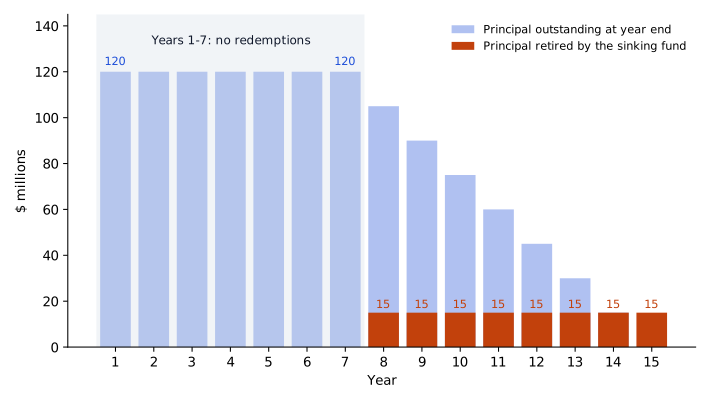
Amortizing structures carry the same trade-off, since a sinking fund is one form of amortization. The more principal a structure repays before maturity (bullet, then partially amortizing, then fully amortizing), the lower its credit risk and the higher its reinvestment risk.
A sinking fund is an obligation of the issuer and is not an embedded option. Waterfall structures, another form of amortization schedule, are used for ABS and MBS. They pay principal to senior tranches first. Junior tranches receive principal only after senior tranches are repaid, although all tranches still receive interest.
Coupon structures
- Floating-rate notes (FRNs) pay the market reference rate (MRR) plus a fixed margin (the credit spread) stated in basis points. Most reset and pay quarterly: the MRR observed at the start of a quarter sets the coupon paid at the end of that quarter. The per-period coupon is . Example. With an MRR of 3.10%, a margin of 60 bps and quarterly payments, the coupon is of par.
- Step-up coupon bonds: the coupon rises on a predetermined schedule, which gives investors some protection against rising interest rates.
- Credit-linked coupon bonds and credit-linked notes: the coupon rises if the issuer's credit rating falls and falls if it improves. Leveraged loans may step up if debt/EBITDA rises. Some green bonds pay more if environmental targets are missed.
- Payment-in-kind (PIK) bonds: the issuer can pay interest by increasing the principal (paying with more bonds). They are used by highly leveraged issuers, so yields are higher.
- Index-linked bonds tie coupons or principal to a published index. Inflation-linked bonds (linkers) are the most common.
- Interest-indexed bonds: the coupon rate is adjusted for inflation, and the principal is unchanged (not protected).
- Capital-indexed bonds (the most common type, e.g., US Treasury Inflation-Protected Securities (TIPS)): the coupon rate stays fixed, and the principal is adjusted up for inflation (down for deflation). The fixed coupon rate is effectively a real rate. Because the coupons and the principal repaid both rise with the index, the investor's purchasing power is fully protected over the bond's life. Adjusted principal can fall below par during the bond's life, but at maturity TIPS repay the greater of the inflation-adjusted principal and par.
- Example. A bond has €5,000 par and a 2% annual coupon paid semiannually. Inflation over the first six months is 1.5%, so the principal becomes and the coupon is .
- Zero-coupon bonds make one payment of par at maturity, so they must trade below par to give investors a positive return. They appeal to investors who want to minimize reinvestment risk. A zero-coupon bond is the extreme case of a deferred coupon bond.
- Deferred coupon bonds pay no coupons for an initial period after issuance and then pay regular coupons to maturity. In some issues the skipped coupons accrue and are paid as one lump sum when the deferral period ends; otherwise the bond is simply sold at a deeper discount. Like zero-coupon bonds, they often trade below par. The structure suits low-rated issuers or projects that generate cash only later.
Periodic coupons also have to be reinvested, so reinvestment risk rises with the coupon rate, and a call feature adds to it. Holding a coupon bond to maturity does not remove it; only a zero-coupon bond held to maturity has none.
Contingency provisions (embedded options)
A contingency provision allows an action to be taken if a specified event occurs. In a bond indenture such provisions are embedded options: they are part of the bond contract and are not separate securities. An embedded option benefits whoever holds the right to exercise it. Bonds without them are straight bonds (option-free bonds).
Key concept
| Bond | Who holds the option | Likely exercised when | Price vs straight bond | Yield vs straight bond |
|---|---|---|---|---|
| Callable bond (issuer may redeem early at the call price) | Issuer | The bond's market yield has fallen (rates dropped or the issuer's credit improved), so the issuer can refinance more cheaply | Lower: callable = straight − call | Higher |
| Putable bond (holder may sell back, usually at par) | Bondholder | The bond's price is below the put price (rates rose or the issuer's credit weakened) | Higher: putable = straight + put | Lower |
| Convertible bond (holder may exchange for common shares) | Bondholder | The share price has risen, lifting the conversion value | Higher | Lower |
- Callable bonds: the period before the first call date is call protection. The call price often steps down over time (e.g., 103, then 101.5, then par). Holders face call risk, and during the call period the call price caps the bond's market value. Example. A 5.5% bond with $1,000 par reaches its first call date, callable at 101, just as its market yield falls to 3.5%. The issuer pays $1,010 per bond and borrows that amount at 3.5%, which cuts annual interest from $55 to per bond. The holder receives $1,010 early and can reinvest it only at the lower yield.
- Convertible bonds: the conversion price is the par amount per share received, the conversion ratio is par divided by the conversion price, and the conversion value is the conversion ratio times the current share price. Example. A $1,000 par bond with a conversion price of $25 converts into 40 shares. At a share price of $28, the conversion value is .
- Warrants attached to straight bonds let holders buy common shares at a fixed price. They can be detached and traded separately.
- Contingent convertible bonds (CoCos) convert automatically into equity if a trigger occurs (e.g., a bank's equity capital falls below a required level).
A typical call schedule steps down toward par after a period of call protection:
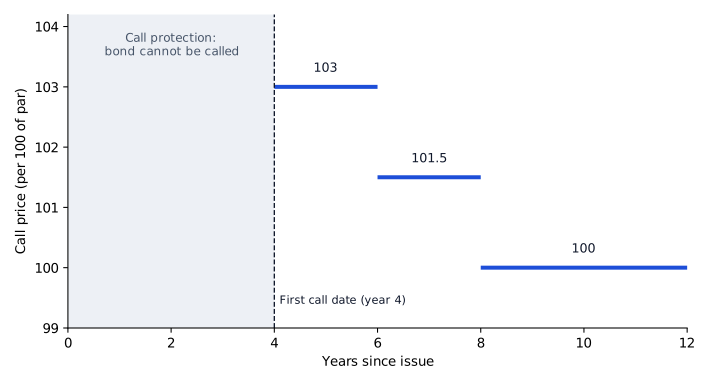
Options are worth more when the underlying is more volatile. Higher interest rate volatility therefore raises the value of the call held by the issuer, so the callable bond's value falls. It also raises the value of the put held by the investor, so the putable bond's value rises.
Common exam traps
- Level payments that leave nothing owing at maturity mean the bond is fully amortizing. Level payments followed by a balloon mean it is partially amortizing, and "bullet" means all principal is repaid at maturity.
- For a partially amortizing loan, enter the balloon as FV. Leaving FV = 0 gives the fully amortizing payment instead. For the $10,000, 4-year, 6% loan with a $2,000 balloon, FV = 0 gives a payment of $2,885.91 instead of $2,428.73.
- A sinking fund is an obligation, and it can hurt holders of premium bonds.
- TIPS have a fixed coupon rate and an adjusted principal. The coupon amount changes because the rate is applied to the adjusted principal. In the €5,000 example, applying the 2% rate to par gives a coupon of €50.00 instead of €50.75.
LOS 52.b — Legal, regulatory and tax considerations
Where bonds are issued and traded
Key concept
| Type | Definition |
|---|---|
| Domestic bonds | Issuer domiciled in the same country as the market where the bonds are issued and traded |
| Foreign bonds | Issued by an issuer from another country and traded in that country's domestic market (e.g., a UK firm selling US dollar bonds that trade in the US) |
| Eurobonds | Issued outside the jurisdiction of any one country, in any currency; less regulated than domestic bonds in most jurisdictions (they began as a way around US regulation). Named by currency: Eurodollar bonds (USD), Euroyen bonds (yen) |
| Global bonds | Trade in the Eurobond market and in at least one domestic market |
The "Euro" in Eurobond does not mean the bonds are denominated in euros, sold in Europe or issued by a European firm; the name comes from the market's origins in Europe, where most Eurobonds are still traded. Foreign bonds, global bonds and Eurobonds are collectively international bonds. Bearer bonds (ownership shown simply by possession, with no record kept by the issuer) were once the norm for Eurobonds. Today most bonds are registered bonds. Markets also differ in laws, regulation and conventions such as coupon frequency, but the currency of a bond is the factor that best explains yield differences across markets, because a bond's yield is driven by interest rates in the country of its currency. Sukuk are Sharia-compliant bonds whose payments are treated as rent on underlying assets.
Taxation of bond income
- Interest income is usually taxed as ordinary income. In the US, interest on municipal bonds is usually not subject to national income tax, and often not to state tax in the issuing state either.
- Gains or losses on selling a bond before maturity are capital gains or losses. They are often taxed at lower rates, and lower still if the gain is long-term.
- Original issue discount (OID) bonds (e.g., zero-coupon bonds): the rise in value toward par is really interest, so in many jurisdictions part of the discount is taxed each year as interest income even though no cash is received.
- Some jurisdictions give bonds issued at a premium the symmetric treatment: part of the premium is used to reduce the taxable portion of the coupon interest.
Common exam traps
- A euro-denominated bond sold in the euro area by a local issuer is a domestic bond.
- A bond sold in a country's own currency and market by a foreign issuer is a foreign bond, not a Eurobond.
- Currency alone does not decide the category. A Eurobond is defined by issuance outside the jurisdiction of any one country, and it can be in any currency.
- The accretion on a zero-coupon bond is interest income and is not treated as a capital gain.
Exam shortcuts
- A partially amortizing payment uses the same calculator entries as the fully amortizing payment, with the balloon entered as FV instead of zero.
- Only a zero-coupon bond held to maturity has no reinvestment risk, so any coupon bond can be eliminated from that answer even if it is held to maturity.
- A callable bond is worth less and a putable bond more than an otherwise identical straight bond, so the three can be ranked by price, and in reverse by yield, without valuing any of them.
Bottom line
- A bullet bond pays only interest before maturity and repays all principal at maturity; a fully amortizing bond's level payments retire the debt by the last payment; a partially amortizing bond's level payments leave a balloon payment at maturity.
- A sinking fund provision obliges the issuer to retire part of the issue on a set schedule, which lowers bondholders' credit risk but adds reinvestment risk.
- A floating-rate note pays the market reference rate plus a fixed margin, so its per-period coupon is (MRR + margin) divided by the number of payments per year.
- A capital-indexed bond such as TIPS keeps a fixed coupon rate, effectively a real rate, and adjusts its principal for inflation, so each coupon is that rate applied to the adjusted principal; an interest-indexed bond adjusts the coupon rate and leaves the principal unprotected.
- An embedded option benefits whoever holds the right to exercise it: callable bond = straight bond − call, with a higher yield, and putable bond = straight bond + put, with a lower yield.
- For a convertible bond, the conversion ratio is par divided by the conversion price, and the conversion value is the conversion ratio times the current share price.
- A foreign bond is issued by a foreign issuer and traded in another country's domestic market, while a Eurobond is issued beyond the jurisdiction of any single country and may be denominated in any currency.
- On an original issue discount bond such as a zero-coupon bond, the rise in value toward par is interest, and many jurisdictions tax part of the discount each year as interest income even though no cash is received.
Quick check
A bond with a par value of $2,000 carries a 6.8% coupon rate, paid semiannually, and is quoted at a price of 104.35. The dollar amount of each semiannual coupon is:
Show answer and explanation
Correct answer: C
Coupons are based on par value, and the market price plays no part. Half of the annual coupon is paid every six months.
The quoted price of 104.35 (104.35% of par) does not enter the calculation.
Why the other options are wrong
- A. $136.00 is the full annual coupon; it is not divided by two for semiannual payments.
- B. $70.96 applies the coupon rate to the market price () instead of to the par value.
Key takeaway The price quote is irrelevant to the coupon amount. Each coupon equals the coupon rate times par, divided by the number of payments per year.
Practice Questions
Which statement about a sinking fund provision is most accurate?
Show answer and explanation
Correct answer: C
A sinking fund provision requires the issuer to retire a portion of the bond issue at specified times over its life. Typically the bond trustee redeems a set amount of principal each year from holders chosen at random. Principal is therefore repaid through a series of payments rather than all at maturity.
Why the other options are wrong
- A. The bonds are actually retired on the schedule. The provision does not simply build up cash to repay the whole issue at maturity.
- B. A right to sell bonds back to the issuer at a set price is a put option, which belongs to the bondholder. A sinking fund is an obligation of the issuer, and the bonds redeemed are chosen by the trustee, not by the holders.
Key takeaway A sinking fund retires part of the issue on a schedule over its life, which reduces the principal outstanding at maturity.
Priya Nair's main concern in her bond portfolio is reinvestment risk. Which of the following is she least likely to do?
Show answer and explanation
Correct answer: C
Holding a coupon bond to maturity does not remove reinvestment risk, because every coupon received must still be reinvested at whatever rates then prevail. An investor focused on reinvestment risk would therefore not rely on this.
Why the other options are wrong
- A. A callable bond may be redeemed early, typically after rates have fallen, forcing reinvestment at lower yields. Preferring a noncallable bond reduces reinvestment risk, so she is likely to do this.
- B. Smaller coupons mean less cash to reinvest, so a low-coupon bond carries less reinvestment risk. She is likely to prefer it.
Key takeaway Reinvestment risk rises with coupon size and with call features; only a zero-coupon bond held to maturity avoids it.
Which of the following bond issues best fits the definition of a Eurobond?
Show answer and explanation
Correct answer: B
A Eurobond is issued outside the jurisdiction of any one country and can be issued in any currency. An Indian firm's Australian dollar bonds sold to investors in Singapore are not issued in Australia's or India's domestic market, so they fit the Eurobond definition. The "Euro" prefix does not mean the bonds are denominated in euros, sold in Europe or issued by a European firm.
Why the other options are wrong
- A. A foreign issuer selling bonds in Switzerland, in Swiss francs, to Swiss investors is issuing a foreign bond.
- C. A German issuer selling euro bonds to investors in its home market is issuing a domestic bond; being denominated in euros does not make it a Eurobond.
Key takeaway A Eurobond is issued outside the jurisdiction of any one country and can be in any currency. The "Euro" prefix says nothing about the currency, the market of sale or the issuer's home country.
Maren Holt buys a newly issued 8-year corporate bond at 106.40 per 100 of par. It pays a 6.5% annual coupon, and she plans to hold it to maturity. Her country taxes coupon interest as ordinary income and gives bonds issued at a premium the treatment that mirrors its original issue discount (OID) provision. Each year, the tax treatment of her coupons is most likely that:
Show answer and explanation
Correct answer: A
Under an OID provision, part of the discount on a bond issued below par is taxed each year as interest income. Some jurisdictions treat bonds issued at a premium symmetrically: part of the premium is used to reduce the taxable portion of the coupon interest. Holt paid 6.40 above par and will receive only par at maturity, so in her country part of that premium offsets her 6.50 coupon each year before tax.
Why the other options are wrong
- B. Taxing the full coupon with no adjustment ignores the premium treatment stated in the stem. Her country lets part of the premium reduce the taxable portion of the coupons.
- C. Adding part of the price difference to taxable interest each year is the OID treatment of a bond issued at a discount. For a bond issued at a premium the adjustment runs the other way and reduces taxable coupon interest.
Key takeaway With an OID provision, part of a discount is taxed each year as interest income. With the symmetric premium treatment, part of a premium reduces the taxable portion of the coupons.
This reading has 42 questions in the full bank. Practice all of them.
Key Takeaways
- The price quote is irrelevant to the coupon amount. Each coupon equals the coupon rate times par, divided by the number of payments per year.
- A sinking fund retires part of the issue on a schedule over its life, which reduces the principal outstanding at maturity.
- Reinvestment risk rises with coupon size and with call features; only a zero-coupon bond held to maturity avoids it.
- A Eurobond is issued outside the jurisdiction of any one country and can be in any currency. The "Euro" prefix says nothing about the currency, the market of sale or the issuer's home country.
- With an OID provision, part of a discount is taxed each year as interest income. With the symmetric premium treatment, part of a premium reduces the taxable portion of the coupons.