Fixed Income · Reading 51
Bond Indenture
CFA Level I · Fixed Income · Reading 51: Fixed-Income Instrument Features · about 23 min
What you'll learn
- LOS 51.a Describe the basic features of a fixed-income security: issuer, maturity, par value, coupon rate and frequency, seniority, contingency provisions, and the price-yield relationship.
- LOS 51.b Describe what a bond indenture contains, the sources of repayment, and contrast affirmative and negative covenants.
Module 51.1
Fixed-Income Instrument Features
This reading introduces the basic features of a fixed-income security and the contents of a bond indenture. A candidate must be able to compute a periodic coupon, classify bonds by issuer, maturity and seniority, and tell affirmative covenants from negative covenants.
LOS 51.a — Features of a fixed-income security
Fixed-income instruments come in two broad forms. A loan is a private, nontradable agreement between a borrower and a lender. A bond (a fixed-income security) is a standardized, tradable security that represents a debt investment. Bond investors lend capital, the principal, also called par value or face value. The issuer promises to repay it together with interest, usually as a periodic coupon stated as a percentage of par. Issuers typically use the money raised to fund long-term investments. For a corporate issuer, bonds and long-term loans are classified as long-term liabilities on the balance sheet.
Key bond features
| Feature | What it specifies |
|---|---|
| Issuer | Who borrows: sovereign (national) governments, corporations, local governments, supranational entities (e.g., the IMF), quasi-government entities (e.g., a state railway), and special purpose entities (SPEs) that buy financial assets and issue asset-backed securities backed by the cash flows of those assets |
| Maturity | The date the final cash flow is paid. The time left until then is the tenor. Original maturity of one year or less = money market securities; more than one year = capital market securities; no stated maturity = perpetual bonds |
| Par value | The principal to be repaid — usually in one amount at maturity, but some instruments (e.g., a mortgage) repay it gradually |
| Coupon rate and frequency | The coupon rate is the annual percentage of par paid as interest; payments may be annual, semiannual, quarterly or monthly |
| Seniority | Debt ranks ahead of equity in bankruptcy or liquidation; senior debt ranks ahead of junior debt (subordinated debt), so junior debt carries more credit risk and must offer a higher yield |
| Contingency provisions | Some bonds include embedded options, such as a call option, a put option or a conversion right (covered in the next reading) |
Key concept
Each periodic coupon . A bond described as a "6% semiannual coupon bond" pays 3% of par every six months.
Example. A $5,000 par bond with a 4% coupon paid semiannually pays every six months, or $200 a year. If it paid quarterly, each coupon would be $50.
Floating-rate notes (FRNs), or floaters, pay a coupon equal to a variable market reference rate (MRR) plus a fixed margin. The margin is quoted in basis points (1 bp = 0.01%).
Zero-coupon bonds (pure discount bonds) pay no interest before maturity. They are sold at a discount to par, and the investor's whole return is the difference between the purchase price and the par value received at maturity. For a given maturity, the lower the price, the higher the return.
Price, yield and the yield curve
A bond's yield is the return an investor expects from buying it at today's price and receiving its promised cash flows. For a fixed-coupon bond, price and yield move in opposite directions. Fixed cash flows can deliver a higher return only if the investor pays less for them.
Key concept
- Premium bond: price above par (its yield is below its coupon rate).
- Discount bond: price below par (its yield is above its coupon rate).
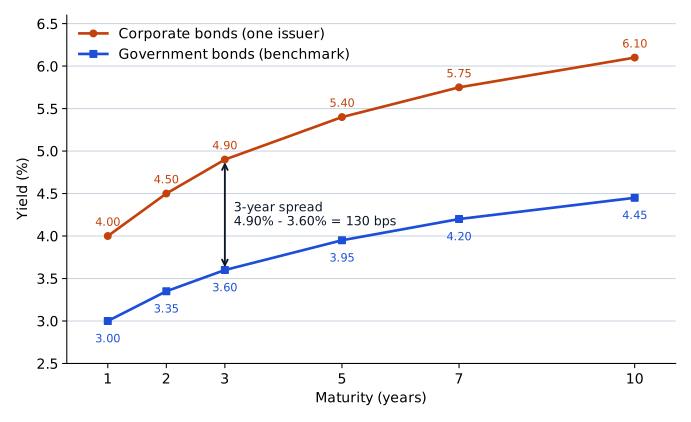
A plot of yields against maturity for one issuer or class of bonds is a yield curve. An upward-sloping curve is a normal yield curve. It is the most common shape, because investors usually demand a higher yield for longer, more uncertain horizons. A downward-sloping curve is an inverted yield curve, which is less common. The US Treasury curve, for instance, was upward sloping in mid-2018 and inverted in mid-2023. Government bonds are usually the lowest-credit-risk bonds in a market, so the government curve is the benchmark, and the extra yield on a riskier bond over a government bond of the same maturity is its spread.
Example. A 3-year corporate bond yields 4.9% and the 3-year government bond yields 3.6%, so the spread is bps.
Common exam traps
- Confusing the per-period coupon with the coupon rate: 2% paid quarterly is an 8% coupon rate. For the $5,000 par, 4% semiannual bond in the example, applying the full 4% to each payment gives a coupon of $200 instead of $100.
- Classifying money market and capital market securities by remaining maturity. The original maturity is what counts.
- Thinking a zero-coupon bond can trade above par when rates fall. As long as its yield is positive, it stays below par until maturity.
- Measuring a spread against a government bond of a different maturity.
- Assuming senior and junior bonds of the same issuer and maturity offer the same yield. The junior bonds are riskier and yield more.
LOS 51.b — The bond indenture and covenants
The bond indenture (also called the trust deed) is the legal contract between the issuer (borrower) and the bondholders (lenders). It sets out the bondholders' rights and the issuer's obligations and restrictions, and it governs all later dealings between the two sides. It specifies the issuer, maturity, par value, coupon rate and frequency, currency, the sources of repayment, any collateral pledged, credit enhancements, and the covenants the issuer must follow.
The indenture does not name the individual bondholders. Bonds are tradable securities, so the holders change over the bond's life.
Sources of repayment
| Issuer / bond type | Repaid from |
|---|---|
| Sovereign bonds | Taxes on economic activity and, in some cases, the power to create currency — hence usually the lowest credit risk in a region |
| Local government bonds | Local taxes, or revenue from projects such as toll roads |
| Secured bond | The company's operating cash flow plus a legal claim (lien or pledge) on specific assets (collateral) if the issuer defaults |
| Unsecured bond | Operating cash flow only |
| Asset-backed security | Cash flows from the financial assets held by the SPE that issued it |
Affirmative versus negative covenants
Bondholders have no votes, but covenants written into the indenture protect them.
Key concept
| Affirmative covenants | Negative covenants | |
|---|---|---|
| Nature | Things the issuer must do (mostly administrative) | Things the issuer must not do (restrictions) |
| Examples | Deliver timely financial reports; use proceeds as stated; pay taxes and comply with laws; insure and maintain assets pledged as collateral; redeem at a premium if acquired; cross-default clause (a default on any other debt is a default on this bond); pari passu clause (this bond ranks equally with the issuer's other senior debt) | Limits on asset sales and sale-and-leaseback deals; no pledging the same collateral twice; no new debt senior to existing debt (negative pledge clause); limits on additional borrowing, share repurchases or dividends, often subject to an incurrence test (e.g., allowed only while debt/EBITDA is below a stated level) |
Negative covenants protect bondholders by stopping actions that would raise default risk, but they must not be so tight that the firm cannot respond to opportunities or changing conditions.
Common exam traps
- Keeping collateral insured is affirmative (a required action). Not selling or re-pledging that collateral is negative (a restriction).
- Covenants are provisions inside the indenture. The indenture is the whole contract.
- Wording can mislead. Cross-default and pari passu clauses sound restrictive, yet they are affirmative covenants. A clause such as "dividends may be paid only while debt/EBITDA is below 2.5×" reads like a duty, but it limits what the issuer may do, so it is a negative covenant (an incurrence test).
Exam shortcuts
- A bond priced above par has a yield below its coupon rate, and a bond priced below par has a yield above it, so comparing the price with par answers a yield-versus-coupon question without any calculation.
Bottom line
- The coupon rate is the annual percentage of par paid as interest, so each periodic coupon equals the coupon rate times par value divided by the number of payments per year.
- A bond with an original maturity of one year or less is a money market security, one with an original maturity of more than one year is a capital market security, and a bond with no stated maturity is a perpetual bond.
- A zero-coupon (pure discount) bond pays no interest before maturity and is sold at a discount to par, so the investor's whole return is the gap between the price paid and the par value received.
- For a fixed-coupon bond, price and yield move in opposite directions; a premium bond yields less than its coupon rate and a discount bond yields more.
- Senior debt ranks ahead of junior (subordinated) debt in bankruptcy or liquidation, so junior debt carries more credit risk and must offer a higher yield.
- A bond's spread is its extra yield over a government bond of the same maturity, with the government yield curve used as the benchmark.
- The bond indenture (trust deed) is the legal contract between issuer and bondholders; it sets out the sources of repayment, any collateral, credit enhancements and the covenants.
- Affirmative covenants state what the issuer must do, including cross-default and pari passu clauses; negative covenants restrict what the issuer may do, including the negative pledge clause and limits subject to an incurrence test.
Quick check
A dealer's inventory includes the three fixed-income securities described below. Which one is classified as a money market security?
Show answer and explanation
Correct answer: B
Money market securities are those with an original maturity of one year or less. The bill issued today with nine months to maturity has an original maturity of nine months, so it is a money market security.
Why the other options are wrong
- A. The note had an original maturity of about three years and four months. Its short remaining maturity does not change its classification: it is a capital market security.
- C. The bond's original maturity is 10 + 14 = 24 months, which is longer than one year, so it is a capital market security.
Key takeaway Money market and capital market securities are classified by original maturity at issuance. The time remaining does not change the classification.
Practice Questions
Which of the following describes a bond that is trading at a premium?
Show answer and explanation
Correct answer: B
A bond trades at a premium when its price exceeds its par value. For a fixed-coupon bond this happens when the market yield is below the coupon rate.
Why the other options are wrong
- A. A coupon rate below the market yield means the bond's price is below par, so the bond trades at a discount.
- C. A bond's redemption value can differ from its face value under its terms, but that difference does not determine whether it trades at a premium. A premium means market price is above par.
Key takeaway A premium bond has a price above par (yield below the coupon rate). A discount bond has a price below par (yield above the coupon rate).
Government bond yields are 4.60% for 2 years, 4.10% for 7 years and 3.90% for 10 years. Ardent Rail's 7-year bond yields 5.85%. The spread on Ardent Rail's bond and the shape of the government yield curve are best described as:
Show answer and explanation
Correct answer: C
The spread is the extra yield over a government bond of the same maturity: 5.85% − 4.10% = 1.75%. Government yields fall as maturity lengthens, so the curve slopes downward, which is an inverted yield curve.
Yields: 2-year 4.60% > 7-year 4.10% > 10-year 3.90%, so the government curve slopes downward (inverted).
Why the other options are wrong
- A. 1.25% measures the spread against the 2-year government yield (5.85% − 4.60%); the benchmark must have the same 7-year maturity.
- B. The spread is right, but a curve on which longer maturities yield less is inverted; a normal yield curve slopes upward.
Key takeaway Match maturities when measuring a spread. An upward-sloping curve is normal, and a downward-sloping curve is inverted.
This reading has 17 questions in the full bank. Practice all of them.
Key Takeaways
- Money market and capital market securities are classified by original maturity at issuance. The time remaining does not change the classification.
- A premium bond has a price above par (yield below the coupon rate). A discount bond has a price below par (yield above the coupon rate).
- Match maturities when measuring a spread. An upward-sloping curve is normal, and a downward-sloping curve is inverted.