Alternative Investments · Reading 80
Alternative Investment Features, Methods, and Structures
CFA Level I · Alternative Investments · Reading 80 · about 33 min
What you'll learn
- LOS 80.a Describe what alternative investments are, why investors hold them, their typical features and their three broad categories.
- LOS 80.b Compare fund investing, co-investing and direct investing on control, fees, diversification, minimum size and expertise.
- LOS 80.c Describe limited partnership structures and fee terms: management fees, performance fees, hurdles, catch-up, high-water marks, waterfalls and clawbacks.
Module 80.1
Alternative Investment Structures
This reading defines alternative investments, the reasons investors hold them and how they differ from traditional investments. It compares fund investing, co-investing and direct investing, and explains limited partnership structures, management and performance fees, hurdle rates, catch-up clauses, high-water marks, waterfalls and clawbacks, including how to calculate the fee under each hurdle.
LOS 80.a — What counts as an alternative investment
Traditional investments are long-only holdings of cash and publicly traded stocks and bonds. Anything outside that box is an alternative investment. Most alternatives are actively managed. They fall into three broad categories: private capital, real assets and hedge funds.
Why investors add them (perceived benefits)
- Diversification: returns have relatively low correlations with those of stocks and bonds, so adding them can reduce portfolio risk.
- Higher potential returns: investors may earn an illiquidity premium, and markets for some alternatives may be less efficient than public markets.
Typical features compared with traditional investments
Key concept
| Feature | Alternatives | Traditional |
|---|---|---|
| Manager knowledge | More specialized | Less specialized |
| Correlation with stocks/bonds | Relatively low | — |
| Liquidity of assets held | Less liquid | Liquid |
| Investor time horizon | Longer | Shorter/flexible |
| Size of commitment | Larger | Smaller |
| Leverage | Used by some vehicles (LBO funds borrow heavily; hedge funds may use leverage and derivatives) | Long-only holdings of cash, stocks and bonds |
| Regulation and transparency | Less | More |
| Fees | Higher | Lower |
| Structures | Limited partnerships and other special legal forms, with management and performance fees | Mutual funds, directly held securities |
Resulting characteristics
- Investment structures designed to let the manager invest directly in the underlying assets.
- Information asymmetry between managers and investors, which funds try to offset with incentive-based fees.
- Difficulty appraising performance: historical return and volatility data are scarce and less reliable.
- Correlations that are low on average can rise sharply during periods of economic stress.
Three broad categories
- Private capital: private equity and private debt. Private equity funds hold shares of unlisted firms, or buy listed firms with the aim of delisting them; many targets sit in the mature or declining phase of their industry. Most private equity funds are leveraged buyout (LBO) funds, which finance the purchase of established firms largely with debt. Venture capital funds finance new firms with no track record, in their start-up and early phases. Private debt funds make direct loans, provide venture debt to young firms, or buy distressed debt of borrowers that are struggling with payments or are in bankruptcy.
- Real assets: real estate, natural resources, infrastructure and other real assets.
- Real estate covers residential and commercial property and real estate-backed debt. It can be held through outright or leveraged ownership of a building, a single property loan, private or listed securities whose collateral is a pool of properties or mortgages, or a limited partnership.
- Natural resources are commodities, farmland and timberland. Commodity exposure can come from physical holdings, commodity derivatives (some funds track a commodity index with futures) or shares of commodity producers. Farmland earns lease income or income from crops and livestock; timberland earns cash flows from harvesting trees.
- Infrastructure means long-lived assets that provide public services: economic infrastructure (roads, airports, utility grids) and social infrastructure (schools, hospitals). Governments often finance and build infrastructure, but more recently public-private partnerships have also taken large stakes in such projects, and an asset may later return to public ownership.
- Other real assets include collectibles (art), intangibles (patents) and digital assets (cryptocurrencies).
- Hedge funds: pooled vehicles open to qualified investors that may use leverage, short positions and derivatives. Despite the name, they do not necessarily hedge.
Common exam traps
- Read the direction of a comparison. A question on how traditional investments differ wants the mirror image of the alternatives column: lower fees, greater liquidity, less specialized managers.
- Diversification rests on low correlation with stocks and bonds. An option that cites high correlation as a benefit is wrong, even though correlations can rise in a crisis.
LOS 80.b — Fund investing, co-investing and direct investing
Key concept
| Method | What the investor does | Control | Fees | Diversification | Minimum size / expertise |
|---|---|---|---|---|---|
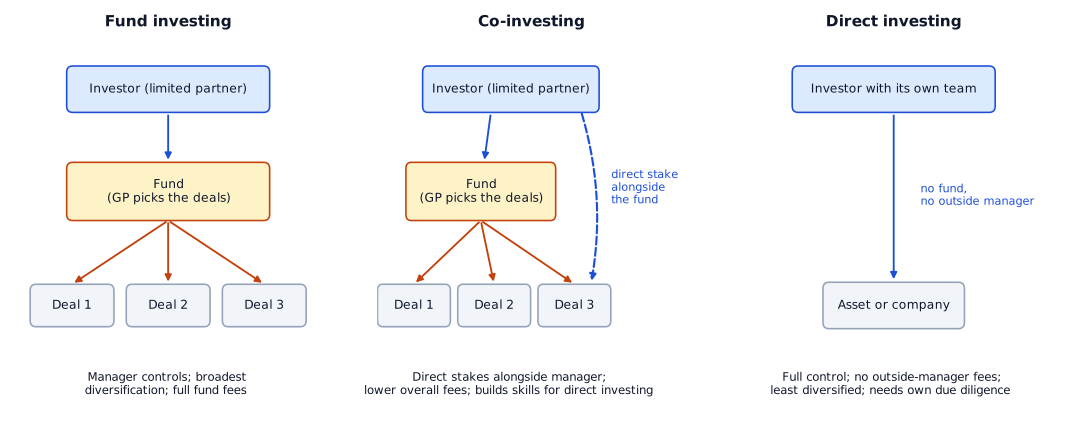
| Fund investing | Pools money with other investors; a fund manager selects and manages the assets | Manager controls | Management + incentive fees | Broadest | Lowest amounts; manager does the due diligence |
| Co-investing | Invests in the fund and has the right to invest directly alongside the manager in some deals | Investor takes selected direct stakes alongside the manager | Lower overall than pure fund investing | Moderate | Larger amounts; builds skills for direct investing |
| Direct investing | Buys assets itself (e.g., a sovereign wealth fund buying farmland or a private company) | Full control | No outside-manager fees | Least | Highest amounts; must do its own due diligence |
A fund's term sheet sets out its investment policy, fee structure and the requirements investors must meet to participate.
The fee saving in co-investing comes from the part of the money that goes into a deal directly rather than through the fund, while the investor still relies on the manager to find and evaluate the deal. For the manager, allowing co-investment can bring in more capital and widen the scope and diversification of the fund.
Common exam traps
- A small investor who wants diversification, or one with no in-house deal team, belongs in fund investing, because the manager does the due diligence.
- Direct investing wins on control and fees but loses on diversification, minimum size and required expertise. The cheapest method is the wrong answer for an investor without scale or staff.
LOS 80.c — Ownership and compensation structures
Limited partnerships. The general partner (GP) is the fund manager: it makes all investment decisions and bears the partnership's liabilities, including its debt. The limited partners (LPs) are the investors: they own shares in proportion to their contributions, have no say in management and no liability beyond their investment. LP interests are usually limited to accredited investors, who have the wealth to bear significant risk and the sophistication to understand it, and a partnership typically caps the number of LPs it admits. LPs often commit an amount up front and contribute it over time as the GP calls capital.
- The limited partnership agreement holds the rules of the partnership.
- A side letter gives terms to one LP that others do not get (e.g., an excusal right to skip a capital call). A most-favored-nation clause requires that special terms granted to other LPs also be offered to this LP.
- A master limited partnership (MLP) is publicly traded; MLPs are common in natural resources and real estate.
Management fee. Typically 1%–2% a year, earned regardless of performance.
- Hedge funds: a percentage of assets under management (AUM), usually the fund's NAV.
- Private equity funds: a percentage of committed capital rather than invested capital. Committed capital is drawn down over roughly three to five years, at the manager's discretion; undrawn commitments are dry powder. Charging on committed capital removes the incentive to invest quickly rather than selectively.
A fee quoted as " and " means an management fee and a performance fee, so "2 and 20" is a 2% management fee and a 20% incentive fee.
Calculating the performance fee
Performance fee. The performance fee (also incentive fee or carried interest) is a share of profits. It is usually paid only after a hurdle rate (preferred return) is reached: the minimum return the fund must earn before the GP receives any performance fee. Below the hurdle, the GP earns no performance fee at all.
- Soft hurdle rate: once the hurdle is met, the fee applies to the whole gain.
- Hard hurdle rate: the fee applies only to the gain above the hurdle.
- Catch-up clause: after LPs receive the hurdle return, the GP receives 100% of the next slice of gains until it has received its full share of all gains so far; after that, gains are split normally. The clause favors the GP.
- Performance fees are usually settled once a year. The base is typically the year's gain in the fund's investments net of the management fee and other charges, such as consulting and monitoring fees billed to portfolio companies. A fund's terms may instead compute the performance fee independently of the management fee, on the full gain.
- High-water mark: no performance fee on gains that only recover earlier losses. The fee is paid only on value above the highest previous net-of-fees value, so investors are never charged twice for the same gain. Each investor can have a different high-water mark.
With a performance fee rate , a hurdle and a fund return at or above the hurdle (no fee if ):
With a full catch-up, the GP receives while is between and , and once is above that point.
Example. A fund earns 11% in a year with a 20% performance fee and a 4% hurdle.
With a catch-up instead, LPs get the first 4%, the GP gets 100% of the next slice until it holds 20% of the total. That total is , so the GP's catch-up is 1%. The remaining is split 80/20, which gives the GP another 1.2%. The GP's total is , exactly 20% of 11%.
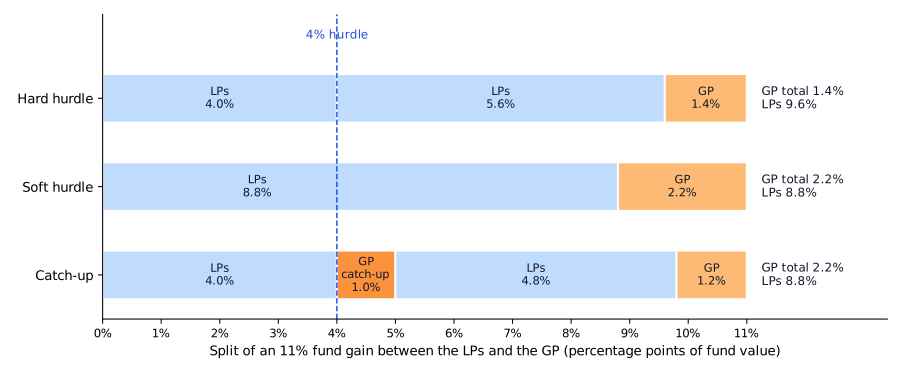
The catch-up gives the same result as a soft hurdle once the gain is large enough to complete the catch-up, here 5%. Between the 4% hurdle and 5%, the GP receives less than a soft hurdle would pay. Had the fund earned 4.6%, the GP would receive the whole 0.6% above the hurdle, less than its full 20% share of 0.92%.
Waterfalls and clawbacks
Waterfalls. A waterfall sets how realized profits are split between the GP and the LPs:
Key concept
| Deal-by-deal waterfall (American waterfall) | Whole-of-fund waterfall (European waterfall) | |
|---|---|---|
| When the GP is paid | As each investment is sold | Only after LPs get back 100% of their capital plus the hurdle |
| Who it favors | GP | LPs |
The deal-by-deal waterfall favors the GP because carried interest is paid on each profitable exit before the LPs have received all of their contributed capital plus the hurdle return.
A clawback provision lets LPs recover incentive fees paid on earlier gains that are later reversed by losses on other deals. For example, if the GP took fees on early winners, the clawback makes sure the LPs still receive their agreed share (e.g., 80%) of the fund's total profit. A clawback is most valuable with a deal-by-deal waterfall.
Common exam traps
- "Invested capital" is the usual wrong answer for a private equity fund's management fee base.
- Check whether the stated hurdle is soft or hard before computing the fee; the two give different answers from the same inputs. In the example, applying a hard hurdle as if it were soft gives a fee of 2.2% instead of 1.4%.
- Sort provisions by whom they favor. GP: catch-up clause, deal-by-deal (American) waterfall. LPs: high-water mark, clawback, whole-of-fund (European) waterfall.
- A high-water mark stops new fees until earlier losses are recovered; a clawback takes back fees already paid. Options often swap the two.
Bottom line
- Alternative investments are everything outside long-only holdings of cash and publicly traded stocks and bonds, and they fall into three broad categories: private capital, real assets and hedge funds.
- Investors add alternatives for diversification, because their returns have relatively low correlations with stocks and bonds, and for higher potential returns from an illiquidity premium and less efficient markets, although correlations that are low on average can rise sharply under economic stress.
- Compared with traditional investments, alternatives have more specialized managers, less liquid assets, longer horizons, larger commitments, less regulation and transparency, higher fees and scarce, less reliable return data.
- Fund investing gives the broadest diversification with the lowest amounts and leaves due diligence to the manager, co-investing lowers fees overall by putting part of the money directly into deals alongside the manager, and direct investing gives full control with no outside-manager fees but the least diversification and the highest size and expertise requirements.
- In a limited partnership the GP makes all investment decisions and bears the partnership's liabilities, while LPs own shares in proportion to their contributions, have no say in management and no liability beyond their investment.
- The management fee, typically 1%–2% a year regardless of performance, is charged on AUM for hedge funds and on committed capital for private equity funds.
- The performance fee is paid only once a hurdle rate is met, on the whole gain under a soft hurdle and only on the gain above the hurdle under a hard hurdle, and a high-water mark bars fees on gains that merely recover earlier losses.
- A deal-by-deal (American) waterfall and a catch-up clause favor the GP, a whole-of-fund (European) waterfall, a high-water mark and a clawback favor the LPs, and a clawback is most valuable with a deal-by-deal waterfall.
Quick check
A trustee new to the investment committee of a family foundation asks what sets alternative investments apart as a group. Which statement is most accurate?
Show answer and explanation
Correct answer: B
Alternative investments are defined by exclusion: traditional investments are long-only positions in cash and publicly traded stocks and bonds, and everything else is an alternative. The group includes private capital, real assets such as real estate, infrastructure and natural resources, and hedge funds, which may use short positions, leverage and derivatives.
Why the other options are wrong
- A. The reverse holds. Markets for some alternatives are thought to be less efficient than public stock and bond markets, which is one reason investors hope to earn higher returns from them.
- C. Alternatives are valued for their relatively low correlation with stocks and bonds, which is the source of their diversification benefit. Correlations can rise in periods of stress, but they are not typically high.
Key takeaway Traditional means long-only cash, listed stocks and listed bonds. Anything outside that definition is an alternative investment. Alternatives tend to have relatively low correlation with traditional assets, and some trade in markets that may be less efficient.
Practice Questions
A large insurer is weighing whether to buy stakes in private companies itself instead of committing money to a private equity fund. Compared with fund investing, direct investing most likely offers:
Show answer and explanation
Correct answer: A
Direct investing avoids paying management and performance fees to an outside manager, so its fees are lower. Its drawbacks are less diversification, larger minimum investments and the need for in-house expertise to evaluate deals.
Why the other options are wrong
- B. Fund investing gives access to a broader, more diversified pool of assets. A direct investor typically holds fewer, larger positions.
- C. Direct deals require larger amounts. In a fund, the cost of each investment is shared with other investors.
Key takeaway Direct investing: lower fees and more control, but less diversification, larger amounts and more expertise needed.
A foundation holds stakes in both a hedge fund and a private equity fund. The management fee charged by the hedge fund is most likely calculated as a percentage of:
Show answer and explanation
Correct answer: A
Hedge fund management fees are a percentage of assets under management, typically the fund's net asset value. The private equity fund, by contrast, would charge its management fee on committed capital.
Why the other options are wrong
- B. Committed capital is the basis for private equity fund management fees. Hedge funds charge on assets under management.
- C. Neither structure normally uses invested capital. Private equity funds use committed capital so the manager is not rewarded for deploying money quickly.
Key takeaway Hedge fund management fee: % of AUM (NAV). Private equity fund management fee: % of committed capital.
The partnership agreement of Halvorsen Growth Partners provides that, each time a portfolio company is sold, the profit on that sale is split between the general partner and the limited partners immediately, without waiting for the rest of the portfolio to be exited. This arrangement is best described as a:
Show answer and explanation
Correct answer: B
In a deal-by-deal waterfall (American waterfall), profits are distributed as each investment is sold and shared under the partnership agreement. This favors the GP, because performance fees can be paid before LPs have received all of their capital plus the hurdle rate.
Why the other options are wrong
- A. In a whole-of-fund (European) waterfall, LPs receive all distributions until they have recovered 100% of their capital plus the hurdle rate, usually after all investments are sold.
- C. A clawback provision lets LPs recover incentive fees already paid if later losses reverse earlier gains. It does not describe how each sale is distributed.
Key takeaway American = deal-by-deal (GP-friendly). European = whole-of-fund (LP-friendly).
This reading has 26 questions in the full bank. Practice all of them.
Key Takeaways
- Traditional means long-only cash, listed stocks and listed bonds. Anything outside that definition is an alternative investment. Alternatives tend to have relatively low correlation with traditional assets, and some trade in markets that may be less efficient.
- Direct investing: lower fees and more control, but less diversification, larger amounts and more expertise needed.
- Hedge fund management fee: % of AUM (NAV). Private equity fund management fee: % of committed capital.
- American = deal-by-deal (GP-friendly). European = whole-of-fund (LP-friendly).