Alternative Investments · Reading 81
Hurdle Rate
CFA Level I · Alternative Investments · Reading 81: Alternative Investment Performance and Returns · about 39 min
What you'll learn
- LOS 81.a Describe why alternative investment performance is hard to appraise: life-cycle timing (J-curve, IRR, money multiple), leverage, valuation (fair value hierarchy) and fees.
- LOS 81.b Calculate and interpret alternative investment returns before and after management fees, performance fees, hurdle rates and high-water marks.
Module 81.1
Performance Appraisal and Return Calculations
This reading explains how to appraise alternative investments given the J-curve, leverage, hard-to-value assets and complex fee terms, and how IRR and MOIC differ. It then covers redemption terms and index biases and shows how to calculate returns before and after management and performance fees, with hurdles, high-water marks, fund-of-funds fees and waterfalls.
LOS 81.a — Appraising the performance of alternative investments
Alternative investments carry risks that an unleveraged, long-only stock or bond portfolio does not. Returns should, as far as possible, be judged with these in mind:
- Timing of cash flows over the fund's life cycle
- Use of leverage
- Valuation of assets that may have no observable market price
- Complexity of fees, taxes and accounting
Life cycle and the J-curve
Key concept
| Phase | What happens | Typical returns |
|---|---|---|
| Capital commitment phase | Manager finds deals and makes capital calls on LPs' commitments | Negative |
| Capital deployment phase | Capital is invested; manager works with the portfolio companies or projects | Still negative (especially for start-ups or troubled firms being turned around), but improving |
| Capital distribution phase | Investments produce income and are exited | Positive and rising, and may level off near the end of the fund's life |
Plotting cumulative returns, or the LPs' cumulative net cash flow, against time gives the J-curve effect: an early dip followed by a steep rise. The dip comes from the timing of cash flows. Capital calls come first, and distributions start only after the investments begin producing income or are sold.
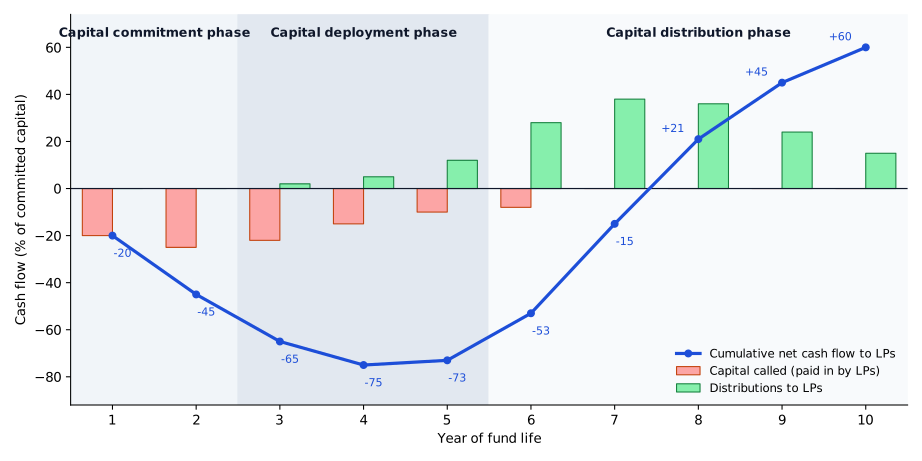
Because the manager controls the timing and size of cash flows, the IRR (a money-weighted return) over the fund's life is the most appropriate performance measure. Its drawback is that it depends on assumed rates: a financing cost for the capital the investor contributes and a reinvestment rate for the distributions the investor receives. A simpler measure is the multiple of invested capital (MOIC), also called the money multiple:
It ignores timing, so it is considered somewhat naive.
Example. In the fund shown in the figure, LPs pay in 100 in total and receive 160 in distributions, with nothing left in the fund at the end, so MOIC . The IRR on the same annual cash flows is about 11.3%. If every distribution arrived two years later, MOIC would still be , but the IRR would fall to about 7.6%. The money multiple cannot see the delay; the IRR can.
Leverage
Hedge funds in particular may borrow through margin financing from prime brokers or gain leverage through derivatives. If a fund with equity borrows at rate and earns on the whole portfolio:
Example. million, million, , .
, versus 7% unleveraged.
Rearranging the formula shows where the extra return comes from:
Key concept
Leverage adds the spread between the portfolio return and the borrowing rate, scaled by the ratio of borrowing to equity. In the example, . The same ratio works against the fund when is below : if the portfolio returned , the fund would return .
Some strategies use leverage because the pricing anomalies they exploit are too small to earn a meaningful return without it. Leverage also brings risks. Margin calls can force sales at bad prices, large forced sales can push prices down further, and lenders may cut off further borrowing.
Valuation: the fair value hierarchy
| Level | Inputs | Examples |
|---|---|---|
| Level 1 | Quoted prices in active markets | Exchange-traded securities |
| Level 2 | Observable inputs, directly or indirectly (models) | Many derivatives |
| Level 3 | Unobservable inputs; few or no transactions | Private equity, real estate |
Level 3 values can stay near cost for long periods and may not reflect exit values. Because these values change little, reported returns are smoothed, so risk and correlation with traditional investments look lower than they really are. Exam convention: stale Level 3 values can also make reported returns appear higher (for example, when write-downs of assets that have lost value are delayed). Current practice: staleness by itself only smooths returns; a lag can hold back a gain as well as delay a write-down, so the direction of any effect on the average return is not fixed.
Fees are negotiable
Fee terms are negotiated and can differ by investor and by when the investor committed. As a result, different investors in the same fund can earn different returns.
Common exam traps
- "Improving" in the deployment phase does not mean positive. Returns typically turn positive only in the distribution phase.
- Stale Level 3 values make a fund look less volatile and less correlated with public markets, not more.
LOS 81.b — Returns before and after fees
Redemption and fee terms
Weak returns tend to trigger redemption requests, which, like margin calls, can force a fund to sell at bad prices and at bad times. Early returns are usually negative (the J-curve), so funds (hedge funds in particular) restrict early redemptions:
- Lockup period: time after the initial investment during which LPs cannot redeem, or can redeem only with significant fees.
- Notice period: time (typically 30–90 days) the fund has to meet a redemption request, so positions can be reduced in an orderly way.
- Redemption fees offset the manager's transaction costs. A gate lets the manager restrict redemptions temporarily.
- Side letters contain investor-specific terms that differ from the standard offering documents.
- Founders class shares: better fee or liquidity terms given to early investors.
- Either-or fees: each year the investor pays the greater of the management fee and the incentive fee. For example, under terms of 1% (management) or 30% (incentive), the investor pays 1% unless the incentive fee works out higher; the terms may also deduct a management fee paid from a later year's incentive fee.
"2 and 20" for single funds and "1 and 10" for funds of funds were once common, but fees are under competitive pressure. Larger commitments can negotiate lower fees, and investors can trade off lower fees against better liquidity (shorter lockup and notice periods). Hurdle rates, the choice of a hard or soft hurdle, and catch-up terms can also be negotiated.
Index biases
Index returns tell an investor little about alternatives as a group: no two funds are structured alike, and the funds in an index may be at very different stages of their life cycles. Comparing funds of the same vintage year deals with the second problem. Survivorship bias (failed funds drop out) is especially large for hedge funds, since by some estimates more than a quarter of them fail within their first three years; it overstates returns and understates risk. Backfill bias (managers add only their successful funds, with their history) may magnify the effect.
After-fee return mechanics
The simplest case has a management fee on end-of-period assets, a performance fee on the total gain and no hurdle:
Each of these provisions must be stated in the fund's terms (or the question); none should be assumed:
Key concept
| Provision | Effect on the performance fee |
|---|---|
| Net of management fee | Fee base = gain minus management fee |
| Independent of management fee | Fee base = full gain |
| Soft hurdle rate | Once the hurdle is met, fee on the whole gain |
| Hard hurdle rate | Fee only on the gain above the hurdle |
| High-water mark | Fee only on value above the highest previous net-of-fees value |
| Management fee on beginning vs ending assets | Changes the management fee amount |
Steps for an after-fee return.
- Compute the management fee on the stated asset base (beginning or end of the period).
- Find the performance fee base: the gain above the high-water mark, or above the beginning value if there is none, after deducting the management fee if the performance fee is net of it.
- Apply the hurdle, measured from the same reference value (the high-water mark or the beginning value). Under a soft hurdle, the whole base earns the fee once the return clears the hurdle, and no fee is due if it does not. Under a hard hurdle, subtract the hurdle amount from the base.
- Multiply the base by the performance fee rate. The fee is zero if the base is zero or negative.
- Add the two fees, subtract them from the ending value and compute the return on the beginning value, as in the formula above.
Example. A $60 million fund charges "2 and 20", with the management fee on year-end assets and the incentive fee net of the management fee. The gross return is 10%.
- million; management fee million
- Incentive fee million
- After-fee return
Example (high-water mark with a hurdle). A fund starts at $40 million. It charges a 1% management fee on beginning-of-year assets and a 20% performance fee on gains net of the management fee, with a 5% hurdle and a high-water mark.
- Year 1: assets fall to $36.4 million before fees. The management fee is million, so the year ends at $36.0 million. No performance fee is due, and the high-water mark stays at $40 million.
- Year 2: assets rise to $44.36 million before fees. The management fee is million, which leaves $44.0 million. The gain above the high-water mark is million, a 10% return measured from $40 million.
- Soft hurdle: 10% clears 5%, so the fee is million. The year ends at $43.2 million, an after-fee return of .
- Hard hurdle: the fee applies only above million, so it is million. The year ends at $43.6 million, a return of .
Without the high-water mark, the soft-hurdle fee would be charged on the whole million rise, which is $1.6 million. Half of that fee would be charged on the $4.0 million that only recovers the Year 1 loss.
Fund of funds. An investor pays two layers of fees: the underlying funds' fees (already reflected in their net values) plus the fund of funds' own fees on top.
Example. An investor puts $30 million into a fund of funds that charges "1 and 10", with both fees computed independently on year-end values. The fund of funds places $18 million with one hedge fund and $12 million with another. A year later the two stakes are worth $20.4 million and $13.2 million, net of the hedge funds' own fees.
- Gross year-end value million
- Management fee million; incentive fee million
- Net value million, a return of
Holding the same two stakes directly would have returned . The gap is the fund of funds' layer of fees.
Waterfalls and clawback. Under a deal-by-deal (American-style) waterfall, the GP earns a fee on each profitable exit even if other deals lose money. Under a whole-of-fund (European-style) waterfall, the fee is based on the net gain across all deals. A clawback lets LPs recover the excess so that total fees equal the agreed share of the fund's net gain.
Example. A fund with a 20% carried interest puts $50 million into each of two companies. One is sold for $70 million and the other for $40 million in the same year. Deal-by-deal, the GP earns million on the winner and nothing on the loser. Whole-of-fund, the net gain is million and the fee is $2 million. A clawback returns million to the LPs. The risk for LPs is greatest when the winners are sold before the losers: a deal-by-deal fee is paid on the early exit, and only a clawback recovers it once the later loss is realized. Exam convention: if the winning deal is sold in an earlier year than the losing deal, a performance fee computed year by year makes the whole-of-fund result the same as the deal-by-deal result. Current practice: a whole-of-fund waterfall pays the GP no carried interest until LPs have received all contributed capital (plus any hurdle), so an early winner on its own does not trigger a fee.
Common exam traps
- Subtracting fee percentages from the return (e.g., "10% − 2% − 20%") gives a wrong answer; the fees are money amounts computed on assets and gains.
- Charging the incentive fee on the gross gain when the terms say net of the management fee (or the reverse) gives a distractor close to the key. In the "2 and 20" example, a fee on the full $6 million gain is $1.2 million and gives 5.80% instead of 6.24%.
- After a loss year, the prior year-end value is the wrong base for a fund with a high-water mark; the fee starts only above the previous peak. In the high-water mark example, measuring from $36.0 million gives a soft-hurdle fee of $1.6 million and a return of 17.8% instead of $0.8 million and 20.0%.
Exam shortcuts
- Delaying distributions without changing their amounts leaves MOIC unchanged but lowers the IRR, so when only timing changes, MOIC can be ruled out as the measure that reflects it.
Bottom line
- Over a fund's life returns are negative in the capital commitment phase, still negative but improving in the deployment phase and positive in the distribution phase, the J-curve, which makes the IRR the most appropriate measure, while MOIC ignores timing.
- The leveraged return is , so borrowing adds return when the portfolio earns more than the borrowing rate and deepens losses when it earns less, and margin calls can force sales at bad prices.
- Level 3 values rest on unobservable inputs and change little, which smooths reported returns so risk and correlation with traditional investments look lower than they are; exam convention: stale values can also make returns look higher; current practice: staleness by itself only smooths, and the direction of any effect on the average return is not fixed.
- Lockup periods, notice periods, redemption fees and gates restrict redemptions, and under either-or fees the investor pays the greater of the management fee and the incentive fee each year.
- Survivorship bias, especially large for hedge funds, overstates index returns and understates risk, backfill bias may magnify it, and comparing funds of the same vintage year deals with differences in life-cycle stage.
- An after-fee return requires the stated asset base for the management fee, whether the performance fee is net of or independent of the management fee, the type of hurdle and any high-water mark, none of which should be assumed.
- An investor in a fund of funds pays the underlying funds' fees, already reflected in their net values, plus the fund of funds' own fees on top.
- Under a deal-by-deal (American) waterfall the GP earns a fee on each profitable exit even if other deals lose money, a whole-of-fund (European) waterfall bases the fee on the net gain across all deals, and a clawback lets LPs recover the excess.
Quick check
Two private equity funds each invested all of their investors' capital at inception and each made a single distribution. Fund Aldgate took in $60 million; at the end of Year 4 it distributed $84 million, and its remaining holdings were then valued at $24 million. Fund Brixton took in $50 million; at the end of Year 8 it distributed $70 million, and its remaining holdings were then valued at $20 million. Which statement is most accurate?
Show answer and explanation
Correct answer: C
The multiple of invested capital (MOIC) divides the total capital returned plus the value of the remaining assets by the total capital paid in. Both funds have a MOIC of 1.80. MOIC ignores the timing of cash flows, however. Aldgate reached 1.80 times its capital in four years and Brixton needed eight, so Aldgate's annualized return (its IRR) is much higher.
Aldgate: . Brixton: .
With one outflow at inception and all value measured at the end of year , the annualized return (IRR) is :
Aldgate: a year. Brixton: a year.
Why the other options are wrong
- A. 1.40 counts only the distributions ( and ). MOIC also includes the value of the holdings that have not yet been realized.
- B. The MOICs are equal, but MOIC says nothing about how long the capital was tied up. The same multiple earned over four years and over eight years implies annualized returns of 15.8% and 7.6%.
Key takeaway MOIC is simple to compute and interpret but ignores timing; the IRR accounts for when cash flows occur and is the preferred measure when the manager controls that timing.
Practice Questions
Brackwater Credit Partners, a hedge fund whose lockup period has expired for all investors, has a 10-day redemption notice period. It holds a few thinly traded corporate bonds, and each position is a large part of that bond's outstanding issue. In one month two issuers default, the fund's net asset value falls by 12%, its prime broker makes margin calls, and investors ask to redeem 40% of the partnership interests. The most likely result is that:
Show answer and explanation
Correct answer: B
Poor returns trigger redemption requests, and, like margin calls, redemptions can force a fund to sell at unfavorable prices and at bad times. Brackwater must raise cash quickly for both the margin calls and a 40% redemption, while its bonds are thinly traded and its positions are large relative to each issue. Selling them fast will depress their prices further, which lowers the value of the remaining interests and gives other investors a reason to redeem as well.
Why the other options are wrong
- A. Notice periods exist so that managers can reduce positions in an orderly way, but 10 days is short for selling 40% of a portfolio of large, thinly traded bond positions, and the margin calls add pressure to sell immediately.
- C. The notice period delays the payout, not the selling. The fund still has to sell large, illiquid positions within a short window, and its own sales will push the prices it receives down.
Key takeaway Redemptions after poor performance, like margin calls, can force sales at bad prices. Large, illiquid positions and short notice periods make the damage worse, which is why funds use lockups, notice periods, gates and redemption fees.
A private equity fund invests $60 million in Ashby Robotics and $40 million in Corran Freight. In the same year, Ashby is sold for $81 million and Corran is liquidated for $34 million. The general partner's carried interest is 20%, profits are distributed under a deal-by-deal (American-style) waterfall, and there is no clawback provision. The limited partners' return on the $100 million, after carried interest, is closest to:
Show answer and explanation
Correct answer: C
Under a deal-by-deal waterfall, carried interest is paid on each profitable exit on its own. The GP earns 20% of Ashby's $21 million gain, and Corran's $6 million loss does not reduce that fee. Without a clawback, the limited partners cannot recover the part of the fee that exceeds 20% of the fund's net gain.
Carried interest on Ashby: million. Corran lost million, so no fee is paid on it.
Proceeds to LPs: million.
Whole-of-fund comparison: net gain million, fee million, LP return . A clawback would return the million difference.
Why the other options are wrong
- A. 15.0% is the return before any carried interest, . The GP's 20% share of the profit on the Ashby exit must be deducted.
- B. 12.0% is the result under a whole-of-fund (European-style) waterfall, or under a deal-by-deal waterfall with a clawback, where the fee is 20% of the $15 million net gain. The fund's terms use a deal-by-deal waterfall with no clawback.
Key takeaway Deal-by-deal: fee on each winning deal, losses ignored. Whole-of-fund: fee on the net gain across all deals. A clawback brings the deal-by-deal result back to the whole-of-fund result.
This reading has 13 questions in the full bank. Practice all of them.
Key Takeaways
- MOIC is simple to compute and interpret but ignores timing; the IRR accounts for when cash flows occur and is the preferred measure when the manager controls that timing.
- Redemptions after poor performance, like margin calls, can force sales at bad prices. Large, illiquid positions and short notice periods make the damage worse, which is why funds use lockups, notice periods, gates and redemption fees.
- Deal-by-deal: fee on each winning deal, losses ignored. Whole-of-fund: fee on the net gain across all deals. A clawback brings the deal-by-deal result back to the whole-of-fund result.