Alternative Investments · Reading 82
Mezzanine Financing
CFA Level I · Alternative Investments · Reading 82: Investments in Private Capital: Equity and Debt · about 24 min
What you'll learn
- LOS 82.a Explain private equity categories (LBO, MBO/MBI, venture capital stages, minority/PIPE), exit routes, and risk/return features.
- LOS 82.b Explain the types of private debt (direct lending, unitranche, mezzanine, venture, distressed) and their risk and return characteristics.
- LOS 82.c Describe the diversification benefits of private capital and the importance of vintage year and the business cycle.
Module 82.1
Private Capital
This reading covers private capital: the main private equity strategies and exit routes, the types of private debt, the diversification private capital offers and the importance of vintage years.
LOS 82.a — Private equity: categories, exits, risk and return
Private capital is funding for companies that is not raised in public markets. It covers private equity, which is equity capital raised outside the public markets, and private debt (LOS 82.b). Private equity funds typically buy stakes in private companies, buy public companies in order to take them private (leveraged buyout funds), or back companies early in their lives (venture capital funds). The companies a private equity fund invests in are its portfolio companies.
Leveraged buyouts
A leveraged buyout (LBO) fund buys a public company with debt financing a large percentage of the purchase price, taking it private. The fund then tries to improve operations so that the company's cash flows can service and repay the acquisition debt.
| LBO type | Who runs the company afterwards |
|---|---|
| Management buyout (MBO) | The existing management team, which takes part in the purchase |
| Management buy-in (MBI) | A new management team brought in by the private equity manager to replace the current one |
Venture capital
Venture capital (VC) funds back young companies, usually taking common equity, but sometimes convertible debt or convertible preferred stock. Convertibles align the interests of the VC investor and the founders while giving the VC investor a higher claim in liquidation. VC investors are hands-on: they often sit on boards or fill key roles. Risk is high, and returns can be very large.
| Stage | Use of the money | Typical source or form |
|---|---|---|
| Formative stage: pre-seed capital / angel investing | Idea stage: business plans, assessing market potential | Individuals ("angels"), small amounts |
| Formative stage: seed stage (seed capital) | Product development, marketing and market research | Usually the first round in which VC funds take part |
| Formative stage: early stage (start-up stage) | Running the business in the lead-up to production and sales | VC funds |
| Later stage (expansion venture capital) | Growth after production and sales have begun (expansion, product improvement, marketing) | VC funds; founders often sell control |
| Mezzanine stage (mezzanine-stage financing) | Preparing the company for an initial public offering (IPO) | Mostly equity or short-term debt |
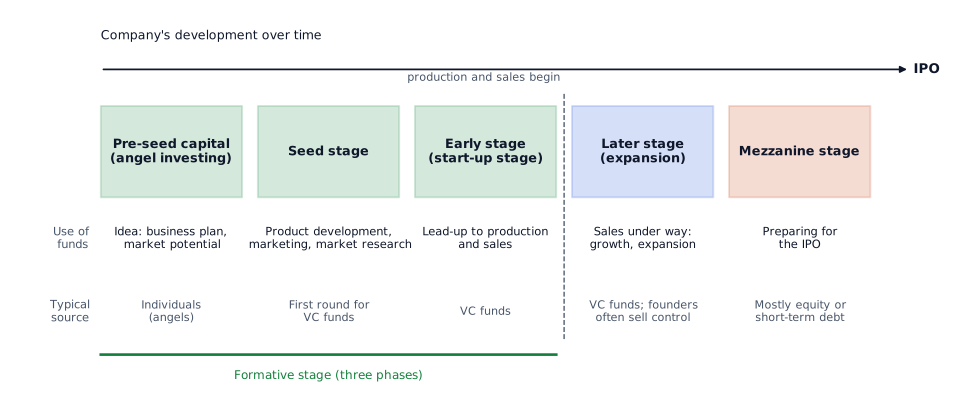
"Mezzanine stage" describes timing (just before the IPO), not the type of security. Mezzanine financing is a separate term for hybrid debt–equity securities such as convertibles.
Minority equity investing
Minority equity investing (developmental capital) buys a less-than-controlling stake to fund growth or restructuring. When the company is public, this is a private investment in public equity (PIPE), a private offering of the company's shares to institutional investors. A PIPE lets the company raise capital faster and more cheaply than a public offering, with fewer disclosures. The company stays listed.
Exit strategies (average holding period of about five years)
| Exit | Buyer / mechanism | Notes |
|---|---|---|
| Trade sale | A strategic buyer, such as a competitor, via direct sale or auction | Buyer often pays a premium for synergies; faster and cheaper than an IPO; management may resist; few buyers |
| IPO | Shares sold to the public with underwriters | Most common listing route; usually the highest price and more visibility; high transaction and compliance costs, and the market may receive it poorly; best for large firms in growing industries with stable finances and a clear strategy |
| Direct listing | Shares listed without underwriters | Lower cost than an IPO because there are no underwriters. Exam convention: a direct listing floats existing shares and raises no new capital for the company. Current practice: some exchanges also permit a primary direct listing, in which the company sells new shares. |
| Special purpose acquisition company (SPAC) | "Blank check" company that raised cash to buy a private firm | Must complete an acquisition within a stated period or return the cash. More flexible than an IPO, less uncertainty about the portfolio company's valuation, and access to investors who deal regularly with the sponsors; drawbacks include dilution from SPAC shares and warrants, a gap between the SPAC's value and the target's value, deal risk, stockholder overhang and growing regulatory scrutiny |
| Recapitalization | Portfolio company issues debt to pay a dividend | Not a true exit: the fund keeps control but extracts cash |
| Secondary sale | Another private equity firm or group of investors | |
| Write-off/liquidation | None | Loss is recognized |
Risk and return
Private equity has historically returned more than public equity, with a higher standard deviation (illiquidity and leverage risk). Indexes are self-reported and subject to survivorship bias and backfill bias, which overstate returns. Infrequent valuation of portfolio companies biases measured volatility and correlation with other assets downward.
Common exam traps
- A question about the first round in which a VC fund invests wants the seed stage. Angel money comes earlier, but from individuals.
- A company with a finished product but no production or sales yet is at the early stage; later-stage (expansion) capital starts only once sales have begun.
- Selling to a competitor is a trade sale and selling to another private equity firm is a secondary sale. Options often swap the two.
- A PIPE leaves the company listed, while an LBO takes it private.
LOS 82.b — Private debt
Private debt is debt that investors provide directly to private entities. Its main types:
| Type | Features | Relative risk |
|---|---|---|
| Direct lending | Loans made directly to private companies without an intermediary; usually senior and secured, with covenants. Exam convention: a leveraged loan is a loan made by a private debt fund that has borrowed money to fund its lending, so the fund's loan portfolio is leveraged. Current practice: in wider market usage (for example, CLO collateral), a leveraged loan is a loan to a highly indebted or low-rated borrower | Lowest of these five types |
| Unitranche debt | Secured and unsecured classes blended into one loan with a blended rate; ranks between senior and subordinated debt | Moderate |
| Mezzanine debt | Subordinated to senior secured debt, often unsecured; may carry warrants or conversion rights | High |
| Venture debt | Lending to start-ups that are not yet profitable; often convertible or paired with warrants; lets founders keep control | High |
| Distressed debt | Debt of mature companies in trouble (default, bankruptcy). Some investors look for sound companies with temporary cash flow problems and wait for recovery; others buy the debt to take an active role in restructuring or turning the company around | High |
Private debt typically offers a higher return than traditional bonds to compensate for more risk (default, illiquidity). It adds diversification because its returns have relatively low correlation with traditional assets. Rates usually float over a reference rate such as SOFR. Senior private debt has steadier yields; mezzanine debt has more upside. Investing in private debt requires specialized knowledge of the debt's structure, the borrower's life cycle phase and, for secured loans, the underlying assets.
Common exam traps
- In a comparison with traditional bonds, private debt offers the higher expected return. Options that give it greater liquidity or lower risk reverse the comparison.
- Warrants and conversion rights point to the riskier types (venture and mezzanine debt). Senior secured direct lending seldom carries them.
- The issuers of distressed debt are mature firms, not start-ups.
LOS 82.c — Diversification and vintage years
Private capital offers some diversification. Correlations of private capital index returns with public markets are reported at roughly 0.63–0.83.
Key concept
A fund's vintage year is the year it makes its first investment. This is not necessarily the year capital is first committed, because committed money may be deployed later. Vintage-year conditions matter a lot:
- Funds that start investing in a business cycle expansion tend to do better if they specialize in early-stage companies (venture capital).
- Funds that start investing in a business cycle contraction tend to do better if they specialize in distressed companies.
Investors should therefore diversify across vintage years.
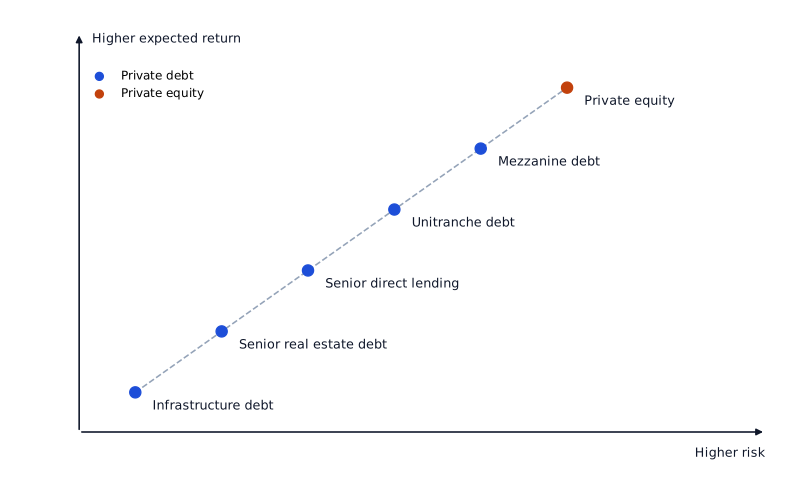
Risk/return ranking (lowest to highest): infrastructure debt < senior real estate debt < senior direct lending < unitranche debt < mezzanine debt < private equity.
Common exam traps
- Options that date a fund by its first commitment or its first exit are wrong; only the first investment sets the vintage year.
- A strong venture capital track record points to a vintage in an expansion.
Exam shortcuts
- Place a VC round by whether sales have begun: formative stages come before production and sales, later-stage capital comes after, and mezzanine-stage financing prepares for an IPO.
Bottom line
- An LBO fund buys a public company largely with debt and takes it private; an MBO keeps the existing management and an MBI brings in a new team.
- Venture capital runs from pre-seed (angel) and seed capital, the first round with VC funds, through early-stage and later-stage financing to mezzanine-stage financing before an IPO.
- Exit routes are a trade sale, an IPO, a direct listing, a SPAC, a secondary sale and a write-off; a recapitalization extracts cash but is not a true exit.
- A PIPE is a private sale of a listed company's shares, and the company stays listed.
- Among private debt types, direct lending carries the lowest risk, unitranche debt moderate risk, and mezzanine, venture and distressed debt high risk.
- Private equity indexes overstate returns through survivorship and backfill bias, and infrequent valuation understates volatility and correlation.
- A fund's vintage year is the year of its first investment, and investors should diversify across vintage years.
Quick check
A private equity firm acquires Ashcombe Textiles in a leveraged buyout. As part of the deal, the firm removes Ashcombe's current executives and installs a leadership team it has recruited from outside the company. This transaction is best described as a:
Show answer and explanation
Correct answer: B
In a management buy-in (MBI), the private equity manager replaces the company's existing management with a new team. In a management buyout, the existing team takes part in the purchase.
Why the other options are wrong
- A. In a management buyout, the existing management team participates in the purchase and stays on.
- C. A PIPE is a minority investment in a company that stays public. It is not a buyout of the whole company.
Key takeaway MBO = existing managers take part in the purchase; MBI = outside managers are brought in.
Practice Questions
A private equity fund exits its stake in Norquay Logistics by selling the company to Tidewell Freight, a larger rival in the same industry that expects cost synergies from the deal. This exit is best described as a(n):
Show answer and explanation
Correct answer: B
A trade sale is the sale of a portfolio company to a strategic buyer, such as a competitor, by direct sale or auction. Strategic buyers often pay a premium because of the synergies they expect.
Why the other options are wrong
- A. A secondary sale is a sale to another private equity firm or group of financial investors. Tidewell is an operating competitor.
- C. An IPO sells some or all of the company's shares to the public.
Key takeaway Sale to a competitor or strategic buyer: trade sale. Sale to another PE firm: secondary sale. Sale to the public: IPO.
To make fair comparisons, a consultant groups private equity funds by vintage year, so that each group holds funds that began putting capital to work under similar market conditions. A fund's vintage year is the year in which it:
Show answer and explanation
Correct answer: B
The vintage year is the year a private equity or venture capital fund makes its first investment. Commitments may come earlier, because capital that has been committed is not necessarily deployed straight away.
Why the other options are wrong
- A. The first commitment can come well before the first investment, because there may be a lag before committed capital is called and invested. Some industry databases date funds by fundraising or first close, but the vintage year that captures the conditions in which capital was deployed is the year of the first investment.
- C. Exits happen years later, near the end of the holding period. They do not define the vintage year.
Key takeaway Vintage year = first investment. Compare funds of the same vintage.
This reading has 19 questions in the full bank. Practice all of them.
Key Takeaways
- MBO = existing managers take part in the purchase; MBI = outside managers are brought in.
- Sale to a competitor or strategic buyer: trade sale. Sale to another PE firm: secondary sale. Sale to the public: IPO.
- Vintage year = first investment. Compare funds of the same vintage.