Alternative Investments · Reading 83
Real Estate and Infrastructure
CFA Level I · Alternative Investments · Reading 83 · about 30 min
What you'll learn
- LOS 83.a Explain real estate investment forms (public/private, debt/equity), direct vs. indirect investment, REIT types and real estate strategies.
- LOS 83.b Explain the risk, return and diversification characteristics of real estate investments.
- LOS 83.c Explain infrastructure categories, investment routes, cash-flow arrangements and greenfield/brownfield/secondary-stage assets.
- LOS 83.d Explain the risk, return and diversification characteristics of infrastructure investments.
Module 83.1
Real Estate
This reading describes the forms of real estate investment, the benefits and drawbacks of direct and indirect ownership, REITs and the core to opportunistic strategies, and how real estate holdings range from bond-like to equity-like. It then describes infrastructure assets, their cash-flow arrangements and the greenfield, brownfield and secondary-stage categories, and compares their risk and return.
LOS 83.a — Features of real estate investments
Real estate earns rental income and may appreciate in price. Property divides into two main types, single-family residential and commercial. Within commercial property the four largest categories are office, rental residential (multifamily and single-family detached), retail (shopping) and industrial (warehouse and distribution).
The four basic forms (the real estate quadrant)
Investments are classified on two dimensions: public vs. private and debt vs. equity.
Key concept
| Equity | Debt | |
|---|---|---|
| Private | Direct ownership: sole ownership, joint ventures, limited partnerships (a GP manages the property and LPs such as pension plans invest). Indirect ownership: real estate funds, private REITs | Mortgage debt, construction loans, mezzanine debt |
| Public | Publicly traded shares: construction, operating and development companies, public REIT shares, UCITS, mutual funds and ETFs | Residential MBS, commercial CMBS, CMOs, covered bonds, mortgage REITs, mortgage ETFs |
Each of the four forms has its own risk, expected return, regulation, legal issues and market structure.
- An equity investor owns the property (or shares of an owner) and controls decisions on borrowing, management and exit. Equity value = property value − outstanding debt.
- A debt investor is a lender. Its claim is secured by the property and ranks ahead of equity in default.
- Private investments are large, indivisible and illiquid. Public securities let investors split ownership without splitting the property, which gives liquidity and diversification across many properties. Direct private ownership needs property-management expertise; REITs and partnerships are professionally managed.
Direct investment
Key concept
| Benefits | Drawbacks |
|---|---|
| Control over purchase, financing, improvements, tenants and timing of sale | Illiquidity and price opacity (properties trade rarely, so current prices are hard to observe) |
| Diversification (returns imperfectly correlated with stocks and bonds) | Complexity of managing property |
| Tax benefits (noncash depreciation and interest deductions) | Need for specialized knowledge of current market conditions |
| High initial capital; concentration risk with few properties |
Indirect investment and REITs
Indirect routes include limited partnerships and joint ventures, where the investor holds a stake in a partnership that owns the property, and publicly traded securities. The quadrant lists these partnerships under private direct ownership because the partnership itself owns the property. REITs are exempt from double taxation, which makes them a popular way to hold income-producing real estate. They have specialized managers and report GAAP metrics such as EPS; some also report net asset value. Exam convention: REITs trade on exchanges, so unlike mutual funds they face no redemption or liquidation risk; investors exit by selling shares to other investors. Current practice: a REIT keeps its tax exemption only if it distributes most of its taxable income, and non-traded REITs also exist; they have no exchange liquidity, and their redemption programs may be limited or suspended.
- Equity REITs own property; mortgage REITs lend or buy MBS/CMBS; hybrid REITs do both.
Strategies (from least to most risky equity strategy)
Key concept
| Strategy | What it does | Typical structure |
|---|---|---|
| Core | High-quality commercial and residential property; stable income | Open-end, indefinite life |
| Core-plus | A little more risk: modest development/redevelopment | Closed-end, finite life |
| Value-add | Larger-scale development/redevelopment | Closed-end, finite life |
| Opportunistic | Large-scale redevelopment and repurposing, distressed property, market speculation | Closed-end, finite life |
LOS 83.b — Investment characteristics of real estate
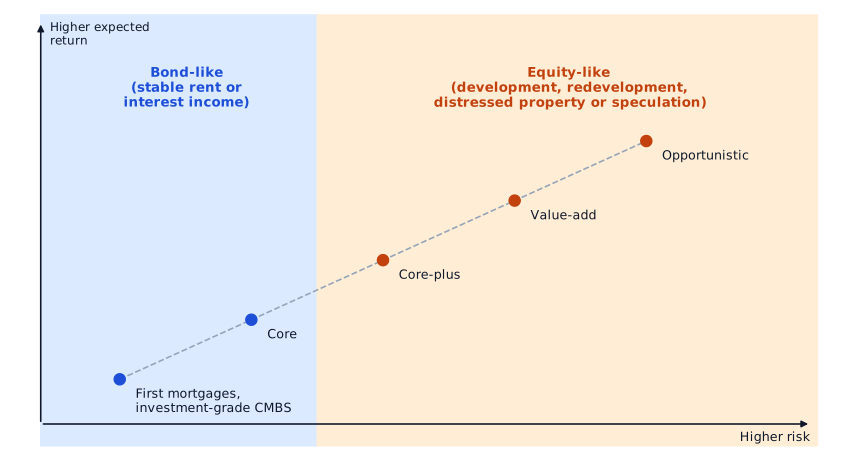
Real estate returns come from rental income, from price appreciation, or from both. The more a holding depends on steady income from leases, the more it behaves like a bond; the more it depends on gains from development or rising prices, the more it behaves like equity. First mortgages and investment-grade CMBS are the least risky real estate investments and behave much like bonds. Core strategies come next and are also bond-like, because their rent is stable and comes from many tenants. Core-plus, value-add and opportunistic strategies take on more risk in turn and are equity-like.
- The diversification and liquidity that publicly traded REITs offer come with a cost: REIT returns are more correlated with equities than direct real estate returns are, and the correlation rises in steep market downturns.
- Even so, adding real estate improves the risk-return profile of a stock-and-bond portfolio.
Example. A closed-end fund buys an empty 1970s office block to convert into apartments. It has little current income and a large development budget, so it is an equity-like, value-add or opportunistic strategy rather than a bond-like core strategy.
Common exam traps
- "Stable income from many tenants" and "open-end" describe core strategies. Both are wrong answers for a strategy built on development or redevelopment.
- Classify by the security held, not by the collateral: CMBS and mortgage REIT shares are public debt even though the underlying loans are private mortgages.
- The extra risk from owning a building directly, compared with listed stocks and bonds, is liquidity risk. Market risk is shared with traditional assets.
Bottom line
- Real estate investments are classified as public or private and as debt or equity; an equity investor owns the property and controls borrowing, management and exit decisions, while a debt investor's claim is secured by the property and ranks ahead of equity in default.
- Direct real estate gives control, diversification and tax benefits, but brings illiquidity, price opacity, management complexity, a need for specialized market knowledge, high initial capital and concentration risk.
- Exam convention: exchange-traded REITs face no redemption or liquidation risk, because investors exit by selling shares; current practice: a REIT keeps its tax exemption only if it distributes most of its taxable income, and non-traded REITs exist whose redemption programs may be limited or suspended.
- Equity real estate strategies run from least to most risky as core (high-quality property, stable income, open-end), core-plus, value-add and opportunistic (closed-end, finite life).
- The more a holding relies on steady lease income the more it behaves like a bond, and the more it relies on development or rising prices the more it behaves like equity, with first mortgages and investment-grade CMBS the least risky.
- Publicly traded REITs offer diversification and liquidity but are more correlated with equities than direct real estate, with the correlation rising in steep downturns, although adding real estate still improves a stock-and-bond portfolio's risk-return profile.
Quick check
A pension fund buys a portfolio of commercial mortgage-backed securities. Within the basic four-quadrant classification of real estate investments, this holding is best classified as:
Show answer and explanation
Correct answer: C
Real estate investments are classified as public or private, and as debt or equity. CMBS are traded securities that give a claim on pools of commercial mortgages, so they are public debt.
Why the other options are wrong
- A. Public equity would be shares of an equity REIT or a real estate company, which are ownership claims rather than claims on mortgages.
- B. Private debt would be a mortgage or loan held directly. CMBS are traded securities.
Key takeaway Debt vs. equity = lender vs. owner; public vs. private = traded securities vs. privately held interests.
Module 83.2
Infrastructure
LOS 83.c — Features of infrastructure
Infrastructure assets are long-lived, capital-intensive assets that provide public services.
Key concept
| Category | Examples |
|---|---|
| Economic infrastructure: transportation | Roads, airports, ports, railways |
| Economic infrastructure: utilities and energy | Gas distribution, electricity generation and distribution, waste disposal and treatment |
| Economic infrastructure: information and communication technology | Telecom towers, cable systems |
| Social infrastructure | Prisons, schools, health care facilities (hospitals) |
Economic infrastructure supports economic activity: it moves people and goods, supplies energy and water, and carries data. Social infrastructure serves people directly, for example through education, health care and justice.
Ways to invest. Build the asset and sell or lease it to the government or operate it; buy an existing asset from the government to lease back or operate; or join a public-private partnership.
Cash-flow arrangements
- Availability payments: paid for making the asset available, regardless of use.
- Usage-based payments: e.g., highway tolls.
- Take-or-pay arrangements: the buyer must pay a minimum price for an agreed volume, whether or not it takes delivery.
Stage of the asset
Key concept
| Type | Meaning | Cash-flow pattern |
|---|---|---|
| Greenfield investment | Assets still to be constructed; typically follows build-operate-transfer (BOT) | Outflows while building, rising inflows once operating, then transfer to a government or third party |
| Brownfield investment | Expanding or privatizing an existing asset, e.g., a sale-leaseback with the government | Existing cash flows, though a newly privatized asset or sale-leaseback may have a short operating record |
| Secondary-stage investment (a type of brownfield investment) | Fully operational facility that needs no further development | Most predictable |
Direct infrastructure investment, such as owning the asset or holding a first mortgage on it, is illiquid because the assets are huge and long-lived. Investors who want more liquidity can use MLPs, ETFs, mutual funds or private equity funds. The listed universe is small and concentrated in a few asset types. Infrastructure debt can be privately placed or publicly traded.
LOS 83.d — Investment characteristics of infrastructure
Key concept
| Secondary-stage / brownfield | Greenfield | |
|---|---|---|
| Cash flows | Stable, relatively high current yield | Uncertain; lower near-term yield |
| Growth potential | Little | Greater |
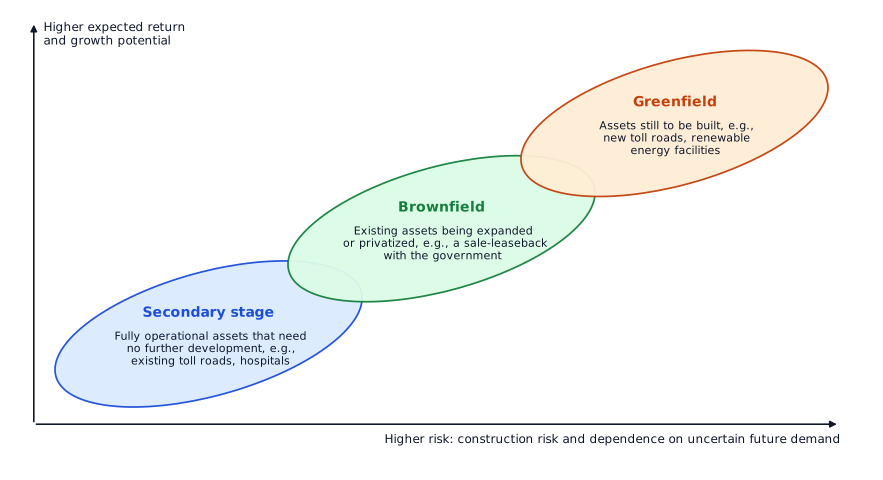
| Risk and expected return | Lower; secondary-stage assets (e.g., existing toll roads and hospitals) are the least risky and offer the lowest return | Higher (e.g., new toll roads, renewable energy facilities) |
- Long-term contracts and barriers to entry make equity cash flows stable and give low correlation with public equities. Infrastructure debt tends to be safe and less cyclical.
- Greenfield projects in developing economies are risky but have produced attractive long-run returns as incomes rise.
- Risks: regulatory risk, financial leverage, cash flows below expectations, construction risk (building projects) and operational risk (privately operated assets).
- Suitable for long-term institutions: pension plans, life insurers, sovereign wealth funds.
How cash-flow arrangements shift risk. The contract behind the revenue matters as much as the asset. Availability payments are made for making the infrastructure available, take-or-pay arrangements require the buyer to pay a minimum price for an agreed volume, and usage-based payments such as tolls depend on how much the asset is used. Projects that rely on revenue from uncertain future demand tend to be the riskiest. A toll road built to serve a city that has not yet grown is therefore riskier than a hospital leased to a health authority on an availability basis.
Example. A consortium plans a new solar farm that has not yet been built. It is a greenfield project with construction risk, early cash outflows, and the most risk and upside. Buying an existing, fully operating water-treatment plant would be a secondary-stage, lower-risk investment.
Common exam traps
- A sale-leaseback of an existing asset is brownfield. Only an asset still to be built is greenfield.
- When an asset is fully operational and needs no further development, "secondary stage" is the more precise answer than "brownfield", even though it is a type of brownfield investment.
- Public use does not make an asset social infrastructure. Waste treatment, power grids and telecom towers are economic infrastructure; prisons, schools and health care facilities are social.
- An infrastructure ETF, mutual fund or MLP is an indirect investment; holding the first mortgage on a toll road counts as direct.
Bottom line
- Economic infrastructure covers transportation, utilities and energy (including waste disposal and treatment) and information and communication technology (including telecom towers), while social infrastructure covers prisons, schools and health care facilities.
- Infrastructure revenue comes from availability payments made regardless of use, usage-based payments such as tolls, or take-or-pay arrangements with a minimum price for an agreed volume, and the projects carrying the most risk are usually those whose revenue depends on demand that is still uncertain.
- A greenfield investment is an asset still to be constructed, typically under build-operate-transfer; a brownfield investment expands or privatizes an existing asset, for example through a sale-leaseback; and a secondary-stage investment is a fully operational brownfield asset needing no further development.
- Secondary-stage and brownfield assets have stable cash flows, a relatively high current yield, little growth potential and lower risk and return, with secondary-stage assets the least risky, while greenfield assets have uncertain cash flows, more growth potential and higher risk and expected return.
- Direct infrastructure investment is illiquid because the assets are huge and long-lived, and MLPs, ETFs, mutual funds and private equity funds offer indirect exposure with more liquidity.
- Infrastructure risks include regulatory risk, financial leverage, cash flows below expectations, construction risk and operational risk, and the assets suit long-term institutions such as pension plans, life insurers and sovereign wealth funds.
Quick check
Which of the following is least likely to be classified as social infrastructure?
Show answer and explanation
Correct answer: B
Waste treatment facilities are utility assets, which are part of economic infrastructure. Schools and health care facilities are social infrastructure.
Why the other options are wrong
- A. Schools are social infrastructure.
- C. Health care facilities are social infrastructure.
Key takeaway Utilities (power, gas, water and waste treatment) are economic infrastructure.
Practice Questions
Which type of infrastructure investment typically offers the highest risk and the highest potential return?
Show answer and explanation
Correct answer: A
Because a greenfield asset does not exist yet, its investors face construction risk and uncertainty about future demand, and they are paid for it with the most upside. At the other end, a fully operating secondary-stage facility with an established record of cash flows sits lowest on the risk-return scale. Brownfield assets lie between the two.
Why the other options are wrong
- B. Secondary-stage investments are fully operational and generate steady cash flows, so they have the lowest risk-return profile.
- C. Brownfield investments involve existing assets. They are riskier than secondary-stage investments but less risky than greenfield.
Key takeaway Risk/return: greenfield > brownfield > secondary stage.
This reading has 12 questions in the full bank. Practice all of them.
Key Takeaways
- Debt vs. equity = lender vs. owner; public vs. private = traded securities vs. privately held interests.
- Utilities (power, gas, water and waste treatment) are economic infrastructure.
- Risk/return: greenfield > brownfield > secondary stage.