Alternative Investments · Reading 84
Natural Resources
CFA Level I · Alternative Investments · Reading 84 · about 24 min
What you'll learn
- LOS 84.a Explain the features, cash flows and investment characteristics of raw land, timberland and farmland.
- LOS 84.b Describe commodity sectors, ways to gain commodity exposure, and futures pricing (cost of carry, convenience yield, contango and backwardation).
- LOS 84.c Analyze the sources of risk, return and diversification for natural resource investments, including inflation hedging.
Module 84.1
Farmland, Timberland, and Commodities
This reading compares raw land, farmland and timberland, describes the commodity sectors and the ways to gain commodity exposure, and shows how a futures price follows from the spot price and the cost of carry, including contango and backwardation. It then covers the sources of commodity risk and return and the diversification and inflation-hedging role of natural resources.
LOS 84.a — Raw land, timberland and farmland
Natural resources include raw land, land used to grow crops or timber, and commodities. Exposure can be direct or through commingled vehicles (ETFs, REITs, limited partnerships, LLCs), as well as through derivatives such as commodity futures and swaps.
Common features of the three kinds of land:
- All are illiquid, and value is driven mainly by location. For farmland and timberland, value also depends on access to transport and markets, water and soil quality.
- Each type can produce lease income as well as gains from rising prices; farmland and timberland add income from what they produce (crops, livestock, timber).
Key concept
| Raw land | Farmland | Timberland | |
|---|---|---|---|
| Current cash flow | Little or none: no output, only possible lease income (value mainly from appreciation or development) | Most steady: annual crop sales or lease income | Yes, but the owner chooses when to harvest |
| Typical owners | Institutions | Mostly individuals (farmland REITs open access to retail investors) | Institutions; lot sizes much larger than farmland |
| Special features | None | Crops must be harvested within a short window; farmers often short commodity futures to hedge the harvest | Harvest timing is flexible: trees keep growing if prices are low; expertise available through timberland investment management organizations (TIMOs) |
Financing choices for farmland and timberland are narrower than for residential or commercial real estate and consist mainly of bank loans or direct private debt. Because crops and trees absorb carbon, they appeal to investors with an ESG climate focus.
Risks. Low liquidity, weather-dependent cash flows, and losses from natural disasters.
LOS 84.b — Commodities and how to gain exposure
Sectors. Commodity sectors are metals (base/industrial, such as copper and aluminum, and precious, such as gold and silver), agricultural products (grains, livestock, coffee) and energy (crude oil, natural gas, coal). Contracts also specify grade (quality) and delivery location. Governments influence supply and demand. They may subsidize food crops for consumers or support prices for farmers, control access to extractable resources, or take part in production themselves. Climate-related regulation can reduce demand for fossil fuels and increase demand for lithium, cobalt, nickel and similar minerals.
Ways to gain exposure. Derivatives are the most common route:
| Vehicle | Key points |
|---|---|
| Physical commodity | Possible (e.g., gold, grain) but has storage and transport costs |
| Futures, forwards, options on futures | Exchange-traded futures have no counterparty risk, because the clearinghouse guarantees performance |
| Exchange-traded products (ETPs): ETFs and ETNs | Trade on exchanges like shares and can track prices or indexes. Exam convention: ETPs, both ETFs and ETNs, suit investors who are limited to buying equity shares. Current practice: an ETN is an unsecured debt note of its issuer and carries issuer credit risk, so an equity-only investor would normally need its mandate to allow debt before holding one; an ETF's fund shares raise no such problem |
| Managed futures funds (e.g., run by commodity trading advisers, CTAs) | Actively managed; may be sector-focused or diversified; structured as LPs (hedge-fund-like fees and investor restrictions) or as publicly traded mutual-fund-style shares (lower minimums, more liquidity) |
| Separately managed accounts (SMAs) | For large investors that want customized portfolios |
| Specialized funds | Focus on one commodity sector, such as oil and gas, grains, precious metals or industrial metals; can use any of the structures above |
Commodity valuation: cost of carry
Holding a commodity today costs financing and storage (warehousing, insurance, spoilage), but it also gives the convenience yield. This is the nonmonetary benefit of having the physical good available to use over the life of the contract. A futures buyer does not have the good until delivery and so gives up this benefit, which is why the convenience yield lowers the futures price while financing and storage costs raise it.
Key concept
Equivalently, futures price = spot price + net cost of carry.
Key concept
| Situation | Net cost of carry | Futures vs. spot | Market classification | Effect on long-only investors |
|---|---|---|---|---|
| Little or no convenience yield | Positive | Futures > spot | Contango | Lowers returns |
| Convenience yield > storage (and financing) costs | Negative | Futures < spot | Backwardation | Raises returns |
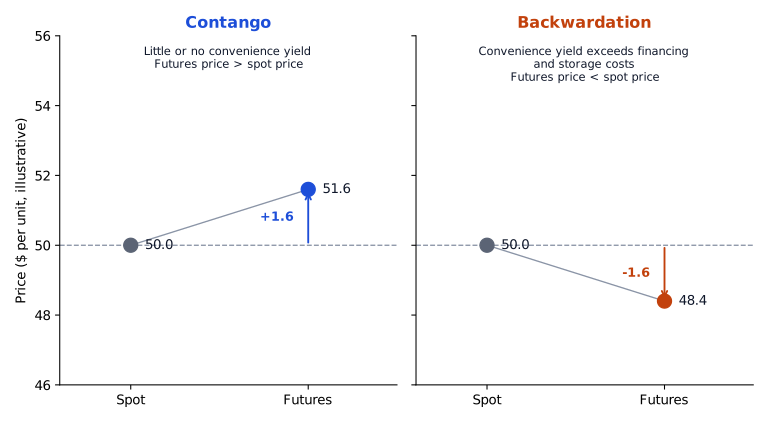
To classify a market from a list of prices, compare each futures price with the spot price: futures above spot indicate contango, and futures below spot indicate backwardation. This spot comparison is separate from the slope of the futures term structure, which describes how futures prices change across maturities; futures can all be above spot without rising at every maturity. When storage costs and the convenience yield are equal, they cancel, so the futures price exceeds the spot price by the financing cost alone whenever the risk-free rate is positive.
Example. Copper spot $9.00/lb, 3% financing for the period, storage $0.12, convenience yield $0.05.
, which is above spot, so the market is in contango.
LOS 84.c — Sources of risk, return and diversification
Prices come from supply and demand. Demand depends on the value to end users and on global economic conditions. Supply depends on production, storage costs and inventories.
- Supply is inelastic in the short run (drilling wells or planting crops takes time), so prices can swing sharply over the economic cycle or after supply shocks such as natural disasters.
- Weather and plant disease drive agricultural output. Poor harvests mean high prices; bumper crops mean low prices.
- Extraction costs rise as producers turn to more expensive methods or more remote sites.
- Forecasters watch inventories, production forecasts, government policy and economic growth.
Return and risk history
In recent decades:
| Asset | Returns | Volatility |
|---|---|---|
| Commodities | Higher than global stocks or bonds | Higher than global stocks or bonds |
| Timberland and farmland | Higher average returns | Lower than global stocks, similar to global bonds |
Speculators who correctly anticipate short-term commodity price moves can earn high returns over short periods.
Farmland and timberland returns come from selling what the land produces and from changes in land values. Timberland values also move with the lumber price outlook and with the volume of timber already cut. Farmland returns depend on crop prices and on crop quality and quantity.
Portfolio benefits
- Diversification: historically low correlation with global equities and bonds.
- Inflation hedge: commodity prices tend to move with inflation, so commodities have tended to outperform stocks and bonds when inflation is high and to underperform when it is low.
- Simply holding a commodity produces no current income; the holder gains only if the price rises.
- Commodity prices are especially sensitive to geopolitical and weather risks.
Common exam traps
- Options that call convenience yield a cash payment, or say it raises the futures price, confuse it with income or with storage costs. In the copper example, adding the $0.05 convenience yield instead of subtracting it gives $9.44 instead of $9.34.
- A negative net cost of carry means backwardation and higher long-only returns. Pairing negative carry with contango is the usual wrong statement.
- The inflation hedge rests on a positive correlation between commodity prices and inflation. An option that cites a negative correlation is wrong.
- "Current income" is the wrong answer when asked for a benefit of holding commodities.
- Timberland's flexibility to delay the harvest is not shared by farmland, whose crops must be harvested within a short window.
Exam shortcuts
- When storage costs equal the convenience yield they cancel, so with a positive risk-free rate the futures price exceeds the spot price by the financing cost alone and the market is in contango.
Bottom line
- Raw land, farmland and timberland are illiquid and valued mainly by location; raw land produces little or no current cash flow, farmland has the steadiest income, and timberland lets the owner choose when to harvest, whereas farm crops must be harvested within a short window.
- Derivatives are the most common route to commodity exposure, and exchange-traded futures carry no counterparty risk because the clearinghouse guarantees performance.
- Exam convention: commodity ETPs, both ETFs and ETNs, suit investors limited to buying equity shares; current practice: an ETN is an unsecured debt note carrying issuer credit risk, so an equity-only mandate would normally have to allow debt before holding one.
- The futures price is approximately spot × + storage costs − convenience yield, the convenience yield being the nonmonetary benefit of holding the physical good, which lowers the futures price.
- A positive net cost of carry puts futures above spot (contango) and lowers long-only returns, while a negative net cost of carry puts futures below spot (backwardation) and raises them.
- Commodity supply is inelastic in the short run, so prices can swing sharply over the economic cycle or after supply shocks such as natural disasters.
- In recent decades commodities have had higher returns and higher volatility than global stocks or bonds, while timberland and farmland have had higher average returns with volatility below global stocks and similar to global bonds.
- Commodities have historically offered diversification through low correlation with global equities and bonds and an inflation hedge because their prices tend to move with inflation, but holding them produces no current income.
Quick check
An investor in land-based natural resources wants the most regular annual cash flow. Which of the following is most likely to provide it?
Show answer and explanation
Correct answer: B
Farmland produces income every year from leasing the land or from selling crops, which must be harvested within a short window. It therefore has the steadiest cash flows of the three.
Why the other options are wrong
- A. Timberland produces cash flow, but the owner decides when to harvest: it can let the trees keep growing when prices are low. Its cash flows are therefore less regular.
- C. Raw land produces no output to sell. It may earn some lease income, but its return comes mainly from price appreciation, so it offers the least regular cash flow.
Key takeaway Cash-flow steadiness: farmland > timberland > raw land.
Practice Questions
For a particular commodity, the convenience yield outweighs the storage and financing costs of holding the physical good. In this situation:
Show answer and explanation
Correct answer: C
If the convenience yield is large enough to more than offset storage and financing costs, the net cost of carry is negative and futures prices are below spot prices. This is backwardation. Backwardation raises the returns of long-only investors. The opposite case, where carrying costs dominate, is contango.
Why the other options are wrong
- A. A spot price below the futures price is contango, which occurs when carrying costs exceed the benefit of holding the good.
- B. Lower returns for long-only investors are a feature of contango. In backwardation, long-only returns are increased.
Key takeaway When the benefit of holding exceeds the carry cost, the market is in backwardation (futures < spot), which helps long-only investors.
Which of the following is least likely to be a benefit of adding commodities to a portfolio of stocks and bonds?
Show answer and explanation
Correct answer: A
Holding a commodity produces no current income. Any return comes from price changes realized when it is sold. Commodities do offer diversification (low correlation with stocks and bonds) and an inflation hedge (their prices tend to rise with inflation).
Why the other options are wrong
- B. Diversification is a benefit: commodity returns have historically had low correlations with global equities and bonds.
- C. An inflation hedge is a benefit: commodity prices generally rise and fall with inflation, so their correlation with it is positive.
Key takeaway Commodities: diversification and inflation hedge, but no income from simply holding them.
This reading has 11 questions in the full bank. Practice all of them.
Key Takeaways
- Cash-flow steadiness: farmland > timberland > raw land.
- When the benefit of holding exceeds the carry cost, the market is in backwardation (futures < spot), which helps long-only investors.
- Commodities: diversification and inflation hedge, but no income from simply holding them.