Alternative Investments · Reading 85
High Water Mark
CFA Level I · Alternative Investments · Reading 85: Hedge Funds · about 35 min
What you'll learn
- LOS 85.a Explain what distinguishes hedge funds from other asset classes and vehicles, including their main strategy families and liquidity terms.
- LOS 85.b Describe the legal forms and vehicles for hedge fund investing: partnerships, commingled funds, SMAs, master-feeder structures and funds of funds.
- LOS 85.c Analyze hedge fund return sources, risk-adjusted comparison, index biases and diversification benefits.
Module 85.1
Hedge Funds
This reading describes what distinguishes hedge funds from other vehicles, their four strategy families and their liquidity and fee terms, including the high-water mark. It then covers their legal forms, separately managed accounts, master-feeder structures and funds of funds, and explains where hedge fund returns come from, how index biases distort reported performance and how to compare funds on a risk-adjusted basis.
LOS 85.a — What makes a hedge fund different, and the main strategy families
A hedge fund is a privately offered pool of capital. Access is normally limited to investors who clear a wealth or sophistication threshold (accredited, qualified or institutional investors). Because it is not sold to the general public, it faces far lighter regulation than a mutual fund or ETF, and the manager enjoys a broad mandate: long and short positions, leverage, derivatives, and securities across many markets. Hedge funds began as long/short vehicles meant to earn positive returns in any market, but they now pursue a wide variety of strategies.
Key features:
- Return drivers: hedge funds try to profit from market inefficiencies (mispricings) and from volatility rather than from simply owning the market.
- Holdings: mostly liquid assets, chiefly the traditional asset classes of debt and equity, along with derivatives. Leverage and derivatives mean the fund's risk/return profile can look very different from the assets it holds.
- Performance evaluation: usually on an absolute (total) return or risk-adjusted basis instead of against a conventional benchmark, because the strategies do not map neatly onto any market index.
- Alignment: managers often co-invest their own money. Incentive fees are commonly subject to a high-water mark, so a fee is earned only on value above the fund's previous peak.
- Versus other vehicles: hedge funds are privately held. Exam convention: mutual funds, REITs and ETFs are all publicly traded. Current practice: private (non-traded) REITs also exist, so the contrast holds for publicly offered REITs. Compared with private equity, hedge funds hold more liquid assets, have a shorter horizon and allow periodic redemptions, while private equity capital is committed for many years. Both are usually structured as limited partnerships, but a hedge fund charges its management fee on assets under management, while a private equity fund charges it on committed capital.
Strategy families
Key concept
| Family | Core idea | Sub-strategies | Typical net exposure |
|---|---|---|---|
| Equity hedge | Long and short positions in listed equities (or equity derivatives/indexes) | Fundamental long/short; fundamental growth; fundamental value; market neutral; short bias | Varies: long/short and growth usually net long; market neutral near zero; short bias net short |
| Event-driven | Profit from corporate events such as takeovers, distress, activism, spin-offs | Merger arbitrage; distressed/restructuring; activist shareholder; special situations | Usually net long |
| Relative value | Buy one security, short a related one, and profit when the price gap between them closes | Convertible arbitrage fixed income; specific fixed income (ABS, MBS, high yield); general fixed income; multistrategy | Paired long and short positions can reduce broad market exposure |
| Opportunistic | Top-down bets on macro trends and commodity/financial futures | Macro; managed futures (CTAs) | Can be long or short any asset class |
Equity hedge and event-driven managers mostly build positions company by company (bottom-up analysis). Macro managers start from views on the economy as a whole (top-down analysis).
Equity hedge sub-strategies
- Fundamental long/short: long undervalued names picked by fundamental research, short a basket or index to trim market risk; most run a long bias. A manager with no negative view on particular stocks can take the hedging short in a market index.
- Fundamental growth: long companies expected to keep growing revenue and earnings quickly (seeking capital appreciation); short low- or no-growth firms; net long.
- Fundamental value: long shares judged cheap versus intrinsic value, short shares judged expensive; results track value versus growth.
- Market neutral: longs and shorts of roughly equal size so that broad market moves cancel; profits come from relative moves; leverage may be used.
- Short bias: mostly short positions in shares the manager believes are overvalued (e.g., weak business models, aggressive accounting), perhaps a few longs, with negative net market exposure; a contrarian style.
Event-driven sub-strategies
- Merger arbitrage: long the target, short the acquirer (typical for a stock deal). Not riskless: the deal can be re-priced or collapse.
- Distressed/restructuring: buy deeply discounted securities (often debt) of firms in or near bankruptcy, expecting value to be unlocked by the restructuring; may short overvalued claims too.
- Activist shareholder: take a stake large enough to push management toward value-raising changes.
- Special situations: trade around issuance, buybacks, spin-offs, asset sales, or capital distributions.
Relative value sub-strategies
- Convertible arbitrage fixed income: exploits mispricing between a company's convertible bonds, its common shares and options on those shares, for example by buying the convertible bond and selling the shares short.
- Specific fixed income (ABS, MBS, high yield): exploits pricing and quality discrepancies in asset-backed, mortgage-backed or high-yield securities.
- General fixed income: trades mispricing between fixed-income securities of different issuers and types.
- Multistrategy: looks for mispricing between related securities, both inside one asset class and across asset classes and markets.
Opportunistic sub-strategies
Opportunistic funds often trade ETFs and derivatives as well as individual securities. Macro funds base long or short positions in currencies, commodities, equities or fixed income on their view of global economic trends; they benefit from volatility around big economic events, and central-bank smoothing of shocks hurts them. Managed futures funds trade commodity or financial futures (commodity specialists are CTAs). Commodity prices tend to self-correct in a way financial asset prices do not: high prices cut demand, which pulls prices down, and low prices cut supply, which pushes prices up.
Liquidity, fees and transparency
Compared with mutual funds and ETFs, hedge funds cost more, because an incentive fee comes on top of a generally high management fee, and they are less liquid. The main terms:
Key concept
| Term | Meaning |
|---|---|
| Lockup period | Minimum period after the initial investment during which the investor cannot redeem (hard lockup) or can redeem only with a significant penalty (soft lockup). |
| Notice period | After the lockup has expired and a redemption request is made, the time the fund has to pay out (commonly 30–90 days). |
| Liquidity gate | A partial limit on redemptions, e.g., a cap on the fraction of the fund that may be withdrawn per period; less drastic than a full suspension. |
| Redemption fee | Charge paid by the redeeming investor to offset the trading costs of meeting the withdrawal. |
| Management fee | Annual fee on assets under management (historically ~2%). |
| Incentive (performance) fee | Share of profits (historically ~20%; some newer funds use ~1% management plus ~30% performance fee based on return relative to a benchmark rather than total return). |
Notice periods and gates let the manager unwind positions in an orderly way. Redemptions tend to spike after poor performance, and the cost of meeting them can further damage the remaining investors. Transparency is limited because managers protect proprietary strategies, which makes independent valuation of holdings difficult.
Example (high-water mark). Maple Ridge Fund's NAV per unit peaked at 110 two years ago, fell to 100, and ends this year at 121 before incentive fees. With a 20% incentive fee and a high-water mark, the fee applies only to the gain above 110: per unit rather than .
Common exam traps
- Swapping lockup (cannot redeem yet) and notice period (time the fund has to honor a request).
- Classifying market neutral as relative value (it is equity hedge) or merger arbitrage as relative value (it is event driven).
- Reversing the merger arbitrage trade: it is long the target and short the acquirer.
- Assuming hedge funds are low risk because they own liquid assets; leverage and derivatives change the risk profile.
LOS 85.b — Legal forms, vehicles and indirect access
Legal form. Most hedge funds are limited partnerships (or limited liability companies). The general partner (or managing member) is the manager and is paid partly on performance; investors are limited partners. The rights and obligations of both sides are set out in the fund documents: the partnership agreement, the private placement memorandum (PPM), or the articles of incorporation. A side letter is different: it is a bilateral agreement granting one investor special terms (e.g., lower fees, extra reporting, better liquidity) and can override the general documents for that investor only. Funds usually have an indefinite life.
Commingled fund vs. separately managed account (SMA)
| Feature | Commingled fund | SMA |
|---|---|---|
| Investors | Many, capital pooled | One (usually a large institution) |
| Customization | Standard terms for all | Portfolio and mandate tailored to the investor |
| Fees | Standard | Often negotiated lower |
| Drawbacks | Terms not tailored to any one investor | More operational oversight, so suited to larger or institutional investors; the manager has no own capital at stake, so interests are less closely aligned; the account may receive allocations of only the manager's most liquid trades |
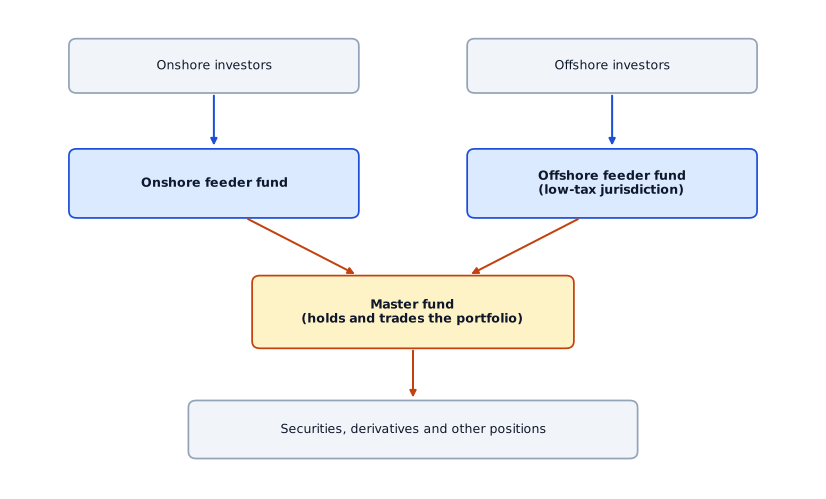
A master-feeder structure is common for commingled funds: an onshore feeder and an offshore feeder (in a low-tax jurisdiction) both invest in a single master fund that holds the portfolio. Benefits: tax efficiency, economies of scale, and access to global capital. The structure also sidesteps regional regulatory requirements.
A fund of funds (FoF) is a vehicle that invests in several hedge funds. Advantages: diversification across strategies and managers, the FoF manager's expertise in selecting and monitoring funds, access for smaller investors to funds they could not enter directly, and often shorter lockups/better exit liquidity. Disadvantage: a second layer of fees (historically about 1% management plus 10% incentive) on top of the underlying funds' fees, which can substantially cut net returns. A FoF does not promise higher returns.
Common exam traps
- Treating a side letter as a fund-wide governing document.
- Listing "stronger manager motivation" as an SMA benefit; weaker incentive alignment is an SMA drawback.
- Saying a FoF lowers fees; it adds fees.
LOS 85.c — Where returns come from, index biases and diversification
Hedge fund returns come from three sources:
- Market beta: the part of return that comes from the broad market index.
- Strategy beta: the return attributable to the specific sectors or strategy the fund is exposed to.
- Alpha: the additional return delivered by the manager's security selection.
Market beta can be bought cheaply through index funds, so hedge funds often short it away. Managers use leverage to magnify strategy beta and alpha. High fees are a drag on net results.
Risk-adjusted comparison. Because hedge funds differ widely in risk, compare them per unit of risk. One simple measure is the coefficient of variation:
A lower CV means less risk per unit of return, i.e., better risk-adjusted performance. A low standard deviation alone ignores return; a high return or alpha alone ignores risk.
Example. Fund P averages 10% with = 12% (CV = 1.2); Fund Q averages 6% with = 5% (CV = 0.83). Q is better risk-adjusted even though P earns more.
Index biases. Hedge fund indexes are built from data that managers report voluntarily. Poor performers tend not to report, so index returns are biased upward, and measured correlations with traditional assets may be distorted.
Key concept
| Bias | What happens | Effect on reported index performance |
|---|---|---|
| Survivorship | Funds that fail or stop reporting drop out (or never reach minimum size/age to enter), so their poor results vanish | Overstates returns |
| Backfill | When a fund joins, its earlier (typically strong) history is added to the index | Overstates returns |
| Selection | Index providers assign funds to strategy categories inconsistently or use differing inclusion rules | Distorts peer-group (category) comparisons; can also tilt reported performance upward when inclusion favors stronger funds |
Diversification. Results depend heavily on the measurement period, but hedge funds as a group have added diversification to portfolios of traditional assets. Their returns are more correlated with equities than with bonds.
Common exam traps
- Options that call the voluntary-reporting bias downward or negligible are wrong, because the funds that stop reporting are the weak ones.
- Survivorship and backfill bias do not offset each other; both push index returns up.
- Asked what leverage is meant to magnify, "market beta" is the trap answer.
Bottom line
- A hedge fund is a privately offered pool open to investors above a wealth or sophistication threshold, lightly regulated and free to use long and short positions, leverage and derivatives, and it is usually evaluated on an absolute or risk-adjusted basis instead of against a conventional benchmark.
- Compared with private equity, hedge funds hold more liquid assets, have a shorter horizon and allow periodic redemptions, and they charge the management fee on assets under management where private equity charges it on committed capital.
- The four strategy families are equity hedge (including market neutral), event-driven (including merger arbitrage, long the target and short the acquirer), relative value (including convertible arbitrage) and opportunistic (macro and managed futures).
- During a lockup period the investor cannot redeem (hard lockup) or can redeem only with a significant penalty (soft lockup), a notice period is the time the fund has to pay out a redemption, a gate partially limits redemptions, and a high-water mark restricts the incentive fee to value above the fund's previous peak.
- A separately managed account is tailored to one investor and often has lower fees but needs more oversight and aligns interests less closely, while a fund of funds offers diversification and access for smaller investors at the cost of a second layer of fees.
- Hedge fund returns come from market beta, strategy beta and alpha; funds often short away market beta because it is cheap to buy through index funds, and they use leverage to magnify strategy beta and alpha.
- The coefficient of variation, , measures risk per unit of return, and a lower CV means better risk-adjusted performance, whereas a low standard deviation or a high return alone ignores the other side.
- Because index data are reported voluntarily, survivorship and backfill bias both overstate hedge fund index returns, and selection bias distorts category comparisons.
Quick check
An adviser makes three claims to a client about hedge funds as a vehicle. Which claim is least accurate?
Show answer and explanation
Correct answer: C
Hedge funds are private pooled vehicles that face light regulation and give managers wide latitude over strategy, leverage and instruments, so the claim that they are tightly regulated and strategy-constrained is false. The other statements are accurate: access is limited to investors meeting high suitability standards, and although most holdings are liquid stocks and bonds, leverage and derivatives change the fund's risk profile, which is why managing the fund's risk exposure matters.
Why the other options are wrong
- A. Accurate. Hedge funds are sold privately to investors who satisfy wealth or sophistication requirements.
- B. Accurate. Leverage and derivatives can make the fund's risk and return behave very differently from the underlying debt and equity positions. For the same reason, owning mostly liquid assets does not make a hedge fund lower risk than, say, a private equity fund.
Key takeaway Hedge funds = private, lightly regulated, flexible. Liquid holdings do not equal low risk once leverage and derivatives are involved.
Practice Questions
A hedge fund that follows a macro strategy is most likely to make which of the following trades?
Show answer and explanation
Correct answer: C
Macro strategies belong to the opportunistic group of hedge fund strategies. They take long or short positions in equities, fixed income, currencies or commodities based on global economic trends and events. The view is top-down: a forecast of a country's inflation drives positions in its currency and bond market, not the analysis of a particular company.
Why the other options are wrong
- A. Buying a takeover target and shorting the acquirer is merger arbitrage, an event-driven strategy built around a specific corporate transaction.
- B. Exploiting price discrepancies between a convertible bond and the issuer's shares is convertible arbitrage, a relative value strategy.
Key takeaway Macro and managed futures are opportunistic strategies driven by economy-wide views; merger arbitrage is event-driven; convertible arbitrage is relative value.
The Northgate Teachers' Pension Plan is choosing between investing in a hedge fund's commingled vehicle and hiring the same manager through a separately managed account (SMA). Which of the following is a drawback of the SMA route?
Show answer and explanation
Correct answer: C
In an SMA the manager has no stake of its own in the account, so the manager's interests are less closely aligned with the investor's than in a commingled fund, where the manager often invests alongside the investors. Other SMA drawbacks are the heavier operational oversight it requires and the risk of receiving allocations of only the manager's most liquid trades.
Why the other options are wrong
- A. Lower negotiated fees are a benefit of an SMA, although the benefit can be offset if the account receives allocations of only the manager's most liquid trades.
- B. A more customizable portfolio with an investor-specific investment mandate is one of the main reasons large institutions choose an SMA.
Key takeaway SMA advantages: a portfolio tailored to the investor and often lower negotiated fees. SMA drawbacks: heavier operational oversight, weaker alignment because the manager has no capital at stake, and possibly receiving only the manager's most liquid trades.
An analyst reviewing a hedge fund index database notes three practices. Each one illustrates a different hedge fund index bias: survivorship bias, backfill bias or selection bias. Which practice is the example of selection bias?
Show answer and explanation
Correct answer: A
Selection bias arises when index providers assign funds to strategy categories inconsistently, or apply differing rules about which funds are included. Placing two funds with practically the same strategy in different categories is that kind of inconsistent assignment, so the category indexes no longer represent comparable peer groups.
Why the other options are wrong
- B. Dropping a failed or non-reporting fund so that its poor results disappear from the index is survivorship bias.
- C. Adding a newly included fund's earlier (and usually favorable) track record to the index history is backfill bias.
Key takeaway Survivorship = losers drop out; backfill = winners' history is added; selection = inconsistent classification or inclusion.
This reading has 21 questions in the full bank. Practice all of them.
Key Takeaways
- Hedge funds = private, lightly regulated, flexible. Liquid holdings do not equal low risk once leverage and derivatives are involved.
- Macro and managed futures are opportunistic strategies driven by economy-wide views; merger arbitrage is event-driven; convertible arbitrage is relative value.
- SMA advantages: a portfolio tailored to the investor and often lower negotiated fees. SMA drawbacks: heavier operational oversight, weaker alignment because the manager has no capital at stake, and possibly receiving only the manager's most liquid trades.
- Survivorship = losers drop out; backfill = winners' history is added; selection = inconsistent classification or inclusion.