Alternative Investments · Reading 86
Introduction to Digital Assets
CFA Level I · Alternative Investments · Reading 86 · about 48 min
What you'll learn
- LOS 86.a Describe how distributed ledger technology works (ledger, consensus protocols, network types) and its financial applications, including the main types of digital assets.
- LOS 86.b Explain how digital assets differ from traditional asset classes in value, validation, use as a medium of exchange and regulation.
- LOS 86.c Describe exchanges, direct and indirect investment vehicles, and asset-backed tokens and DeFi as forms of digital asset investment.
- LOS 86.d Analyze the drivers of digital asset returns, their volatility and their potential diversification benefits.
Module 86.1
Distributed Ledger Technology
This reading explains distributed ledger technology, blockchains and their consensus protocols, permissionless and permissioned networks, and the main types of digital asset. It then compares digital assets with traditional assets, describes the ways to invest in them directly and indirectly, and covers their return drivers, risk and diversification potential.
LOS 86.a — Distributed ledger technology and the digital assets built on it
What a digital asset is
Digital assets are assets that are created, stored and transferred electronically. The class is young and includes cryptocurrencies, tokens and digital collectibles. Every digital asset is secured and validated with distributed ledger technology (DLT), often called blockchain technology. A cryptocurrency runs on its own blockchain; a crypto token is built on top of a blockchain that already exists.
The distributed ledger
A distributed ledger is a database that is shared among market participants. Each participant keeps an identical copy, and the ledger holds a record of every transaction.
| DLT benefits | DLT drawbacks |
|---|---|
| Accuracy, transparency and security of records | Data protection concerns |
| Rapid transfer of ownership | Possible violations of privacy |
| Peer-to-peer (P2P) creation, trading and monitoring of assets, with no intermediary | Very large computing power (and energy) needed to verify transactions |
A DLT network has three parts:
- a digital ledger (the shared record itself);
- a consensus mechanism, which is how the network agrees on the state of the ledger by validating transactions and then updating the ledger; and
- a network of participants (who may perform the network's functions).
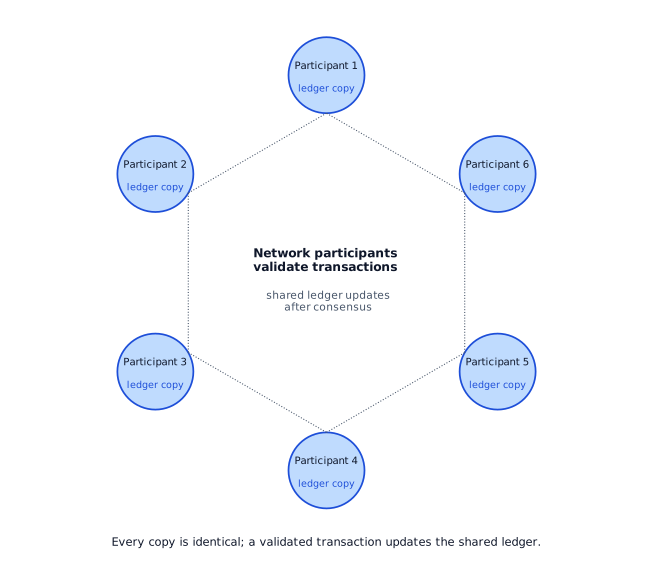
Validation plus updating makes records immutable, meaning they cannot be changed afterwards, while keeping them visible to all participants. Cryptography encrypts the data so that unauthorized parties cannot read it.
Smart contracts are computer programs on a DLT network that execute by themselves when pre-agreed terms and conditions are met. Examples: automatically settling contingent claims, or moving collateral to a lender when a borrower defaults.
Blockchains and consensus protocols
A blockchain is a digital ledger that stores information in blocks recorded in sequence. Each block holds a group of transactions plus a cryptographic link (a hash) to the block before it, so the blocks form a chain. A new transaction joins the chain only after authorized participants validate it.
Consensus protocols decide how blocks are chained together and are designed to resist manipulation.
Key concept
| Proof of work (PoW) | Proof of stake (PoS) | |
|---|---|---|
| Who validates | Miners | Validators |
| How | Computers race to solve a cryptographic problem that verifies the transaction | Participants pledge collateral (staking) to vouch that a block is valid; other validators then confirm it |
| Reward | Newly earned cryptocurrency | A return on the staked collateral |
| Protection against attack | Rewriting history would require controlling most (51%) of the network's computing power, which is very costly | Exam convention: validators protect the network from malicious attacks by controlling most of its computational power. Current practice: PoS security rests on staked collateral, so an attacker would need to control most of the stake rather than most of the computing power |
| Status | Most widely used | Emerging |
Because a PoW attack needs a majority of the network, a blockchain with many participants is harder to attack and more likely to succeed.
Permissionless versus permissioned networks
Key concept
| Permissionless network (open) | Permissioned network | |
|---|---|---|
| Who can transact | Any user; all network functions open to every participant | Some users restricted from some activities |
| Visibility | All transactions visible to all users | Access levels set by permissions, e.g., members add transactions, a regulator may only view history |
| Trust | Parties need not trust each other: consensus, not a central authority, confirms transactions, and the record is immutable | Controlled by whoever sets the permissions |
| Cost | Less cost effective | More cost effective (stronger restrictions) |
| Example | Bitcoin and many other cryptocurrencies | Private networks run by a group of institutions |
Types of digital assets
Digital assets fall into two families, cryptocurrencies and tokens.
| Family | Type | Example or note |
|---|---|---|
| Cryptocurrencies | Bitcoin | The most widely traded cryptocurrency |
| Cryptocurrencies | Altcoins: other cryptocurrencies | Ether, on the Ethereum network |
| Cryptocurrencies | Altcoins: stablecoins | Tether, pegged to the US dollar |
| Cryptocurrencies | Altcoins: meme coins | Dogecoin |
| Cryptocurrencies | Central bank digital currencies (CBDCs) | A central bank's equivalent of a cryptocurrency |
| Tokens | Nonfungible tokens (NFTs) | Each token is unique, e.g., a piece of digital artwork |
| Tokens | Security tokens | Initial coin offerings (ICOs) |
| Tokens | Utility tokens | Paying for network services and network fees |
| Tokens | Governance tokens | Voting on how a permissionless network operates |
- Cryptocurrency: a digital currency issued privately, with no central bank backing. It allows near-real-time transactions without an intermediary. Many cryptocurrencies limit the number of units that can be issued to support their role as a store of value, yet prices are still very volatile. Bitcoin is the most widely traded. Altcoins are alternatives built on Bitcoin's technology. The best known is Ether on the Ethereum network, a programmable blockchain on which users build smart contracts, so its value is not limited to being a store of value. As of mid-2022, Bitcoin and Ether together made up more than 80% of the cryptocurrency market.
- Stablecoin: designed to hold a stable value by being linked to the value of another asset (such as the US dollar); Tether, pegged to the US dollar, is a widely used example. Reserve-backed stablecoins are secured by a reserve basket of assets. Algorithmic (smart) stablecoins instead use algorithms to mint additional units when demand increases; they may hold no actual reserves, and a peg that depends only on the algorithm can fail, as TerraUSD's did in 2022. Exam convention: a stablecoin cannot be converted into fiat currency and has no legal or regulatory backing. Current practice: some issuers do redeem their stablecoins for fiat currency, and some jurisdictions have begun to regulate stablecoin issuers. An asset-backed token is a special case: its value is pegged to a target asset such as gold.
- Meme coin: launched for entertainment. Prices can soar on social media attention and then collapse. The best known is Dogecoin.
- Central bank digital currency (CBDC): a central bank's equivalent of a cryptocurrency, in effect a digital version of its banknotes and coins. Unlike cryptocurrencies, it is government issued.
- Tokenization: using DLT to record and track the ownership history of physical assets (e.g., real estate), which reduces the work needed to verify ownership when assets change hands. The token is the unit that represents the ownership right.
- Nonfungible token (NFT): a form of tokenization that ties a digital asset to a certificate of authenticity. Each NFT represents a distinct item (e.g., a piece of digital art), unlike fungible tokens, which are interchangeable.
- Security token: tracks ownership rights in publicly traded securities digitally. A blockchain can handle custody, settlement, recordkeeping and post-trade processing on one ledger.
- Initial coin offering (ICO): a way for a company to raise money by selling crypto tokens in exchange for money or other cryptocurrency. An ICO is classified as an example of a security token. The tokens are often usable later for the issuer's products or services.
- Utility token: used to pay for services on the network, such as service payments and network fees. It compensates holders only for network activity, while a security token may pay dividends.
- Governance token: issued on permissionless networks. It gives holders voting rights over how the network operates, e.g., voting on how to fix a technical problem.
ICO versus regulated IPO
Key concept
| ICO | Regulated IPO | |
|---|---|---|
| Regulation | Unregulated (many jurisdictions considering rules because of fraud) | Regulated |
| Issuance cost | Potentially lower | Higher |
| Time to raise capital | Potentially shorter | Longer |
| Voting rights | Usually none | Common shares normally carry votes |
| What investors get | Crypto tokens | Shares (registered securities) |
Example
A cooperative owns a $12 million grain terminal. It records ownership on a distributed ledger and issues 120,000 tokens, each representing of the terminal. Each token then represents a $100 claim (). A buyer with $5,000 can hold 50 tokens, and each transfer of tokens is logged on the immutable ledger. This is tokenization: ownership of a physical asset is tracked on DLT. Because each token is a digital ownership claim on a physical asset, the tokens are also asset-backed tokens (LOS 86.c).
Common exam traps
- Proof of work and proof of stake are consensus protocols. They are not types of ledger or types of network of participants.
- Options often swap the roles: miners and computing power go with PoW; validators and staked collateral go with PoS.
- A statement that parties on a permissionless network must trust each other is false, because consensus replaces trust. The cost advantage belongs to permissioned networks.
- Token, tokenization, smart contract and blockchain are often offered together. Match the noun the stem asks for: the ownership unit (token), the process of recording physical-asset ownership on DLT (tokenization), self-executing code (smart contract) or the ledger structure (blockchain).
- Stablecoins stay stable by being linked to other assets, through reserves or, for algorithmic stablecoins, through supply adjustments. Fiat convertibility and government backing are not the mechanism.
- ICO buyers usually receive crypto tokens with no voting rights. Governance tokens are the ones built around voting.
- A digital currency with government backing is a CBDC, not a stablecoin.
Bottom line
- Digital assets are created, stored and transferred electronically and secured with distributed ledger technology; a cryptocurrency runs on its own blockchain, while a crypto token is built on an existing one.
- The three parts of a DLT network are the digital ledger, the consensus mechanism and the network of participants, and validating and then updating the ledger makes its records immutable while keeping them visible to all participants.
- Under proof of work, miners solve a cryptographic problem and an attack would need most of the network's computing power; under proof of stake, validators pledge collateral, and the exam convention says validators guard the network by controlling most of its computational power, while in current practice an attacker would need most of the stake.
- A permissionless network is open to every user with all transactions visible and no need for parties to trust one another, while a permissioned network restricts some users' activities and is more cost effective.
- Stablecoins hold their value by being linked to another asset through reserves or, for algorithmic stablecoins, supply adjustments; exam convention: they cannot be converted into fiat currency and have no legal or regulatory backing; current practice: some issuers redeem them for fiat and some jurisdictions regulate issuers.
- Tokenization records ownership of physical assets on DLT, an NFT represents a distinct item, ICO buyers usually receive crypto tokens with no voting rights in an unregulated offering, utility tokens pay for network services, and governance tokens give voting rights over the network.
Quick check
Two blockchains differ in how new blocks are accepted. On the first, miners compete to solve a cryptographic problem before a block is locked in. On the second, validators pledge some of their own holdings as collateral to vouch for a block, and further validators then confirm it. The two blockchains differ in their:
Show answer and explanation
Correct answer: C
A DLT network has three components: the digital ledger, the consensus mechanism and the network of participants. Consensus protocols determine how blocks are validated and chained together. The first chain uses proof of work (miners solve cryptographic problems and earn cryptocurrency), and the second uses proof of stake (validators stake collateral and earn a return on it).
Why the other options are wrong
- A. The network of participants determines who may perform network functions. Those functions are open to all users in a permissionless network and restricted in a permissioned one. The network of participants does not set the rule used to validate and add blocks.
- B. The digital ledger is the shared, identical record of transactions itself. Proof of work and proof of stake are ways of agreeing on how to update that ledger. They are not ledgers in their own right.
Key takeaway Proof of work and proof of stake are the two main consensus protocols. Miners belong to PoW; validators and staking belong to PoS.
Module 86.2
Digital Asset Characteristics
LOS 86.b — Investment features of digital assets versus other asset classes
The number of cryptocurrencies has grown from dozens to thousands, and institutional investors are paying attention because of high expected returns and possible diversification benefits. Exchanges and custodians have built infrastructure to serve them. Digital assets nonetheless differ from traditional financial assets in four main ways:
Key concept
| Feature | Traditional financial assets | Digital assets |
|---|---|---|
| Inherent value | Backed by underlying assets and the cash flows they generate (interest, dividends) | Most have no backing and generate no cash flows, so they have no fundamental value. Prices reflect expected price appreciation, driven by scarcity (limited supply) and the ability to transfer value in the future |
| Transaction validation | Recorded on private ledgers kept by central intermediaries | Recorded on decentralized digital ledgers, often on permissionless blockchain networks |
| Medium of exchange | Traded and priced in globally accepted fiat currencies | Used as an alternative to fiat currency, mostly for online transactions. Mainstream finance is reluctant to accept them because of high transaction costs, the fact that they are not legal tender in many jurisdictions, and heavy restrictions in some countries. CBDCs are being evaluated as tokenized fiat currency |
| Regulation | Clear, established rules in most jurisdictions | Lack well-developed standards. Rules are still being written; US regulators treat some digital currencies as commodities, while others see them as nonfinancial assets. Crypto exchanges are often unregulated, so behavior such as market manipulation is not specifically prohibited |
LOS 86.c — Investment forms and vehicles
Where cryptocurrencies trade
Direct owners hold a cryptocurrency wallet, which stores the digital encryption keys needed to access and trade the assets.
Key concept
| Centralized exchange | Decentralized exchange | |
|---|---|---|
| Structure | Privately held; trades run on the exchange's private servers | No central authority; runs on a distributed framework of many computers |
| Popularity | Most popular type (even though centralization conflicts with Bitcoin's design) | Less used |
| Security | More vulnerable: a compromised server can halt trading and leak data such as wallet keys | Harder to attack: if one computer is hit, the others keep the exchange running |
| Regulation | Some are regulated as financial exchanges, depending on jurisdiction | Difficult to regulate, because no person or group controls it |
| Price and volume information | Platforms provide price transparency and volume data | No central platform |
On both types, weak oversight raises investor protection concerns. Fraud and manipulation are more likely, e.g., pump-and-dump schemes that hype a coin on social media to push its price up.
Direct investment
A direct investment is a transaction recorded on the blockchain itself: buying tokens on a crypto exchange, trading an NFT, or taking part in an ICO. Most crypto exchanges trade continuously. Key risks:
- Fraud: theft, scam ICOs and attempts to obtain wallet credentials, on top of the manipulation risk that comes with weak exchange oversight.
- Loss of access: coins sit in wallets that require unique passkeys. If the passkey is lost, the coins cannot be retrieved and are effectively worthless. An estimated 20% of all Bitcoin sits in lost or abandoned wallets.
- Whales: a few large holders who own enough of a small cryptocurrency to manipulate its price. This is mainly a risk in thinly held coins; in the largest, widely held coins no single holder is likely to have that power.
Indirect investment
Key concept
| Vehicle | How it gives exposure | Points to remember |
|---|---|---|
| Cryptocurrency coin trusts | Shares in a trust whose assets are large holdings of the cryptocurrency itself | Trade over the counter, similar to a closed-end fund; more transparency; the investor needs no digital wallet or encryption keys; some charge high fees |
| Cryptocurrency futures contracts | Agreement to buy or sell a set quantity of a cryptocurrency at a future date, based on spot prices from crypto exchanges | Typically cash settled and leveraged; more volatile and less liquid than traditional futures |
| Cryptocurrency exchange-traded products (e.g., ETFs) | Mimic crypto returns using cash or cryptocurrency derivatives | Exchange traded rather than over the counter. Exam convention: they typically do not hold the coins directly. Current practice: some spot ETPs launched since 2024 do hold them |
| Cryptocurrency stocks | Shares of firms connected to digital assets: exchanges, payment providers, firms that accept, hold or mine crypto, blockchain service providers | Exposure through the business, not the coin |
| Cryptocurrency hedge funds | Discretionary long, long/short, quantitative and multistrategy approaches | Some also mine Bitcoin to add return |
Digital investment in nondigital assets
Asset-backed tokens are digital claims on physical or financial (nondigital) assets such as oil, gold, real estate or equities, and they are collateralized by the underlying asset. They:
- can potentially make high-priced assets, such as real estate, more liquid through fractional ownership;
- create an immutable ownership record, which improves transparency and lowers transaction costs;
- are generally classified by regulators as securities.
They are often issued on Ethereum, where smart contracts allow P2P interaction. Decentralized applications (dApps) record transactions on the blockchain without a central system. Decentralized finance (DeFi) is the resulting marketplace of open-source dApps that can serve as a medium of exchange and a store of value, tokenize assets and keep immutable ownership records. Today most dApps focus on speculating in digital assets.
LOS 86.d — Risk, return and diversification
Return drivers. Returns on cryptocurrencies come mainly from asset appreciation. A major driver of prices is limited supply: Bitcoin is capped at 21 million units, and some call it "digital gold" for that reason. Prices are also affected by:
- market adoption and network impacts (network effects);
- technological innovation;
- regulation, including how new rules develop;
- speculation and investors' risk appetite.
Risk. Bitcoin and other cryptocurrencies have delivered high returns with high volatility compared with traditional asset classes, with very large rises followed by steep falls. Fraud, crime, uncertain regulation and outright bans in some countries (China banned cryptocurrencies in 2021) add to the uncertainty. Over January 2011 to January 2022, Bitcoin's average monthly log return was about 8.8%, against roughly 0.2% to 1.1% for US equities, global equities and global bonds, and its monthly standard deviation (about 0.32) was about eight times that of equities. Its coefficient of variation (standard deviation per unit of average return, about 3.7) was close to that of US equities and below those of global equities and global bonds.
Diversification. Historically, crypto returns have shown low correlations with traditional asset class returns (Bitcoin's monthly correlations with US equities, global equities and global bonds were only about 0.14 to 0.22 over the same period), so they may provide diversification benefits. The evidence is not settled, and correlations can rise during periods of extreme market stress, just when diversification is most needed.
Example
A coin's price goes from $8,000 to $20,000 over one year and then falls to $11,000 over the next. The first-year return is , and the second-year return is . The two-year holding period return is . No dividend or interest was received, so the whole return comes from price change. Such large swings are typical of the asset class's high volatility.
Common exam traps
- The value of an unbacked cryptocurrency does not come from cash flows. "Projected cash flows" or "dividends" is the wrong answer to a question about the value or price drivers of such a cryptocurrency. This does not extend to every digital asset: security tokens may pay dividends, and asset-backed tokens draw value from the underlying asset.
- Options often attach "more popular" or "more vulnerable to attack" to decentralized exchanges. Both describe centralized exchanges.
- A vehicle that holds the coins and trades over the counter is a coin trust. Under the exam convention an ETF does not hold the coins.
- Asset-backed tokens lower transaction costs and increase transparency; options that reverse either effect are wrong.
Bottom line
- Unlike traditional financial assets, most digital assets have no backing and generate no cash flows, so they have no fundamental value; they are recorded on decentralized ledgers, are not legal tender in many jurisdictions and lack well-developed regulatory standards.
- Centralized crypto exchanges are the most popular type but more vulnerable to attack, while decentralized exchanges keep running if one computer is hit and are difficult to regulate.
- Direct investment carries the risks of fraud, permanent loss of coins whose passkey is lost, and, in thinly held coins, price manipulation by whales.
- Indirect exposure comes from coin trusts, which hold the coins and trade over the counter, cash-settled and leveraged futures, exchange-traded products (exam convention: typically not holding the coins; current practice: some spot ETPs launched since 2024 do), crypto stocks and crypto hedge funds.
- Asset-backed tokens are digital claims collateralized by nondigital assets, which allow fractional ownership, create an immutable ownership record that improves transparency and lowers transaction costs, and are generally classified by regulators as securities.
- Cryptocurrency returns come mainly from price appreciation, with limited supply a major driver, and have been high but highly volatile; their historically low correlations with traditional assets may offer diversification, although correlations can rise in periods of extreme stress.
Quick check
An investment committee is debating whether to add digital assets to a multi-asset portfolio. Regarding their role as an investment class, which statement is most accurate?
Show answer and explanation
Correct answer: B
Cryptocurrency returns have historically shown low correlations with traditional asset class returns, so they may provide diversification benefits. The evidence is not conclusive, and correlations can rise in periods of extreme market stress, so the benefit is potential rather than assured.
Why the other options are wrong
- A. Returns have not closely tracked traditional asset classes; the low correlations are what make diversification possible. Digital assets have also produced much higher (and more volatile) returns than traditional assets.
- C. Digital assets are a new, highly speculative asset class with no clear legal protections, marked by high returns and very high volatility, so they are not a stable asset class.
Key takeaway Crypto offers potential diversification (low historical correlation) but with high volatility, and correlations may rise under stress.
Practice Questions
Kestrel Robotics is weighing two ways of raising new capital: a regulated initial public offering (IPO) or an initial coin offering (ICO). Compared with the IPO, the ICO would most likely involve:
Show answer and explanation
Correct answer: C
An ICO may be less expensive to issue and may raise capital in less time than a regulated IPO. These are possible advantages, not guaranteed outcomes.
Why the other options are wrong
- A. An ICO may raise capital in less time than an IPO, so a longer capital-raising period is the opposite of the expected difference.
- B. Most ICOs attach no voting rights to the tokens sold, whereas common shares sold in an IPO normally carry votes. ICO buyers therefore typically get fewer voting rights.
Key takeaway An ICO may be less costly and faster than an IPO; it typically offers fewer investor protections and often no voting rights.
This reading has 16 questions in the full bank. Practice all of them.
Key Takeaways
- Proof of work and proof of stake are the two main consensus protocols. Miners belong to PoW; validators and staking belong to PoS.
- An ICO may be less costly and faster than an IPO; it typically offers fewer investor protections and often no voting rights.
- Crypto offers potential diversification (low historical correlation) but with high volatility, and correlations may rise under stress.