Corporate Finance · Reading 23
Cash Conversion Cycle
CFA Level I · Corporate Finance · Reading 23: Working Capital and Liquidity · about 30 min
What you'll learn
- LOS 23.a Explain the cash conversion cycle (DOH + DSO - DPO), what lengthens or shortens it, the cost of trade credit, and compare CCCs across issuers.
- LOS 23.b Explain liquidity, primary and secondary liquidity sources, drags and pulls on liquidity, the cost of liquidity, and the current, quick and cash ratios.
- LOS 23.c Describe working capital objectives and compare conservative, moderate and aggressive approaches to financing working capital, and factors affecting short-term funding.
Module 23.1
Liquidity Measures and Management
This reading explains the cash conversion cycle and its components, the cost of trade credit and measures of working capital, and how to compare issuers on them. It then covers primary and secondary sources of liquidity, drags and pulls on liquidity, liquidity ratios, and conservative, moderate and aggressive approaches to managing working capital.
LOS 23.a — The cash conversion cycle
The cash conversion cycle (CCC), also called the net operating cycle, measures how long a company's cash is tied up between paying for inventory and other resources and collecting cash from the resulting sales:
Key concept
- Days of inventory on hand (DOH): how long inventory is held before it is sold;
- Days sales outstanding (DSO): how long customers take to pay (average days of receivables);
- Days payable outstanding (DPO): how long the company takes to pay its suppliers (average days of payables).
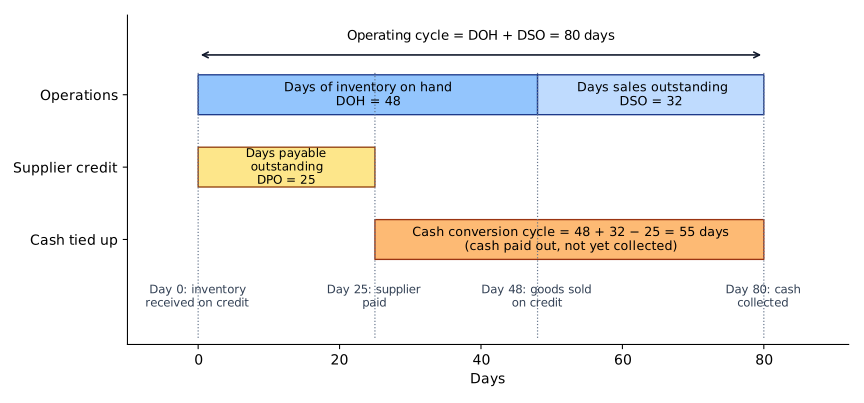
The operating cycle is the time from receiving materials to collecting cash from the sale, so it equals . Suppliers finance the first DPO days of it, so the CCC is the part of the operating cycle that the company must finance itself.
Example. , and give an operating cycle of 80 days and a CCC of 55 days, as the timeline shows.
From turnover ratios to days. Activity data are often given as turnover ratios, so convert them to days first (365-day year):
- , where ;
- , where ;
- , where ;
- .
Example. Inventory turnover of 6.0, receivables turnover of 9.125 and payables turnover of 7.3 give DOH , DSO and DPO days. The operating cycle is 100.8 days and the CCC is days. A higher turnover means fewer days.
A lower CCC is generally better: less capital is tied up in working capital and cash is generated faster. A CCC that is high relative to peers may signal excessive investment in working capital and possible cash flow strain.
| Change | Effect on CCC |
|---|---|
| DOH ↑ (slower inventory turnover) | ↑ |
| DSO ↑ (slower collection, looser customer credit) | ↑ |
| DPO ↓ (suppliers tighten terms, demand faster payment) | ↑ |
| DOH ↓, DSO ↓ or DPO ↑ | ↓ |
Because the CCC is a linear combination of its components, scaling every component by the same factor scales the CCC by that factor. A percentage change in one component is not the percentage change in the CCC. In the timeline example, if DPO rises from 25 to 35 days (the firm negotiates longer supplier terms), the CCC falls to 45 days: DPO rose 40%, but the CCC fell about 18%.
A company can shorten its CCC by working on any of the three components, but each lever has a cost:
| Lever | How the CCC is shortened | Cost or risk |
|---|---|---|
| DOH ↓ | Hold less raw material and finished goods | Production bottlenecks if supplies are disrupted; unable to meet spikes in demand |
| DSO ↓ | Tighten the credit given to customers | Lost sales |
| DPO ↑ | Take longer to pay suppliers | Early-payment discounts are given up (see the cost of trade credit below) |
Trade credit and its cost
Accounts payable are an implicit source of credit from suppliers (bank loans are an explicit source). Terms a/b net c mean a discount of (a percentage) if paid within days, otherwise the full amount is due by day . Skipping the discount is borrowing per $1 of invoice for days at a cost of :
Key concept
where is the discount as a decimal, the days until the discount expires and the days until full payment is due.
Example. Terms 1/10 net 40, bank rate 7%. , so borrow from the bank and take the discount.
Comparing CCCs
CCCs differ by industry. Pharmaceutical firms, for example, carry large inventories (long CCC); airlines collect cash before providing the service and hold little inventory (short CCC). Compare a firm with its own industry or with its own history. Scale working capital by sales to compare firms of different size, and compare only firms in similar lines of business, because the ratio varies by industry. A company with a short CCC ties up less working capital for each unit of sales, so the two measures usually point the same way. Analysts often prefer net working capital, built from operating items only, because it ties closely to the CCC:
Example. Current assets of 645 are cash and marketable securities 55, receivables 260, inventory 310 and prepaid expenses 20. Current liabilities of 485 are accounts payable 290, accrued expenses 45, short-term notes 120 and the current portion of long-term debt 30. Total working capital . Net working capital .
Common exam traps
- Adding DPO to the operating cycle. Supplier credit shortens the CCC, so DPO is subtracted. In the timeline example, days instead of 55.
- A CCC can be negative. With prepaid sales and little inventory, the firm collects from customers before it pays suppliers, so supplier credit funds its operations.
- For net working capital, remove only cash and marketable securities from current assets and only short-term and current debt from current liabilities. Receivables, prepaid items, accounts payable and accrued expenses stay in.
LOS 23.b — Liquidity
Liquidity of an asset is its nearness to cash; of a liability, its nearness to settlement. Inventory is less liquid than receivables (it must be sold, then collected).
| Current asset | What must happen before it becomes cash | Liquidity |
|---|---|---|
| Cash | Nothing | Highest |
| Marketable securities | Sell them in the market | Very high |
| Accounts receivable | Collect from customers | Lower |
| Inventory | Process (if needed) and sell, then collect the receivable | Lowest |
For an issuer, liquidity is the availability of cash and liquid assets to meet short-term obligations. Long-term solvency depends on generating enough cash from the business to service liabilities, and analysts judge liquidity management mainly from the statement of cash flows. Companies normally rely on primary sources and turn to secondary sources only when needed.
| Primary liquidity sources | Secondary liquidity sources |
|---|---|
| Cash and marketable securities on hand | Suspending dividends |
| Bank borrowings (e.g., credit lines) | Delaying or reducing capital investment |
| Cash generated by the business | Selling assets; issuing equity |
| Renegotiating/restructuring debt; filing for bankruptcy protection |
Secondary sources are costlier and send a negative signal to the market. Cash buffers cost money (idle capital) but reduce the risk of having to rely on secondary sources when the CCC deviates from normal (seasonality, demand shocks).
- A drag on liquidity delays cash inflows: slow-moving or obsolete inventory (DOH ↑), slow or uncollectible receivables (DSO ↑).
- A pull on liquidity accelerates cash outflows: suppliers cut credit lines or demand faster payment (DPO ↓).
The cost of liquidity is the discount to fair value accepted when assets must be sold quickly. Example. $50 of cash (0% cost), $150 of receivables and inventory sold at a 10% discount, and $200 of equipment sold at a 25% discount give proceeds of against a fair value of $400; cost .
Liquidity ratios
A current ratio above 1 means current assets are enough to cover current liabilities. The quick ratio excludes inventories, the least liquid current asset, so it is more conservative than the current ratio; the cash ratio also excludes receivables and is the most stringent. Example. With cash 30, receivables 50, inventory 90 and current liabilities 100, the current ratio is 1.70, the quick ratio 0.80 and the cash ratio 0.30.
Common exam traps
- Classing delayed capital expenditure or suspended dividends as primary sources. Firms turn to them only under pressure, so they are secondary sources.
- Suppliers cutting credit lines is a pull on liquidity, not a drag, even though it lengthens the CCC just as slow collections do.
- Leaving receivables out of the quick ratio. Only the cash ratio excludes them. In the ratio example, instead of 0.80.
LOS 23.c — Managing working capital and liquidity
Working capital management tries to maximize profit while keeping enough liquidity to run the business and meet obligations. Holding more short-term assets is safer but earns less; financing with short-term debt is cheaper than long-term debt or equity but carries rollover risk. Compare firms by scaling short- and long-term assets by sales.
Key concept
| Conservative approach | Moderate approach | Aggressive approach | |
|---|---|---|---|
| Short-term assets held | High (relative to long-term assets) | Middle | Low |
| Financing of working capital | Long-term debt and equity | Permanent current assets: long-term; variable (seasonal) current assets: short-term | Short-term debt |
| Benefits | Permanent capital, little rollover need; flexibility in market disruptions; high probability of meeting short-term obligations | Balance | Lower financing costs, higher returns |
| Costs / risks | Higher costs, lower profitability; long-term lenders may impose covenants (e.g., minimum interest coverage) | Balance | Risk of failing to meet obligations; vulnerable to market disruptions |
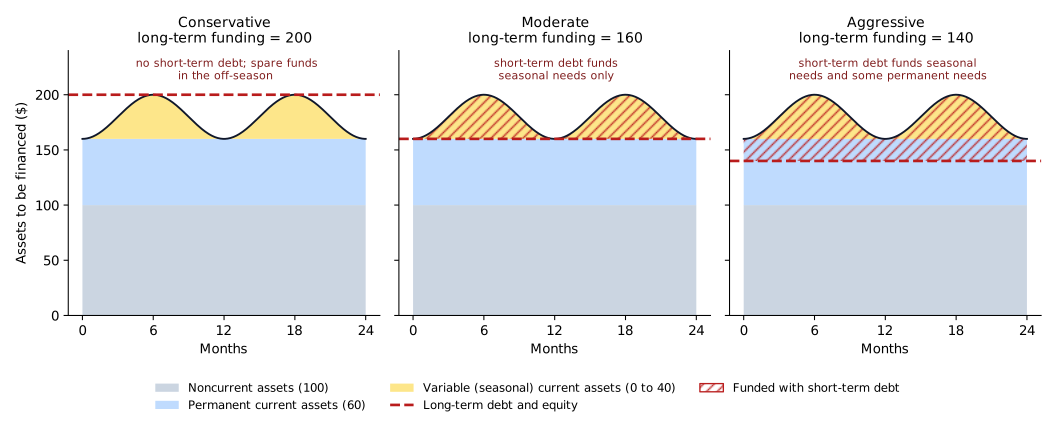
Permanent current assets are the level of current assets the business needs all year; variable (seasonal) current assets are the extra amount needed at peak times. For the same assets, the approaches differ in how far long-term debt and equity reach up this stack of needs; the rest is funded short term:
Factors in choosing short-term funding: company size (small firms have fewer options), creditworthiness, the legal system (lender protections), regulation (e.g., banks and utilities), and the underlying assets available as collateral. Firms should keep several funding sources, know their costs, and arrange them before they are needed.
Common exam traps
- Treating long-term funding of recurring needs such as inventory, wages and rent as the moderate approach. Funding all working capital long term is conservative; the moderate approach funds only permanent needs long term and seasonal needs short term.
Exam shortcuts
- Compare the EAR of skipping the discount with the bank rate: if the EAR is higher, borrowing from the bank to take the discount is cheaper.
- Scaling every CCC component by the same factor scales the CCC by that factor, but a percentage change in one component is not the CCC's percentage change, so recompute the CCC in days.
Bottom line
- The cash conversion cycle is ; the operating cycle is DOH + DSO, and the CCC is the part of it the company must finance itself.
- With a 365-day year, DOH, DSO and DPO equal 365 divided by inventory turnover, receivables turnover and payables turnover.
- A lower CCC is generally better; it rises with DOH or DSO and falls with DPO, and each lever has a cost: production bottlenecks, lost sales or forgone early-payment discounts.
- Forgoing a discount on terms a/b net c costs per year.
- CCCs vary by industry, so compare a firm with its industry or its own history; net working capital removes cash and marketable securities and short-term and current debt, which ties it closely to the CCC.
- Primary liquidity sources are cash and marketable securities, bank borrowings and cash generated by the business, while secondary sources such as suspending dividends, delaying capital investment or selling assets are costlier and send a negative signal.
- A drag on liquidity delays inflows (higher DOH or DSO), a pull accelerates outflows (lower DPO), and the quick ratio excludes inventories while the cash ratio also excludes receivables.
- A conservative approach holds more short-term assets financed long term, an aggressive approach holds fewer financed with short-term debt, and a moderate approach funds permanent current assets long term and seasonal ones short term.
Quick check
The CFO of Brightwater Distributors wants to shorten the company's cash conversion cycle (CCC). Which of the following changes would achieve this goal?
Show answer and explanation
Correct answer: C
The CCC equals DOH plus DSO minus DPO and measures how long cash is tied up in inventory and receivables before it returns from sales. Selling inventory faster lowers DOH and therefore shortens the CCC.
A lower DOH shortens the CCC; a higher DSO or a lower DPO lengthens it.
Why the other options are wrong
- A. Slower collection of receivables raises DSO and lengthens the CCC.
- B. Paying suppliers sooner lowers DPO; because DPO is subtracted, the CCC gets longer.
Key takeaway CCC falls when DOH or DSO falls, or when DPO rises.
Practice Questions
Kellan Foods buys ingredients from a supplier that offers terms of 3/15, net 75. Kellan can also borrow from its bank at an annual rate of 9%. Which source of financing is cheaper for Kellan?
Show answer and explanation
Correct answer: A
Forgoing a 3% discount to delay payment by 60 days is an implicit loan from the supplier. Its effective annual rate is about 20.4%, far above the 9% explicit cost of bank borrowing, so Kellan should borrow from the bank and pay within 15 days to take the discount.
Financing period days; forgoing the discount means paying $3 extra for each $97 of credit.
Bank: 9%. Since 20.4% > 9%, the bank is cheaper.
Why the other options are wrong
- B. Comparing the 3% discount with the 9% bank rate ignores the time period: the 3% is earned for only 60 days, which annualizes to about 20.4%. Supplier credit is therefore the more expensive source.
- C. The costs are far apart (about 20.4% vs. 9%). Even a simple, uncompounded annualization () is well above the bank rate.
Key takeaway Terms a/b net c: , with a as a decimal. Trade credit that forgoes a discount is usually far more expensive than a bank loan.
Talbridge Electronics' main component suppliers have cut the trade credit line they extend to it and now require payment within 15 days instead of 45 days. For Talbridge, this development is best described as a:
Show answer and explanation
Correct answer: B
A pull on liquidity occurs when cash outflows speed up, for example when suppliers reduce credit lines or demand faster payment. Days payable outstanding falls, the cash conversion cycle lengthens and liquidity is reduced.
Why the other options are wrong
- A. A drag on liquidity is a delay in cash inflows, such as slow-moving or obsolete inventory or slow collection of receivables. Here the problem is faster outflows.
- C. Secondary sources of liquidity are actions the firm can take to raise cash, such as suspending dividends, delaying capital spending, selling assets, issuing equity or restructuring debt. Losing supplier credit reduces liquidity rather than providing it.
Key takeaway Drag = inflows slow down (DOH or DSO up). Pull = outflows speed up (DPO down).
Three companies describe how they handle their working capital. Whose practice fits a conservative approach best?
Show answer and explanation
Correct answer: C
A conservative approach finances working capital, including permanent needs such as inventory, salaries and rent, with long-term sources (long-term debt and equity). It also involves holding relatively high levels of short-term assets compared with long-term assets.
Why the other options are wrong
- A. Paying recurring costs such as rent and wages with short-term borrowing that must be rolled over is typical of an aggressive approach.
- B. Conservative firms hold relatively more short-term assets. A firm with low short-term assets relative to long-term assets is closer to the aggressive end.
Key takeaway Conservative: lots of current assets, long-term financing. Aggressive: few current assets, short-term financing.
This reading has 22 questions in the full bank. Practice all of them.
Key Takeaways
- CCC falls when DOH or DSO falls, or when DPO rises.
- Terms a/b net c: , with a as a decimal. Trade credit that forgoes a discount is usually far more expensive than a bank loan.
- Drag = inflows slow down (DOH or DSO up). Pull = outflows speed up (DPO down).
- Conservative: lots of current assets, long-term financing. Aggressive: few current assets, short-term financing.