Corporate Finance · Reading 24
NPV vs IRR
CFA Level I · Corporate Finance · Reading 24: Capital Investments and Capital Allocation · about 41 min
What you'll learn
- LOS 24.a Describe the four types of capital investments (going concern, regulatory/compliance, expansion, other) and the analysis each requires.
- LOS 24.b Describe the capital allocation process; calculate and interpret NPV, IRR and ROIC and contrast their use in capital allocation.
- LOS 24.c Describe the principles of capital allocation (after-tax incremental cash flows, sunk and opportunity costs, externalities, timing) and common pitfalls.
- LOS 24.d Describe the types of real options relevant to capital investments: timing, abandonment, expansion, flexibility and fundamental options.
Module 24.1
Capital Investments and Project Measures
This reading classifies capital investments, sets out the capital allocation process, and calculates and compares NPV, IRR and ROIC. It then covers the principles for estimating a project's cash flows, common capital allocation pitfalls, and the real options that can add value to a project.
LOS 24.a — Types of capital investments
A capital investment is spending on long-lived assets whose cash flows arrive over more than one year. Capital investments fall into four groups, which differ mainly in how much analysis they need. The first two keep the existing business running; the last two aim to grow it and need the most analysis.
Key concept
| Type | Purpose | Typical depth of analysis |
|---|---|---|
| Going concern projects | Keep the existing business running, or cut costs in it (e.g., replace a worn or obsolete but still usable machine with a cheaper-to-run model) | Low: maintenance spending needs little analysis; efficiency (replacement) decisions need a cost comparison |
| Regulatory/compliance projects | Required by a government agency or an insurer, often for safety or environmental reasons | Moderate: the firm must do it, so the analysis compares alternative ways of carrying it out; the project itself brings in little to no revenue |
| Expansion projects | Grow the business: new markets or new products in the current market | High: needs forecasts of demand, revenues and expenses |
| Other projects | Investments outside existing lines of business (start-up-like ventures, buying a firm in a new industry) | High: great uncertainty, risk of overpaying in acquisitions |
For pure maintenance spending the only questions are whether to keep the existing operations going and, if so, whether to keep the current processes.
Two further points:
- Firms often use match funding: financing a project with sources whose life matches the project's life, which reduces financing risk.
- Analysts often use annual depreciation expense as a rough estimate of the capital spending a firm needs just to maintain its business (going concern spending).
Common exam traps
- Little or no revenue is not a reason to reject a regulatory/compliance project.
- Replacing a machine that still works, to lower operating costs, is a going concern project, not an expansion project, even though it involves buying new equipment.
LOS 24.b — The capital allocation process, NPV, IRR and ROIC
The process
Capital allocation is the process of identifying and evaluating capital projects, meaning projects whose cash flows are received over a period longer than one year. The same framework can be applied to any corporate decision that affects future earnings. It matters because the assets are costly and long-lived, because the same thinking applies to other decisions (working capital, mergers and acquisitions), and because good capital allocation serves management's primary goal of maximizing shareholder value.
The four administrative steps are:
- Idea generation: the most important step; ideas come from senior management, divisions, employees or outsiders.
- Analyzing project proposals: forecast each project's cash flows to judge its profitability.
- Creating the firm-wide capital budget: rank and schedule profitable projects given cash flow timing, available resources and the firm's strategy; a project that looks attractive alone may not fit the strategic plan.
- Monitoring decisions and conducting a post-audit: compare actual with forecast results; the post-audit exposes systematic forecasting errors and pushes managers to improve operations.
Arranging the financing for projects is not one of these four steps.
Net present value (NPV)
The net present value (NPV) adds up the present values of all the expected incremental after-tax cash flows of a project, discounted at the project's required rate of return (the firm's cost of capital adjusted for project risk):
Key concept
where is usually a negative initial outlay. Decision rule for independent projects: accept if (expected to increase shareholder wealth), reject if . A zero-NPV project is expected to leave shareholder wealth unchanged. In theory, accepting a project raises the firm's value by its NPV, so the share price rises by the NPV per share.
Example. A company with 40 million shares trading at $25 announces a project that costs $90 million; the present value of its after-tax inflows is $96 million. If investors had not expected the project and accept these estimates, NPV million, or per share, so the price rises to $25.15.
Internal rate of return (IRR)
The internal rate of return (IRR) is the discount rate at which the inflows and the outflows have equal present values, i.e., the rate at which NPV = 0:
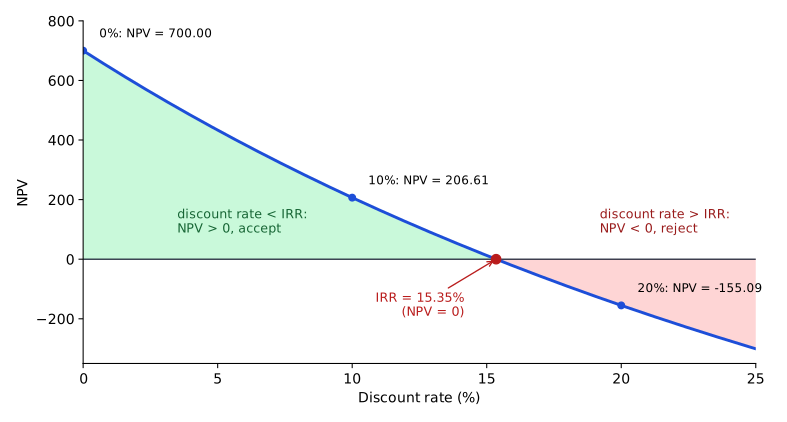
Decision rule: accept if IRR > required rate of return (the hurdle rate), reject if IRR < hurdle rate. The required rate is usually the firm's cost of capital, raised or lowered when the project is riskier or safer than the firm's average project. Because NPV falls as the discount rate rises, the two rules agree for a conventional independent project:
| Discount rate used vs. IRR | Sign of NPV |
|---|---|
| Discount rate < IRR | NPV > 0 |
| Discount rate = IRR | NPV = 0 |
| Discount rate > IRR | NPV < 0 |
Example. A project costs 2,000 and returns 700, 900 and 1,100 at the ends of years 1–3; the required return is 10%.
Calculator (TI BA II Plus): [CF] [2ND][CLR WORK]; CF0 = −2,000; C01 = 700, F01 = 1; C02 = 900, F02 = 1; C03 = 1,100, F03 = 1; [NPV] I = 10, [↓][CPT] = 206.61; [IRR][CPT] = 15.35%. Both rules say accept (NPV > 0 and 15.35% > 10%).
The figure plots this project's NPV at discount rates from 0% to 25%; it shows the table above as a curve.
Calculator tips for uneven cash flows
- Use the frequency registers (F01, F02, …) for repeated equal cash flows.
- A year with no cash flow must be entered as a cash flow of 0; skipping it shifts every later cash flow one year too early.
- If a sale (or clean-up cost) happens in the same year as an operating cash flow, net them into one cash flow for that year; entering the sale as an extra period puts it one year too late.
Conventional vs. unconventional cash flows
A conventional cash flow pattern changes sign once (outflow(s) followed by inflows). An unconventional cash flow pattern changes sign more than once, e.g., an outflow at the end for decommissioning. Cash flows spaced at uneven time intervals are also treated as unconventional. Spreadsheets handle both cases best.
NPV vs. IRR
Key concept
| NPV | IRR | |
|---|---|---|
| Main advantage | Direct measure of the expected increase in firm value | A percentage return; shows the margin of safety (how far the return can fall before NPV turns negative) |
| Reinvestment assumption | Interim cash flows reinvested at the required rate of return (more realistic) | Interim cash flows reinvested at the IRR |
| Unconventional cash flows | No problem | Possible multiple IRRs that are hard to interpret |
Return on invested capital (ROIC)
Return on invested capital (ROIC) measures, for the firm as a whole, the after-tax operating return on all capital (debt and equity):
Net operating profit after tax (NOPAT) = net income + after-tax interest expense . Invested capital is the average book value of the firm's total capital, the debt and equity that finance it. Exam convention: invested capital is long-term debt plus equity, and working capital is left out of it, meaning non-interest-bearing current liabilities such as accounts payable are not counted as capital. Current practice: debt and equity finance receivables and inventory as well as fixed assets, so operating working capital is not subtracted from capital; invested capital is usually total interest-bearing debt, including short-term borrowings, plus equity, often net of excess cash. The ratio of sales to invested capital is also called asset turnover, so a firm can raise ROIC by improving its after-tax operating margin or by turning over its capital faster. If ROIC exceeds the investors' blended required return, the firm is adding value over time.
Example. Net income 18m, interest expense 5m, tax rate 20%, sales 275m. Long-term debt plus equity is 190m at the start of the year and 210m at the end. NOPAT m; average invested capital m; ROIC .
ROIC is attractive to outside investors because it uses published accounting data and applies to the whole firm, which is what they can buy. However, it is not comparable across different accounting treatments, it is backward-looking and volatile, and good projects can hide bad ones in the company-wide figure. NPV and IRR are project-specific.
Common exam traps
- NPV is the PV of inflows minus the initial outlay. The PV of inflows alone is a common wrong answer. In the three-year example, the PV of the inflows alone is 2,206.61 instead of an NPV of 206.61.
- Do not add unadjusted (undiscounted) cash flows. In the three-year example, instead of 206.61.
- For NOPAT, add back interest after tax; adding the full pretax interest overstates NOPAT. In the ROIC example, m gives an ROIC of 11.5% instead of 11%.
Exam shortcuts
- For a conventional independent project, NPV is positive exactly when the discount rate is below the IRR, so once the IRR is compared with the required return the sign of the NPV is known.
Bottom line
- Capital investments are going concern, regulatory/compliance, expansion and other projects, and the last two, which aim to grow the business, need the most analysis.
- The capital allocation process is idea generation (the most important step), analysis of proposals, the firm-wide capital budget, and monitoring with a post-audit that exposes systematic forecasting errors.
- NPV is the sum of a project's incremental after-tax cash flows discounted at its required rate of return, , and an independent project is accepted when NPV > 0.
- The IRR is the discount rate at which NPV = 0, an independent project is accepted when the IRR exceeds the hurdle rate, and for a conventional independent project the NPV and IRR rules agree.
- NPV measures the expected increase in firm value and assumes reinvestment at the required return, while the IRR assumes reinvestment at the IRR and can give multiple values for unconventional cash flows.
- ROIC = NOPAT ÷ average invested capital = after-tax operating margin × capital turnover, with NOPAT = net income + interest × ; under the exam convention invested capital is long-term debt plus equity excluding working capital, while current practice usually counts all interest-bearing debt plus equity.
Quick check
Tamsin Foods is reviewing three capital projects. Which one would typically need the most detailed analysis?
Show answer and explanation
Correct answer: B
An expansion project that brings a new product into a new market requires forecasts of demand, revenues and expenses that are all highly uncertain. It therefore needs the most detailed analysis of the three.
Why the other options are wrong
- A. Replacing a usable machine to lower costs is a going concern project. It needs a cost comparison, but its cash flows are much easier to estimate than those of a new product in a new market.
- C. Insurer-mandated safety equipment is a regulatory/compliance project. The firm must do it, so the analysis centers on comparing alternative ways of complying.
Key takeaway Depth of analysis rises with uncertainty. Projects that maintain the business need little analysis, regulatory/compliance projects call for comparing alternative ways to comply, and expansion and other projects need the most detailed analysis.
Module 24.2
Capital Allocation Principles and Real Options
LOS 24.c — Principles of capital allocation and common pitfalls
Principles
- Decisions are based on cash flows rather than accounting income, because accounting income is built on accruals and ignores when cash is received or paid. The cash flows are measured after tax, since the firm's value rests on the cash it keeps rather than the cash it pays in taxes. Tax savings from non-cash deductions such as depreciation and amortization are part of the cash flows.
- Only incremental cash flows count: the cash flows that change because the project is accepted.
- Sunk costs are excluded. These are amounts already spent that cannot be recovered whatever the decision.
- Opportunity costs are included. An opportunity cost is the value of the best alternative use of a resource the project will use, such as rent forgone on a building the firm owns.
- Effects on the rest of the firm are included: cannibalization is a negative effect in which the new product takes sales from an existing product, as when a "light" version of an existing snack is launched; a positive externality is an increase in sales of other product lines (e.g., a printer maker adding a scanner that lifts sales of its cables).
- The timing of cash flows is important: money received sooner is worth more (time value of money).
- Financing costs are not deducted from the cash flows; they are reflected in the project's required rate of return, the rate used to discount the cash flows. Subtracting interest as well would count the cost of financing twice.
Key concept
| Item | Include in project cash flows? |
|---|---|
| Sunk cost | No |
| Opportunity cost | Yes |
| Cannibalization (negative externality) | Yes (as a reduction) |
| Positive externality | Yes |
| Tax effects, including depreciation tax savings | Yes |
| Interest on financing | No; captured in the discount rate |
Common pitfalls
Cognitive errors (calculation errors):
- Poor forecasting, for example misallocating overhead or ignoring how competitors will respond.
- Not considering the cost of internal funds: retained earnings are not free; their cost is the cost of equity (they could have been paid out as dividends). Firms reluctant to pay dividends risk spending retained earnings on poor projects.
- Incorrectly accounting for inflation: real cash flows need a real discount rate; nominal with nominal.
Behavioral biases (errors of judgment):
- Pet projects of senior management get optimistic forecasts and less scrutiny.
- Inertia in setting the entire capital budget: anchoring each year's budget to last year's rather than to the opportunities available; a warning sign is a static or rising budget alongside falling returns. A value-focused firm returns surplus cash to shareholders when positive-NPV projects are scarce and argues for a bigger budget when they are plentiful.
- Basing investment decisions on EPS or ROE: managers paid on short-term EPS or ROE may pass up positive-NPV projects that depress those ratios early on.
- Failure to generate alternative investment ideas: stopping at the first "good" idea instead of looking for a better one.
Common exam traps
- A consulting or research fee paid before the decision is a sunk cost even if it was paid "for" the project.
- Cannibalization is counted even though the lost sales belong to another product line. The test is whether the firm's total cash flows change.
- Depreciation is not itself a cash flow, but the tax it saves is. Leave out the depreciation charge and include the tax saving.
LOS 24.d — Real options
Real options are future actions a firm may take because it invested in a project today. Like financial options, they give the right but not the obligation to act. Because the firm will simply not exercise an option whose exercise would destroy value, a real option can never have a negative value; at worst it is worth zero.
Key concept
| Real option | What it lets management do | Example |
|---|---|---|
| Timing options | Delay an investment to wait for better information | Postpone building a plant until a pilot's results are known |
| Abandonment options | Exit a project when the PV of the cash flows from exiting exceeds the PV of continuing | Close a loss-making branch and sell its equipment |
| Expansion options (also called growth options) | Make further investments later if they will create value | Buy land next to a new plant so capacity can be doubled later |
| Flexibility options: price-setting options and production-flexibility options | Change operating decisions: raise prices when demand is high; use overtime, switch input materials or produce a different variety of product | A bakery line that can switch between two flours depending on cost |
| Fundamental options | The project itself is an option because its payoff depends on the price of an underlying asset | A gold mine that is opened when the gold price is high and closed when it is low |
Valuing a project with real options. One approach is:
Key concept
using option pricing models or decision trees. Another is to treat the NPV without options as the project's minimum value. If that minimum is already positive, the project can be accepted without valuing its options, because an option can only add value.
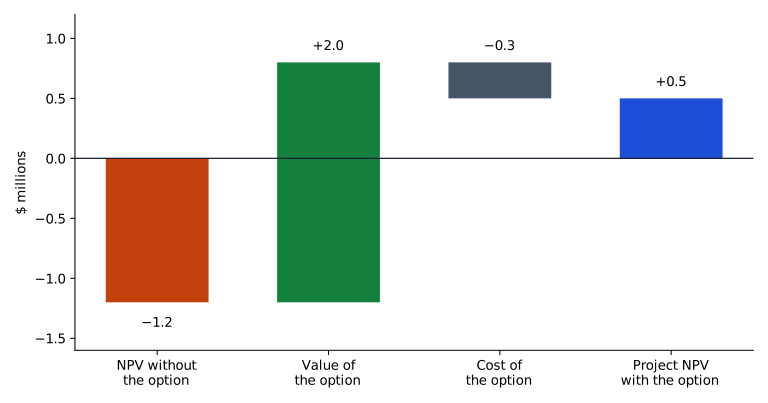
Example. A project's NPV on its own is −1.2m. Paying 0.3m now for an option to expand later adds an estimated 2.0m of option value. Adjusted NPV m, so the project with the option is worth doing.
Common exam traps
- Buying rights now that let the firm invest in future projects (sequels, extra capacity, a second phase) = expansion option.
- Paying overtime or switching inputs is a flexibility option, not an expansion option: it changes how the existing project runs rather than adding a new investment.
- A resource project undertaken because the commodity price is high = fundamental option.
Exam shortcuts
- Test each cost by asking whether the firm's total cash flows change if the project is accepted: amounts already spent are sunk and excluded, while forgone rent, cannibalized sales and extra sales of other products are included.
- If a project's NPV without options is already positive, it can be accepted without valuing its real options, because an option can only add value.
Bottom line
- Capital allocation uses after-tax incremental cash flows rather than accounting income, including the tax savings from depreciation and amortization.
- Sunk costs are excluded, while opportunity costs, cannibalization and positive externalities are included in project cash flows.
- Financing costs are reflected in the required rate of return and are not also deducted from the project's cash flows.
- Cognitive errors include poor forecasting, ignoring the cost of internal funds (the cost of equity) and mixing real and nominal terms, while behavioral biases include pet projects, inertia in the capital budget, decisions based on EPS or ROE and failure to generate alternatives.
- Real options give the right but not the obligation to act and so never have negative value; they include timing, abandonment, expansion, flexibility (price-setting and production-flexibility) and fundamental options.
- A project with real options is worth its NPV without options plus the value of the options minus their cost.
Quick check
For the past eight years, Farrow Plastics' capital budget has been set at roughly the prior year's amount plus 3%, even though the returns on its recent projects have been falling. This practice is best described as which capital allocation pitfall?
Show answer and explanation
Correct answer: C
Anchoring each year's capital budget to the prior year's, rather than to the positive-NPV opportunities actually available, is the behavioral bias of inertia. A budget that stays the same or keeps rising while returns fall is the usual warning sign. A firm focused on shareholder value would return excess funds when good projects are scarce.
Why the other options are wrong
- A. This bias is stopping at the first acceptable idea without searching for better ones. It concerns which projects are proposed rather than how the size of the budget is set.
- B. Pet projects are individual projects backed by influential executives that get optimistic forecasts and little scrutiny. Nothing in the scenario points to a favored project.
Key takeaway A static or steadily rising capital budget combined with declining returns signals inertia (anchoring to last year's budget).
Practice Questions
Harwick Instruments has estimated that a proposed sensor line has an internal rate of return of 11.5% and a net present value of +$1.9 million. The company's 9.0% cost of capital is appropriate for the risk of the line. Harwick should most likely:
Show answer and explanation
Correct answer: C
Both decision rules point the same way. The NPV is positive, so the line is expected to add value for shareholders. The IRR of 11.5% is above the 9.0% cost of capital (the hurdle rate), so the IRR rule also says accept. For a conventional, independent project the two rules always agree, because a discount rate below the IRR produces a positive NPV.
Why the other options are wrong
- A. Rejection would require a negative NPV and an IRR below the hurdle rate. Here the NPV is positive and 11.5% > 9.0%.
- B. The IRR rule also supports acceptance (11.5% exceeds 9.0%). Relying on the NPV alone would only be needed if the two rules conflicted, and they do not here.
Key takeaway Positive NPV and IRR above the cost of capital go together for a conventional independent project: accept on both criteria.
Fenmoor Packaging earns an operating margin after tax of 8.0%, and its sales are 1.5 times its invested capital. The blended rate of return that its debt and equity investors require is 10.0%. Which statement about Fenmoor is most accurate?
Show answer and explanation
Correct answer: C
Return on invested capital (ROIC) is after-tax operating profit divided by invested capital, which equals the operating margin after tax times capital turnover. Analysts compare ROIC with the blended rate of return required by debt and equity investors. Fenmoor's ROIC of 12.0% is above the 10.0% required return, so it is adding value over time.
Compare: , so the firm earns more than its investors require.
Why the other options are wrong
- A. 5.3% divides the margin by the turnover, . ROIC is the product of the two ratios.
- B. 8.0% is the operating margin after tax alone. It measures profit per unit of sales and leaves out how hard the invested capital is worked.
Key takeaway ROIC = operating margin after tax × capital turnover. ROIC above the blended required return means the firm is adding value over time.
Kinloss Cold Storage is evaluating a refrigerated warehouse that would cost $8.20 million today. Discounted at Kinloss's required rate of return, the warehouse's expected after-tax cash flows have a present value of $7.65 million. For an additional $0.45 million paid now, Kinloss can buy the adjoining parcel of land, which would allow it to double the warehouse's capacity later if demand justifies it. Using a decision tree, Kinloss's analysts value this expansion option at $1.30 million. The NPV of the warehouse project including the expansion option is closest to:
Show answer and explanation
Correct answer: A
A real option is brought into the project analysis by adding its estimated value to the NPV without the option and deducting any extra cost of acquiring it. On its own the warehouse has an NPV of −$0.55 million. The expansion option is worth $0.85 million more than it costs, which more than covers that shortfall, so the project with the option has a positive NPV and is worth undertaking.
NPV without the option, in millions of dollars: .
The project with the expansion option has an NPV of about +$0.30 million.
Why the other options are wrong
- B. −$0.55 million is the warehouse's NPV without the option. It leaves out both the $1.30 million value of the expansion option and the $0.45 million paid for it. The NPV without real options serves only as the project's minimum value.
- C. −$1.00 million deducts the $0.45 million cost of the option but gives no credit for its $1.30 million value, as if the option were worth something only once exercised. A real option has value today, and that value can never fall below zero.
Key takeaway . A project with a negative stand-alone NPV becomes acceptable when the option's value, net of its cost, exceeds that shortfall.
This reading has 35 questions in the full bank. Practice all of them.
Key Takeaways
- Depth of analysis rises with uncertainty. Projects that maintain the business need little analysis, regulatory/compliance projects call for comparing alternative ways to comply, and expansion and other projects need the most detailed analysis.
- Positive NPV and IRR above the cost of capital go together for a conventional independent project: accept on both criteria.
- ROIC = operating margin after tax × capital turnover. ROIC above the blended required return means the firm is adding value over time.
- A static or steadily rising capital budget combined with declining returns signals inertia (anchoring to last year's budget).
- . A project with a negative stand-alone NPV becomes acceptable when the option's value, net of its cost, exceeds that shortfall.