Ethical and Professional Standards · Reading 94
Code of Ethics
CFA Level I · Ethical and Professional Standards · Reading 94: Code of Ethics and Standards of Professional Conduct · about 36 min
What you'll learn
- LOS 94.a Describe how the CFA Institute Professional Conduct Program is organized, how inquiries start and proceed, and which sanctions can result.
- LOS 94.b Identify the six components of the Code of Ethics and the seven Standards of Professional Conduct, and tell Code components apart from Standards.
- LOS 94.c Explain the ethical responsibilities set out in the Code and Standards, including every sub-section of each Standard.
Module 94.1
Code and Standards
This reading describes how the CFA Institute Professional Conduct Program enforces the Code and Standards, sets out the Code of Ethics with its six components, and lists the seven Standards of Professional Conduct with their sub-sections. A candidate must be able to explain how an inquiry starts and how it can end, and to match a duty to the Code or to the Standard it comes from.
LOS 94.a — The Professional Conduct Program and enforcement
The Professional Conduct Program is how CFA Institute enforces the Code and Standards: it looks into possible violations and, where needed, imposes sanctions. The Professional Conduct Program (PCP) is governed by the CFA Institute Bylaws and by its Rules of Procedure for Proceedings Related to Professional Conduct. Two principles run through it: fairness toward the members and candidates involved, and confidentiality of the proceedings.
- The CFA Institute Board of Governors has overall responsibility for the program.
- Its Disciplinary Review Committee is responsible for enforcing the Code and Standards.
- The Professional Conduct staff carry out inquiries.
An inquiry can start in five ways. Complaints are only one of them.
- Self-disclosure on the annual Professional Conduct Statement (being party to civil litigation, being under criminal investigation, or being named in a written complaint), for example a statement that reports a pending lawsuit;
- written complaints that reach the Professional Conduct staff about how a member or candidate has acted professionally, such as a client's letter to CFA Institute;
- evidence of misconduct from public sources, such as a newspaper article on a fraud;
- a report by a CFA exam proctor of a possible violation during the exam;
- CFA Institute's own analysis of exam materials and monitoring of social media, which can reveal a candidate posting exam content online.
During an inquiry the staff may ask the member or candidate (in writing) for an explanation, interview him or her, interview the complainant or third parties, and collect relevant documents and records.
The staff may conclude with (1) no disciplinary sanction, (2) a cautionary letter, or (3) disciplinary sanction. A member or candidate offered a proposed sanction can either accept it or reject it. If it is rejected, the matter goes to a disciplinary review panel of CFA Institute members for a hearing.
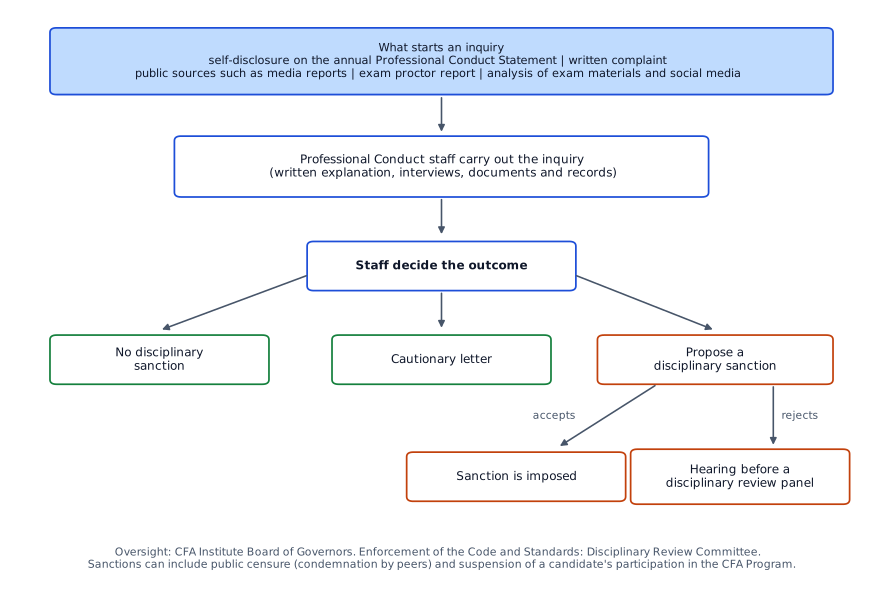
Sanctions may include condemnation by the member's peers (public censure) and suspension of a candidate's continued participation in the CFA Program.
Exam convention: the curriculum lists these two sanctions. Current practice: the preamble to the Code and Standards also names revocation of membership, of candidacy in the CFA Program and of the right to use the CFA designation.
Fines, repayment of profits and bans from working in the industry are not on the list. The program enforces the Code and Standards, which bind members of CFA Institute (including charterholders) and candidates for the CFA designation.
Common exam traps
- Staff do not suspend a member simply because an inquiry is in progress.
- A member who does not yet hold the charter is still bound by the Code and Standards and can be sanctioned; the Code covers all members of CFA Institute, not only charterholders.
- Misconduct under Standard I(D) concerns professional activities. Acts outside a member's professional capacity, such as a minor offense unrelated to work, are not addressed by it, while disclosing exam content violates Standard VII(A).
Worked example: an inquiry under the Professional Conduct Program
A Level II candidate posts a description of several questions from her exam on a social media forum the day after the exam. CFA Institute's monitoring of social media finds the post. Explain how the matter reaches the Professional Conduct staff, what the staff may do, which Standard is involved and how the matter can end.
Step 1. CFA Institute's own monitoring of social media and review of exam materials is one of the five ways an inquiry can start, so no complaint is needed.
Step 2. The staff may ask the candidate in writing for an explanation, interview her and any third parties, and collect relevant documents and records.
Step 3. Disclosing exam content violates Standard VII(A), which covers conduct as a participant in CFA Institute programs.
Step 4. The staff may conclude with no disciplinary sanction, a cautionary letter or a disciplinary sanction. If the staff propose a sanction, the candidate can accept it or reject it; if she rejects it, the matter goes to a hearing before a disciplinary review panel made up of CFA Institute members.
Result. Under the exam convention, the sanctions that apply to a candidate include suspension of her continued participation in the CFA Program; current practice also names revocation of candidacy in the CFA Program.
LOS 94.b — The Code of Ethics and the seven Standards
Key concept
Code of Ethics. Members of CFA Institute and candidates for the CFA designation (Members and Candidates) must (the Code's text is in italics):
- Act with integrity, competence, diligence, respect and in an ethical manner with the public, clients, prospective clients, employers, employees, colleagues in the investment profession, and other participants in the global capital markets.
- Place the integrity of the investment profession and the interests of clients above their own personal interests.
- Use reasonable care and exercise independent professional judgment when conducting investment analysis, making investment recommendations, taking investment actions, and engaging in other professional activities.
- Practice and encourage others to practice in a professional and ethical manner that will reflect credit on themselves and the profession.
- Promote the integrity and viability of the global capital markets for the ultimate benefit of society.
- Maintain and improve their professional competence and strive to maintain and improve the competence of other investment professionals.
Exam convention: the curriculum prints component 1 with a comma after "respect". Current practice: the official Code text has no comma there, as shown above.
The seven Standards of Professional Conduct:
I. Professionalism · II. Integrity of Capital Markets · III. Duties to Clients · IV. Duties to Employers · V. Investment Analysis, Recommendations, and Actions · VI. Conflicts of Interest · VII. Responsibilities as a CFA Institute Member or CFA Candidate.
The Code is short and general. Specific duties, such as keeping records or distinguishing fact from opinion, come from the Standards. The table maps phrases that often appear in questions to their source.
| Sounds like... | Where it lives |
|---|---|
| "integrity, competence, diligence, respect" | Code, component 1 |
| "use reasonable care and exercise independent professional judgment" | Code, component 3 |
| "reflect credit on the profession" | Code, component 4 |
| "professional competence" of self and others | Code, component 6 |
| act with and maintain the competence one's own responsibilities require | Standard I(E) |
| comply with laws; stricter law applies | Standard I(A) |
| diligence, independence and thoroughness in analysis | Standard V(A) |
| suitability of investments | Standard III(C) |
| priority of client transactions | Standard VI(B) |
| integrity of the CFA designation and exams | Standard VII(A) |
Several plausible-sounding duties are not components of the Code: complying with the Global Investment Performance Standards (GIPS); advocating new laws; educating the general public; honoring contractual provisions; maximizing return per unit of risk.
Common exam traps
- Component 1 names specific groups (public, clients, prospective clients, employers, employees, colleagues, other market participants). It does not name "CFA Program candidates" as a group.
- The four qualities in component 1 are integrity, competence, diligence and respect. Honesty, candor, skill and humility are not on the list.
LOS 94.c — The Standards and their sub-sections
Key concept
| Standard | Sub-sections | Core requirement in brief |
|---|---|---|
| I Professionalism | I(A) Knowledge of the Law; I(B) Independence and Objectivity; I(C) Misrepresentation; I(D) Misconduct; I(E) Competence | Know and follow the stricter of applicable law and the Code and Standards and dissociate from violations; maintain independence and objectivity, with no gift or benefit that could compromise it; no knowing misstatements; no professional conduct involving dishonesty, fraud or deceit, and no act that reflects badly on professional reputation, integrity or competence; stay competent |
| II Integrity of Capital Markets | II(A) Material Nonpublic Information; II(B) Market Manipulation | Don't act or cause others to act on material nonpublic information; don't distort prices or inflate volume to mislead |
| III Duties to Clients | III(A) Loyalty, Prudence, and Care; III(B) Fair Dealing; III(C) Suitability; III(D) Performance Presentation; III(E) Preservation of Confidentiality | Duty of loyalty, reasonable care and prudent judgment, with clients' interests ahead of the employer's and one's own; treat all clients fairly; in an advisory relationship, inquire into the client's experience, objectives and constraints before acting and reassess regularly, confirm that each investment suits the client's financial situation and written objectives, mandates and constraints, and judge suitability in the total-portfolio context; when managing to a stated mandate, act only within its objectives and constraints; fair, accurate, complete performance; keep information about current, former and prospective clients confidential unless it concerns illegal activities on the part of the client, disclosure is required by law, or the client or prospective client permits it |
| IV Duties to Employers | IV(A) Loyalty; IV(B) Additional Compensation Arrangements; IV(C) Responsibilities of Supervisors | Act for the employer's benefit: don't withhold skills, divulge confidential information or otherwise harm the employer; get written consent from all parties before accepting compensation or benefits that compete or could conflict with the employer's interest; make reasonable efforts to make supervisees comply |
| V Investment Analysis, Recommendations, and Actions | V(A) Diligence and Reasonable Basis; V(B) Communication with Clients and Prospective Clients; V(C) Record Retention | Diligence, independence and thoroughness, with a reasonable and adequate basis; disclose the nature and cost of services, the investment process (and material changes to it promptly), and significant risks and limitations; include the important factors in client communications; separate fact from opinion; keep records supporting analysis, recommendations and client communications |
| VI Conflicts of Interest | VI(A) Avoid or Disclose Conflicts; VI(B) Priority of Transactions; VI(C) Referral Fees | Avoid, or fully and fairly disclose, matters that could impair independence and objectivity or interfere with duties, in prominent, plain-language disclosures; client and employer trades before personal trades; disclose referral compensation |
| VII Responsibilities as a CFA Institute Member or CFA Candidate | VII(A) Conduct as Participants in CFA Institute Programs; VII(B) Reference to CFA Institute, the CFA Designation, and the CFA Program | Don't compromise the reputation or integrity of CFA Institute or the CFA designation, or the integrity, validity or security of CFA Institute programs; don't misrepresent or exaggerate what membership, the charter or candidacy means |
Exam convention: the curriculum's list of the Standards extends the first III(E) exception to illegal activities of a prospective client as well as of the client. Current practice: the official Standard III(E) names illegal activities on the part of the client only, so the exception is not extended to a prospective client.
Mini-cases
- Standard I(C) Misrepresentation. A salesperson tells a prospect that her firm has an emerging-markets desk, not knowing whether that is true. Presenting a claim as fact without knowing whether it is true is misleading. Once she learns it is false she must correct it, and staying silent after learning the truth is a further failure.
- Standard V(C) Record Retention. A manager recommends a trade to a client over dinner. Back at the office he should document the recommendation, its basis and the client's response. Suitability should already have been assessed before the recommendation was made, and nothing should be executed until the client gives instructions.
- Standard III(B) Fair Dealing. Before changing a research rating, the firm should limit the number of people who know the change is coming and shorten the time between the decision and its release. Its personnel guidelines for pre-dissemination should forbid anyone with prior knowledge from discussing or acting on the pending change, and the change should go to all interested clients at the same time.
- Standard I(A) Knowledge of the Law. Where local law is less demanding than the Code and Standards, the member follows the Code and Standards because they are more strict. Where local law is stricter, the member follows local law.
- Standard III(E) Preservation of Confidentiality. Information about a client's illegal activity is an exception to the duty of confidentiality, so disclosing it to the authorities is permitted without the client's consent.
Common exam traps
- A misrepresentation need not be a deliberate lie. Presenting as fact a claim one knows is unverified, or leaving a statement uncorrected after learning it is false, is enough.
- Additional compensation arrangements belong to Standard IV Duties to Employers (IV(B)), even when a client offers the compensation.
Exam shortcuts
- Specific duties such as keeping records or distinguishing fact from opinion come from the Standards, so an answer that places them in the Code of Ethics can be ruled out.
Bottom line
- The Professional Conduct Program enforces the Code and Standards on the principles of fairness and confidentiality: the Disciplinary Review Committee is responsible for enforcement and the Professional Conduct staff carry out inquiries.
- An inquiry can start from self-disclosure on the annual Professional Conduct Statement, a written complaint, evidence from public sources, a report by an exam proctor, or CFA Institute's own monitoring of social media and review of exam materials.
- The Professional Conduct staff may conclude with no disciplinary sanction, a cautionary letter or a disciplinary sanction, and a member or candidate who rejects a proposed sanction is referred to a disciplinary review panel for a hearing.
- Exam convention: the sanctions listed are condemnation by the member's peers (public censure) and suspension of a candidate's continued participation in the CFA Program. Current practice: the preamble to the Code and Standards also names revocation of membership, of candidacy and of the right to use the CFA designation.
- Component 1 of the Code names four qualities, integrity, competence, diligence and respect, while complying with GIPS, advocating new laws, educating the general public, honoring contractual provisions and maximizing return per unit of risk are not components of the Code.
- Standards I to VII cover, in order: professionalism; integrity of capital markets; duties to clients; duties to employers; investment analysis, recommendations, and actions; conflicts of interest; and responsibilities as a CFA Institute member or candidate.
- Under Standard I(A), a member follows the Code and Standards where local law is less demanding and follows local law where it is stricter.
- The Code and Standards bind members of CFA Institute, including charterholders, and candidates for the CFA designation, so a member who does not yet hold the charter can still be sanctioned.
Quick check
Moses Adeyemi, CFA, is told that the Professional Conduct staff have concluded that he violated the Code and Standards, and they propose a disciplinary sanction. If Adeyemi rejects the proposed sanction:
Show answer and explanation
Correct answer: B
A member or candidate may accept or reject a sanction proposed by the Professional Conduct staff. If it is rejected, the matter is referred to a disciplinary review panel of CFA Institute members, which holds a hearing.
Why the other options are wrong
- A. Rejecting a proposed sanction does not trigger an automatic suspension; it leads to a hearing.
- C. Rejection does not end the matter; the existing case is referred to a disciplinary review panel of CFA Institute members for a hearing.
Key takeaway A rejected sanction goes to a hearing before a disciplinary review panel.
Practice Questions
Sven Adler, a CFA candidate, is making flash cards. He marks each duty "Code" if it is one of the six components of the Code of Ethics and "Standard" if it appears only in the Standards of Professional Conduct. Which of the following duties should Adler mark "Standard"? Members and candidates must:
Show answer and explanation
Correct answer: A
Standard VII(A) Conduct as Participants in CFA Institute Programs forbids members and candidates to do anything that damages the reputation or integrity of CFA Institute or the CFA designation, or that undermines the integrity, validity or security of CFA Institute programs (for example, cheating on the CFA exam or disclosing its content). This is a specific Standard: none of the six components of the Code of Ethics mentions CFA Institute, the CFA designation or its programs, so Adler should mark this duty "Standard".
Why the other options are wrong
- B. Placing the integrity of the investment profession and the interests of clients above one's own personal interests is the second component of the Code of Ethics, so this card should be marked "Code".
- C. Promoting the integrity and viability of the global capital markets for the ultimate benefit of society is the fifth component of the Code of Ethics, so this card should be marked "Code".
Key takeaway The Code's six components are broad principles; the duty to protect the reputation and integrity of CFA Institute, the CFA designation and the CFA exams comes from Standard VII(A).
Elena Varga, CFA, is a relationship manager at Northgate Wealth Partners. A prospective client asks whether Northgate can manage a portfolio of Indian equities. Varga has heard that her colleague Tomas Reyes might have managed Indian equities at a previous employer, and without checking she tells the prospect that Northgate has that expertise. Two days later she learns that Reyes has never managed Indian equities. She does not contact the prospect, who later opens an account with Northgate. Varga has:
Show answer and explanation
Correct answer: A
Standard I(C) Misrepresentation prohibits members and candidates from knowingly making misrepresentations about their professional activities, and this includes claims, spoken or written, about what their firm is able to offer clients. Varga did not know whether her claim was true, so presenting it as fact was misleading even though it was not a deliberate lie. Once she learned it was false, she was obliged to go back to the prospect and set the record straight, and she did not.
Why the other options are wrong
- B. The first statement was already a violation: asserting the firm's expertise without knowing whether it existed misrepresented the firm's services.
- C. A lack of intent does not excuse the claim. Presenting an unverified claim as fact is misleading, and failing to correct it after learning the truth is a further violation.
Key takeaway Standard I(C) Misrepresentation: do not present as fact something not known to be true, and correct a misstatement as soon as it comes to light.
This reading has 34 questions in the full bank. Practice all of them.
Key Takeaways
- A rejected sanction goes to a hearing before a disciplinary review panel.
- The Code's six components are broad principles; the duty to protect the reputation and integrity of CFA Institute, the CFA designation and the CFA exams comes from Standard VII(A).
- Standard I(C) Misrepresentation: do not present as fact something not known to be true, and correct a misstatement as soon as it comes to light.