Ethical and Professional Standards · Reading 95
Knowledge of the Law
CFA Level I · Ethical and Professional Standards · Reading 95: Guidance for Standard I: Professionalism · about 1 h 4 min
What you'll learn
- LOS 95.a Apply the Code and Standards, in particular Standards I(A) Knowledge of the Law, I(B) Independence and Objectivity, I(C) Misrepresentation, I(D) Misconduct, and I(E) Competence, to situations involving professional integrity.
- LOS 95.b Recommend practices and procedures (e.g., consulting counsel and dissociating, restricted lists, gift limits, background checks, continuing education) that prevent violations of the Code and Standards.
- LOS 95.c Identify conduct that conforms to the Code and Standards and conduct that violates them.
Module 95.1
Guidance for Standards I(A), I(B), I(C), I(D), and I(E)
This reading covers Standard I, Professionalism: Knowledge of the Law, Independence and Objectivity, Misrepresentation, Misconduct and Competence. For each part a candidate must be able to explain what it requires, apply it to a fact pattern, and recommend practices and procedures that help prevent violations.
Standard I Professionalism has five parts: Standard I(A) Knowledge of the Law, Standard I(B) Independence and Objectivity, Standard I(C) Misrepresentation, Standard I(D) Misconduct, and Standard I(E) Competence. Questions on Standard I often bring in other Standards too, such as a trustee who trades on a tip or an adviser who never updates client data. Those related Standards are summarized in a table at the end.
LOS 95.a / 95.c — Standard I(A) Knowledge of the Law
Key concept
Members and candidates must understand and comply with all applicable laws, rules, and regulations (including the CFA Institute Code of Ethics and Standards of Professional Conduct) of any government, regulatory organization, licensing agency, or professional association governing their professional activities. In the event of conflict, Members and Candidates must comply with the more strict law, rule, or regulation. Members and Candidates must not knowingly participate or assist in and must dissociate from any violation of such laws, rules, or regulations.
Guidance
- Strictest rule wins. The Code and Standards set a minimum level of professional conduct. A member compares the laws that apply to the activity (those of the country where he or she resides and of the country where the business is done, to the extent each governs it) with the Code and Standards, and follows whichever is strictest on each point. Where applicable law is weaker or silent, the Code and Standards govern, so a country with no securities law relaxes nothing.
- A member cannot use a permissive local rule to do something the Code and Standards forbid. If a market legally allows trading on material nonpublic information, a member still may not trade on it, either for clients or for his or her own account.
- Knowledge of the law means keeping current. Members need not be legal experts, but they must know the rules that govern their jobs, including new rules. Breaking an applicable rule the member did not know about is still a violation, even if a regulator's grace period allows the breach to be corrected without penalty. Relying solely on the firm's compliance department is not enough.
- Knowingly participating or assisting includes looking the other way: a member who knows (or who is dealing with conduct whose illegality would be evident to anyone knowing the law) and takes no action to stop it or to dissociate can be treated as a participant. Senior management approval does not excuse a member. Passing the task to someone else, such as asking a supervisor to sign a document the member has refused to sign, is still assisting.
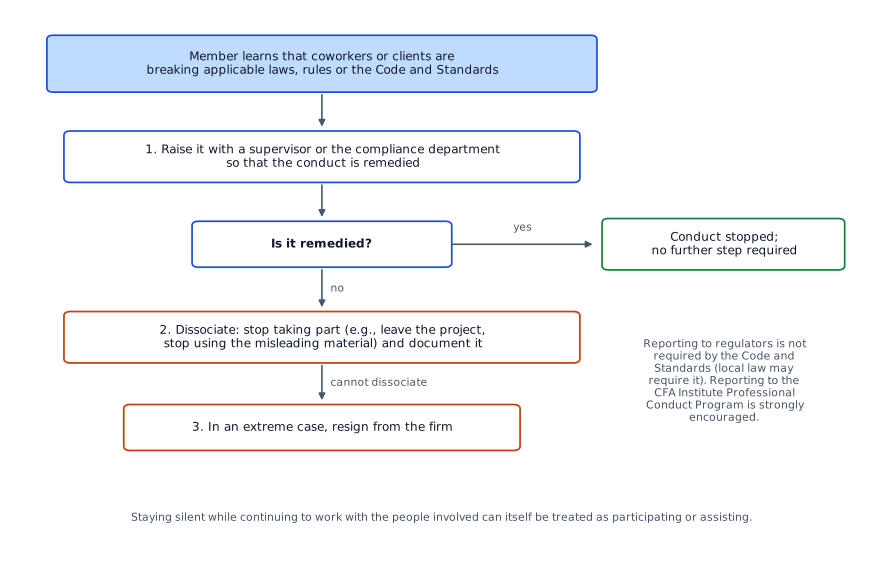
- Reporting. The Code and Standards do not require members to report wrongdoers to governmental or regulatory authorities, although local law may require it and reporting may be prudent. CFA Institute strongly encourages members to report potential violations of the Code and Standards by other members and candidates to the CFA Institute Professional Conduct Program.
- Escalation path. A member who learns that coworkers or clients are breaking applicable rules first goes to a supervisor or the compliance department to have the conduct remedied. If they will not or cannot fix it, the member must dissociate (e.g., stop working with a trading desk that allocates client trades unfairly, stop using marketing material the member knows or should know is misleading). In an extreme case, dissociation may mean resigning from the firm.
- Because the Code and Standards are themselves among the rules a member must obey, any violation of the Code and Standards is also a violation of Standard I(A).
- Standard I(A) covers the rules that govern professional activities. A scuffle at a recreational sports match or a traffic offense is personal conduct. It falls outside Standard I(A) and, for the same reason, outside Standard I(D) Misconduct (see below).
Example: which rule applies?
| Situation | Law where member resides | Law where business is done | Member must follow |
|---|---|---|---|
| Home law weaker than the Code; client country has no securities law | Weaker than Code | None | Code and Standards in both countries |
| Client country's disclosure rule is stricter than the Code | Weaker than Code | Stricter than Code | Client country's law for that business |
| Home country forbids gifts from issuers, and the ban covers its residents' business abroad; business country allows them | Stricter than Code | Weaker than Code | Home law (no gifts) |
| Home law is stricter than the Code but tells residents to follow local law for business done abroad; client country's law is weaker than the Code | Stricter than Code, but defers to local law abroad | Weaker than Code | Code and Standards |
Recommended procedures (LOS 95.b)
- When in doubt about legality: consult a supervisor, compliance personnel or a lawyer (legal counsel).
- When dissociating: keep records documenting the violation, encourage the employer to bring it to an end, and remove one's name from documents one cannot stand behind.
- Members (or their employers) should: set up procedures that keep employees informed of changes in relevant laws, rules, and regulations; review the written compliance procedures regularly; and maintain copies of current laws, rules, and regulations.
- Firms should: have a code of ethics, give employees information on the laws, rules, and regulations that govern their professional activities, and have procedures for reporting suspected violations.
Worked example: dissociating from a violation
A portfolio manager learns that her firm's trading desk regularly gives its best fills on block trades to a few large accounts, which breaks the firm's allocation rules and applicable regulation. She is not involved in the allocations, but her own clients' orders go through the desk. Explain what Standard I(A) requires of her and what she should do.
Step 1. Standard I(A) forbids knowingly participating or assisting in a violation of applicable laws, rules or regulations and requires dissociation from it. Looking the other way after learning of the practice could make her a participant.
Step 2. She takes the matter to her supervisor or the compliance department to have the conduct remedied.
Step 3. If they will not or cannot fix it, she must dissociate, for example by not working with the desk for her clients' trades. In an extreme case, dissociation may mean resigning from the firm.
Step 4. While dissociating, she keeps records documenting the violation and encourages the firm to bring it to an end.
Result. The Code and Standards do not require her to report the desk to a regulator, although local law may require it and reporting may be prudent; CFA Institute strongly encourages members to report potential violations by other members and candidates to the Professional Conduct Program.
LOS 95.a / 95.c — Standard I(B) Independence and Objectivity
Key concept
Members and candidates must use reasonable care and judgment to achieve and maintain independence and objectivity in their professional activities. Members and Candidates must not offer, solicit, or accept any gift, benefit, compensation, or consideration that reasonably could be expected to compromise their own or another's independence and objectivity.
Guidance
- Gifts and entertainment. Modest gifts and ordinary business entertainment are acceptable. The test is objective: whether the item could reasonably be expected to compromise judgment, whatever the member believes about her own resolve. The Standard does not require token items from non-clients to be reported to the employer, although firm policy may. Distinguish the source:
- a gift from a client usually rewards past service and is considered less likely to impair objectivity. It may be accepted, but it must be disclosed to the employer, before acceptance if possible and otherwise afterward. Standard IV(B) Additional Compensation Arrangements requires written consent when the benefit is compensation tied to future performance;
- a gift from a party seeking to influence the member (an issuer, a broker, a fund sponsor) calls for more caution.
- Offering benefits. The Standard covers giving as well as receiving. A manager competing for a university endowment's mandate who treats the chair of its investment committee to a weekend at a luxury resort violates Standard I(B), even if his own firm approved the cost as a marketing expense.
- Pressure and inducements to give a security a particular rating, to select certain outside managers or vendors, or to produce favorable (or unfavorable) research all threaten objectivity. A member who lets them shape the analysis violates the Standard. Allocating shares of an oversubscribed IPO to one's personal account violates this Standard and Standard III(B) Fair Dealing.
- Sell-side and investment banking pressure. Research must reflect the analyst's own view even when the firm's investment banking department has a relationship with the issuer. Firms separate research from banking with firewalls. When a firm does not want to issue a negative opinion on a banking client, it places the company on a restricted list and publishes only factual information, instead of issuing favorable opinions it does not hold. A banker may tell a prospective corporate finance client that the firm will cover the company, but may not promise favorable research: the analysts must stay free to reach their own conclusion.
- Buy-side and issuer pressure. Portfolio managers who hold a stock may lean on analysts not to downgrade; companies may threaten to cut off access. Neither is a reason to change a rating.
- Issuer-paid research is permitted if compensation is a flat fee (best practice: agreed before the report is written) that is not tied to the report's conclusions, recommendations, or market impact, and if the fact that the research is issuer-paid is disclosed.
- Credit ratings. Ratings from recognized agencies are not automatically objective; members should consider the conflicts of interest in the rating process and may need independent research to judge a rating's soundness.
- Using outside research. A member may rely on third-party research (another firm's reports, a data vendor, a model licensed from outside) after a reasonable and diligent review of its assumptions and soundness. Nothing requires a member to use only his own or his firm's research.
- Other pressures include fund manager and custodial relationships, credit rating agency work, performance measurement, and the member's own holdings in a covered stock (disclose them).
Recommended procedures (LOS 95.b)
- Members: pay (or have the firm pay) for travel to company events when practicable; limit use of corporate aircraft to trips where commercial travel is not an alternative.
- Firms: restrict employee participation in IPOs and private placements and require pre-approval for participation; appoint a compliance officer, have written policies on independence and objectivity, and establish clear procedures for reporting violations; allow only token items as gifts from anyone other than clients.
LOS 95.a / 95.c — Standard I(C) Misrepresentation
Members and candidates must not knowingly make any misrepresentations relating to investment analysis, recommendations, actions, or other professional activities.
Guidance
- Misrepresentation includes knowingly misleading investors, omitting relevant information, presenting selective data to mislead, and plagiarism.
- Typical violations: presenting third-party research as one's own; guaranteeing a specific return on securities not explicitly guaranteed by a government body or financial institution; picking the valuation service that assigns the highest values to untraded holdings; choosing a benchmark that is not comparable to the strategy; performance or attribution data that omit accounts or relevant variables; false or misleading claims about the experience, expertise or capabilities of the analyst or the firm; and using misleading third-party marketing materials.
- Services and qualifications. Members must not overstate their own experience, credentials, or their firm's capabilities. Telling a client "our firm can handle all your needs" is acceptable if it is true, based on the firm's actual capabilities and the client's facts. A trainee claiming years of experience in areas she does not cover is a violation. Claiming a degree before it has been awarded (for example, by handing out business cards that show it) is a violation. Ordering cards to use once the degree is awarded is not.
- Guarantees. Accurately describing an instrument that really is guaranteed by a government body or financial institution (e.g., a government-backed bond) is not a misrepresentation. An opinion ("I think this stock looks attractive") is not a guarantee.
- Keeping information current. If a member is responsible for a firm website or marketing material, outdated or inaccurate content that clients rely on is a misrepresentation. An honest slip, such as a misplaced decimal point in a published report, is not a knowing misstatement when it is made. Once the member discovers it, she must stop its circulation and correct it promptly, because continuing to circulate it after that point would be a knowing misrepresentation.
- Plagiarism means taking charts, graphs, spreadsheets, models, forecasts, reports, ideas or quotations that others created and using them without crediting the source. Quotations attributed to "leading analysts" without naming them, and slightly reworded excerpts from another analyst's report used without credit, are plagiarism. Exception: projections, statistics, and tables from recognized financial and statistical reporting services (factual data such as government bond yields or published index levels, as distinct from someone's analysis or opinion) may be used without citation. Models or research developed by colleagues at the member's own firm may be used, and the names of colleagues who have left may be omitted, as long as the member does not present that earlier work as solely his own.
- Forecasts or statistics by others used with the source named but with their original qualifications stripped out still mislead.
Recommended procedures (LOS 95.b)
- Members: prepare a summary of their own experience, qualifications, and the services they can perform; cite the source of any summaries of others' material; keep copies of all reports, articles, and other materials used in preparing research; encourage employers to verify marketing materials provided by third parties.
- Firms: provide a written list of the firm's available services and qualifications, and periodically review employees' documents and communications (including websites) to catch any misstatement of the qualifications and capabilities of employees or the firm.
LOS 95.a / 95.c — Standard I(D) Misconduct
Members and candidates must not engage in any professional conduct involving dishonesty, fraud, or deceit or commit any act that reflects adversely on their professional reputation, integrity, or competence.
Guidance
- Any professional conduct involving dishonesty, fraud, or deceit is a violation: lying under oath (perjury) in a case involving the firm, padding expense reports, falsifying a résumé, making promises the member knows cannot be kept.
- The Standard applies only to conduct in professional activities; acts outside a member's professional capacity are not addressed by it. Professional activities include dealings with clients, employees, and coworkers; activities as a member, charterholder, or candidate; volunteer work for a CFA society or CFA Institute; attending industry events, meetings, or courses; writing about investments (articles, reports, message boards) even outside the workplace; and communications with regulators and professional organizations.
- Misconduct can involve legal as well as illegal acts. Behavior that impairs the ability to perform professional duties, such as excessive drinking during business hours or coming to work intoxicated, violates the Standard. So does failing to act when professional obligations require it, such as neglecting due diligence on a recommendation.
- Not every illegal act is misconduct: civil disobedience (such as being arrested at a peaceful protest) is generally not a violation because it does not reflect on honesty, integrity, or competence. Personal bankruptcy is not a violation unless fraudulent or deceitful professional conduct was part of the circumstances.
- Members must not use enforcement of this Standard to settle personal, political, or other disputes unrelated to professional ethics or competence.
Recommended procedures (LOS 95.b)
Firms should adopt a code of ethics that states plainly that unethical behavior will not be tolerated, provide employees with a list of potential violations and sanctions (up to dismissal), and check references of potential employees (background checks on character and eligibility to work in the industry). Such checks are a recommended practice and do not breach any privacy obligation under the Code.
LOS 95.a / 95.c — Standard I(E) Competence
Members and candidates must act with and maintain the competence necessary to fulfill their professional responsibilities.
Guidance
- Competence means having, and keeping up, the knowledge, skills and abilities that the member's professional responsibilities require.
- What counts as competent depends on the role the member takes on.
- When a member accepts a new or unfamiliar role, it is the member's own responsibility, not the employer's, to develop the abilities, skills, and knowledge the role calls for.
- Continuing education is recommended. The Standard does not require it.
- A poor outcome does not by itself show a lack of competence. A recommendation that turns out badly, made with reasonable analysis, violates neither I(E) nor V(A) Diligence and Reasonable Basis.
Recommended procedures (LOS 95.b)
Ways to maintain competence include continuing education, professional development and employer-provided training; earning professional designations; going to relevant seminars and conferences; joining professional organizations; and informal self-study.
Related Standards that appear in the same fact patterns
Each of these Standards has its own module with the full guidance. The table gives only the points that the questions in this module rely on.
| Standard | Key point when it appears alongside Standard I |
|---|---|
| II(A) Material Nonpublic Information | Do not act or cause others to act until the information is public (a magazine article out "tomorrow" is still nonpublic; news given on a conference call to analysts is not public until the announced press release). The recommended response is to make reasonable efforts to achieve public dissemination of the information by the company. The mosaic theory permits conclusions built from public information plus nonmaterial nonpublic information (e.g., executives' travel). The Standard applies to anyone who possesses such information, however it was obtained (overheard, read in a spouse's papers). Firms prevent misuse with firewalls (control of interdepartmental information), watch or restricted lists and review of trading. |
| III(A) Loyalty, Prudence, and Care | Duty is to the ultimate beneficiaries: for a pension plan, the plan participants and beneficiaries, not the sponsor or the company paying the adviser. Proxy voting must be informed and in clients' interests (not rubber-stamped with management, and not passed to a sponsor when the manager has been given voting authority). Soft dollars: client brokerage must be used to benefit the client, so it may pay for research that benefits the client but never for the manager's own operating expenses. Governance and soft-dollar issues fall under this Standard. Because of cost–benefit considerations, it may not be necessary to vote every proxy. |
| III(B) Fair Dealing | Do not use hot-issue allocations to reward, placate or retain a client; offer a new issue to every client for whom it is suitable and prorate it if it is oversubscribed. Disseminate recommendation changes through a system designed to treat all clients fairly (fair, not necessarily simultaneous); never tip selected colleagues, analysts or journalists first. An issuer should release material news by press release, not to favored analysts. A client's order that goes against the current recommendation may be executed after the client is told of the recommendation. A family member's fee-paying account in which the member has no beneficial interest is treated like any other client account, neither favored nor excluded, including in the order of trades under VI(B). |
| III(C) Suitability | Reasonable inquiry into the client's investment experience, objectives (risk and return) and constraints before acting, reassessed and updated regularly (not only when something changes). A process that looks only at the probability of reaching a return target ignores risk tolerance. Suitability is judged for the portfolio as a whole, not security by security; update the policy statement when circumstances change (e.g., the client sells the concentrated holding that a hedge was built around). |
| III(D) Performance Presentation | Performance must be fair, accurate and complete: presenting one account's results as representative of all accounts is a violation. Recommended practice: present a weighted composite of similar portfolios, include terminated accounts and state when they were terminated, and disclose whether results are gross or net of fees. |
| III(E) Preservation of Confidentiality | Keep information about current, former and prospective clients confidential; for example, never pass client names to a charity, however worthy. Cooperating with an investigation by the CFA Institute Professional Conduct Program is permitted. |
| IV(A) Loyalty | Employer's models and records are employer property; copying them without permission is a violation, even if the employer no longer uses them. Honor legal and confidentiality agreements with former employers. While still employed, a member may prepare to compete (register a firm, sign a lease) but must not solicit clients or take records; after leaving, and absent a non-compete agreement, former clients may be contacted using memory and public sources. Giving the employer a copy of the Code and Standards is recommended, not required. |
| IV(B) Additional Compensation Arrangements | Written consent from all parties involved before accepting compensation, such as board fees and options, that competes with or could create a conflict with the employer's interest. |
| IV(C) Responsibilities of Supervisors | A supervisor needs adequate compliance procedures; if the firm will not adopt them, the member should decline in writing to accept supervisory responsibility until it does. Missing procedures (e.g., none for allocating block trades) are a supervisory failure. |
| V(A) Diligence and Reasonable Basis | Recommendations need a reasonable and adequate basis; extrapolating a manager's offhand conjecture into a published claim fails this test, and so does changing a rating on a colleague's unfinished notes. A thoroughly researched quantitative model that the manager understands is a reasonable basis; applying a model one does not understand is a diligence failure. A poor outcome, or a later restatement by the issuer, does not by itself show a lack of diligence. |
| V(B) Communication with Clients and Prospective Clients | Disclose the basic format and general principles of the investment process and promptly disclose changes that could materially affect it (e.g., a new valuation method, or managers overriding a quantitative model with their own research). Routine refinements of a model need not be disclosed one by one. Distinguish fact from opinion. |
| VI(A) Avoid or Disclose Conflicts | Disclose board seats, stock options and similar interests to the employer and clients. The firm's market-making activity in a security and board seats held by the firm's principals must be disclosed in research and to clients. Personal matters such as a bankruptcy need disclosure only if they create a conflict. |
| VI(B) Priority of Transactions | Client and employer trades come before trades in which the member has beneficial ownership. Firms may require duplicate confirmations and pre-clearance; they need not collect the holdings of employees' friends. Order: clients first, then the employer's own account, then the member's personal account. A family member's fee-paying client account ranks with other clients (see III(B)). The member may own the same securities as clients, as long as client trades come first. |
| VI(C) Referral Fees | Disclose referral fees to the employer, clients and prospects; where local law bans them outright, the stricter rule (the ban) governs. |
| VII(B) Reference to CFA Institute, the CFA Designation, and the CFA Program | Members must sign the Professional Conduct Statement and pay dues each year; a member who does not is no longer an active member, so presenting the CFA designation as current would misrepresent membership. A true statement, such as having completed the CFA Program in three years, is acceptable; claiming superior ability because of it is not. No form of the designation (e.g., "CFA in waiting") before the charter is awarded — state facts such as the levels passed. Refer to someone as a CFA candidate only while he or she is registered for a CFA exam or awaiting its results. Statements that the charter reflects commitment to ethics are fine; implying superior performance is not. |
Common exam traps across the reading
- "The Code and Standards apply only where the law is silent" is wrong.
- Most items turn on a single fact in the stem, such as commercial travel being unavailable, information already being public, or a statement being based on fact.
Bottom line
- Under Standard I(A), a member compares the applicable laws with the Code and Standards and follows whichever is strictest on each point, so where applicable law is weaker or silent the Code and Standards govern.
- A member who learns that coworkers or clients are breaking applicable rules goes to a supervisor or the compliance department to have the conduct remedied and, if it is not remedied, must dissociate, which in an extreme case may mean resigning.
- The Code and Standards do not require a member to report wrongdoers to governmental or regulatory authorities, although local law may require it.
- Under Standard I(B), modest gifts and ordinary business entertainment are acceptable, the test being whether an item could reasonably be expected to compromise independence and objectivity, and a gift from a client may be accepted but must be disclosed to the employer.
- Issuer-paid research is permitted if the compensation is a flat fee not tied to the report's conclusions, recommendations or market impact and the issuer payment is disclosed.
- Under Standard I(C), misrepresentation covers plagiarism, selective data presented in order to mislead, the omission of relevant information and any knowing attempt to mislead investors, but factual data from recognized financial and statistical reporting services may be used without citation.
- Standard I(D) covers only professional conduct: dishonesty, fraud or deceit violates it, while civil disobedience is generally not a violation and personal bankruptcy is not one unless fraudulent or deceitful professional conduct was involved.
- Under Standard I(E), the member, not the employer, is responsible for developing the competence a new role requires, and continuing education is recommended but not required.
Quick check
After 18 years with a large Toronto asset manager, Lionel Batiste, CFA, sets up his own advisory firm in Port Aurelia, a jurisdiction whose securities rules are far weaker than both Canadian law and the CFA Institute Standards of Professional Conduct. Most of his clients are Canadian residents who moved their accounts to the new firm, and Canadian law continues to apply to his dealings with them. Batiste finds that Port Aurelia rules would let him skip several client disclosures that he always had to make in Canada. According to the Code and Standards, Batiste must follow:
Show answer and explanation
Correct answer: C
Under Standard I(A) Knowledge of the Law, when applicable laws and the Code and Standards differ, members must follow the strictest requirement: the law where they live, the law where they do business (including the law governing their clients' accounts), or the Code and Standards. Because Canadian law still governs his dealings with Canadian clients, Batiste must meet the stricter of Canadian law and the Code and Standards.
Why the other options are wrong
- A. Moving to a less strict jurisdiction does not lower the standard. Disclosing the differences to clients does not allow a member to follow a weaker rule.
- B. The Code and Standards are a minimum, not the only rule. If applicable law (here, Canadian law) is stricter on a point, the member must comply with that law as well.
Key takeaway When several rule sets apply, follow the strictest one. Moving offshore never lowers the bar.
Practice Questions
Irene Vautrin, CFA, has managed domestic large-cap equity portfolios for ten years. Her firm asks her to take over its frontier-market bond fund next month, an asset class she has never analyzed. Which response is most consistent with Standard I(E) Competence?
Show answer and explanation
Correct answer: A
Standard I(E) requires members to act with and maintain the competence (abilities, skills and knowledge) that their professional responsibilities require. When a member accepts a new or unfamiliar role, it is her own responsibility to develop the competence that role calls for, for example through study, training, or working with experienced colleagues.
Why the other options are wrong
- B. Employer training can help, but the responsibility for acquiring the needed competence rests with the member.
- C. The Standard does not bar members from new roles or asset classes; it requires them to become competent in them.
Key takeaway A new role calls for new competence, and the member, not the employer, is responsible for acquiring it.
Hana Petrov runs an independent advisory practice with 140 individual clients. When she takes on a new client, she collects the information she needs to make recommendations, such as the client's tax situation, income, spending needs, and willingness to take risk. With respect to this client information, the Standards require Petrov to:
Show answer and explanation
Correct answer: B
Standard III(C) Suitability requires an adviser to make a reasonable inquiry into a client's objectives and constraints before acting and to reassess and update that information regularly. Waiting for a trigger event, such as a portfolio change or news of a change in the client's life, is not enough, because circumstances can change without the adviser being told.
Why the other options are wrong
- A. Tying updates to portfolio changes gets the logic backwards: portfolio decisions should rest on current client information, which must be refreshed regularly.
- C. Updating after a known change is necessary but not sufficient; the Standard calls for regular reassessment so that unreported changes are picked up.
Key takeaway Client profiles are not one-off: reassess them regularly (and at least whenever a material change becomes known).
While looking for a file on her firm's shared drive, Nadia Petrova, an equity analyst, opens a colleague's half-finished draft notes on a retailer that Petrova covers. After reading them, and without doing any further work, Petrova immediately changes her own recommendation on the retailer from sell to buy. Which Standard has Petrova violated?
Show answer and explanation
Correct answer: A
Changing a recommendation on the strength of a colleague's incomplete notes, without any review or analysis of her own, shows a lack of diligence and thoroughness and leaves the new recommendation without a reasonable and adequate basis, violating Standard V(A).
Why the other options are wrong
- B. Nothing in the facts suggests that an outside party or incentive compromised her independence or objectivity; the failure is one of inadequate research.
- C. The facts do not show her placing her own or her employer's interests ahead of clients; the problem is the missing research basis for the recommendation.
Key takeaway A recommendation needs a reasonable and adequate basis, and a colleague's unfinished notes are not one.
Marguerite Olsen has worked as an independent financial adviser for 20 years. She was awarded the CFA charter in 2011 but has not paid this year's CFA Institute dues because she feels the designation brings her little business, so her membership has lapsed. She still has several boxes of business cards printed with "CFA" after her name, and her brochures state that she completed the CFA Program in three years, which is true. Olsen:
Show answer and explanation
Correct answer: A
Under Standard VII(B), members must not misrepresent their membership or the CFA designation. Members must pay CFA Institute dues each year, and a member who does not is no longer an active member. Handing out cards that show "CFA" after her name presents the designation as current and so misrepresents her status. Her brochures state a true fact, that she completed the program in three years, which is acceptable as long as she does not claim superior ability because of it.
Why the other options are wrong
- B. The brochures state a true fact about completing the CFA Program in three years. They do not claim current use of the designation.
- C. The designation may not be used at all while membership has lapsed, so the existing cards cannot be used up.
Key takeaway Lapsed membership: stop using "CFA" at once. True factual statements, such as having completed the program in three years, remain acceptable.
This reading has 141 questions in the full bank. Practice all of them.
Key Takeaways
- When several rule sets apply, follow the strictest one. Moving offshore never lowers the bar.
- A new role calls for new competence, and the member, not the employer, is responsible for acquiring it.
- Client profiles are not one-off: reassess them regularly (and at least whenever a material change becomes known).
- A recommendation needs a reasonable and adequate basis, and a colleague's unfinished notes are not one.
- Lapsed membership: stop using "CFA" at once. True factual statements, such as having completed the program in three years, remain acceptable.