Financial Statement Analysis · Reading 29
Analyzing Balance Sheets
CFA Level I · Financial Statement Analysis · Reading 29 · about 51 min
What you'll learn
- LOS 29.a Explain how intangible assets are recognized, measured and disclosed under IFRS and US GAAP, including R&D costs.
- LOS 29.b Explain how goodwill arises, is measured and tested for impairment, and how analysts adjust for it.
- LOS 29.c Explain the classification and measurement of financial instruments (marketable securities) under US GAAP and IFRS.
- LOS 29.d Explain the reporting of non-current liabilities, including amortized cost, fair value exceptions and deferred tax liabilities.
- LOS 29.e Calculate and interpret common-size balance sheets and balance-sheet-based liquidity and solvency ratios.
Module 29.1
Intangible Assets and Marketable Securities
This reading covers intangible assets, goodwill, financial instruments and non-current liabilities, including deferred tax liabilities, and ends with common-size balance sheets and balance sheet ratios. A candidate must be able to compute goodwill, state how each class of financial asset is measured and where its gains and losses are reported, and calculate the liquidity and solvency ratios.
LOS 29.a — Intangible assets
Intangible assets are nonmonetary assets that lack physical substance. Securities are financial assets, so they are not intangible assets.
| Type | Features | Examples |
|---|---|---|
| Identifiable intangible assets | Can be acquired separately, or arise from legal rights or privileges | Patents, trademarks, copyrights, licenses, franchises |
| Unidentifiable intangible assets | Cannot be acquired separately; may have an unlimited life | Goodwill |
Purchased intangibles: measurement after acquisition
Key concept
| IFRS | US GAAP | |
|---|---|---|
| Cost model (cost − accumulated amortization − impairment) | Allowed | Required |
| Revaluation model (carry at fair value) | Allowed only if an active market exists for the asset | Not allowed |
Internally created intangibles. Under US GAAP, research and development costs are expensed as incurred (apart from certain legal costs). IFRS splits the project into two stages:
- Research stage (seeking new scientific or technical knowledge): expense the costs.
- Development stage (applying research to design or plan products): capitalize the costs once the project is technically feasible, the firm has the intention and resources to complete it and to use or sell the product, and a market exists. Capitalized development cost includes materials, direct labor and production overhead.
Both IFRS and US GAAP require these costs to be expensed when incurred: start-up costs, training costs, administrative overhead, advertising and promotional spending, relocation and reorganization costs, and termination costs.
Amortization and impairment. Finite-lived intangibles are amortized over the period they are expected to be used, and impairment testing follows the same rules as for PP&E. The amortization method and useful life are reassessed at least once a year. Indefinite-lived intangibles are not amortized but are tested for impairment at least annually.
Example. Oriel Diagnostics (IFRS) spends €450,000 on research for a new blood test until it proves feasible. After that, with resources, intent and buyers in place, it spends €300,000 on materials and direct labor, €90,000 on production overhead, €40,000 training technicians and €25,000 on administrative overhead.
- Capitalized (development): €300,000 + €90,000 = €390,000
- Expensed: research €450,000 + training €40,000 + admin €25,000 = €515,000
- Under US GAAP the whole €905,000 would be expensed.
A purchased patent costing $360,000 with a six-year useful life is carried at after one year under the cost model (straight-line, no residual value), even if its market value has risen.
Some analysts remove intangibles when analyzing balance sheets, but each one should first be judged on its value to the firm.
LOS 29.b — Goodwill
Key concept
Buyers pay above fair value for items that are not on the target's balance sheet (reputation, customer loyalty, in-process R&D kept off the books) and for expected synergies, such as closing duplicate facilities.
- Goodwill is recognized only in an acquisition. Internally generated goodwill is expensed as incurred and never appears on the balance sheet.
- If the price is below the fair value of identifiable net assets (a bargain purchase), the difference is recognized immediately as a gain in the income statement, and no goodwill arises.
- Goodwill has an indefinite life. It is not amortized but is tested for impairment at least annually. An impairment loss reduces goodwill and net income but has no cash flow effect. Its carrying amount is the original goodwill less any impairment losses. An impairment suggests that the acquired business is now worth less than the price paid, because the company has lowered its estimate of the future excess returns that business is expected to generate. A loss is recognized only when the impairment test shows the goodwill is impaired.
Measuring goodwill at the acquisition date:
- Start from the target's assets and remove any goodwill already on its balance sheet. That goodwill came from the target's own past acquisitions and cannot be separated, so it is not an identifiable asset.
- Restate the remaining identifiable assets, and the liabilities, to fair value.
- Identifiable net assets = fair value of identifiable assets − fair value of liabilities.
- Subtract identifiable net assets from the purchase price, as in the goodwill formula above.
Example. Hale Partners pays $9.2 million for a target whose balance sheet shows total assets of $10.4 million, including $0.6 million of goodwill, and liabilities of $3.5 million. The target's plant is worth $1.2 million more than its carrying amount; every other item is already at fair value. Identifiable assets million, identifiable net assets million, and goodwill million. Had Hale paid $7.1 million, it would instead report a $0.4 million gain.
| Accounting goodwill | Economic goodwill | |
|---|---|---|
| Source | Past acquisitions | Expected future performance of the firm |
| On the balance sheet? | Yes (purchased only) | No |
Is goodwill an asset? One view treats it as the present value of the above-normal returns the target is expected to generate, and therefore a genuine asset. The other view notes that it cannot be sold separately and may simply reflect overpaying for the target. Goodwill impairments help an analyst judge how successful past acquisitions have been.
Manipulation risk. Because goodwill is not amortized, management can raise future net income by assigning more of the price to goodwill and less to depreciable or amortizable identifiable assets, especially when fair values are subjective. Depreciation and amortization fall and reported income rises, but the risk of a later impairment is higher.
Analyst adjustments. For comparability, analysts remove goodwill from the balance sheet and remove goodwill impairment losses from the income statement before computing ratios. An acquisition is assessed by comparing what was paid with the earning power obtained.
LOS 29.c — Financial instruments
Financial instruments are contracts that create a financial asset for one party and a financial liability or equity instrument for another. On the asset side they range from investment securities (bonds and stocks) to derivatives, receivables and loans. Three measurement bases are used: historical cost, amortized cost and fair value (mark-to-market).
US GAAP classifications
Key concept
| Measurement basis | Items | Unrealized gains and losses |
|---|---|---|
| Historical cost | Unquoted equity investments whose fair value cannot be reliably measured; loans and notes receivable | Not recognized |
| Amortized cost | Held-to-maturity securities | Not recognized, because the security is not remeasured to market |
| Fair value | Trading securities and derivatives | Income statement |
| Fair value | Available-for-sale securities | Other comprehensive income |
- Amortized cost = issue price − principal repayments + amortized discount (or − amortized premium) − impairment losses. Later market price changes are ignored.
- Held-to-maturity securities are debt securities the firm intends to hold until they mature; they are carried at amortized cost.
- Trading securities (held-for-trading) are debt securities bought to sell in the near term. They are reported at fair value, and unrealized gains and losses go to the income statement. Exam convention: all listed equity holdings without significant influence are treated this way, and US GAAP does not allow equity to be classified as available-for-sale. Current practice: ASC 321 measures these equity securities at fair value through net income without using the trading label, so the balance sheet value and the income statement effect are the same. Derivatives are treated like trading securities.
- Available-for-sale securities are debt securities that are neither held to maturity nor traded. They are reported at fair value, and unrealized gains and losses go to other comprehensive income (part of equity).
- Under US GAAP, for every classification, interest and dividend income and realized gains and losses go to the income statement. The categories differ only in balance sheet value and in where unrealized gains and losses (holding period gains and losses) are reported.
IFRS classifications and their US GAAP counterparts:
| IFRS category | US GAAP counterpart | Used for |
|---|---|---|
| Amortized cost | Held-to-maturity | Exam convention: debt whose cash flows are solely principal and interest and that the firm intends to hold to maturity, plus loans and notes receivable. Current practice: IFRS 9 calls this business model "hold to collect" (holding the asset to collect its contractual cash flows) and applies the same solely-principal-and-interest (SPPI) test. |
| Fair value through other comprehensive income (FVOCI) | Available-for-sale | Debt held both to collect interest and to sell; equity securities if the firm makes an irrevocable election at purchase |
| Fair value through profit or loss (FVTPL) | Trading | Everything that fits neither category above (the default for all equity investments, listed or unlisted, and for derivatives); plus any financial asset the firm irrevocably designates at initial recognition under the fair value option |
The IFRS categories can be read as a decision sequence (see the figure below).
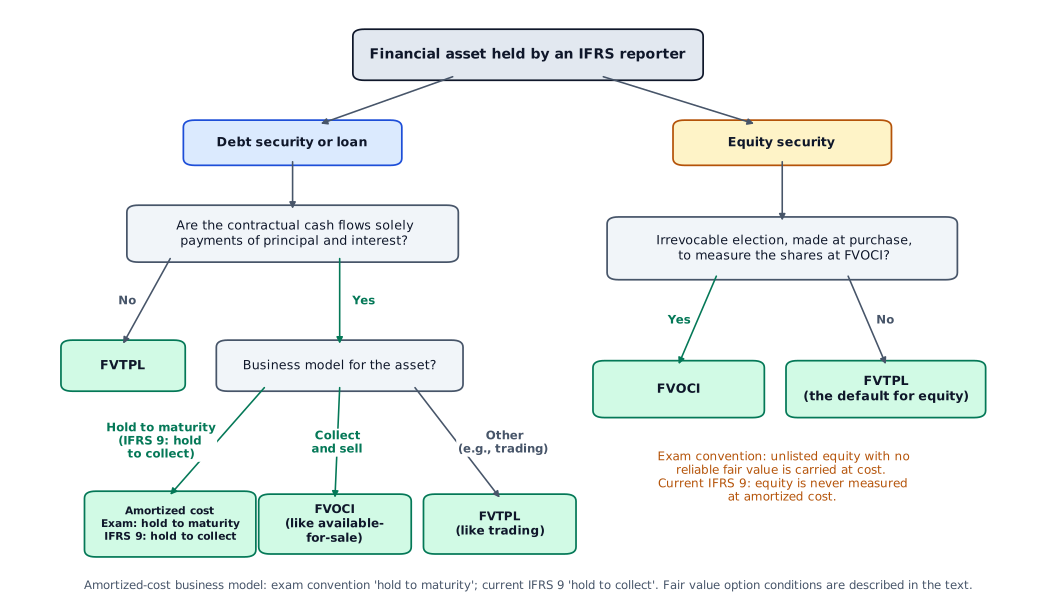
Exam convention: interest, dividends and realized gains and losses reach the income statement under every IFRS category too, as under US GAAP. Current practice: IFRS 9 treats the two kinds of FVOCI asset differently. For a debt security at FVOCI, interest goes to profit or loss, and the cumulative gain or loss held in OCI is reclassified (recycled) to profit or loss when the security is sold. For an equity investment designated at FVOCI, dividends go to profit or loss, but fair value gains and losses stay in OCI and are never recycled, even on sale; the cumulative amount may be transferred within equity, for example to retained earnings.
Exam convention: unlisted equity securities whose fair value cannot be determined reliably are carried at historical cost under both frameworks, alongside loans and notes receivable. Current practice: IFRS 9 measures every equity investment at fair value (FVTPL, or FVOCI by election), with no cost-measurement exemption. In limited circumstances, such as too little recent information, cost may be an appropriate estimate of fair value, but the measurement basis remains fair value.
Fair value option. Exam convention: under IFRS a firm may irrevocably choose, at purchase, to carry any financial asset at FVTPL, and US GAAP offers no such choice. Current practice: the option exists under both frameworks, with conditions. A firm may, at initial recognition, irrevocably elect to carry a financial asset at fair value and report its unrealized gains and losses in profit or loss.
- IFRS: designation at FVTPL is allowed for a financial asset that would otherwise be at amortized cost or FVOCI only if it eliminates or significantly reduces an accounting mismatch (a measurement or recognition inconsistency with a related liability or asset).
- US GAAP: the fair value option (FASB Statement 159, now ASC 825) may be elected instrument by instrument for eligible financial assets, including debt that would otherwise be held-to-maturity.
- Absent an election, debt held to maturity is at amortized cost under both frameworks (current IFRS 9 calls this business model "hold to collect").
Example. Linwood Corp buys $500,000 of 5% bonds at par; at year-end their fair value is $488,000.
- Held-to-maturity / amortized cost: balance sheet $500,000; interest income of $25,000 in net income.
- Trading / FVTPL: balance sheet $488,000; interest of $25,000 and the unrealized loss of $12,000 both in net income (net +$13,000).
- Available-for-sale / FVOCI: balance sheet $488,000; interest of $25,000 in net income; the $12,000 loss in OCI.
LOS 29.d — Non-current liabilities
Long-term financial liabilities (bank loans, notes payable, bonds payable, some derivatives) are usually reported at amortized cost: issue price − principal repayments + amortized discount (or − amortized premium). Premiums and discounts are amortized through interest expense, so the carrying amount converges on face value at maturity. A loan issued at face value simply stays at that amount, less repayments.
Liabilities reported at fair value include held-for-trading liabilities (e.g., a short position in a stock), derivative liabilities, and non-derivative liabilities whose exposures are hedged with derivatives.
Deferred tax liabilities (DTL) are income taxes payable in future periods because of temporary timing differences between financial and tax reporting. A DTL arises when income tax expense in the income statement exceeds taxes payable. This happens when:
- expenses are deducted for tax before they appear in the income statement (e.g., accelerated depreciation for tax, straight-line for reporting), or
- revenues or gains appear in the income statement in an earlier period than they are taxed (e.g., credit sales booked at sale but taxed on cash collection; subsidiary earnings recognized before dividends are paid).
DTLs reverse when the tax is eventually paid. Permanent differences (e.g., revenue that is never taxable) do not create deferred taxes.
Common exam traps
- Training costs are expensed even when incurred during the development stage.
- An annual impairment test is not an annual write-down. A loss is recognized only when the test shows that the carrying amount is too high.
- Treating an intangible as indefinite-lived is not the conservative choice. No amortization is charged, so reported income is higher unless an impairment is later found.
- A consultant's valuation of internally built goodwill is never recorded.
- Computing goodwill from the target's book values, or counting goodwill already on the target's books as an identifiable asset. For Hale, book values give goodwill of $2.9 million, and treating the target's $0.6 million of goodwill as identifiable gives $1.1 million, instead of $1.7 million.
- "Unlisted equity is always at cost" and "listed equity is always at FVTPL" are both too absolute under IFRS.
- Moving held-to-maturity debt to FVTPL when the facts state that no fair value option was elected at initial recognition.
- An available-for-sale bond whose price falls still raises net income through interest income; the loss bypasses net income.
- Interest income is in net income for held-to-maturity securities too.
- Bonds issued at a premium or discount are carried at amortized cost. Face value and fair value are both wrong answers.
- When tax treatment matches book treatment, no deferred tax arises.
Exam shortcuts
- Under US GAAP, interest and dividend income and realized gains and losses go to the income statement for every classification of security, so only the balance sheet value and the location of unrealized gains and losses depend on the classification.
Bottom line
- After acquisition, IFRS allows purchased intangibles to be carried under the cost model or, only if an active market exists, the revaluation model, while US GAAP requires the cost model.
- US GAAP expenses R&D costs when incurred (apart from certain legal costs); IFRS expenses research costs and capitalizes development costs once the project is technically feasible, the firm has the intention and resources to complete it and to use or sell the product, and a market exists.
- Finite-lived intangibles are amortized over the period they are expected to be used, while indefinite-lived intangibles, including goodwill, are not amortized but are tested for impairment at least annually.
- Goodwill equals the purchase price minus the fair value of the identifiable net assets acquired; it arises only in an acquisition, and a price below that fair value is a bargain purchase recognized immediately as a gain.
- US GAAP carries held-to-maturity debt at amortized cost, trading securities and derivatives at fair value through the income statement, and available-for-sale debt at fair value through other comprehensive income; the IFRS counterparts are amortized cost, FVTPL and FVOCI respectively.
- A deferred tax liability arises when income tax expense exceeds taxes payable because of a temporary difference, and permanent differences create no deferred taxes.
Quick check
Norvale Biotech, which reports under IFRS, is developing a rapid diagnostic kit. Early in the year it spent €640,000 on laboratory research, and that work showed the kit to be technically feasible. Norvale intends to finish the kit, has the resources to do so, and has signed a supply agreement with a hospital network. For the next phase it expects the following costs:
- staff training: €72,000
- materials and direct labor: €415,000
- production overhead: €185,000
- general administrative overhead: €38,000
The total amount Norvale should expense under IFRS is closest to:
Show answer and explanation
Correct answer: C
Under IFRS, costs of the research phase are expensed, while development-phase costs are capitalized once the project is technically feasible, a market exists, and the firm has the intention and resources to complete and sell the product. All of these conditions are met here. Training costs and administrative overhead are expensed whenever they are incurred, even during development; materials, direct labor and production overhead of the development phase are capitalized.
Classify each cost:
| Cost | Phase | Treatment |
|---|---|---|
| Laboratory research €640,000 | Research | Expense |
| Staff training €72,000 | Any | Expense |
| Administrative overhead €38,000 | Any | Expense |
| Materials and direct labor €415,000 | Development | Capitalize |
| Production overhead €185,000 | Development | Capitalize |
Capitalized development cost . (Under US GAAP all €1,350,000 would be expensed.)
Why the other options are wrong
- A. €640,000 expenses only the research-phase costs and wrongly capitalizes the training and administrative overhead, which must be expensed as incurred.
- B. €712,000 correctly expenses research and training but forgets that general administrative overhead is also expensed as incurred.
Key takeaway Research costs are expensed. Once the development criteria are met, materials, direct labor and production overhead are capitalized. Training, administrative overhead, advertising, start-up, relocation and termination costs are always expensed.
Module 29.2
Common-Size Balance Sheets
LOS 29.e — Common-size balance sheets and balance sheet ratios
Vertical common-size balance sheet
A vertical common-size balance sheet divides every line item by total assets, so total assets equal . It removes the effect of size, which allows time-series analysis (the same firm over time) and cross-sectional analysis (different firms at one date). A common-size income statement uses revenue (sales) as the base instead.
Key concept
What to read from it:
- Working capital current assets current liabilities, as a % of assets. A high value means more liquidity, but also more money tied up in low-return assets.
- Composition of current assets: cash, receivables and inventory. Unusually high inventory may signal obsolescence.
- Reliance on fixed assets (PP&E share) and on acquisitions (goodwill share).
- Capital structure: the shares of liabilities and equity. Equity as a % of assets is the reciprocal of the financial leverage ratio (total assets / total equity).
- Equity detail: common stock (par value) plus additional paid-in capital equals the amount received from issuing common shares. Equity also includes retained earnings and accumulated other comprehensive income; preferred stock is shown separately.
Example.
| Item | Nolan Co. | % | Pryce Co. | % |
|---|---|---|---|---|
| Current assets | 2,600 | 32.5% | 1,170 | 18.0% |
| Non-current assets | 5,400 | 67.5% | 5,330 | 82.0% |
| Total assets | 8,000 | 100% | 6,500 | 100% |
| Current liabilities | 1,200 | 15.0% | 455 | 7.0% |
| Long-term debt | 2,800 | 35.0% | 1,495 | 23.0% |
| Equity | 4,000 | 50.0% | 4,550 | 70.0% |
Nolan's working capital is of assets vs. for Pryce; Pryce is more asset-heavy (82% non-current). Nolan is more leveraged: financial leverage vs. .
Liquidity ratios (short-term obligations)
Each common-size percentage is a balance sheet ratio, one balance sheet item divided by another (here, total assets). Balance sheet ratios are used, over time and against peers, to judge liquidity and solvency. Liquidity ratios measure the ability to meet short-term obligations as they fall due.
Key concept
The quick ratio (acid-test ratio) excludes inventory; the cash ratio also excludes receivables. Read them together: when Firm A's current ratio exceeds Firm B's while A's quick ratio is below B's, the difference must come from A holding relatively more inventory. Current liabilities include accounts payable and short-term debt.
Solvency ratios (long-term obligations)
Solvency ratios measure the ability to meet long-term obligations. The four below should be read together.
Key concept
In these ratios, debt means interest-bearing obligations (short- and long-term borrowings). Accounts payable and accruals are excluded. The financial leverage ratio captures all liabilities, whether or not they bear interest. A higher long-term debt-to-equity but lower total debt-to-equity than a peer means the peer relies more on short-term debt. When only percentages of assets are known, , where is equity as a fraction of assets.
Limitations
- Accounting standards and estimates differ across peers.
- Ratios may not be comparable across industries.
- Interpretation requires judgment.
- The balance sheet is a snapshot at a single point in time.
Common exam traps
- The denominator of a common-size balance sheet is total assets. Equity and sales are wrong bases.
- Quick ratio numerator excludes inventory; the denominator is all current liabilities, including both payables and short-term debt.
- Using the prior year's balances when the question asks for the latest year.
- Inverting a ratio, for example computing current liabilities / current assets instead of current assets / current liabilities. For Nolan, the inverted current ratio is 0.46 instead of 2.17.
- Treating common stock plus additional paid-in capital as total equity.
Exam shortcuts
- If Firm A's current ratio is above Firm B's while A's quick ratio is below B's, A holds relatively more inventory, with no further data needed.
- From a common-size balance sheet alone, with equal to equity as a fraction of total assets, the financial leverage ratio is and total liabilities to equity is .
Bottom line
- A vertical common-size balance sheet divides every line item by total assets, while a common-size income statement uses revenue as the base.
- The current ratio is current assets divided by current liabilities; the quick ratio uses cash, marketable securities and receivables in the numerator, and the cash ratio uses only cash and marketable securities.
- In the debt-to-equity and debt ratios, debt means interest-bearing short- and long-term borrowings, excluding accounts payable and accruals, while the financial leverage ratio, total assets divided by total equity, captures all liabilities.
- Equity as a percentage of total assets is the reciprocal of the financial leverage ratio.
- Balance sheet ratios are limited because accounting standards and estimates differ across peers, ratios may not be comparable across industries, interpretation requires judgment, and the balance sheet is a snapshot at a single point in time.
Quick check
Part of the most recent common-size balance sheet of Harrowgate Mills is shown below.
| Item | % of total assets |
|---|---|
| Preferred stock | 10% |
| Common stock | 2% |
| Additional paid-in capital | 23% |
Which interpretation of these data is most appropriate?
Show answer and explanation
Correct answer: C
A common-size balance sheet states each item as a percentage of total assets. Capital raised by issuing common shares is recorded partly as common stock (at par value) and partly as additional paid-in capital (the excess over par), so together they show that common share proceeds are of total assets.
Common-share proceeds of total assets.
Why the other options are wrong
- A. The 10% is a percentage of total assets. As a share of shareholders' equity, preferred stock would be larger than 10%.
- B. Adding the three items (35%) leaves out other parts of equity, such as retained earnings and accumulated OCI, so total equity is very likely larger than 35% of assets.
Key takeaway Common stock (par) + additional paid-in capital = contributed capital from common shares. Every common-size balance sheet percentage is relative to total assets.
Practice Questions
Which statement best describes how available-for-sale securities are accounted for under US GAAP after purchase?
Show answer and explanation
Correct answer: B
Available-for-sale securities are reported at fair value on the balance sheet, but their unrealized gains and losses bypass the income statement and are reported in other comprehensive income, within shareholders' equity. Interest, dividends and realized gains and losses still go to the income statement.
Why the other options are wrong
- A. Amortized cost with market value changes ignored describes held-to-maturity securities.
- C. Fair value with unrealized gains and losses in the income statement describes trading securities.
Key takeaway AFS: fair value on the balance sheet, unrealized gains/losses in OCI (the IFRS counterpart is FVOCI).
In Veloria, companies record revenue in their financial statements when a sale is made. Montclair Tiles sells mainly on 60-day credit terms. Which Velorian tax rule would most likely cause Montclair to report a deferred tax liability?
Show answer and explanation
Correct answer: B
If revenue is taxed only on collection, credit sales appear in the income statement before they are taxable. Income tax expense in the financial statements then exceeds taxes currently payable, and the tax due when the cash arrives is recorded as a deferred tax liability. This is a temporary timing difference that reverses on collection.
Why the other options are wrong
- A. Taxing revenue at the point of sale matches the accounting treatment, so no timing difference and no deferred tax arises.
- C. Revenue that is never taxable creates a permanent difference. Deferred taxes arise only from temporary timing differences.
Key takeaway DTL: revenue in the books before it is taxed (or expense deducted for tax before it is booked). Permanent differences never create deferred taxes.
The liabilities and equity section of Galloway Instruments' balance sheet is shown below.
| Item | Amount |
|---|---|
| Accounts payable | 400 |
| Accrued expenses | 150 |
| Short-term notes payable | 300 |
| Long-term debt | 1,500 |
| Total equity | 2,650 |
| Total liabilities and equity | 5,000 |
Treating only interest-bearing obligations as debt, as is usual for solvency ratios, Galloway's debt ratio is closest to:
Show answer and explanation
Correct answer: A
The debt ratio divides total debt by total assets. For solvency ratios, debt means interest-bearing obligations (here the short-term notes payable and the long-term debt), so accounts payable and accrued expenses are excluded. Total assets equal total liabilities and equity of 5,000.
Total debt (interest-bearing)
Why the other options are wrong
- B. 47% treats every liability as debt, including non-interest-bearing accounts payable and accrued expenses: . Some data services define the debt ratio as total liabilities to total assets, but the question measures debt as interest-bearing obligations only, so payables and accruals are left out.
- C. 68% is the total debt-to-equity ratio , which uses equity rather than total assets as the denominator.
Key takeaway Solvency ratios use interest-bearing debt; the financial leverage ratio (assets/equity) is the one that captures all liabilities.
This reading has 35 questions in the full bank. Practice all of them.
Key Takeaways
- Research costs are expensed. Once the development criteria are met, materials, direct labor and production overhead are capitalized. Training, administrative overhead, advertising, start-up, relocation and termination costs are always expensed.
- AFS: fair value on the balance sheet, unrealized gains/losses in OCI (the IFRS counterpart is FVOCI).
- DTL: revenue in the books before it is taxed (or expense deducted for tax before it is booked). Permanent differences never create deferred taxes.
- Common stock (par) + additional paid-in capital = contributed capital from common shares. Every common-size balance sheet percentage is relative to total assets.
- Solvency ratios use interest-bearing debt; the financial leverage ratio (assets/equity) is the one that captures all liabilities.