Financial Statement Analysis · Reading 30
Analyzing Statements of Cash Flows I
CFA Level I · Financial Statement Analysis · Reading 30 · about 1 h 5 min
What you'll learn
- LOS 30.a Describe how the cash flow statement links to the income statement and balance sheet, and how timing differences between accruals and cash appear in balance sheet accounts.
- LOS 30.b Describe the steps in preparing direct and indirect cash flow statements, including computing operating, investing and financing cash flows from income statement and balance sheet data.
- LOS 30.c Demonstrate how an indirect-method statement of cash flows is converted to the direct method.
- LOS 30.d Contrast statements of cash flows prepared under IFRS and US GAAP (classification of interest, dividends, taxes and bank overdrafts; CFO presentation).
Module 30.1
Cash Flow Introduction and Direct Method CFO
This reading explains how the statement of cash flows connects with the income statement and balance sheet, and how operating, investing and financing cash flows are prepared. A candidate must be able to compute CFO with both the direct and the indirect method, derive investing and financing flows from balance sheet changes, convert an indirect statement to the direct format, and classify items under IFRS and US GAAP.
LOS 30.a — How the cash flow statement links to the income statement and balance sheet
Why a separate cash flow statement?
The income statement is prepared on the accrual basis, so net income differs from the cash a firm generates. The statement of cash flows reports the actual cash receipts and cash payments of the period and sorts them into three activities:
Key concept
| Activity | What it captures | Balance sheet accounts it relates to |
|---|---|---|
| Cash flow from operations (CFO) | Cash effects of the firm's day-to-day revenue and expense transactions | Mostly working capital accounts (current operating assets and current operating liabilities) |
| Cash flow from investing activities (CFI) | Buying and selling long-term assets and certain investments | Noncurrent assets (PP&E, intangibles, long-term investments) |
| Cash flow from financing activities (CFF) | Transactions with creditors and shareholders that change the capital structure | Noncurrent liabilities and equity |
The terms cash flow from operations, cash flow from operating activities and operating cash flow mean the same thing.
The classification depends on what a transaction means for the company reporting it. When a machinery maker sells a press to a printing firm, the maker reports an operating inflow, because selling presses is its business. The printing firm reports an investing outflow, because it is buying a long-term asset.
The statement reconciles the opening and closing cash balances. Each section is a signed net amount, so a net outflow enters as a negative number:
Key concept
The income statement is also a flow statement (sometimes called a dynamic statement): like the statement of cash flows, it covers the period between two balance sheet dates, and net income reaches the closing balance sheet through retained earnings (see the figure below). Because of accrual accounting, net income is not the cash the firm generated, and many investing and financing cash flows, such as buying equipment or borrowing, do not touch the income statement when they occur.
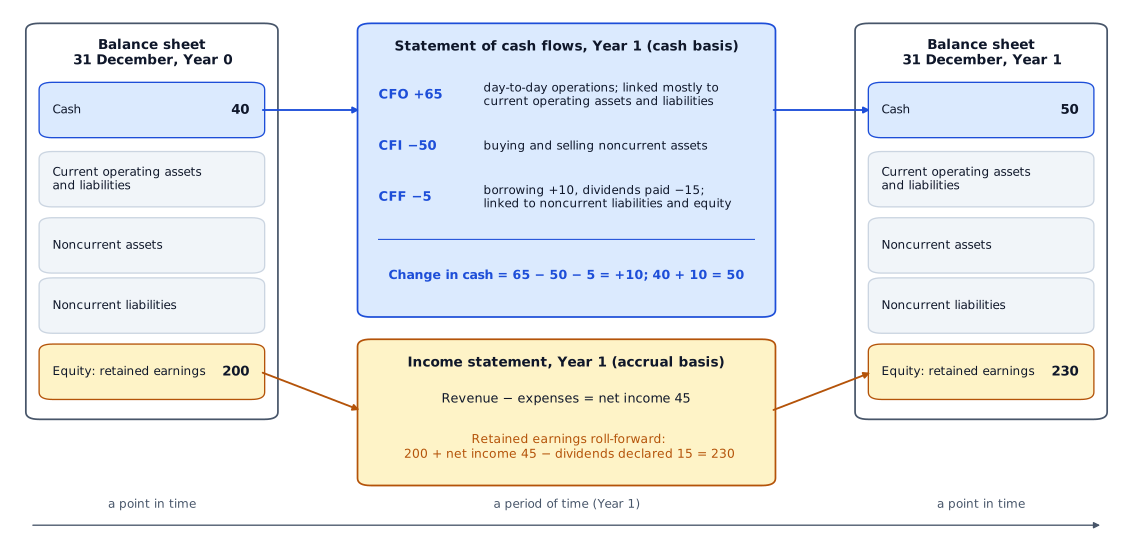
Analysts use the statement of cash flows to judge liquidity, solvency and financial flexibility, meaning whether operations can fund the business, repay maturing debt, absorb shocks and take up opportunities without new financing. It also shows the quality of earnings. Earnings are of higher quality when CFO is close to, or above, net income; earnings that persistently exceed CFO are not backed by cash.
Timing differences show up on the balance sheet
When revenue or expense recognition and the cash flow happen in different periods, a balance sheet account absorbs the difference:
| Situation | Balance sheet effect |
|---|---|
| Sales exceed cash collected from customers (sales on credit) | Accounts receivable increase |
| Cash collected exceeds sales | Accounts receivable decrease |
| Purchases exceed cash paid to suppliers | Accounts payable increase |
| Cash paid to suppliers exceeds purchases | Accounts payable decrease |
| Customers pay before revenue is recognized | Unearned revenue (a liability) increases |
| Premiums paid before the expense is recognized | Prepaid expenses (an asset) increase |
Every such account can be written as a roll-forward, e.g. for receivables:
so that cash collected = sales − increase in AR (or + decrease in AR). Knowing any three items gives the fourth.
Revenue recognition rules decide when a sale reaches the income statement, not when the customer pays. Cash received in advance, for instance for a multi-year service contract, is reported in the statement of cash flows when it arrives, while the revenue is recognized gradually as the contract runs. Tracing each account this way also helps an analyst detect aggressive accounting, since reported revenue or expenses that do not fit the related cash and balance sheet changes stand out.
Example. Sales are $540,000; AR rise from $62,000 to $77,000; unearned revenue rises from $9,000 to $13,000. Cash collected .
LOS 30.b — Preparing CFO with the direct method
Sources and uses of cash
CFO can be presented with the direct method or the indirect method. The presentation differs but the CFO total is the same, and CFI and CFF are presented the same way whichever method is chosen. Sources of cash are shown as positive numbers (inflows) and uses of cash as negative numbers (outflows).
Key concept
| Change in account | Effect on cash |
|---|---|
| Increase in an operating asset | Use of cash (subtract) |
| Decrease in an operating asset | Source of cash (add) |
| Increase in an operating liability | Source of cash (add) |
| Decrease in an operating liability | Use of cash (subtract) |
The direct method
The direct method lists the operating cash receipts and payments themselves. Typical lines are cash collected from customers (usually the largest component), cash paid to suppliers (cash inputs), cash paid for operating expenses such as wages, cash paid for interest and cash paid for taxes. It gives the analyst more detail than the indirect method, which helps with forecasting.
Steps: begin with the first line of the income statement; for each revenue or expense line (treat expenses as negative numbers), find the related operating asset or liability, apply the source/use rules to its change, and move to the next line. Noncash items such as depreciation and gains and losses on asset disposals are ignored because they are not operating cash flows. Sum the adjusted lines to get CFO. Net income never appears in a direct-method CFO section.
Key formulas. Each formula starts from the income statement amount and corrects it for the part that was not received or paid in cash this period, using the change in the related balance sheet account.
If purchases are given directly, no further inventory adjustment is made, because the inventory change is already built into purchases. The same identities can be run backwards: expense cash paid increase in the related prepaid asset, or cash paid increase in the related payable.
Example. A retailer reports sales of $820,000, COGS of $510,000, wage expense of $140,000, depreciation of $35,000 and tax expense of $30,000. AR fell by $12,000, inventory rose by $18,000, AP rose by $9,000, wages payable fell by $4,000, taxes payable were unchanged.
| Line | Computation | Cash flow |
|---|---|---|
| Cash collected | 832,000 | |
| Cash paid to suppliers | (519,000) | |
| Cash paid for wages | (144,000) | |
| Depreciation | noncash, ignored | 0 |
| Cash taxes paid | (30,000) | |
| CFO | 139,000 |
Common exam traps
- Linking operating activities to noncurrent assets (investing) or to long-term debt and equity (financing).
- Subtracting the ending balance of AR from sales instead of the change in AR. In the LOS 30.a example, this gives cash collected of $467,000 instead of $529,000.
- Forgetting that an increase in unearned revenue means cash arrived before the sale was recorded, so the increase is added. In the LOS 30.a example, subtracting the $4,000 increase gives $521,000 instead of $529,000.
- Including depreciation, a noncash charge, as a cash expense. For the retailer, this gives CFO of $104,000 instead of $139,000.
- Adjusting purchases a second time for the inventory change.
- Getting the sign of a liability change wrong. A decrease in wages or interest payable means more cash was paid than expensed. For the retailer, adding the $4,000 decrease in wages payable gives cash paid for wages of $136,000 instead of $144,000, and CFO of $147,000 instead of $139,000.
- Dropping interest paid and taxes paid from direct-method CFO. Under US GAAP both are operating outflows.
Exam shortcuts
- A balance sheet roll-forward such as beginning AR + sales − cash collected = ending AR links four items, so any three of them give the fourth.
Bottom line
- CFO relates mostly to working capital accounts, CFI to noncurrent assets, and CFF to noncurrent liabilities and equity.
- CFO + CFI + CFF equals the change in cash, and beginning cash plus that change equals ending cash.
- Earnings are of higher quality when CFO is close to, or above, net income; earnings that persistently exceed CFO are not backed by cash.
- An increase in an operating asset is a use of cash and an increase in an operating liability is a source of cash; decreases work the other way.
- Cash collected from customers equals net sales − ΔAR + Δunearned revenue, and cash paid to suppliers equals COGS + Δinventory − ΔAP.
- The direct method lists operating cash receipts and payments and ignores noncash items, for example depreciation or a gain on an asset sale, so net income never appears in a direct-method CFO section.
Quick check
Alvern Truck Works builds delivery trucks for sale. It sells 25 new trucks for cash to Ardwell Couriers, which will use them in its delivery business for about eight years. Both companies report under US GAAP. How will the cash that changes hands be classified in each company's statement of cash flows? Answer in the form: Alvern; Ardwell.
Show answer and explanation
Correct answer: A
Cash flows are classified by what the transaction means for the company that reports it. Selling trucks is Alvern's ordinary business: the trucks are its inventory, the sale produces revenue and cost of goods sold, and the cash is collected from a customer, so it is an operating inflow. For Ardwell the trucks are long-term assets bought for use over several years, so the payment is an investing outflow. One transaction can therefore fall in different sections of the two companies' statements.
- Alvern: trucks held for sale are inventory. Cash received from customers is part of cash flow from operations (CFO).
- Ardwell: trucks bought for use are property, plant, and equipment, a noncurrent asset. Purchases of long-term assets belong in cash flow from investing activities (CFI). Ardwell will later depreciate the trucks, which reduces net income but is a noncash expense.
Why the other options are wrong
- B. This treats Ardwell's purchase as an operating payment. Buying a long-term asset for use over several years is an investing activity; only Alvern, for which the trucks are inventory, reports an operating cash flow.
- C. This treats Alvern's sale as the disposal of a long-term asset. Trucks that Alvern builds in order to sell them are inventory, not PP&E, so the proceeds are cash collected from customers, an operating inflow.
Key takeaway Classify a cash flow by its role for the reporting company. The sale of inventory is operating for the seller, while the same asset bought for long-term use is an investing outflow for the buyer.
Module 30.2
Indirect Method CFO
LOS 30.b — Preparing CFO with the indirect method
Starting point: net income
The indirect method starts with net income and reconciles it to CFO. Net income already contains noncash items and nonoperating gains and losses, so these are unwound, and then the changes in operating working capital are applied:
Key concept
where NCC are noncash charges and WC is the investment in working capital (the net increase in operating assets less operating liabilities).
Step 1–2: noncash charges, gains and losses
Key concept
| Add back to net income | Subtract from net income |
|---|---|
| Depreciation, depletion and amortization | Gains on asset disposals |
| Losses on asset disposals | Gains on early retirement of debt |
| Asset impairments and write-downs | Reversals of impairments and write-downs |
| Losses on early retirement of debt | Amortization of premiums on bonds issued (amortized cost method) |
| Amortization of discounts on bonds issued (amortized cost method) | Decreases in deferred tax liabilities, increases in deferred tax assets |
| Increases in deferred tax liabilities, decreases in deferred tax assets | |
| Losses of equity-accounted associates |
Noncash components of revenue are subtracted in the same way. Although these items are called noncash "charges", they can raise or lower net income.
An inventory write-down reduces both net income and the inventory balance, so it must be counted only once; the two consistent ways to handle it are set out under LOS 30.c.
A gain on the sale of equipment is removed because the whole cash proceeds from the sale belong in CFI. The gain is the part of those proceeds above carrying value, and it also sits in net income. Leaving it in would count it twice and misclassify investing cash as operating cash. A loss reduced net income without any operating cash outflow, so it is added back.
Step 3: working capital changes
Key concept
| Add | Subtract |
|---|---|
| Decreases in current operating assets (AR, inventory, prepaid expenses) | Increases in current operating assets |
| Increases in current operating liabilities (AP, wages payable, interest payable, taxes payable, unearned revenue) | Decreases in current operating liabilities |
Only operating working capital counts. Cash and short-term investments are ignored, except trading securities, whose flows are CFO. Short-term interest-bearing debt and dividends payable are financing items and are also ignored.
The definition of working capital depends on the context. For ratio analysis it is total current assets minus total current liabilities. For cash flow work, and in corporate finance, it means operating assets minus operating liabilities, often called noncash working capital. The working capital changes can be applied line by line or as one net figure: the increase in noncash working capital is subtracted.
Some items never enter CFO under the indirect method because they are not in net income or are not operating: issuing or repaying bonds, issuing or buying back stock, dividends paid (CFF under US GAAP), and purchases of PP&E or land (CFI). They matter for CFO only through any gain or loss they create.
Example
Net income $64,000; depreciation $15,000; gain on sale of a delivery van $3,000; AR up $7,000; inventory down $4,000; prepaid rent up $1,000; AP up $6,000; wages payable down $2,000; dividends paid $10,000.
The $10,000 dividend is a financing outflow and is not deducted. When there are no disposals, the increase in accumulated depreciation equals the period's depreciation, which is the add-back seen from the balance sheet.
Direct vs. indirect presentation
| Direct method | Indirect method | |
|---|---|---|
| Starts with | Cash receipts from customers | Net income |
| Depreciation and gains/losses | Not considered (noncash) | Adjusted (added back / subtracted) |
| Working capital changes | Used to convert each revenue/expense line | Used to adjust net income |
| Main advantage | Shows actual operating receipts and payments | Shows why net income and CFO differ (earnings quality) |
The CFO totals agree because both methods start from the same income statement and use the same working capital changes. The direct method converts each revenue and expense line to cash and leaves out noncash items. The indirect method takes net income, in which those lines are already netted, and unwinds the noncash items and gains instead.
Example. The retailer in the direct-method example of Module 30.1 has net income of . Indirect method: , the same CFO that the direct method gives.
Most firms present CFO with the indirect method. What each framework requires of the choice is compared under LOS 30.d.
Common exam traps
- Adding a gain (or subtracting a loss) instead of the reverse. In the example, adding the $3,000 gain gives CFO of $82,000 instead of $76,000.
- Subtracting depreciation, or adding it under the direct method. In the example, subtracting the $15,000 of depreciation gives $46,000 instead of $76,000.
- Deducting dividends paid or bond repayments in CFO. In the example, deducting the $10,000 dividend gives $66,000 instead of $76,000.
- Using the full sale proceeds of an asset in CFO instead of removing only the gain.
- Computing a gain from an out-of-date carrying value. The carrying value on the sale date includes the depreciation charged in the year of sale.
Exam shortcuts
- The direct and indirect methods give the same CFO total, so a CFO figure found with one method need not be recomputed with the other.
- Dividends paid, debt and stock issues or repayments, and purchases of PP&E or land can be skipped when computing indirect CFO; they matter only through a gain or loss they create.
Bottom line
- Under the indirect method, CFO equals net income plus noncash charges minus the investment in working capital.
- Depreciation, amortization, impairments and losses on asset disposals are added back to net income, while gains on disposals are subtracted, because the whole sale proceeds belong in CFI.
- Decreases in current operating assets and increases in current operating liabilities are added to net income; increases in operating assets and decreases in operating liabilities are subtracted.
- Only operating working capital enters CFO: short-term interest-bearing debt and dividends payable are financing items, and cash is ignored.
- The direct method shows the actual operating receipts and payments, while the indirect method shows why net income and CFO differ.
Quick check
An analyst is rebuilding the operating section of Castellan Paper's statement of cash flows, which is prepared using the indirect method. Which of the following items recorded by Castellan during the year requires an addition to net income in arriving at cash flow from operating activities?
Show answer and explanation
Correct answer: A
The indirect method starts with net income and removes items that affected income without a matching operating cash flow. A loss on retiring debt early reduced net income, but the cash paid to retire the bonds is a financing outflow, so the loss is added back. Otherwise operating cash flow would be reduced by an amount that belongs in financing activities.
Why the other options are wrong
- B. A gain on the sale of a truck raised net income, but the full sale proceeds are an investing inflow. The gain is subtracted so that it is not counted in operating cash flow as well.
- C. A decrease in a deferred tax liability means income tax expense was lower than the tax payable for the period, so net income overstates the cash left after taxes. The decrease is subtracted from net income.
Key takeaway Indirect method: add back losses and subtract gains that arise from investing or financing transactions, such as asset sales and debt retirement. Add increases and subtract decreases in deferred tax liabilities.
Module 30.3
Investing and Financing Cash Flows and IFRS/US GAAP Differences
LOS 30.b — Cash flow from investing and financing activities
Investing activities (CFI)
Cash flow from investing activities covers buying and selling long-term assets and investments: purchases and sales of PP&E and intangibles, purchases and sales of investments in bonds and shares (trading securities excepted), and loans the firm makes to others and later collects. Only the cash paid or received counts. For an asset sale the cash is the disposal proceeds:
Key concept
When the proceeds must be backed out of the balance sheet:
Carrying value sold = gross cost − accumulated depreciation removed; then add the gain or subtract the loss. The three steps can be combined:
Land is not depreciated, so its carrying value is its cost. With no land purchases, the carrying value of land sold is the fall in the land balance.
Worked example: proceeds from an equipment sale
A firm's gross PP&E is $480,000 at the start of the year and $515,000 at the end, and it bought $95,000 of equipment for cash during the year. Accumulated depreciation is $160,000 at the start and $178,000 at the end, and depreciation expense for the year is $52,000. The income statement shows a $7,000 gain on the sale of equipment. Find the carrying value of the equipment sold, the cash proceeds and the firm's CFI, assuming no other investing transactions.
Step 1. Gross cost of disposals .
Step 2. Accumulated depreciation removed .
Step 3. Carrying value sold . The one-line check gives the same figure: beginning net PP&E of $320,000 less depreciation of $52,000, plus purchases of $95,000, less ending net PP&E of $337,000 .
Step 4. Proceeds , an investing inflow; the $7,000 gain is subtracted from net income in indirect CFO.
Result. CFI .
Financing activities (CFF)
Cash flow from financing activities covers transactions with the providers of capital:
Dividends paid often have to be derived:
Example. Net income is $640, retained earnings rise from $1,500 to $1,880, and dividends payable fall from $70 to $40. Dividends declared . Dividends paid , a financing outflow. More cash went out than was declared because part of the payable left over from last year was also settled.
The Level I convention assumes bonds are issued at par and shares are repurchased at their issue price, so the changes in bonds payable and in contributed capital (common stock at par plus additional paid-in capital) give the principal and equity flows. For a bond issued at a discount or premium, the amortization is noncash: interest expense = coupon + discount amortized − premium amortized, and the carrying value of the bond changes without any financing cash flow. When buybacks occur at a price different from the issue price, the difference goes through retained earnings. The total of CFO, CFI and CFF must equal the change in the cash balance, which serves as a check figure.
Noncash investing and financing activities
Transactions with no cash, such as buying an asset in exchange for bonds or stock or converting bonds into preferred or common stock, do not appear in CFI or CFF. They are disclosed in a footnote or supplementary schedule. If an asset is bought partly for cash, only the cash portion is an investing outflow.
US GAAP classification summary
Key concept
| Operating | Investing | Financing | |
|---|---|---|---|
| Inflows | Cash from customers; interest received; dividends received; sales of trading securities | Sale of PP&E and intangibles; sale of debt/equity investments; collection of loans made | Debt issued; stock issued |
| Outflows | Suppliers and employees; other expenses; interest paid; taxes paid; purchases of trading securities | Purchase of PP&E and intangibles; purchase of investments; loans made | Principal repaid; stock repurchased; dividends paid |
Example. A firm buys machinery for $42,000, sells a warehouse (carrying value $30,000) for $36,000, issues bonds of $25,000, repays a bank loan of $8,000 and pays dividends of $11,000. CFI ; CFF . The $6,000 gain is removed from net income in CFO.
LOS 30.c — Converting an indirect statement to the direct method
Only the CFO section differs between the two formats, so the conversion uses the income statement plus the working capital changes from the indirect statement:
- Total the revenues and gains, and separately total the expenses and losses.
- Remove all noncash items (depreciation, amortization, gains and losses, inventory writedowns, deferred tax changes) and break the rest into individual lines.
- Convert each line from accrual to cash using the related working capital change.
| Direct-method line | Adjustment |
|---|---|
| Cash collected from customers | Start with net sales; subtract an increase (add a decrease) in AR; add an increase (subtract a decrease) in unearned revenue |
| Cash paid to suppliers (as a positive amount) | Start with COGS; add an increase (subtract a decrease) in inventory; subtract an increase (add a decrease) in AP; subtract noncash items inside COGS such as an inventory writedown or depreciation included in COGS. When the writedown is removed from COGS, the inventory change must also exclude the writedown (see below) |
An inventory writedown (lower of cost or market / net realizable value) raises COGS but involves no cash, so it is taken out of COGS when computing cash paid to suppliers. A decrease in inventory means some goods sold came out of existing stock and were not bought this period, so it also reduces the cash paid.
The writedown also lowers the ending inventory balance, so it must not be counted twice. There are two consistent routes:
- Subtract the writedown from COGS and use the inventory change before the writedown (purchases less cost of units sold), or
- Keep COGS including the writedown and use the raw balance sheet inventory change (after the writedown), with no separate writedown adjustment.
Example. Beginning inventory 200, cash purchases 90, cost of units sold 70, writedown 20, ending inventory 200, AP unchanged. Reported COGS is 90 and the balance sheet inventory change is 0. Route 1: . Route 2: . Cash paid = 90 either way; mixing the routes is wrong.
LOS 30.d — IFRS versus US GAAP
Key concept
| Item | US GAAP | IFRS |
|---|---|---|
| Interest received | CFO | CFO or CFI |
| Interest paid | CFO | CFO or CFF |
| Dividends received | CFO | CFO or CFI |
| Dividends paid | CFF | CFO or CFF |
| Bank overdraft | Treated as debt (a financing item) | Included in cash and cash equivalents when repayable on demand and part of cash management |
| Taxes paid | All CFO | May be split among CFO, CFI and CFF according to the transaction that caused the tax to become payable (CFO unless tied to an investing or financing transaction) |
| Presentation of CFO | Direct encouraged; indirect allowed; direct users must disclose the indirect reconciliation | Direct encouraged; indirect allowed |
Under these IAS 7 choices, interest and dividends received are never financing and interest and dividends paid are never investing, and every US GAAP classification of the four items is also allowed under IFRS. Exam convention: the IAS 7 choices in the table above. Current practice: IFRS 18, effective for annual periods beginning on or after 1 January 2027, amends IAS 7 and removes most of this choice for companies whose main business is not investing or financing (interest and dividends received go to CFI; interest and dividends paid go to CFF).
Example. Investment property is sold for $3.2 million and tax of $0.25 million is paid on the gain. Under US GAAP the statement shows a CFI inflow of $3.2 million and a CFO outflow of $0.25 million. Under IFRS the firm may classify the tax in investing activities, so the sale adds a net $2.95 million to CFI (total taxes paid are still disclosed).
Common exam traps
- Putting interest paid in CFF for a US GAAP firm.
- Treating dividends paid as CFO for a US GAAP firm (only IFRS allows it).
- Including noncash exchanges (bonds for land, bonds converted to stock) in CFI or CFF.
- Using dividends declared as the CFF outflow without adjusting for the change in dividends payable. In the dividend example, this gives an outflow of $260 instead of $290.
- Using the gain, or the carrying value, instead of the sale proceeds in CFI. In the CFI example, the gain gives CFI of −$36,000 and the carrying value gives −$12,000, instead of −$6,000.
Exam shortcuts
- The carrying value of PP&E disposed of can be found in one line as beginning net PP&E − depreciation + purchases − ending net PP&E, instead of working through gross cost and accumulated depreciation separately.
Bottom line
- Proceeds from an asset sale equal the carrying value of the asset sold plus the gain, or minus the loss, and only the proceeds are reported in CFI.
- CFF equals new borrowing minus principal repaid, plus stock issued minus stock repurchased, minus cash dividends paid, where dividends paid equal dividends declared (opening retained earnings plus net income less closing retained earnings) minus the change in dividends payable.
- Noncash investing and financing transactions, such as buying an asset with bonds or converting bonds into stock, are not in CFI or CFF but are disclosed in a footnote or supplementary schedule.
- Under US GAAP, interest received, dividends received, interest paid and taxes paid belong in CFO, and dividends paid belong in CFF.
- Exam convention: IFRS allows interest and dividends received in CFO or CFI and interest and dividends paid in CFO or CFF. Current practice: IFRS 18, effective for annual periods beginning on or after 1 January 2027, removes most of this choice for companies whose main business is not investing or financing.
- An inventory writedown is noncash and must be counted only once when cash paid to suppliers is computed: either subtract it from COGS and use the inventory change before the writedown, or keep it in COGS and use the balance sheet inventory change.
Quick check
On December 31, Tarn Retail, which reports under IFRS, borrowed €45,000 on a 90-day bank note and used the cash to buy merchandise inventory. On the same day it issued €200,000 of seven-year bonds and used the proceeds to buy delivery vans. No interest was paid during the year. The combined effect of these transactions on Tarn's statement of cash flows for the year is that:
Show answer and explanation
Correct answer: B
Classification follows the nature of each cash flow, not the maturity of the borrowing. Buying inventory is part of day-to-day operations, so the €45,000 paid is an operating outflow. Borrowing, whether on a short-term note or long-term bonds, is a financing inflow, and buying vans is an investing outflow.
CFO: inventory purchase −€45,000.
CFI: vans −€200,000.
CFF: note +€45,000 and bonds +€200,000, a total of +€245,000.
The net change in cash is zero.
Why the other options are wrong
- A. Financing cash flow rises by €245,000, because the 90-day note is also borrowing and belongs in financing activities together with the bonds.
- C. The cash used to buy inventory is an operating outflow, so operating cash flow falls by €45,000 even though the purchase was funded by a bank note.
Key takeaway Borrowing of any maturity is financing; paying for inventory is operating; buying long-term assets is investing. Match each leg of a transaction to its own section.
Practice Questions
Dmitri Volkov is deciding whether to present the operating section of a projected statement of cash flows using the direct or the indirect format. Which of the following statements is most accurate?
Show answer and explanation
Correct answer: B
The indirect method begins with net income, and net income has been reduced by both cash and noncash expenses. Depreciation reduced net income without any cash leaving the firm, so it is added back when reconciling net income to CFO.
Why the other options are wrong
- A. The direct method ignores depreciation entirely. It lists cash receipts and payments, and depreciation is neither.
- C. Net income includes sales rather than cash collections. The change in receivables is exactly the gap between the two, so it must be adjusted for.
Key takeaway Depreciation matters only under the indirect method, where it is added back to net income. It never appears as a cash item under the direct method.
Under US GAAP and under IFRS, how may interest paid be classified in the statement of cash flows?
Show answer and explanation
Correct answer: B
US GAAP requires interest paid to be reported as an operating cash flow. IFRS allows interest paid to be classified as either an operating or a financing cash flow. These are the IAS 7 choices the exam applies; IFRS 18, effective for annual periods beginning on or after 1 January 2027, removes the choice for companies whose main business is not investing or financing and puts their interest paid in financing.
Why the other options are wrong
- A. This reverses the two frameworks. US GAAP has no choice for interest paid; IFRS has the choice.
- C. The IFRS part is right, but US GAAP classifies interest paid as an operating outflow.
Key takeaway Interest paid is CFO under US GAAP and CFO or CFF under IFRS. Interest received is CFO under US GAAP and CFO or CFI under IFRS.
This reading has 59 questions in the full bank. Practice all of them.
Key Takeaways
- Classify a cash flow by its role for the reporting company. The sale of inventory is operating for the seller, while the same asset bought for long-term use is an investing outflow for the buyer.
- Indirect method: add back losses and subtract gains that arise from investing or financing transactions, such as asset sales and debt retirement. Add increases and subtract decreases in deferred tax liabilities.
- Depreciation matters only under the indirect method, where it is added back to net income. It never appears as a cash item under the direct method.
- Borrowing of any maturity is financing; paying for inventory is operating; buying long-term assets is investing. Match each leg of a transaction to its own section.
- Interest paid is CFO under US GAAP and CFO or CFF under IFRS. Interest received is CFO under US GAAP and CFO or CFI under IFRS.